

You may be excellent at what you do, but can you explain your value in a way that other people immediately understand? Many capable women struggle to communicate their value clearly. They may minimize their achievements, rely on vague descriptions of their work or become uncomfortable when asked to speak about their experience.
This can affect how they introduce themselves, contribute during meetings, pitch their services, appear in interviews and respond when opportunities arise.
Confidence is not always about speaking loudly or having a naturally outgoing personality. It is about understanding what you bring, organizing your thoughts and communicating them with clarity.
When people understand your value, they are more likely to remember, recommend, hire or invite you into the right rooms.
Why Communicating Your Value Matters
People cannot respond to expertise they do not understand. You may have years of experience, strong professional qualifications and meaningful results. However, if your message is unclear, the person listening may struggle to recognize why your work matters.
Communicating your value helps you:
- Make stronger professional introductions
- Contribute confidently during important conversations
- Explain your services more effectively
- Strengthen your media and speaking pitches
- Position yourself for leadership opportunities
- Become easier to remember and recommend
The goal is not to exaggerate your abilities. It is to stop making other people work too hard to understand them.
1. Become Clear About the Value You Provide
It is difficult to communicate your value when you have not clearly defined it for yourself. Start by identifying the connection between your expertise and the outcome it creates.
Ask yourself:
- Who do I help?
- What problem do I help them solve?
- What becomes easier, stronger or more successful because of my work?
- What experience or perspective makes my approach valuable?
- What do people regularly seek my help with?
Your value is not limited to your job title. It includes the problems you can solve, the decisions you can improve and the results you help create.
Instead of saying, “I work in communications,” you could explain:
“I help organizations communicate complex ideas clearly so their audiences can understand, trust and respond to them.”
The second version gives the listener a clearer reason to care.
2. Lead With Outcomes, Not Only Responsibilities
People often describe their work by listing tasks. They say they manage projects, create content, organize events or advise clients. These details may be accurate, but they do not always show the significance of the work.
Move beyond what you do and explain what your work helps achieve.
For example:
- “I create social media content” becomes “I develop content that helps brands build trust and remain visible to their customers.”
- “I organize professional events” becomes “I create experiences that help professionals connect, exchange ideas and build meaningful relationships.”
- “I provide business coaching” becomes “I help entrepreneurs identify growth barriers and build practical systems for moving forward.”
Responsibilities explain your activity. Outcomes communicate your value.
3. Use Evidence to Support Your Message
Confidence becomes more credible when it is supported by evidence. Your evidence may include:
- A measurable result
- A successful project
- A client transformation
- An industry recognition
- A difficult problem you resolved
- The number of people or organizations you have supported
- A lesson gained from years of experience
You do not need to recite your entire résumé. Select the evidence that is most relevant to the conversation.
If you are speaking to a potential client, share a result connected to their needs. If you are being considered for a leadership opportunity, highlight an example that demonstrates your ability to lead, solve problems or influence outcomes.
Evidence helps people understand that your confidence is grounded in experience.
4. Tailor Your Message to the Audience
One version of your message will not work in every situation. The way you introduce yourself at a networking event may differ from how you present your experience during an interview, panel discussion, client meeting or media appearance.
Before speaking, consider:
- Who is listening?
- What is important to them?
- What problem are they trying to solve?
- What part of my experience is most relevant?
- What do I want them to remember?
Tailoring your message does not mean changing who you are. It means selecting the information that creates the clearest connection between your expertise and the audience’s needs.
5. Prepare a Concise Professional Introduction
Many people wait until they are unexpectedly asked, “Tell me about yourself,” before deciding what to say. Preparation helps you respond with greater clarity.
A strong professional introduction can include:
- Who you are
- Who you help
- The problem you solve
- The result your work creates
- What you are currently focused on
For example:
“I am a media strategist and brand visibility consultant. I help women professionals and entrepreneurs communicate their value, strengthen their public presence and position themselves for media, speaking and business opportunities.”
Keep your introduction conversational. It should provide enough information to create interest without becoming a lengthy biography.
6. Pay Attention to How You Deliver the Message
Your words matter, but your delivery also influences how people receive them. Speaking too quickly may make a well-prepared message difficult to follow. Constantly apologizing, adding unnecessary disclaimers or minimizing your accomplishments may weaken what you are trying to communicate.
Practise:
- Speaking at a measured pace
- Pausing between important points
- Maintaining comfortable eye contact
- Removing unnecessary qualifying language
- Using a steady and audible voice
- Finishing your sentences without trailing off
You do not need to perform or imitate someone else’s speaking style. The objective is to communicate in a way that feels natural, clear and assured.
7. Practise Before the Important Opportunity Arrives
Confidence grows through repetition. Record yourself answering common professional questions. Practise your introduction before an event. Explain your work to someone outside your industry and ask what they understood.
You can also prepare short responses to questions such as:
- What do you do?
- What makes your approach different?
- What project are you most proud of?
- What problem do you help people solve?
- Why does your work matter?
- What opportunity are you currently seeking?
The more familiar you become with your own message, the less likely you are to become overwhelmed when an opportunity appears.
Confidence Is Built Through Clarity
Communicating your value is not self-promotion without substance. It is giving people the information they need to understand how your experience, expertise and perspective can help. You do not need to share everything about yourself or dominate every conversation. You need a message that is clear, relevant and supported by evidence.
When clarity improves, confidence often follows.
Learn More From Cynthia Mwangi at MVBC 6.0
This conversation will continue at the Media Visibility Bootcamp 6.0 with Cynthia Mwangi, MPRSK, a communications and public relations strategist, public-speaking trainer and corporate master of ceremonies. Her public profiles also recognize her among the Top Women in PR 2024. Learn more about Cynthia’s work.
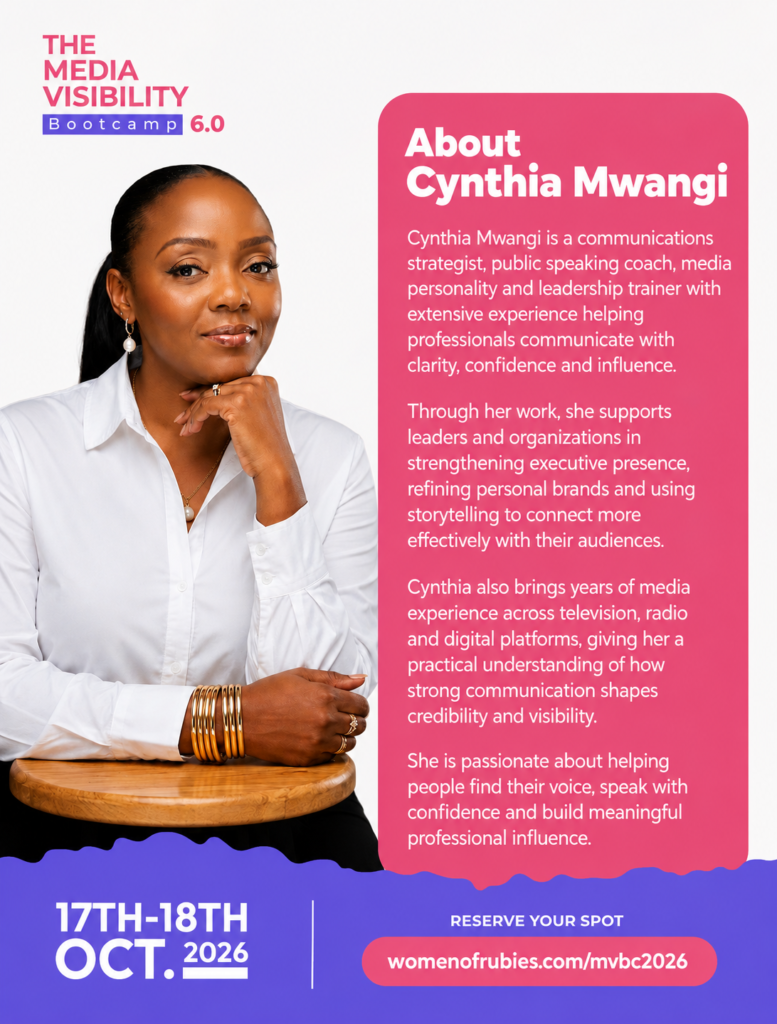
Cynthia will help participants think more intentionally about how they speak, present their expertise and communicate their value in professional and public settings.
Her session will be valuable for women who have meaningful experience but want to express it with greater clarity, confidence and influence.
Media Visibility Bootcamp 6.0 | October 17–18, 2026 | Virtual | Open virtuallyReserve your access at: womenofrubies.com/mvbc2026
Connect With Cynthia Mwangi
Connect with Cynthia Mwangi to learn more about her work in public speaking, strategic communication, public relations and event moderation. LinkedIn: Cynthia Mwangi, MPRSK | Instagram: Cynthia Mwangi

Comments are closed.