Women of Rubies

Category

self development

Category
When we take a look to the East we see the Japanese phenomena known as karōshi. This is translated as death from overwork. This term arose in the 1970s and is used to describe a death as a result of a heart attack, stroke due to stress, starvation diet or suicide all borne as a direct consequence of work stress and being overworked.This has historically been driven by working long hours, overtime of up to 80 hours a month, getting involved in after-hours work related activities such as having after work drinks with colleagues where the main topic of discussion is work, not taking leave days in order to have a mental break from work.

Long work hours unfortunately do not equate to high productivity. This is clear in analysing the G7 countries where amongst the countries is Japan, which has the longest work hours, in fact has the lowest labour productivity. Japan produces an average of 45.5 Gross Domestic Product per hour worked whilst the United States of America with much more relaxed working hours produces 68.3 Gross Domestic Product per hour.

The fallacy of long hours and working hard result in success is quickly being dismissed. Quality of work versus quantity of working hours is what results in success. Productivity in employees is actually increased by having healthy employees. Employees who are well rested, have a healthy work life balance, are empowered and are allowed to think dynamically are proven to be more productive.

Some of the best ways to increase productivity is by creating a work environment that is transparent and encourages feedback amongst colleagues. A work environment that gives people autonomy and freedom both liberates and empowers. It gives individuals the ability to execute the how of their given tasks. The most empowering work space is one where tasks are given, objectives outlined but the how is left to the creativity of those executing the work. Doing this allows for innovation, efficiency creation, camaraderie amongst colleagues, smart working and productive employees.

I encourage us all to be the kind of employees who may never suffer from karōshi but instead flourish in work you enjoy and life you love. May you be productive, working smart and strategically adding great value and not just sitting in the office working laborious hours with mundane impact.


Culled from Guardian Woman

On Tuesday, October 16, 2018, in Los Angeles, top singer and actress Lady Gaga was honoured as one of Elle’s Women In Hollywood.

Gaga delivered her Women in Hollywood acceptance speech from an extremely vulnerable and honest place. She opened up about her sexual assault, mental illness, and a plea for women to lift up each other’s voices and “beckon the world towards kindness.” “I wanted to take the power back,” she said.

And part of reclaiming that power had to do with what she wore. While promoting A Star Is Born, Gaga has worn dramatic, glamorous, Old Hollywood gowns.

At ELLE’s Women in Hollywood event, she wore an oversized Marc Jacobs suit, her hair in a low bun. For Gaga, it was stripped down.

25th Annual ELLE Women In Hollywood Celebration - Arrivals

Here, an extended excerpt from Gaga’s moving acceptance speech:

“I tried on dress after dress today getting ready for this event, one tight corset after another, one heel after another, a diamond, a feather, thousands of beaded fabrics and the most beautiful silks in the world. To be honest, I felt sick to my stomach. And I asked myself: What does it really mean to be a woman in Hollywood? We are not just objects to entertain the world. We are not simply images to bring smiles or grimaces to people’s faces. We are not members of a giant beauty pageant meant to be pit against one another for the pleasure of the public. We women in Hollywood, we are voices. We have deep thoughts and ideas and beliefs and values about the world and we have the power to speak and be heard and fight back when we are silenced.

So, after trying 10 or so dresses, with a sad feeling in my heart, that all that would matter was what I wore to this red carpet, I saw an oversized Marc Jacobs suit buried quietly in the corner. I put it on to a resounding view of eyes glaring at me in confusion. But the Rodarte was so beautiful! one said. But the Raf Simons for Calvin Klein was so stunning on you! said another. But what about the Brandon Maxwell? What about the Dior? Lots of questions. They were all dresses. This was an oversized men’s suit made for a woman. Not a gown. And then I began to cry. In this suit, I felt like me today. In this suit, I felt the truth of who I am well up in my gut. And then wondering what I wanted to say tonight become very clear to me.

As a sexual assault survivor by someone in the entertainment industry, as a woman who is still not brave enough to say his name, as a woman who lives with chronic pain, as a woman who was conditioned at a very young age to listen to what men told me to do, I decided today I wanted to take the power back. Today I wear the pants.

In an age where I can barely watch the news, I gasped at the unjust men, and some women quite frankly, that I see running this country. I had a revelation that I had to be empowered to be myself today more than ever. To resist the standards of Hollywood, whatever that means. To resist the standards of dressing to impress. To use what really matters: my voice.

After I was assaulted when I was 19 I changed forever. Part of me shut down for many years. I didn’t tell anyone. I avoided it myself. And felt shame even still today standing in front of you. I feel shame for what happened to me. I still have days where I feel like it was my fault. After I shared what happened to me with very powerful men in this industry, nobody helped me. No one offered my guidance or a helping hand to lead me to a place where I felt justice, they didn’t even point me in the direction of the mental health assistance I was in dire need of. Those men hid because they were afraid of losing their power. And because they hid, I began to hide.

I hid for a long time until I started to feel physical pain. Then I had to go to the doctor because I didn’t know what was wrong with me. And then I was diagnosed with PTSD and Fibromyalgia, which many people don’t think is real, and I don’t even know what the fuck to say about that. But I’ll tell you what it is. It’s a syndrome that is essentially a cyclone of stress induced pain. And I really wish my friend Lena Dunham was here tonight because I think she could probably articulate this much better than me. And I hope we can all agree that she’s a remarkable woman.

Depression, anxiety, eating disorders, trauma—these are just a few examples of the forces that can lead to this tornado of pain. So what I would like to say in this room of powerful women and men today is let’s work together to beckon the world towards kindness. I’m fortunate enough now to have the resources to help me. But for many, the resources either don’t exist or people don’t have the ability to pay for or access them. I want to see mental health become a global priority. We’re not able to control all of the challenges and tragedies that life throws our way. But we can work together. This room can work together to heal each other. And we can also try to find the strength in the best way that we can to ask for help if we need it.

It is my personal dream that there would be a mental health expert teacher or therapist in every school in this nation and hopefully one day around the world. Let’s lift our voices. I know we are, but let’s get louder. And not just as women. But as humans. And see that there are great men in the world. And ask them to hold our hands. For justice. That our voices be heard. Whatever our story may be. For an equal standing. We will fight for justice for women and men and those with other sexual identities. For me, this is what it means to be a woman in Hollywood. It means, I have a platform. I have a chance to make a change. I pray we listen and believe and pay closer attention to those around us to those in need….Be a helping hand. Be a force for change”.

Culled from Elle

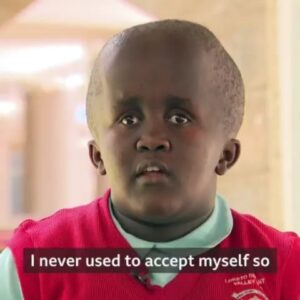
Angel Wanjiru was born with a congenital disorder called hydrocephalus which affected the shape of her head. Speaking to BBC Africa in an interview,  Angel said, several doctors told her mother, she wouldn’t survive but she did.

In 2016, at the age of 14, Angel released her first song, which was inspired by the discrimination she faced with people around her. She said the only way she has survived so far was ignoring people’s perception about her.

Angel encouraged everyone to accept themselves just the way they are. Watch this video for more details on her interview with BBC Africa.

Watch below:


In a classroom in the South African township of Soweto, girls listen carefully, knowing they need to learn how to avoid the threat of rape that hangs over their daily lives.

“You are going to pretend that it is the rapist’s testicles,” says trainer Dimakatso Monokoli, holding out a padded target.

An 11-year-old girl charges without flinching and delivers a powerful knee slam.

It is part of a day of self-defence and rape avoidance strategies taught at the Thabisang school, where chairs and desks have been pushed back to the pink walls of the classroom.

Official statistics suggest that more than 110 rapes are recorded by the police every day in South Africa.

But such numbers are widely seen as inaccurate due to under-reporting. Some studies suggest only one in 13 rapes is reported to the police.

Recent news stories have triggered fresh horror among South Africans over the prevalence of rape.

In September, a 17-year-old was raped in a hospital maternity ward by a man pretending to be a doctor one day after she had given birth.

Around the same time, a seven-year-old girl was raped in the toilets of a popular chain restaurant in the capital Pretoria, with a video footage emerging of the naked man moments after the attack.

For the African National Congress Women’s League, drastic action is needed.

“We have tried our best… there’s nothing that seems to lower (the number of attacks). Hence, we are calling for chemical castration,” ANCWL secretary general Meokgo Matuba said after the two rapes.

Spotting the risk

Back in another classroom in Soweto, Monokoli teaches not only self-defence, but how girls can read and react to potentially risky situations.

“Don’t ever, ever make the mistake of being in the same room as someone you don’t feel comfortable with because your guts have warned you,” she says.

“They have sent a message — you are not supposed to be alone with that person.”

If you are attacked, she says: “Scream as much as you can.”

Monokoli works for Action Breaks Silence (ABS), a South African charity that works with schools to educate girls in self-defence.

It also runs a “Hero Empathy” programme for boys to try to preempt abusive and violent behaviour.

ABS founder Debi Steven was herself raped as a child, and has spent decades teaching and advising at schools and companies.

“Violence has been normalised in South Africa,” she told AFP.

“There is so much rape that people have become desensitised to it.”

Setting boundaries

She advocates a mix of self-defence training with mental awareness.

“The self-defence gives girls the confidence to set boundaries,” she said.

“If I have an education about what is wrong and right, I know what abuses it, and I am going to identify the minute you start abusing me emotionally, physically, sexually, financially.”

In many cases, sexual violence is committed by relatives or people known to the victim. Steven says two women are murdered every day by their partners or former partners in South Africa.

In the classroom, the girls — wearing their blue school uniform and long socks — giggle occasionally but the atmosphere is serious and focused.

“We are going to teach you how to fight smart, without strength,” one male instructor tells them, pointing out they can always “rip off the ears and nostrils.”

And the lessons seem to have sunk in.

“We are warriors,” says Nonkululeko, an energetic 11-year-old.

“I have this amazing drug in me, adrenaline, that helps you fight. It helps you to do almost the impossible.”

The classes are often cathartic, with pupils occasionally sharing with instructors their own stories of abuse they have suffered.

Teaching boys too

At another Soweto school, boys in the “Hero Empathy” programme run through roleplay games that encourage them to show emotions and develop empathy for other people’s feelings.

They have to act out moods such as anger or sadness while their classmates try to guess how they feel — not always successfully.

“In an African community, it is often taught that boys (should not) show emotions. When you show emotions, it is like a sign of weakness,” said instructor Isaac Mkhize.

ABS has taught over 13,000 children, and its impact has impressed the government health ministry, which has asked the charity to train 160 new staff.

One mother, Mali Masondo, explained how deeply the fear of rape is embedded in the daily lives of children and families.

“You don’t know who to trust, who to love and who to care for,” she said.

“Sometimes you don’t even allow people to love your kids as they wish because every time you think of the negative side”


Credit: Pulse News, AFP

Shonda Rhimes is on one of the eight covers for Elle‘s Women in Hollywood issue and the television producer – who is behind shows like Grey’s Anatomy and Scandal – spoke about how she’s making TV that represents everyone, talking to her daughters about success and more.

Read excerpts below.

On her deal with Netflix: I keep hearing about how I got lured away as if somebody wagged a piece of candy in front of me. But really, it was me deciding I had a vision, and [Netflix’s chief content officer] Ted Sarandos shared that vision. I wanted to be able to decide what kind of shows we were going to make and how we were going to make them. So to have that kind of power has been an amazing experience so far. It’s also a little bit like Christmas because there’s a very ‘Yes, we can’ attitude. Almost so much that we have to be careful what we ask for, like, ‘Don’t ask for the moon, because they will build you the moon.’

On making shows with representation:It’s hugely important, but I didn’t know how conscious it was until I was inducted into the Television Academy Hall of Fame. I was trying to figure out my speech, and I realized it was about how you cannot be what you cannot see. I talked about having grown up watching Oprah every single day of my life. How this was a woman of color, who did not look a certain way, who was [based in] Chicago, and who took over the world through television, basically. When I started writing TV shows, I wanted to represent everybody, because it should look like the real world. It should feel normal when you turn on the television and see people who look like you.

On what she tells her daughters about success: For a long time, my oldest daughter thought I was a doctor, because I was always at work, and it was a hospital. Now she’s 16, so she doesn’t think that anymore. My little ones are six and four and think there’s a land called Shonda. They don’t really understand how it relates to their mother, but it’s nice that they understand that women go to work and enjoy it and that you can have a business and be in charge.

For more from Shonda, visit  Elle.com!

Credit: Bella Naija

Today, we are going to talk about the one thing a man must feel in order to desire a committed relationship with you.
I have always thought about it that what brings two people together for a lasting relationship. I asked a male friend of mine and he shared with me dis short story.Jide had recently broken up with a woman he had been dating for a few months. He was frustrated because all of the relationships he got into seemed to be superficial and fleeting. They did not last.

And he did not really enjoy them. He was starting to think that being in a relationship was not really worth it.
So then one day, he came upon a realization, something that changed the way he looked at how to create and build a relationship.

He said it was something that seemed so simple yet it had never even occurred to him before.
He said, the formula for commitment has one powerful ingredient. Then he digresses by telling me a bit about his childhood.While growing up, he never knew how to talk to women. He had one girlfriend before the age of 21 and she cheated on him with a close friend of his. He felt alone and frustrated and was determined to figure this stuff out.

He read books, attended seminars, and even got some counselor to guide him. He said he learned it all.

And it did not take long before he could meet a woman anywhere and create a relationship with her.
He got so good that most but if not all of his friends started coming to him for advice and he eventually became a coach. But he had a problem; none of his relationships would last.
Everything he learned was about playing games, manipulation, and pretending like he was someone he was not. He could not take it anymore.

No matter how many women he met, he always ended up in a miserable relationship that eventually ended in frustration and heartbreak.

No matter how many women he did meet and date, he always just felt empty inside.
Then he began drinking heavily to numb the pain of his disappointment. With everything he learned, he felt like he had not really accomplished anything.

His life seemed to be plagued with chasing short-term satisfaction and nothing to show for it.
So one day, he got together with some other friends of his and they realized that many of the guys using the kind of techniques he used in getting girls could not stay in relationships.

They just did not last. Some of the guys ended up in great relationships but most of them did not. So they decided to look at the ones that worked. What was different about them?
What were the patterns, the key elements that made these relationships last? Alignment.
The people who were successful were aligned. It was not just compatibility. It was not just shared interests. It was not just chemistry.
While those things are important, the most important factor was alignment. Alignment is the biggest key to commitment.

If you want a man to think of you as someone he can get into a committed relationship with, he needs to be able to see you as someone he can be with in the distant future.

He needs to see you as “marriage material”, He needs to see that his life and values align with yours.
If you do not align with a man’s life, he will never see you as anything more than a casual fling.
So how do you do this? You need to find out what his dreams are in life and consistently show him that you see him becoming the man he wants to be in the future.

Do this and he will begin to see you as someone he could commit to forever. It is that simple. Trust me.
To our happiness. Cheers.


To mark the Day of the Girl child on October 11th, 2018, the United States Consulate in Lagos partnered with the Africa Creative Children’s Network (ACCN) on an event to inspire young secondary school girls. On hand to interact with these girls included Nollywood star Mercy Johnson Okojie; BellaNaija‘s founder/CEO Uche Pedro; Nollywood, director and lawyer Mildred Okwo; CNN Hero Abisoye Ajayi-Akinfolarin; Head, Accelerate TV, Colette Otusheso; W Tech founder Oreoluwa Somolu-Lesi; and editor of Guardian Life Chidera Muoka.

Themed ‘No girl left behind’, guests were also treated to a performance by music icon Yinka Davies.
“It is amazing to see a vision kick off as this has, we at the Africa Creative Children’s Network are very grateful to the US consulate for this invaluable partnership and support for the girl child. We are thankful for these incredible women who have given of their time and knowledge so selflessly today. Above all, we are excited to see the passion and ambition in these young girls who we are celebrating today.” explained ‘Oma Areh, Executive Director, Africa Creative Children’s Network.

The interactive session kicked off with the US Consulate Cultural Affairs officer Kevin Krapf who welcomed the young girls and mentors to the session. The US Mission Country coordinator, Alice Seddon also shared her experience as a young girl and how she ended up as a career diplomat encouraging the young girls gathered to work towards their dreams.

Mercy Johnson Okojie

A panel session moderated superbly by Uche Pedro followed: Mildred Okwo reflected on her decision to study theatre arts, her career as a lawyer in the United States and her decision to follow her passion into Nollywood. Colette Otusheso shared on how she was inspired by her teachers to follow her dreams and her transition from an entirely corporate job into an entertainment powerhouse, Oreoluwa Somolu-Lesi spoke of how she found her space in tech and her passion to inspire young girls to excel in the field. Mercy Johnson-Okojie told her story on how her passion to succeed broke her away from poverty, advising the girls not to let their backgrounds hold them from dreaming. CNN Hero Abisoye spoke of the role of mentorship in her life and how her early career as an intern helped shape her future. Chidera Muoka spoke on how setting goals and pushing hard for them made her the youngest editor in Nigeria at the age of 25. The young girls thoroughly drilled the panel with questions and inspired others as well with their dreams and ambitions.

The event ended with a vote of thanks from the organisers’ the Africa Creative Network. ACCN founder Sarah Inya Lawal had a message on the organisation’s activities including a formal launch in November 2018, a Children’s creative festival in 2019 and a broadcast network in 2020. The network is in partnership with the US Consulate, Ascend Studios, Accelerate TV, WildFlower PR and Peaceville Entertainment.

Lavie By CK founder, Claude Kameni was raised in Cameroon, where her passion for fashion was cultivated. Upon moving to the United States, she was able to hone her skills and build her brand, which successfully fuses her experiences from both cultural backgrounds.

Lavie By CK, is known for creating lavish and instantly eye-catching designs, using structured silhouettes and dramatic flares and pleats

Hollywood actress, Tracee Ellis Ross hosted the 2018 AMAs, and she worn a piece by the Cameroonian designer.

Tracee Ellis Ross is not the only big celebrity who has been seen in one of Claude’s designs, as she also dressed Janet Jackson in the video for ‘Made For Now’s.

Check out more Lavie By CK designs right here:

When the hand is broken, we go to see the doctor.
No, we run to see the doctor.
We know it needs fixing.
No one will see you carrying a broken hand and tell you to suck it up, hide it, you don’t want anyone to know. Of course, no one will stigmatize you for your broken hand.

The intense pain will not let you hide, you will run off to a surgeon and ask him to do something.
We all know the hand is replaceable and we even have two.We have two hands, two legs, two eyes, two ears, two kidneys; nearly every organ in the body can be successfully transplanted or fixed surgically.
You also know that even if you lose those limbs, there are prosthetic limbs you can wear so we have at our beck and call a ton of remedies for fixing a broken limb. Let’s not mention the friends and family that will support you during recovery and take turns by your bed side.Sadly, when your mind/brain is ‘broken’. They tell you to hide it. Don’t seek help. You will bring shame on the family and wrongly so, ignorant people will begin to avoid you and your family.

How else would you fix the mind/brain if you don’t seek help?
Do you have two brains? Do you know anyone that will donate one for you?

Are you looking forward to doing a mind/brain transplant or are there prosthetic minds/brains available for sale? Some people even have the resources to seek help but will hide under the cover of ‘do you know who I am?’. My pedigree? My status? Yet, they are not whole.

The broken mind/brain does not have prosthesis.
The broken mind or brain cannot be transplanted from a family member or donor.
Only you know where it hurts and how it hurts.

Some of us have emotional baggage from our childhood and past experiences that only therapy can take care of. Unfortunately, we can’t place these feelings and its consequences so we are unable to deal with it. It affects our relationships, our performance at work/productivity and our wellbeing. For this reason, some have been tagged as ‘having spiritual problem’ or being possessed while being ferried from one prayer house to another. It is a factor in the domestic violence/emotional abuse in marriage towards spouse and children.

It is no longer enough to tell people to lose weight, to follow a meal plan, to register at the gym, to wake up first thing in the morning to exercise – as long as those deep-seated issues are not dealt with through therapy and inquiry (excavating & uprooting); many of us will continue to use food as a coping mechanism. This is why with my clients, I choose first to focus on behavior remodeling. Sadly, many people don’t want to deal with the real issues they prefer a ‘meal plan’ that will fail them again and again.
You know deep within you that this mind/brain is not ‘working’ as it should and you want to be whole…believe me, there is absolutely nothing to be ashamed of. Mental illnesses are disorders affecting a state and part of the body just like you would have kidney diseases, liver diseases and every other disease that affects a part of the body. Once a disorder in any of these parts result, it becomes an illness. There should be no stigma associated with it, just because they manifest differently is not a cause for stigma either. If we are not stigmatizing the person with a broken hand, we are wrong to stigmatize the one with a broken mind/brain.

Please, don’t let your ‘well-meaning’ pastor tell you ‘we will pray it out’. Why did that other church member who fractured her knee get admitted in the hospital and you all went to see her with baskets of fruits. Why was she not managed in church with prayer and fasting?
PS: Your pastor cannot fulfill every role in your life and a good pastor should be the first person encouraging you to seek professional help.

Yes, in God’s word there is an answer for every situation. Just like we had priests, we had kings, we had men at the city gates, we had scribes. Each one fulfilling a different purpose.
Today, we have therapists, psychologists and psychiatrists. Every wisdom here on earth comes from God. So, the therapists and psychiatrists you will see are acting under God’s divine wisdom just like the pastor is.

Even the psychiatrist is stigmatized.
In my 2nd year of Medical School (about 13 years ago), I heard about the psychiatrist in my city. They said he behaves like his patients, jumps on tables when attending to patients and ‘looks and acts crazy’. I’m sure most people who ‘distributed’ that narrative had never seen this man. I on the other hand have been there during a 4-week posting in my 5th year, never for once did I witness any of the doctors jumping on tables. This is what ‘the danger of a single story’ does to the world of psychiatry.

Psychiatrists are medical doctors who are trained to diagnose and treat mental  illness with medication or evideAccording to the WHO, while information is lacking on mental health and access to mental health in Nigeria is quite limited, it is estimated that at least 4% of the population suffer from depression. I assume this number is very much underestimated thanks to our poor health seeking behaviors (people don’t seek medical help until it is severe).

While there are non-existent desks in the ministries at any level for mental health and only 3.3% of the Federal Government’s health budget goes to mental health, we can do better as individuals. Stigmatization will only lead to more and more people suffering in silence, never getting help and even getting worse. A 4-week therapy session for that woman suffering post-partum depression will go a long way in helping her raise mentally strong children that will neither be neglected nor emotionally abused …but she won’t go for fear that YOU & I will stigmatize/ostracize her and her children.

Summary;
– When we feel pain in our muscles or limbs we see the orthopedic surgeon
– When we feel pain around the abdomen, we see the gastroenterologist
– When our heart hurts suddenly we run down to the cardiologist. No one wants to die of a heart attack.
– When we feel pain in our minds/brains we have every right like every other person who seeks help for pain in other parts of their body to see a therapist or a psychiatrist.

Having a mental illness does not mean you’re broken or weak. far from it. Acknowledging that you have a biological imbalance and need help is the most courageous thing that you can do today: It is a sign of strength, not weakness. I believe everyone deserves a therapy session at least twice a year.
As a psychiatrist rightly quoted, there is no health without mental health.

Mental Health Helplines and Resources in Nigeria
Nigeria Suicide Prevention Initiative: +234 806 210 6493
Mentally Aware Nigeria Initiative +234 806 010 1157
She Writes Woman +234 817 491 3329


About Ezinne Meribe
Dr. Ezinne Meribe is the host of Beyond A Dress Size podcast; a podcast series that creates stimulating conversations to pull down misconceptions on nutrition, weight loss, health and body diversity while empowering women to live life beyond the numbers on the dress label, scale or tape.
She is the Lead Wellness Coach/Founder at Zinnyslifestyle, where she leverages her professional qualifications and personal experience to teach women how to OWN & LOVE their bodies and LIVE in it fabulously; having successfully won the struggle with being overweight and loving her body. A UK certified Wellness Professional with a Bachelors in Medicine and Surgery (MBBS), she completed her postgraduate training in Public Health at Kumamoto University, Japan. As a Medical Doctor and Public Health Specialist, she continues to promote preventive medicine as the number one way to combat the severe health system constraints in developing countries.

You can connect with her on
Instagram @zinnyslifestyle
Facebook @zinnyslifestyle
Read more on Medium @ezinnemeribe
Or send an email to info@zinnyslifestyle.com


The latest feature in BBC Innovators series is 31-year old Aggrey Mokaya who runs an NGO – Change Hub – bring tech training to women in Langata maximum-security prison, Nairobi, the Kenyan capital.

Mokaya, who is also a tutorial fellow at Jomo Kenyatta University of Agriculture, has through his organisation, trained 21 women so far and hopes to expand to every prison in Kenya.
“It’s all about giving people a second chance. It’s all about giving them a chance to tap into the economy they were not a part of before,” he said in the feature by Tamasin Ford and Suzanne Vanhooymissen.

60-80% of all inmates in Kenya will reoffend and land back in jail, according to Kenya Prisons’ statistics from 2014.

Mokaya’s organisation is working to reduce this.

“An ex-convict and a person who has never committed a crime, in the eyes of the law they are the same. So I think they should also be the same in the eyes of the economy, in the eyes of entrepreneurship or opportunities.
“If they are denied opportunities and chances to actually get into a space where they can make something of themselves we are basically setting them up to fail,” Mokoya said.

One of the beneficiaries, Dorcus, 44 who is due to be released later this month after serving half of her 3 and half-year sentence fr forgery had this to say:
When I came to prison I didn’t know computers. Now I can do anything. I can even create you a computer.

I have five children and I’m a widow, so going back to those children is the most important thing to me.

I won’t be moving around having dust on my feet as I don’t have a car.
It will change my life. I will be saving time and money.

Another beneficiary Rahab Nyawira, 35, who was released this year and now runs her catering business is also thankful and grateful she’s making her three children proud.
“There’s nothing you can compare with prison. Prison is the worst place to be but for me it was my turning point.

My website, I can say, it is my superpower in my business. It helps me meet new clients online everywhere in Kenya.

I learnt so many things through Change Hub. I was introduced to HTML, CSS and Javascript. For my website I coded everything myself.

When my daughter sees me now, I feel so proud,” she said.

On why he chose to start with a women’s prison, Mokaya said:
There’s a gender bias when it comes to technology.
If I’m able to impact the life of one woman it means you know there is a knock-on effect. It’s even a chance for her kids to get exposed to that programming early on.
When you talk about wanting to do a technology project everyone says why don’t you go to the men’s prison, or the juvenile prison?
I look at that and say yes it’s important, but it’s secondary. We will get there once we get it right at the women’s prison.

Credit: Bellanaija