Category

womenofrubies

Category

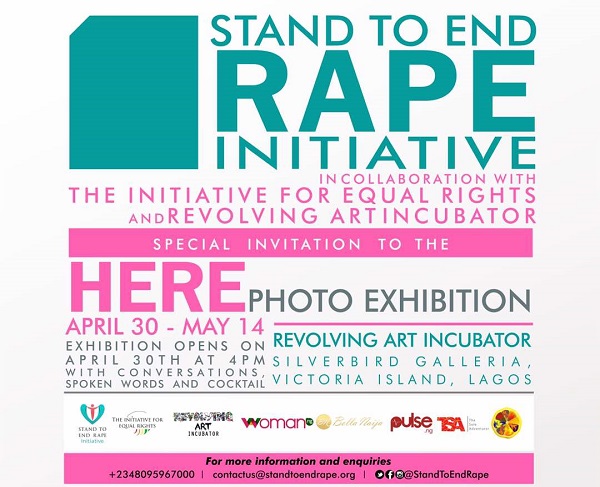
Stand to End Rape Initiative in collaboration with The Initiative for Equal Rights and the Revolving Art Incubator present the HERE Exhibition from April 30th to May 12th at the Revolving Art Incubator, 2nd Floor, Silverbird Galleria, Victoria Island, Lagos.

The HERE Exhibition Opening Event holds on 30th of April at 4pm and will feature conversations with guest speakers; Titilope Sonuga and Arit Okpo, and spoken word.

The HERE Exhibition is a platform for sharing the stories of survivors. The goal of the exhibition is to empower survivors of sexual violence to break the silence and regain their freedom. The photos in the exhibition highlights places where rape occurs, thereby disrupting the stigmatization that people who are violated in such locations face.

The use of imagery (photography) is strategic as it creates a body of work that literally hits close to home; reflecting the reality of how close survivors often are to their abusers.

The exhibition also serves as a fundraiser for a rehabilitation center where women and girls will be sheltered, while we are helping them to reintegrate into the society. While at the center, they will be empowered with life skills to enable them become economically independent of their abuser in cases where this occurs at the home front

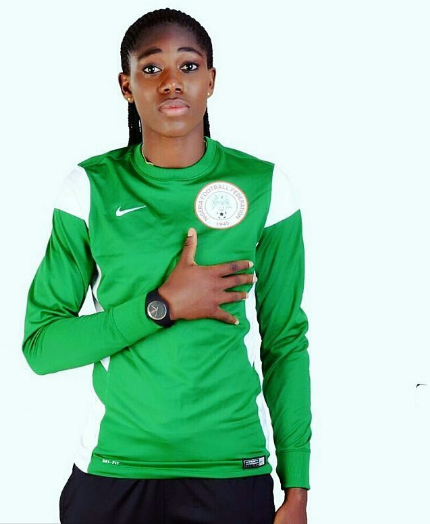
Asisat “Superzee” Oshoala is the first African footballer to join the FA Women’s Super League. Signed to Liverpool Ladies, Asisat Oshoala has continued to do Nigeria and indeed Africa proud as she garners accolades and awards from around the world.

Apart from playing with a prestigious team- Liverpool Ladies, a few awards to her name include the BBC Women’s Footballer of the Year: 2015, Queen of The Pitch Award: 2014 African Women’s Footballer of the Year: 2014. African Women’s Youth Player of the Year: 2014. African Women’s Championship Golden Ball: 2014, FIFA U-20 Women’s World Cup Golden Boot: 2014 and many others.

The question that usually comes to mind in the face of such resounding success is – what is the secret?

Let’s take a look.

JOIN A TEAM YOU LIKE

In an interview with Goal.com, Asisat says “I like my team. It has always been my dream to play for Liverpool Ladies.” The result is that her team members “enabled me score those goals that gave me the award”

HANG OUT WITH PEOPLE WITH A SIMILAR VISION AS YOURS

In an interview with theguardian.com, Asisat talks about her how her goals affected her choice of friends.
According to her; “I love football and I can’t be moving with people who maybe only want to talk about clothes and bags. I love football and that’s why I mingled with the boys, I didn’t really walk with the girls.”

FOLLOW YOUR DREAMS NO MATTER THE OPPOSITION

Asisat’s parents never supported her dreams to be a footballer. They insisted that she follows the traditional route of completing her academics. However, Asisat had a better pan and she stuck with it.
In an interview with supersport.com, she tells us about it, “my parents never supported me at the initial stage because I was exceptionally good in my academics.I had to drop out of school to the chagrin of my parents.It was not an easy decision but with the benefit of hindsight, I think it was the right one”

ALWAYS KEEP A HAPPY DISPOSITION

Asisat, in an interview with FIFA.com spoke on her philosophy; “It’s my life philosophy. I consider myself a happy girl, because whatever situation I find myself in, I try to be happy. I like to see people smiling, to make my friends laugh and smile. That’s what I’m like!”

NEVER STOP DREAMING

When speaking with Naij.com, Asisat insisted that her dreams have not yet being achieved besides all the accolades she has already, “I see myself at the very echelon of female sports in the world “ she said.

Some content curled from woman.ng

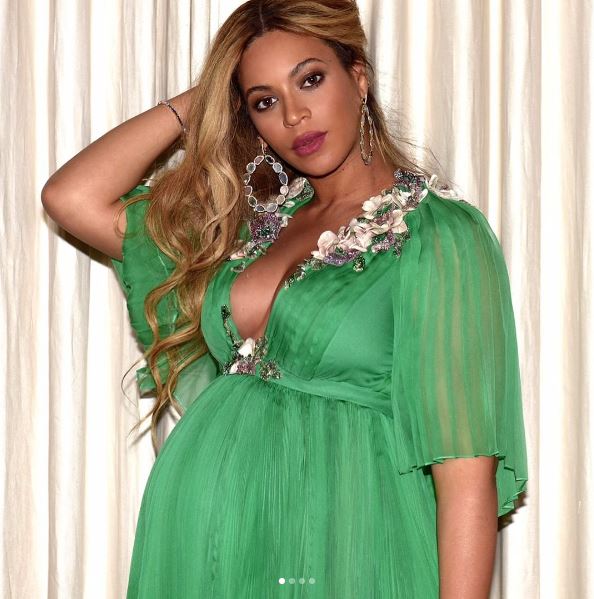
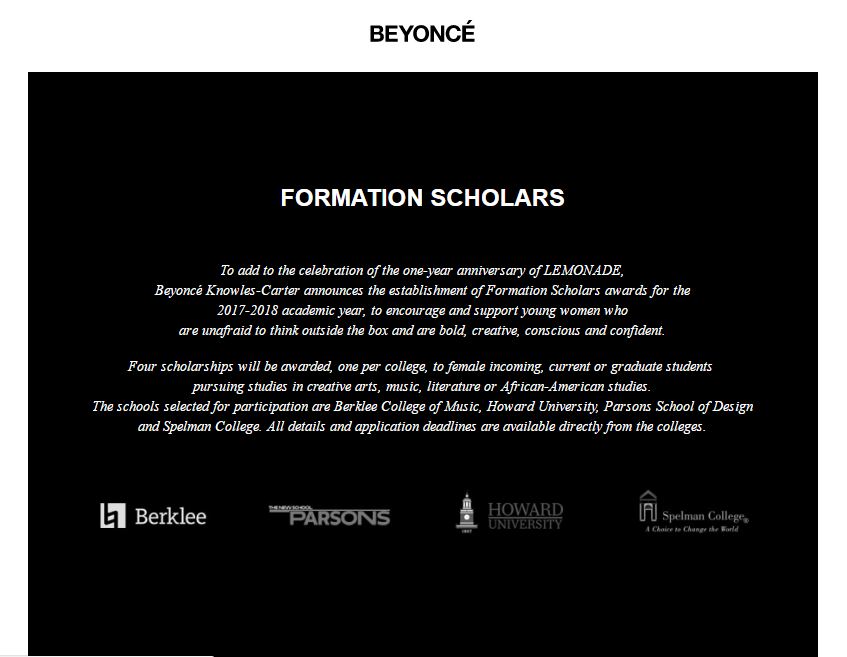
As part of the one-year anniversary celebration for her Lemonade album, Beyoncé has announced via her official website that she will be giving four scholarships – tagged ‘Formation Scholars’ – to four young college women for the 2017-2018 academic year.

According to the 35-year-old star, the scholarship is to “encourage and support young women who are unafraid to think outside the box and are bold, creative, conscious and confident.”

Her website states that Women who are interested in studying creative arts, music, literature, or African-American studies are welcome to apply, and the schools participating include Berklee College of Music, Howard University, Parsons School of Design, and Spelman College.

Source: Bellanaija

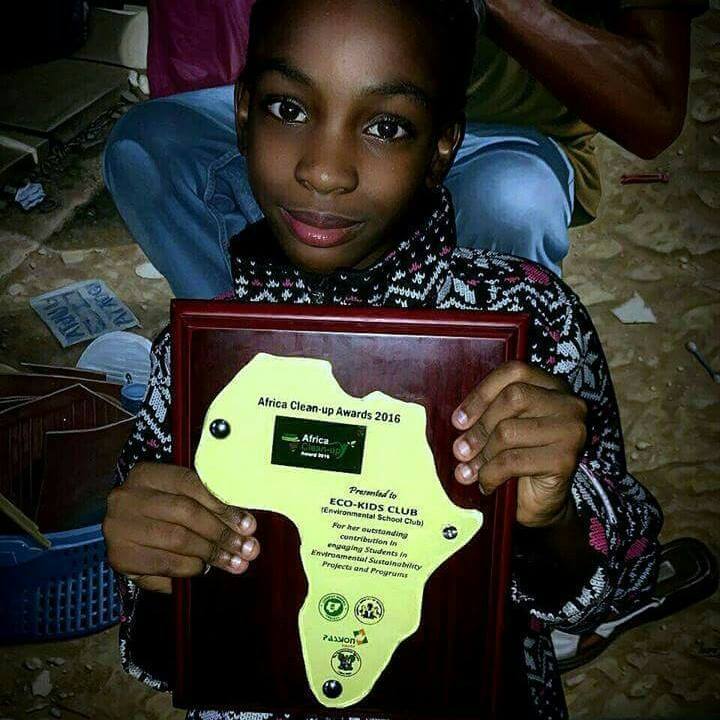
This impressive nine-year-old, Misimi Isimi, is one of Nigeria’s youngest environmentalists and gender equality advocates. Her passions include teaching other children about the importance of gender equality, personal hygiene and protecting our environment.

Misimi is currently the president of Eco-kids green club – a club designed to inspire children to become lifelong environmental stewards.

Not even 10 years old yet, Misimi has already led awareness programmes on World Environment Day and Earth Day about environmental protection. She’s also led sensitization programmes in primary schools: educating other kids on the importance of healthy-living habits.

Her biggest vision is to partner with organizations that’ll help her achieve her aim of promoting Global Goals 4 and 5 (gender equality and quality education) for all kids – especially underprivileged kids.

On the International Day of the Girl Child, Misimi celebrated the strength and resilience of girls, using martial arts as her campaign to stop the violence and discrimination girls face on a daily basis.

As if that wasn’t amazing enough, she was then recently honoured as the first child environmentalist in Nigeria at the Africa Clean-up Awards thanks to her tireless efforts.

Not showing any signs of slowing down, Misimi is now working on her very own environmental documentary and a magazine called Ade and the Wheelie Bin.

In a sea of all the impressive Nigerian short films we’ve been getting this past year, we may have just gotten the best one yet: Ifeoma Chukwuogo‘s incredibly moving Bariga Sugar which first premiered at the Africa International Film Festival (AFRIFF) last year.

(Photo: Fizzy K Pictures)

(Photo: Fizzy K Pictures)

Directed, co-produced and co-written by Ifeoma (and Ikenna Edmund Okah), the 21-minute short film is set in the 90s and follows Ese (Halimat Olarewaju), an 8-year-old who lives in Bariga Sugar – a brothel in Lagos – with her mother, Tina, one of Bariga Sugar’s working women.

Often lonely with dreams of one day ruling the brothel, she forms an unlikely friendship with Jamil (Tunde Azeez), a new child in the brothel.

screen-shot-2017-02-23-at-17-29-37

(Photo: Fizzy K Pictures)

While speaking with Konbini about what inspired her film, Ifeoma said:

“I was inspired by Ikenna’s premise – and the Oscar-winning documentary, Born In Brothels, inspired us to write the screenplay the way we did.

Ikenna wanted to tell a story about true and pure friendship in (or against) a bleak situation.”

When you actually take the film apart, it’s kind of a miracle that Bariga Sugar works at all. It’s a period piece led by child actors – but Ifeoma shows what a skilled director is capable of: bringing so many moving parts together flawlessly.

What’s even more impressive, is that this is only Ifeoma’s first short film out of film school – and she already shows so much promise, we are already impatiently waiting to see what she does next.

Source: Konbini

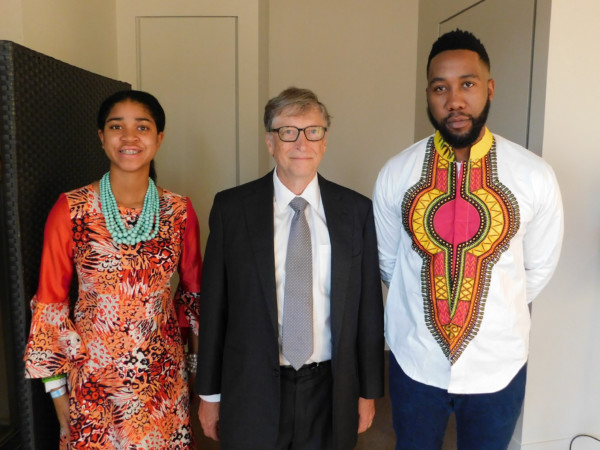
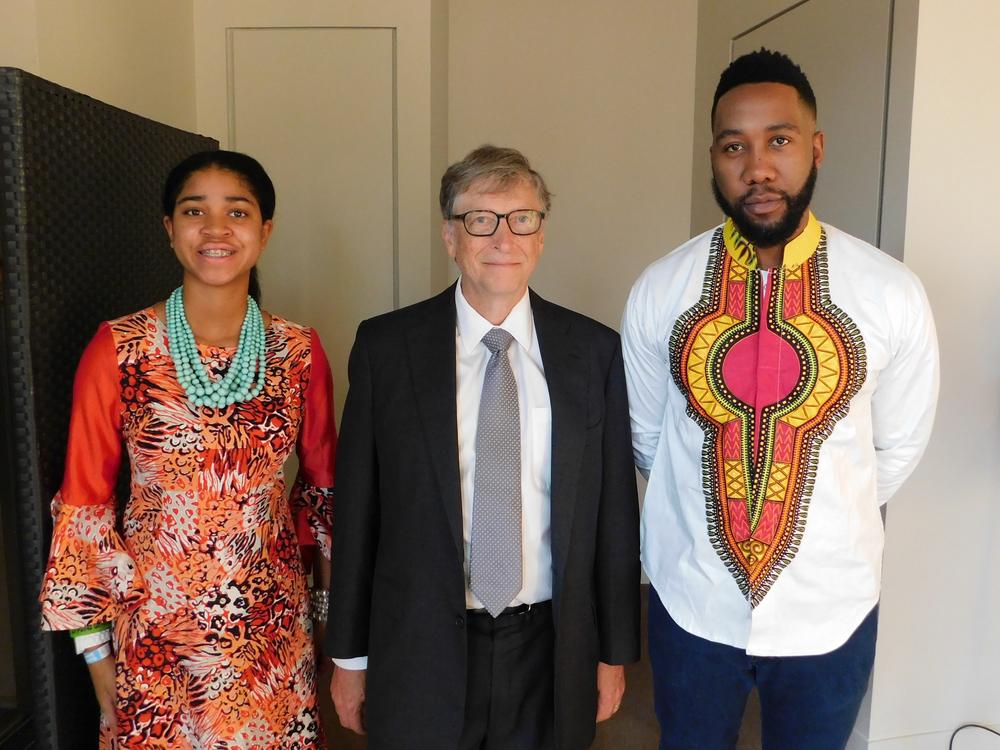
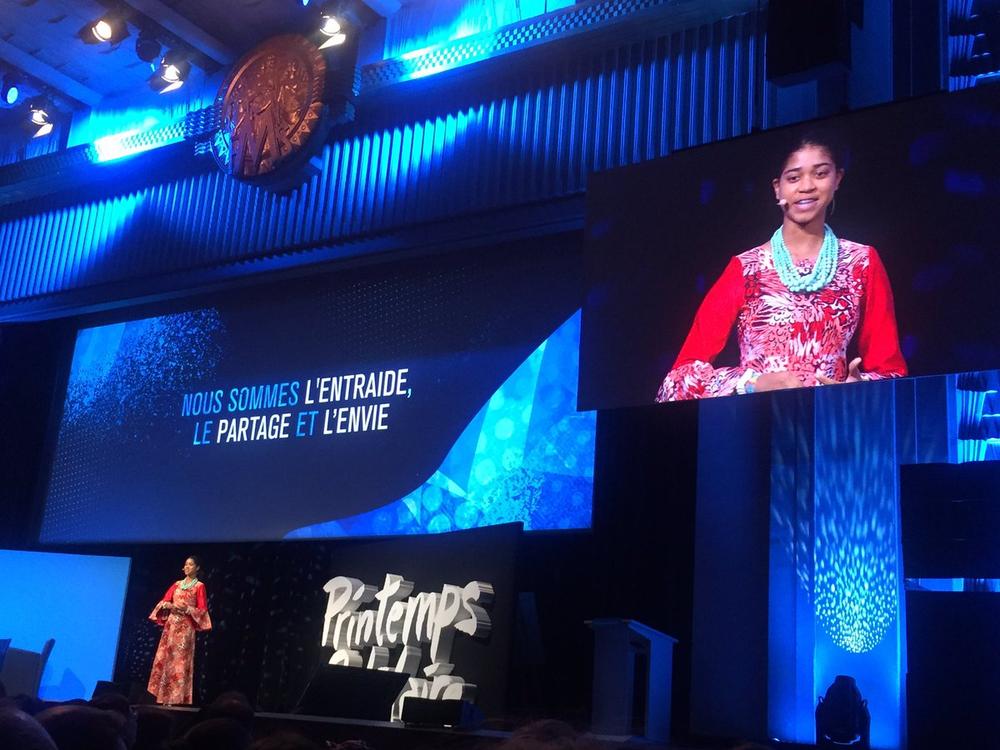
Girl-child education advocate and filmmaker Zuriel Oduwole spoke alongside Microsoft founder Bill Gates and Ndaba Mandela at an event organised by one of France’s largest social development NGO’s Printemps Solidaire.

The event brought more than 500,000 youths to the Champs Elysees, in celebrating the power of youths in changing the perception of social issues across the globe.

Zuriel shared her experiences as head of Dream Up, Speak Up, Stand Up (DUSUSU) Foundation. She spoke about balancing being a youth, with her interests such as Girl Education advocacy and Filmmaking. Ndaba Mandela, the Grandson of the South African icon Nelson Mandela and head of Africa Rising Foundation, spoke about the importance of a good Legacy, having come from one himself – Mandela.

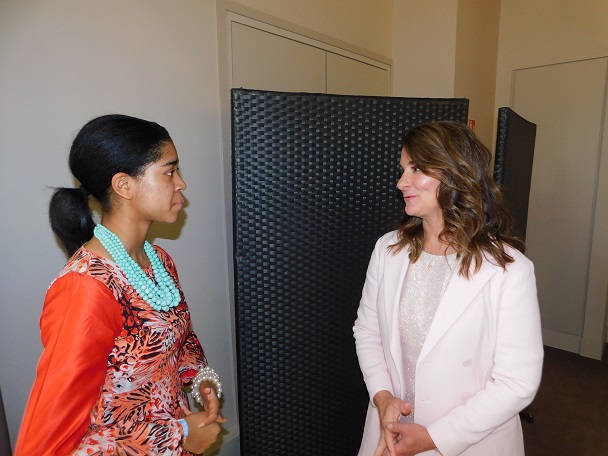
Melinda Gates commended Zuriel for finding her passion early, and working to make a difference in the lives of girls across the globe. Zuriel shared her idea of building an e-school platform for girls in the rural parts of Africa.

Zuriel Oduwole in a chat with Melinda Gates

Zuriel Oduwole in a chat with Melinda Gates

L-R: Zuriel Oduwole, Bill Gates and Ndaba Mandela

L-R: Zuriel Oduwole, Bill Gates and Ndaba Mandela

Source: Bellanaija

Light House a Non-Governmental Organization is set to host the second edition of their annual conference tagged Revamp. Revamp is an empowerment forum where established industry leaders provide mentorship and inspiration to young adults.

According to Precious Eniayekan, the convener of Revamp:” Revamp was born out of the passion to show young adults the way and to provide mentorship for them. It is organized to help them discover what life is about and equip them for what they have been called to do, thereby providing them with accurate information and models .When I was a child I had questions,  I needed explanations and it seemed like everyone was too busy to give me answers.  I made mistakes that could have been avoided, I took steps and made decisions I shouldn’t have made yes they made me who I am today.  But I feel it would have been better if I had someone or people to show me the way” she said.

The speakers for this second edition include Nollywood actor  Lateef Adedimeji, celebrity photographer Body Lawson, Ruky Toje, Timilehin Ayekitan and others . The event will hold on 13th of May at Primrose Event Centre, Ikeja

Precious Eniayekan is a young entrepreneur,Co-Founder Dida.com.ng and also an information technology expert.

Recently, award-winning author and feminist Chimamanda Ngozi Adichie in an interview with the UK Guardian came out to say that she would be more successful in Nigeria if she is not a feminist.

“Feminism is not that hot. I can tell you I would sell more books in Nigeria if I stopped and said I’m no longer a feminist. I would have a stronger following, I would make more money” she said.

She is spot on in this case. Feminism in Nigeria is an endangered movement or belief; it is associated with so much bile, prejudice and stigmatisation. You are either ascribed to one or more of the following stereotypes; man-haters, angry nasty women, pro-abortionists, homosexual or pseudo homosexual, unmarried or a career woman, anti-motherhood ,an atheist, unbeliever, a bad wife or an amoral woman. . .

A little over a year ago, Senator Biodun Olujimi sponsored a bill to seek redress on gender parity issues which purpose was to permit women to have equal rights with men in marriages, education, property rights and employment etc. As we all know it was met with strong opposition based on cultural, political and religious colourations.

Is this the right way to swing? I leave that to your judgement.
According to the World Bank in 2015, the women population in Nigeria stood at 49.07%. Yes, almost half of our population are women; and the sad reality is that large factions of these women are handicapped socially, medically, politically and economically. Factually speaking,  we should highlight and enforce women rights in our country if we truly seek redress on our economic productivity, improved sustainable development. We should ensure that our policies are more representative for a more holistic effect in the society. Are we deliberately going to leave this faction of our populace undervalued, defenceless, faceless, unemployable and underpowered? In which case they are more vulnerable to abuse, poverty, health issues and even death.

Nigeria is a signatory to the Maputo Protocol otherwise known as The Protocol to the African Charter on Human and Peoples Rights on the Rights of Women in Africa. This guarantees comprehensive rights to women and propagates gender parity in core areas which would further empower the African woman. This seeks to address pertinent challenges affecting the girl child and women in Africa, which have been relegated to the background for too long. It has consequently hindered the growth and empowerment of these women. In so many ways, their dreams are caught short as soon as the doctors declare their sex in the labour room.

These issues such as child marriage/early marriage, domestic violence, female genital mutilation (FGM), stigmatisation, gender pay gap, rape culture, marginalization of all forms, denial of property rights and inheritance, etc. are familiar occurrences in our society which affects girls and women. They fight these battles silently and the least that we could do is empathize, commiserate and sensitize these issues. But alas, our silence is just another web in the tangling and vicious cycle.

According to Wikipedia, feminism is a range of political movements, ideologies, and social movements that share a common goal: to define and advance political, economic, personal, and social rights for women. This includes seeking to establish equal opportunities for women in education and employment.

What it means to be a feminist in Iceland or Rwanda which are of the world’s best countries in terms of gender equality, is very different from what it means to be a feminist in Semen, Syria of even Nigeria. This is why feminism is a relative concept and a ready tool which could be used to advocate and propagate women rights that we require in our society  – to enable women to assume their full potential and prospects.

It would be truly amiss for me as a typical Nigerian not to highlight the religious/ cultural angle that casts a shadow on the propagation of women rights in our country. Religion and cultural norms play a huge role on our stance on so many issues, as such most antagonists usually use this premise to expound why women rights should not be enforced or just given the cursory lip service. But then should this be a justification to hamper our development? Especially as it can be clearly seen that the lack of / enforcement of such rights are detrimental to our women and future generations yet unborn.

It’s truly amusing when certain individuals try to besmirch women rights and associate the affiliation of such rights to the breakdown of nuclear family, home values and the dynamics of marriage in general. It is perceived as a threat to the stability and dynamics of the family.

I would argue that this would in fact create a more stable, well balanced homestead; in most heterosexual societies women are wives, homemakers, mothers, breadwinners etc, whose roles in building the future and society cannot be overstated. So in that vein, why shouldn’t they be empowered in all spheres of life according to their capacities and abilities instead of the norm of limiting the scope of what they can even dream about?
I ask again why not?

So when people ask me why I am a feminist in Nigeria. These are my reasons as stated above and so much more. I simply choose not to be silent. I am a Christian first, a feminist second and both at the same time. (I will elucidate on this in another article.)

I stand with women rights. What about you?

Source: Bellanaija

A report from UNESCO estimates that one in ten girls in Sub-Saharan Africa misses school during her menstrual cycle due her inability to access affordable sanitary products, and conversations about periods are almost an abominable topic of discussion in Nigeria. To complicate that further, because our country is in a recession, the prices of everything, including sanitary products, has doubled.

It was one such discussion that inspired Oghenekaro (Karo) Omu, a social media & brand specialist, to start the Sanitary Aid for Nigerian Girls initiative.

(Photo: S.A.N.G.)

(Photo: S.A.N.G)

On the 15th of January 2017, Karo learned that the prices of sanitary products had increased by more than 100% and she immediately thought of how it would impact the underprivileged girls who had barely been able to get access to these products. And she decided to do something about it. She sent out a tweet

As with most initiatives, once she started, she realized that it was a bigger problem than she’d imagined. So she put together a team of 6: Gabriella Scott, Cynthia Ndeche, Tolani Thomas, Alexa Chukwumah, Ifeyinwa Mbanugo and Olamide Odukoya; with a group of other eager volunteers. The initiative raised over N800,000 within a week, from crowd-sourcing on Twitter alone.

(Photo: S.A.N.G)

(Photo: S.A.N.G)

Karo and her team have so far raised N1.3 million and distributed sanitary pads to over 1,500 women and girls across 3 schools and an IDP camp in Jos.

This coming week, the initiative has plans to give sanitary products to at least 1,000 women and girls in Borno. And at the end of the second quarter of the year, the Sanitary Aid for Nigerian Girls initiative intends to reach up to 15,000 girls in Lagos, Ogun, Abuja, Plateau and Borno.

Speaking to Konbini about her future plans for the initiative, Karo says:

“In the future, we intend to make sanitary education part of communities especially low income ones that don’t have the exposure. Our goal is to reach up to a million girls with both sanitary hygiene education & free pads.”

“We’ve approached brands to partner with us and some of them like Microsoft have been very interested in coming on board.

(Photo: S.A.N.G)

(Photo: S.A.N.G)

This isn’t Karo’s first humanitarian effort, she’s been very involved in providing aid and food to IDP camps across Nigeria. On her experience on this journey, Karo says:

“I’ve always wanted to do things for other people. Every project is different. I used to want to have everything in place before starting but this project was different.”

“I was determined to do it with or without help. Imagine my surprise when everyone that heard about the project saw the relevance.

“Every girl we reach is a big deal because their stories are different. We get asked all sorts of questions. For some girls it’s their first time owning a pack of pads.”

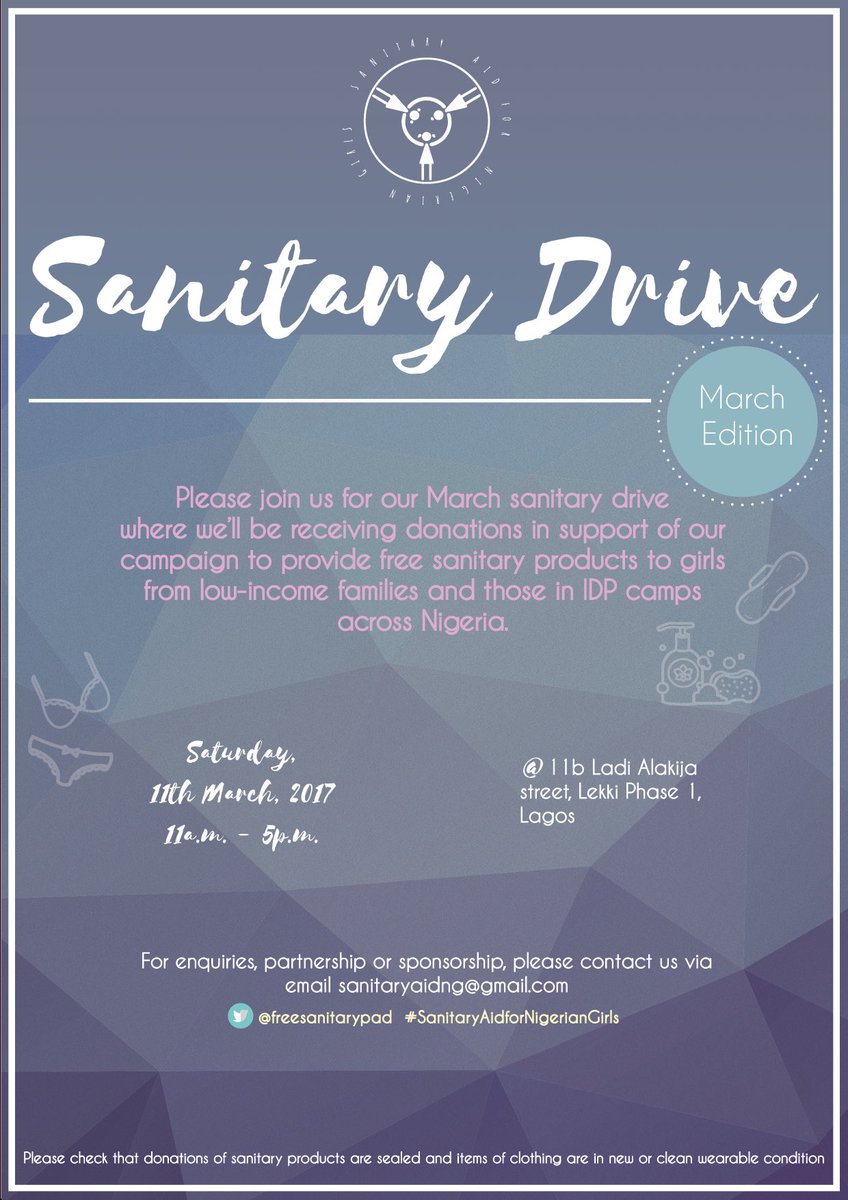
The initiative holds Sanitary drives every month for willing Nigerians to come and donate sanitary products and/or money; and sign up to volunteer to work with the initiative.

Subsequently, Karo hopes to have joint projects with willing participants to reshape education for the children from lower income homes, and be more involved in social advocacy projects that help improve the lives of the most vulnerable people – children, women and the aged – in our society, in Nigeria.

The initiative can be reached by email or via Twitter and Instagram.

(Photo: S.A.N.G)

(Photo: S.A.N.G)

(Photo: S.A.N.G)
Source: Konbini