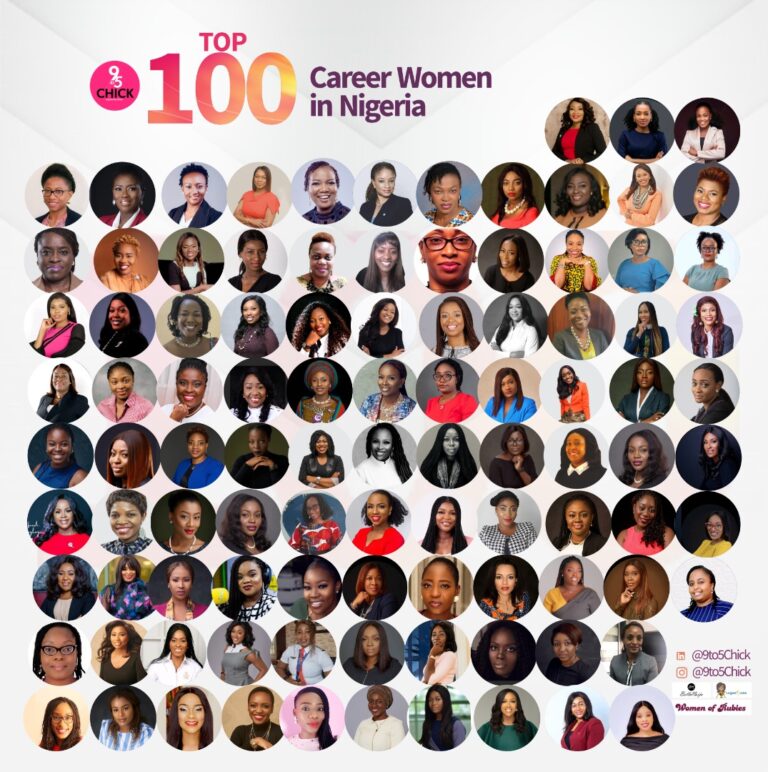
The 9to5chick Top 100 Career Women in Nigeria list, celebrates inspiring mid and senior level female professionals in the corporate sector who are making significant contributions at work, leading by example, and disrupting the status quo.
The list is a deliberate compilation of female leadership, some of whom hitherto now, despite having various laudable, documented achievements, may not have been given the visibility commensurate to their significant career contributions.
These professionals, who are defying the odds, and driving business results despite COVID-19, were nominated by peers and colleagues, or put themselves forward.
Nominations were then reviewed by an independent judging panel comprising Yemi Faseun, Head, Human Resources, Globacom, Osayi Alile, CEO, Aspire Coronation Trust, and Funke Amobi, Country Head, Human Capital, Stanbic IBTC – who evaluated each person on the influence of their role, their impact, including giveback initiatives both within and outside their careers, documented thought leadership and career achievements.
The result: 100 female professionals in 20 industries who are advancing excellence and professionalism in Nigeria’s corporate sector.
Here they are:
Tope Akinsanya
Human Resources Director, West Africa, British American Tobacco
Tope is an experienced Human Resources professional with over 10 years HR consulting and management experience. She is currently the Human Resources Director at British American Tobacco, West Africa, where she provides strategic HR Leadership, Business Partnering, and Talent Management Solutions, covering over 22 countries across West Africa. Prior to this, Tope worked at top firms including KPMG, Stanbic IBTC, where she led HR Services.
Bunmi Adeniba
Marketing Director, Unilever Plc, Nigeria
Bunmi is an experienced Marketing Professional and Commercial Operator with cross functional experience in Brand Building, New Category Development, Innovation Management and Quality Management. She has hands-on general management experience in the end-to-end oversight function of a division. In 2020,she was appointed the Vice-President of the World Federation of Advertisers and is responsible for coordinating the Regional Network of Advertisers in Africa.
Patricia Obozuwa
Vice President, Government Affairs, Communications, Cocacola
As Head, External Relations, Nigeria and Corporate Communication Leader, Sub-Saharan Africa at Procter & Gamble (P&G), she pioneered the public relations function and built the West Africa communications team; as Chief Communications & Public Affairs Officer for General Electric Africa, notable among her achievements in the organisation is the creation of ‘GE Lagos Garage’- a hub for advanced manufacturing skills development that has produced over 2,400 graduates; and as Arts and Sponsorship Manager for the British Council in Nigeria, she influenced and attracted attention to the Council. In December 2020, she was appointed Vice President, Public Affairs, Communications & Sustainability, Africa at The Coca-Cola Company. Throughout her career, Patricia has identified personal leadership as the cornerstone for success.
Mofoluwaso Ilevbare
HR Director, Procter and Gamble
Mofoluwaso Ilevbare is a Confidence Coach, Bestselling Author and a seasoned HR Thought Leader with over 17 years industrial & organizational experience across Africa, Middle East, India, U.S. and Europe. Mofoluwaso is a member of the John Maxwell Team, a Cherie Blair Women & WIMBIZ Mentor, The Queen’s Young Leaders Advisory Mentor, Founder of two not-for-profit associations which champion initiatives for women and girls and founder of the Flourishing Forties, a networking platform where extraordinary leaders in their forties share ideas, collaborate, and thrive. ‘Fofo’ as she’s fondly called is a 6-time Amazon Best-selling Author, co-authoring six Amazon best-sellers, writing fourteen books of her own. She’s the founder of African Women in the Workplace and hosts several programs for university undergraduates, girls and women.
Sade Falase-Morgan
Corporate Affairs Director, Nigerian Breweries
Sade is a Corporate Affairs Management specialist with wide cross-geographical experience. She started her career as a lawyer 23 years ago and in her current role as corporate director of a global leading brand, she is driving responsive CSR and delivering optimal operating environment agenda. She has brought significant contribution to operational success. She has a strong focus on women empowerment and talent development.
Azukaego Chukwuelue
Supply Chain Director, Kimberly Clark Nigeria
Azukaego Chukwuelue is a Supply Chain Director in one of the leading global FMCG organisations. Over the course of her 20-year career which saw her work in Consumer goods and Pharmaceuticals, she has gained versatility and depth working across different fields, including Sales and Supply Chain. With competencies in revenue growth, international logistics, demand forecasting and supply network design, she is the go-to person for troubleshooting potential operational loopholes that span across forecasting and planning, customer relationship management, distributor management dynamics etc .
Azukaego Chukwuelue is passionate about gender inclusion in male-dominated fields and she achieves this through Truss empowerment Foundation. She’s a gender inclusion advocate and thought leader.
Esther Adegunle
Business Development Leader, DAI Nigeria
Esther is the Business Development Leader at DAI Nigeria. She leads local business development and works with other business development teams to win opportunities with donor organisations like DFID, USAID, WB and EU. As a multi-faceted lady, she manages her social enterprise Belle&Grace where she supports mums to be and new mothers during breastfeeding. Also, she founded an NGO – BeyondaDegree- which in the last 6 years has supported over 200 students/new graduates transit to life after school. Lastly, she is a storyteller, documenting her life journey on her blog – Chronicles of Grace – and recently published a book “Driving in Lagos”.
Chineze Amanfo
Lead, Public Relations, 9mobile
Amanfo who has come to be known in the perception industry as a conscientious and creative corporate communications professional, has extensive experience spanning over 15 years, commencing with a career at foremost PR agency, C&F Porter Novelli. The alumna of the University of Calabar’s experience cuts across proactive and reactive corporate and product communications as well as crisis management. An accredited public relations practitioner and toastmaster, Chineze is actively involved in community organizations and activities aimed at advancing the public relations profession. She is passionate about capacity building, and in her spare time mentors at youth empowerment programs. Her passion is transferring knowledge in her areas of core competence – Public and media Relations strategy, branding, Crisis Communication, Reputation management & Media training.
Omotola Oyebanjo
Head, Corporate Affairs and Communications,
Africa and Middle East,Upfield
Omotola Oyebanjo is the Head, Corporate Affairs and Communications for Africa, Upfield, the largest plant-based consumer goods company in the world. She has accrued close to two decades of experience in Corporate, Development and Marketing Communications across FMCG, extractive, marketing and financial industries.
Omotola Oyebanjo is the immediate past Head of Corporate Communications at Lafarge Africa. She was the Head, Strategic Communications and Media at Union Bank of Nigeria; Communications Consultant at Aerialview Marketing Communications Africa and Head Corporate Communications at British Council. She also worked in a managerial capacity in the Internal Communications department at Unilever Nigeria.
As a Consultant she has managed accounts such as the Australian Trade Commission, International Breweries, Kia Motors, Haansbro Confectioneries, NISSAN Motors, United Kingdom Education Advisory Services, Edinburgh Napier University Scotland, BPP University and Sheffield Hallam University UK. She is also involved in several empowerment programmes for women and young people in Nigeria.
Ugochi Akwiwu-Onyike
Operations Manager, Nigerian Petroleum Development Company
Ugochi Akwiwu is currently the Supervisor, Operations Performance Management in the Planning & Commercial Division of the NPDC, a subsidiary of the NNPC. A sought after thought leader, she was a speaker at the Society of Petroleum Engineers (SPE),Benin section, and was also discussant at the 2020 virtual colloquium which dwelt on business growth, survival and improvement in the post covid-19 era.
Alero Balogun
Head, Corporate Communications, Oando
Alero Balogun is the Head, Corporate Communications and CSR at Oando PLC. With over 15 years’ experience in marketing and communications, she joined Oando in 2013 as the Corporate Communications Manager, a role she held for 4 years before rising to her current position. She presently heads a team with the remit of driving positive brand perception both internally and externally via showcasing Oando as the most desirable company to work and invest in. She successfully managed the strategy development and execution of local and international campaigns for Oando’s N1.6bn acquisition of ConocoPhillips Nigeria in 2014. Prior to joining the company, she worked in various marketing companies in the United Kingdom and Nigeria, with oversight over brands such as Microsoft, Columbia Tristar, Cadbury, Elizabeth Arden, and Virgin Nigeria. She was a speaker at the Africa oil week.
Rosario Osobase
Senior Manager, Commercial Development, Nigeria,
Tenaris Global Services
Rosario Osobase is Commercial Manager for Tenaris Global Services in Nigeria. She has 14 years of experience spanning both technical and commercial roles in leading local and international companies including British American Tobacco, Schlumberger and Tenaris. While with Schlumberger Nigeria, Rosario started out as a Drilling Services Engineer working on major fields for the International Oil Companies operating in Nigeria. Following this phase, she took up various lead technical roles in deepwater drilling operations which culminated in the role of Sales engineer for one of Schlumberger’s Businesses in Nigeria. She later joined Tenaris Global Services, where she is responsible for executing commercial strategy in Nigeria. Rosario has a Bachelor degree of Computing University of Bradford (first class honours graduating with the overall best performance). She has also attended numerous local and overseas management training. She is the Executive Secretary of petroleum contractors trade section under LCCI, a fund raiser volunteer at Slum2school Africa and was a business mentor at the CIS Lagos.
Fabia Ogunmekan
Executive Director, Wiscar Nigeria
Fabia Ogunmekan has spent the last 18 years working in the fields of Law and Development and has worked in various capacities with non-profits in the Healthcare, Gender and Entrepreneurship sectors. She was the Executive Secretary of Women in Successful Careers (WISCAR) an NGO that advocates for gender parity and empowerment of women through structured mentoring and role modeling for leadership programmes. Since her appointment as ES, Fabia has driven the visibility of the WISCAR brand and created new impressive channels of impact. In 2020, she was appointed as the Executive Director of WISCAR. She is also the Founding Trustee of Imara Foundation, a women’s philanthropic movement promoting women’s cause-based organizations. She spent 8 successful years in different management and executive roles, culminating in her role as Head of Group Legal and Regulatory Compliance; the Tony Elumelu Foundation as Alumni Engagement Manager where she was responsible for engagement programs and collaborative partnership opportunities for the Alumni network. She has consulted and is a facilitator at the Lagos Business School’s Nonprofit Leadership and Management Programme. In her spare time she volunteers as a mentor.
Jane Onwuchekwa
Educator, Data Analyst, Coursera, Data Stuma LLC
Jane is a data-driven and insightful educator who is passionate about STEM, bridging the gender gap in STEM and redefining the educational sector. She is involved in mentoring and coaching girls from low-income backgrounds to become confident to face challenges irrespective of their environment. She achieves this by teaching them Robotics, Electronics, Mechanics, Science, Computer Programming, fundamentals of web design and computer programming to stimulate their interest in STEM fields. She also provides lessons in soft skills courses such as Leadership and Entrepreneurship to ensure value based, ethical and transformed women who will become bold leaders and create jobs by solving problems.
Kemi Ogunsanya
Literacy Educator, Sunnydale School, Lagos
Kemi is an educator par excellence, a literacy educator at SunnyDale, Lagos. She has teaching experience across both public and private schools at primary and secondary levels. Kemi has her first degree in English Education and her Masters Degree in Educational Planning and Administration. She is the convener of The Pristine Project, an initiative aimed towards the advocacy of menstrual health and hygiene for females as well as equipping girls in rural areas with entrepreneurial skills. She is also the convener of The Teachers Discourse Series, a platform born to equip teachers with relevant skills necessary to upscale their impact.
She facilitated the creative use of technological tools and platforms in facilitating learning for more than 100 students during the pandemic-induced lockdown. In 2020, she was involved in Advancing training in Teacher Education by reaching out to more than 1000 teachers via volunteering to facilitate at various physical and virtual platforms where she taught extensively on Quality Education strategies, 21st Century Educator Skills, Multiple Intelligences, amongst other pertinent topics.
She convened a menstrual hygiene campaign and a skill empowerment session for female teenagers in Ebute-Metta Lagos where the girls were educated on menstrual health practices, taught to produce basic hygiene products, and free sanitary wares were also distributed to them. She consistently leverages social media to share best practices, valuable experiences, and insights into the world of Education garnered on her role as a classroom teacher which can be inculcated by teachers seeking growth.
Dr Yemi Dawodu
Director, CLINA LANCET LABORATORIES NIGERIA
Yemi is a pathologist (Anatomic and Molecular) and CEO in a world class multinational ISO 15189 accredited laboratory in Nigeria. She has over 15 years recognised experience in the healthcare sector spanning clinical, research, senior management and administrative roles. She led her team in setting up a facility at Maitama which was unveiled as part of the company’s efforts to provide laboratory services of international standards with 100% accurate and reliable test results at all times.
Ezinne Okey-Uchendu
Assistant Director, National Agency For Control Of AIDS(NACA)
Ezine is a health development expert with over 15years. She currently works as a Chief Programme Officer with the Community Prevention and Care Services Directorate of The National Agency for the control of AIDS (NACA) Abuja, Nigeria where she leads the HIV and Drug Use component of the HIV response. She works in the area of building the capacity of stakeholders and local Non-governmental organizations to be sustainable service delivery implementers and change agents. She has a proven track record for improving the living conditions of Nigerians focusing on poor community members and building strong relationships between them and the donors. She is a recognised thought leader and international speaker who has presented papers at many international conferences, including the Pan-Africa Health Conference in Yaoundé Cameroon
Lara Yeku
Head, HR, Food Division at Flour Mills of Nigeria PLC
Lara is a global HR leader, a coach, and a strategist who has had a progressive career climb. She started her career at Cadbury Nigeria Plc. Thereafter, she moved to Human Capital Development Consultants Ltd (HCDC), one of Nigeria’s fastest-growing HR Consulting firms and later joined DHL Excel Logistics as a Human Resource Officer. In 2008, Lara joined the HR team at Accenture and rose to the position of Country HR Lead for Accenture in Nigeria, where she served until March 31st, 2019. Lara cares about the professional growth of HR professionals, hence, she founded the HR GEMs Coach Network (Human Resources Great Excellent Minds Coach Network) – a platform that offers a safe haven for HR professionals to thrive, learn, share and build life transformation skills. She is also the author of a first of its kind, imaginative mentoring through storytelling concept book – My HR Storybook for HR professionals. She is currently the Head of HR, Food Division at Flour Mills of Nigeria.
Senami Johnson
Group Head, Listings & Quotations, FMDQ Group
Senami is an experienced emerging market investor banker and advisor with 12 years experience in client coverage, transaction origination, deal structuring, due diligence and project execution. She is a P3 Member at Parity and a Women In Management and Business Associate and Mentee. She is an Investment Banker solving problems for early growth start-ups by providing access to inexpensive capital. Senami is the founder of Growvest investment club and she teaches on personal finance tips and tricks. Senami has interest in simplifying three distinct problems for women and early growth start-ups; valuation, optimal capital structure and access to inexpensive capital.
Seun Runsewe
Vice President of growth, Softcom Limited
Seun Runsewe is the Vice President of Growth at Softcom, where she is leading efforts to deliver growth to Nigerian entrepreneurs through their digital bank, Eyowo. Prior to Softcom, she was the Director of Product at Opera-backed payments startup OPay. OPay has raised ~USD170m in funding in the last year and has over 300,000 agents in Nigeria — the largest agent network in the country — who process over $2 bn in monthly transactions.
Prior to OPay, she built and beta-launched Switch by Sterling Bank, a multi-currency digital bank with integrations to interest savings, health insurance products for the Nigerian middle class and Nigerians in the Diaspora to address multiple financial needs in one place, making her the youngest banking CEO in Africa at the time. Before building Switch, she was an early member and the Business Lead at Paystack, a Y-Combinator backed online payments company that got acquired by Stripe for $200m.
Seun started her career as a Management Consultant and the Project Coordinator for Project Africa, KPMG’s initiative to push the frontiers of Financial Services in Africa across banking, payments and financial risk management – where she built muscles around strategy and business planning.
In 2019, she was recognized by The Future Project as an honoree of #YTech100 for being one of the brightest and best Nigerian technocrats. She founded Biamo Maternity designs,a thoughtful mummy gear, born out of pain of HG in pregnancy.
Engr Lola Masha
Executive Director, Babban Gona
Lola Masha is a Nigerian technology executive. She is currently the Executive Director of Babban Gona, “an innovative Agricultural Franchise model founded to leverage the private sector to address Nigeria’s spiralling youth unemployment challenge.” Lola started her career as a consultant at the Chicago office of McKinsey & Company, engaging with senior management across several industries. She moved on to a new role leading the corporate strategy team at one of Nigeria’s commercial banks. She later joined OLX Group, starting as Country Manager for Nigeria, and then adding SSA Product Lead to her portfolio She was the director trust and safety at OLX and was responsible for driving all elements of OLX in Nigeria, including Business Development, Product Localization, Marketing and other relevant functions. Prior to joining OLX, Lola spent four years at Google leading various Product Partnerships efforts across EMEA and Emerging Markets. Lola was one of the earliest Googlers in Sub-Saharan Africa (SSA) when the technology company began its operations in the region. Lola shaped the regional strategy, executed on several core initiatives and led business development efforts with key SSA partners including telcos, original equipment manufacturers, digital content providers and local entrepreneurs. Lola holds a BSc. in Chemical Engineering from the University of Virginia (UVA) and a PhD. Chemical Engineering from the University of California, Berkeley, where she was elected as the President of the Graduate Student council.
Colette Otusheso
Head, Accelerate, Access Bank Plc.
Colette is an experienced, value driven marketing, communications and project management professional with a proven record of championing organisational wide initiatives within cross- functional teams. Colette Otusheso is celebrated for her groundbreaking work in media and entertainment; from coordinating top international collaborations, organizations and events such as MTV’s MAMA Awards, Nickelodeon and BET Projects e.t.c to currently leading the movement of empowerment, education and entertainment for Millennial, through the Accelerate TV platform. Collette is known as a champion for the creative industry, creating opportunities for premium collaborations and platforms to showcase the work of talented creatives
Bukola Kogbe
Regional HR Director, Africa, Barry Callebaut Group
Bukola has over 17years proven track record in delivering outstanding value in Manufacturing, Pharmaceutical, Consumer Goods, B2B, Investment Banking industries. She is a HR professional, founder and coordinator of Working Woman Africa – an initiative set up to promote the lives and rights of women in sharing trade secrets on time, money, running a household and raising kids. She is a speaker, certified job plus coach and a certified investigator.
PEARL UZOKWE,
Director Sustainability and governance, Sahara Group
Pearl Uzokwe is the Director for Governance and Sustainability at Sahara Group Limited. Pearl has had remarkable professional growth in the last fifteen years whilst building her legal career within UK and Nigerian corporate structures. In 2002, she began working at the Crown Agents UK providing specialist and multidisciplinary services in institutional development, international trade & procurement and finance. Her role in the legal department of the organization, saw her partner frequently with the UK Department for International Development (DFID) in the development and administration of a number of notable funds including the Private Infrastructure Development Group – set up to facilitate private investment in the infrastructure needed to help alleviate poverty in developing countries and the International Finance Facility for Immunisation (IFFIM) – a $4 billion investment facility designed to accelerate the availability of funds to be used for health and immunisation programs in 70 of the world’s poorest countries. She built a strong working relationship from amongst the donors which included country donors like the UK, French and South African governments and private NGOs like the Bill & Melinda Gates Foundation Pearl’s vast professional experience within the upstream, downstream and midstream sectors of the oil and gas industry, corporate law and international development culminated in her appointment as the Group’s Director for Governance and Sustainability – a role which her professional pursuits and private passions seemed to have been leading up to in the period before hand. She has been featured in several platforms for interviews and as a speaker.
Taiwo Dayo Abatan
Group Head, HR, Mutual Benefit Assurance PLC
Taiwo ‘Dayo-Abatan is a seasoned HR Specialist and currently the Group Head, Human Resources of Mutual Benefits Assurance PLC. With over 17 years’ experience in Human Resources Management, she has over the years developed competencies in Performance Management, People and Cultural Transformation, Learning and Development, Manpower Planning etc. She currently oversees HR activities in 4 subsidiaries of the Organization across Nigeria and the West African Coast with a work force of over 4000. As a Trainer, Taiwo seats on the faculty of some Consulting Firms among which are Beth’s Consulting Limited, Bellforte Consulting among others where she facilitates various HR and Leadership Trainings. As a way of giving back to the HR profession and fulfilling her passion which is impacting and improving professionals, Taiwo is the Founder of the HR Foundry a capacity building platform for HR professionals.
Ojoma Ochai
Regional Director, Art and Creative Economic programmes,
British Council
She is Director Programmes British Council with overall responsibility for leading education and society (social justice, governance, inclusion etc.) programmes in Nigeria as well as overseeing arts programmes across West Africa. In the last fifteen years, Ojoma has worked in various creative economy development roles with organisations like British Council (2006 to date), World Bank (2014 to 2016), and since 2015 has been a member of the UNESCO expert panel on the 2005 Convention on Diversity of Cultural Expressions. She is passionate about the advancement of creative and cultural expressions for shaping narratives and enhancing livelihood opportunities for sector practitioners in the global south (particularly Africa).
Dr Yemi Falajayo
Head Of Programmes, UN WOMEN, Malawi
Dr Yemi currently serves as the head of programs for the UN women Malawi country office. She brings to the fore over 19 years experience in leadership and management. Her country portfolio includes: Nigeria,Zambia, Namibia, Lesotho, Botswana, South Africa,Malawi and regional bodies such as the Southern African Development Community.
Omokehinde Adebanjo
SVP, Regional Franchise Lead (Middle East & Africa), Mastercard
Omokehinde Adebanjo is VP & Area Business Head For West Africa, Mastercard. In this role, she is responsible for advancing the acceptance and issuance of MasterCard’s payment products in Nigeria and other English-speaking countries in West Africa. She is committed to introducing the benefits of a cashless society to Nigeria and the region, and keen on implementing a vision of a world beyond cash, and the Central Bank of Nigeria’s goals to reduce the circulation of cash in the country’s economy. She started her career at Goldman Sachs International, initially as a Derivatives Trader. She was promoted and tasked with the responsibility of managing a portfolio of structured equity derivatives, as an Investment Analyst. She was named a Goldman Sachs Global Leaders Scholar and was a recipient of the Goldman Sachs and Institute of International Education’s Global Leaders Award.
Joana Nnazua Kolo
Commissioner for Youths and Sports Development ,
Kwara State Government
Joana Nnazua Kolo is a humanitarian and the youngest serving Commissioner for Youth and Sports Development in Kwara State. She is believed to be the youngest commissioner in the history of Nigeria. She is an advocate of good governance.
Teju Abisoye
Executive Secretary, Lagos State Employment Trust Fund
Teju Abisoye is a lawyer with extensive experience in development finance, project planning, execution, monitoring and evaluation of humanitarian projects, government interventions and investment opportunities. Prior to joining LSETF where she acts as the Acting Executive Secretary, she served as Director (Post Award Support) of YouWiN! where she was responsible for managing consultants nationwide to provide training, monitoring & evaluation for a minimum of 1,200 awardees annually. She has also managed the affairs of a Non-Government Organization based in Lagos State. Under her leadership, LSETF has created many innovative campaigns and solutions aimed at tackling unemployment in Lagos state, chief amongst this being the launch of the Lagos Economic Acceleration Programme (LSETF-LEAP)- a N5 Billion initiatives aimed at helping businesses in Lagos recover, save and create more jobs in the wake of the COVID-19 pandemic.
Odiri Oginni
CEO, United Capital Asset Management Limited
Odiri Oginni is the CEO at United Capital Asset Management Limited. In this leadership role, she drives the strategic direction and operational performance of United Capital Asset Management, which manages over N250 billion in total assets, for both institutions and individual investors. The firm is a top-3 manager of Mutual Funds across Equities, Fixed Income, and Multi-Asset Strategies and Solutions in Nigeria.
Over the last two years, she has been able to transform the business from 10th position to the 3rd largest fund manager in Nigeria with growth in mutual funds asset under management from N7bn to 150 Billion as of October 2020 through increased operational efficiency in the investment management process and building a robust distribution platform for the mutual funds.
In 2020, Amazon Watch recognized Odiri with the African Leadership Impact Award. She was also listed as one of the Top 100 Africa Power Women 2020. This prestigious and exclusive listing recognizes and profiles female icons who wield significant influence from across industries and professions.
Chinwe Egwim
Senior Economist, FBN Quest
Chinwe Egwim is a professional Economist, author, and gender inclusion advocate. She is an Amazon best selling author who has 500+ published economic notes geared towards macro, development and financial economics. She is currently the Senior Economist at FBNQuest Merchant Bank, an arm of FBN Holdings. She has notable practical experience in producing relevant economic research reports. Chinwe is an active member of the AfDB Annual Meetings. She sits on the board committee on research at the Nigeria Economic Summit Group. She is also the National Focal point for Nigeria on a UNECA development project on services trade in Africa. She has received several recognitions for her professional work. Her TedX talk on equipping the female economy has contributed to various conversations lifting women.
She was recently one of the speakers at the Africa CEO Forum.
Oremeyi Akah
Group Chief Core Operations, Interswitch
Oremeyi has been a member of the Interswitch team for 18 years where she started her career as a pioneer member in 2002. She has worked in several capacities within the fintech value chain including – software engineering, implementation, training, operations and business management. Oremeyi believes that Africa has a bright future and that it will take Africans to build Africa. While doing her MBA in Cambridge UK, she served as the Vice president of the Nigerian Students’ association. She was also a part of the 5-man team that won the 2011 Hult Global Case Challenge in New York, endorsed by the Clinton Foundation.
Wunmi Adelusi
Bank Examiner, Central Bank of Nigeria
Wunmi is a Chartered Accountant and Finance Specialist who is passionate about promoting shared prosperity, financial stability, compliance and integrity in the financial sector. Currently, she is a Bank Examiner with the Central Bank of Nigeria (CBN). At the CBN, she works within a multicultural team to assess the financial performance of deposit money banks against set criteria such as terms of total assets and liabilities, earnings, capital, staff capability, compliance to local and international financial standards. She has worked with a national NGO to develop the summer camp curriculum to support and inspire young teenagers towards occupying leadership roles. Spurred by the desire to mentor and inspire students and young professionals, she started an online community of millennial employees where she shares relevant information aimed at building, empowering, inspiring, supporting and promoting employees to thrive in their careers. She has written several articles.
Funmilayo Falola
Head, Brand & Marketing Communications, Wema Bank
She has been at the front line of leading brands’ management and corporate communications in Nigeria for more than 15 years, Funmilayo is keen on effective communication to promote brands and is driven by measurable results. Her passion for brand management and proven expertise is evident in her current role as the Head of Brand and Marketing Communications of Wema Bank where she manages both the Wema and ALAT brands.
Adedoyin Pearse
General Counsel and Company’s Secretary, Siemens Energy
Adedoyin Pearse is the General Counsel and Company Secretary for Siemens Nigeria. Her career is one of many firsts, from spearheading the set up of the first legal department for Siemens Ltd to working on many high profile, first of its kind, compliance transactions. She has also been consistently involved in various specialized, complex, multi-party, multi million Euros transactions in the power sector. Adedoyin is an astute, strategic business partner and trusted advisor providing sound legal and commercial advice based on context beyond the knowledge of the law.
Ngover Hyembe Nwankwo
Head Coverage, Rand Merchant Bank
Ngover Ihyembe-Nwankwo is currently the Head Coverage at Rand Merchant Bank Nigeria and the Chairperson of the WIMBIZ (Women in Management, Business & Public Service) Executive Council where she is focused on elevating the status and influence of women and their contribution to nation building. Ngover She is deeply passionate about advocacy for Gender Parity and supporting women to achieve their full potential. She is a Corporate and Institutional Banking Executive with 18+ years’ experience in Financial Services across a wide range of functions including, Corporate Relationship Management, Sales, Credit, Transaction Banking, Remedial Account Management and Risk.
Folawe Omikunle
Partner/CEO, Teach For All
In 2015, Folawe joined Teach For Nigeria as the Program Manager in its early stages. She quickly transitioned to become the CEO in 2016, leading the start-up, planning, and development of the organization; cultivating relationships with key stakeholders; fundraising; and driving the organizational development. In 2017, Folawe was named among the 100 most influential young Nigerians, an honor that recognizes her experience and commitment to social development. She has dedicated her professional life to tackling the challenges in the education sector in Nigeria.
Zansi Adebowale
Facility Engineer, Ebony Life
Engr Zansi is an active member of the Association of Professional Women Engineers in Nigeria (APWEN). With over 10 years of professional experience she is currently the facility manager of Ebony Life Place. She has changed roles from a Building Services Engineer to Facility Manager and she moved later on to become the Personal Assistant to the General Manager. These experiences have shaped the career woman she is today and has helped build up her network. She has written articles on health and safety and is passionate about personal Development
Dupe Akinsiun
Head, Leadership and Culture, Cocacola, Hellenic Bottling Company
Dupe Akinsiun is the Head, Leadership & Capabilities Centre of Expertise, Coca Cola. She is a versatile Human Resources professional with over eleven years of continuous progressive practice. She is the Lead Consultant with Passionate Pursuit Company, a Professional Training & Coaching Company. She had served as a strategic HR Business Partner across multiple African countries (Nigeria, Ghana, Angola, Mozambique, Botswana, Zimbabwe, Mauritius, Madagascar and Namibia). Dupe has worked with PricewaterhouseCoopers as an HR Consultant in the Advisory practice where she delivered HR & Corporate Governance solutions to clients across multiple sectors. She also had a stint working for some indigenous companies in the Investment Banking and Consulting space.
Modupe is a certified member of the John Maxwell Team of Coaches, Speakers and Trainers around the world. She is a Personal Development advocate and is passionate about helping people develop capabilities that will help them get the best out of life. With an extensive work experience within the Human Resources space, she has come to learn and know how to help people succeed in the workplace. She is also the convener of The Accelerate Conference which is focused on helping working professionals build capacity to thrive in the workplace.
Mayowa Kuyoro
Partner, McKinsey
Mayowa Kuyoro is an Associate Partner in McKinsey’s Lagos office and one of the leaders of McKinsey Africa’s Financial institutions practice. She joined McKinsey in 2010 and has worked with the several multilateral institutions both within and outside of Africa. She has extensive experience across West, South and East Africa serving major institutions on topics related to large strategic transformations. She co-leads McKinsey’s women’s initiative in West Africa. Mayowa has a Masters in Business Administration with Distinction from Harvard Business School.
Bolanle Asumah
Director of People, Africa, McKinsey
Bolanle is an experienced Human Resources Professional with over 15 years work experience in strategic people management. Specialties: HR Strategy, HR Consulting, Executive Search and Coaching, Learning, Career Development, Staffing, Performance Management, Employee Engagement.
She has been invited as a thought leader to speak at several webinars and conferences
Nonye Cally-Bechi
Chief Operating Officer, Poise Nigeria
She is the chief operating officer of Poise Nigeria and has been involved in training, coaching and consulting for more than 12 years with the intention of increasing profit, productivity, and the performance of people. She has led her team to provide practical and exceptional development programmes through excellence in culture, people, impact and service delivery.
Christine Okokon Sijuwade
Partner, Udo Udoma & Belo Osagie
With about 15 years experience in the legal profession, Christine has contributed to several publications and women career development programs. She was a co-contributor to the 2020 publication by the African Private Equity and Venture Capital Association’s (AVCA) Legal and Regulatory Committee on merger control in Africa.
Ifeadi Anigbogu
Group Head, Human Resources, TechAdvance Limited
Ifeadi is a grounded professional in Human Resources Management, Human Resource Consulting, Management Consulting, Business Strategy, Business Architecture Design & Change Management. Highly driven with over twelve years’ experience spanning several business areas and multiple industries across major sectors of the economy. Ifeadi is a creative problem solver with skills in developing and leading human resources and business transformation programs, implementing strategic initiatives, driving results, evaluating effectiveness & designing improvement plans. She founded ‘CareerBanters With Ifeadi’ a Corporate Social Responsibility (CSR) initiative. Ifeadi’s consulting and talent management experience cuts across major industries and sectors of the economy.
Omowale David-Ashiru
Country Director, Andela
Omowale David-Ashiru is the Country Director of Andela. In this capacity, she is responsible for leading a rapidly growing team of 500+ people, and ensuring that the organization continues to advance its objectives of developing Africa’s future technology leaders. She has professional experience spanning almost two decades in management consulting and entrepreneurship. Prior to joining Andela, she was a Management Consultant and Certified Project Manager at Accenture. Under Omowale’s watch, Andela has generated additional funding, and has increased the reach of its impact.
Foluso Gbadamosi
Executive Director, Junior Achievement Nigeria
In January 2021, Foluso Gbadamosi was appointed the Executive Directo of Junior Achievement Nigeria. Her career spans over 15 years in the Telecommunications, FMCG, Financial Services and Oil & Gas industries. She worked as a technology specialist in the United States and has held management leadership roles at Procter & Gamble, Monarch Communications Ltd, IGI Insurance and Prime Atlantic Group.
She is an author of the book ‘’Dream, on Dreamer’ and a business leader who provides solutions to business problems and challenges using technology.
She serves on the Board of Directors of Swift Networks, Cousant Technologies, Kuda Bank and on the Advisory Board Member of Skool Media. She is co-founder of Serving with Love Foundation and an Executive Council Member of WIMBIZ. She is a Gallup Certified Strengths Coach, a certified John Maxwell Speaker & Trainer, a Certified Management Consultant, holds a Certificate from the Yale CEO College, Massachusetts Institute of Technology and IE Business School. She is the recipient of the 2020 Social Good Awards in the Personal Development Category and the 2020 Seed Builders Women Impact Award for her contribution to Women Advancement & Empowerment, Digital Transformation & Humanitarian Service.
Chinwe Onuchukwu
Human Resources Business Partner, Pillar Oil Limited
Chinwe Onuchukwu is a Transformational Leader, Certified HR Professional, Career Coach and Personal Development Advocate. Her core competencies cut across Talent Management, Employee Engagement Strategy, Career Development, HR Strategy and Transformation. Under her leadership, pillar oil has recorded zero attrition in the past 13years. She also runs a career development platform – Career Development by Chinwe- which equips young professionals with the required employability skills to credibility and rise the career ladder.
Adaugo Onyeri
Head of Talent Attraction, Europe and Africa, Maersk International
For over 16 years, Adaugo has consistently delivered results by balancing a keen knowledge of academic principles with the reality of day to day business. Under her leadership, she has driven the implementation of various employee benefit schemes and policies including the company’s maternity policy. She is also a part of the Europe and Africa People Partner Leadership Team at Maersk
Kemi Onabanjo
Associate Partner, Mckinsey & Company
Oluwakemi Onabanjo is currently a consultant for McKinsey & Company’s Lagos office, where she serves the public sector, social sector and corporate clients across West Africa on their growth, strategy and transformation programs. In addition to her client work, she is a member of the board of trustees for Helping Other People Excel (HOPE), an NGO whose theory of change is that developing leadership skills in Nigeria’s teenagers today will cultivate change agents who will drive social change in the country. She is also the President of Covenant University Alumni Association and Member of the Mandela Washington Fellowship.
Dewunmi Alugbin
Partnerships Manager, Tony Elumelu Foundation
Dewunmi is a Sustainable Development Champion passionate about the Economic Development of Africa. Having worked as a Development Programme Manager and Sustainability Consultant with Governmental & Community Relations over the past 7 years, she has gained experience across several industries. Currently heading Partnerships at the Tony Elumelu Foundation, she works to forge local and international strategic partnerships to scale the $100m TEF Entrepreneurship Programme across Africa. She works with Development Organisations & Finance Institutions, Multilateral Organisations and the Public & Private Sector to promote and support an enabling environment for entrepreneurship in Africa through a concept she calls collaborative philanthropy. Dewunmi is passionate about entrepreneurship and innovation and is a firm proponent of the principle that the empowerment of African entrepreneurs to participate in and contribute to the private sector holds the key to sustained socio-economic development for the African continent.
Tolulope Falola
Managing Director, Energy First Limited
Prior to her appointment as Managing Director of Energy First Limited, Tolulope was the Regional Business Development Manager of Sterling and Wilson, Segment manager (Oil and Gas) for Schneider Electric. Tolulope is an experienced Business Development and Commercial Executive with a vast knowledge of the Oil, Gas and Power sector (Upstream/Downstream, EPC). Tolu offers a combination of techno-commercial expertise in the energy business and is a sponsor of energy diversity seeking ways to infuse renewable energy into the existing energy sources. She is deeply networked within the energy industry and passionately pursues the capacity development and strengthening of women in the sector.
Lola Esan
Workforce Advisory Services Leader (West Africa), EY Consulting
Lola Esan is an Organisation Design, Transformation and Change Management professional with almost two decades professional experience from Nigeria, Switzerland and Mexico. Today, Lola practices her trade as the Workforce Advisory Services Leader of Ernst & Young (EY) West Africa. At other times in her career, she worked with PwC Nigeria’s HR Consulting Practice, had a stint as the Head, Human Capital of Cornerstone Insurance Plc, Phillips Consulting Limited and as a media officer in the headquarters of the World Health Organisation in Geneva. As part of her commitments, she serves as an Advisory Board member of WISCAR (Women in Successful Careers) where she is committed to mentoring young professionals
Shola Adegbuyi
Director of Operations, Pulse Nigeria
Shola is the Director of Accounts and Operations at Pulse Nigeria. She is passionate about content quality, administration and management. She worked as the head of online account management and strategy for over 6 years at Ringier Nigeria before moving to lead the team at Pulse Nigeria
Bridget Oyefeso-Odusami
Head Marketing & Communications, Stanbic IBTC holdings Plc
Bridget is a multifaceted marketing professional with more than 22 years of global experience in brand strategy, sponsorships, digital marketing, data analytics and all elements of communications. She has a proven track record in running internal and external corporate communications as well as products Integrated Marketing Campaigns (IMC) across various countries and sectors including aviation, NGO and financial services. She is also a member of the Advertising Practitioners Council of Nigeria (APCON), the Chartered Institute of Marketing (CIM), UK, an associate member of the Nigerian Institute of Public Relations (NIPR) and a member of WIMBIZ (Women in Business and Management). She has participated in various global business and economic summits. Her achievements in the course of these include: receiving the highest ratings for creativity, innovation and dedication for functional responsibilities at British Airways Plc; the best of British Airways community volunteering award whilst she effectively managed the brand, corporate image and reputation in Nigeria, Tanzania, Kenya, Nigeria, Ghana, Zambia, Mauritius, and Uganda.
Nsima Ogedi-Alakwe
Marketing Director, Unilever
Nsima is a consumer and Customer focused Business Leader, with strong cross functional experience and knowledge in Marketing, Business Strategy, Execution, Planning, Coaching and Mentoring. She pioneered and led the team on the execution of Sustainability Initiatives on Knorr that gained global and national recognition and adoption across multiple countries within Unilever and also led the Foods and Refreshment Division for Ghana and Nigeria to deliver 4G growth and profitability, crafting and leading the execution of Business growth initiatives. She is passionate about building winning teams, making a positive impact, diversity and digital. She is actively involved in tackling food waste crisis. She has shared her expertise at several webinars and conferences.
Tega Edwin-Ajogun
Director, Marketing Strategy & Planning, Quilk Digital Agency
Tega Edwin-Ajogun is an experienced Marketing and Communications Strategist focused on delivering creative performance-based marketing campaigns that have a huge impact on her client’s bottom-line as well as the ability for the campaign to meet clearly defined marketing objectives. Tega is a speaker at tech webinars, a writer, storyteller and blogger. She was nominated for the Future Awards Africa 2020 under the category Intrapreneurship.
Bukonla Adebakin
COO, RED for Africa
Bukonla is responsible for Project Development & Project Implementation of The Future Projects’ Programs including Acceleratelabs.ng. Consistently for five (5) years, she has managed the Internal Operations of The Future Awards Africa overseeing the Nominations Process, Research, Production, and Media. She also oversees and manages the Media, Content and Strategy for The Future Project.
Bukonla Adebakin is a seasoned administrator with extensive experience in project management, research and data analysis and social media for enterprise strategy and execution. Her ability to build relationships across disciplines, work as part of a team as well as execute and deliver within tight timelines and in complex environments makes her an exceptional team leader and player.
She is passionate about Women, Media, Youth Empowerment, Community Relations, Education, Human Development, and Enterprise Creation.
PERENAMI MOMODU
Partner, Aelex
Perenami is a Partner in the firm’s Dispute Resolution, Insolvency, Energy, Agriculture and Labour Practice Groups. She is regularly involved in high stakes, commercial disputes resolution before arbitral tribunals and superior courts. She is currently leading the team handling a portfolio of matters arising out of the privatisation & bid process, ownership and title of one of Nigeria’s major enterprises. She led a team that successfully represented an exploration and production company in an arbitration pertaining to assignment of interest and cost recovery in a marginal field to the tune of about US$40 million. She is part of the team representing an investment and asset company in several litigation in relation to capital market disputes at the Securities and Exchange Commission and appeals at the Supreme Court.
She renders advisory services to financial institutions, corporate organisations and multinational companies on insolvency, restructuring and turnaround of companies etc. In 2019, Perenami received a Special Recognition Award from the Vice-President of the Federal Republic of Nigeria – Professor Yemi Osinbajo – for her involvement with the proposed insolvency reforms in Nigeria.
She has published numerous articles and is a sought after speaker. She is also a mentor to younger lawyers.
Chinyere Okorocha
Partner, Jackson, Etti and Edu
Chinyere is a Partner & Head Of Sectors at Jackson, Etti & Edu, a top tier law firm headquartered Lagos Nigeria. She also heads the Health & Pharmaceuticals Sector Of the firm. She is a member of the World Association For Medical Law, the Healthcare Federation Of Nigeria and being on the Board Of Trustees Of a renowned Hospital chain in Nigeria. She wears many crowns some of which include: Vice Chairperson , NBA, Women Forum, Council Member & Treasurer – NBA Section on Business Law, Immediate past Chairperson, Intellectual Property (IP) Committee – NBA, Section on Business Law, Patron – The Law Society, Faculty of Law, University of Lagos etc .In the course of her career, she has written a number of articles for publication in the journals of various organizations on IP related issues. In January 2009 she was appointed as a columnist of the Intellectual Property section of the ESQ magazine, a local legal publication in Nigeria. An ardent speaker, she has also presented various papers and moderated a number of sessions during seminars in this area of the law.
Bukola Bankole
Partner, The New Practice
Bukola began her legal career with The New Practice (TNP) in 2011. In June 2019, she became a partner and now leads the firm’s Private Equity team, as well as other roles in Corporate Finance and Mergers & Acquisitions. She is a solution-oriented transactional adviser with a peculiar focus on corporate finance, private equity and venture capital investments. Bukola is also particularly committed to working towards finding solutions that address and lead to the scale up of FinTech companies in Africa with a broader view on the impact of their services in growing the African economy and reaching underserved communities.
She is an Author of numerous articles on private equity, Company and Allied Matters Act etc She is a member of the African Private Equity and Venture Capital Association.
Sandra Ezekwesili
Broadcast Journalist and Media Personality, Info 99.3fm
Sandra Ezekwesili is an experienced communications professional currently hosting a news and current affairs radio talk show while overseeing the creation of partnerships between Nigeria Info and other organizations (NGOs, corporations, MSMEs, MDAs).
She is the host of Hard Facts, a show that airs on Monday to Friday from 3-7pm examining current, topical issues with expert guests. She also hosts The Glass Ceiling on Wednesdays, a show about issues concerning women, and how gender equality can be achieved, which is also available to listen as a podcast afterwards. She recently hosted the #Glascon 2021 featuring nine women – Kate Henshaw, Hon Zainab Buba and others on the topic: Challenging The System- Nigerian Women Taking Political Power. She has consistently used her platform as a voice for women and youth development
Sandra is also a Master of Ceremonies/Red carpet host/Panel Moderator, a producer and presenter for creative content for radio, her podcast, her YouTube channel and TV.
Raliat Abe
Consultant, Heroshe Services
Raliat Abe is a consultant for various businesses. Currently, she consults for Heroshe Services. She has over nine years experience in various industries like technology, travels, makeup, and beauty, etc spanning retail, product development, customer relations, beauty services training, inventory management, and staff management. She also has core experience managing technical and leadership capacities of team members within organizations. Raliat Abe worked as the Retail Operations Manager of House of Tara International. She was responsible for overseeing the revenue, people, and operational activities in twenty-two branches within the country, and ensured the achievement of sales targets and customer service standards in the company’s retail outlets.
She was responsible for initiating three branches in Abuja and fostering the growth of Retail outlets in the Northern Region while also leading the region’s staff to exceed the regional sales target and also improve customer experience index in the Retail outlets.
She’s an author of the book – Work Smart & Stand Out. She created the Raliat Abe podcast and offers online educational resources for beauty professionals and entrepreneurs.
Raliat also has various awards and recognitions to her portfolio as she is the recipient and Winner, TAMS Nigeria Employee of the Year Award (NEYA) 2019 as well as a recipient of the company’s Exceptional Leadership Award in 2017. In her leisure, Raliat runs a female-led book club as well as runs her own beauty business consult for women.
She also mentors young women.
Onyinye Ikenna-Emeka
General Manager, Enterprise Marketing, MTN Nigeria
Onyinye Ikenna-Emeka is currently the GM , Enterprise Marketing with MTN Nigeria Plc. An alumnus of the University of Manchester, she is a business Leader with over 22 years’ experience in the telecommunication industry an indelible reputation for leading the development of impactful business strategies, incubating new business models, and building out effective channel to market programs
Onyinye is a member of Forbes Councils and a member of the leadership team within MTN Nigeria. She is a valued International speaker on women in leadership, commercial models and technology. She is also a member of the Fintech Nigeria Association. She volunteers as a guest faculty at the Tekedia Institute and co-founded the OIEhub where she podcasts and delivers commercial tips to sales and marketing professionals.
As part of senior management within MTN Nigeria, She has also been involved in the development and management of profitable business models for high-end enterprise services projected to be MTN Nigeria’s next area of growth opportunities; her expertise in overseeing go to market models has also helped nurture new products into mature revenue-generating engines.
She attended Harvard Business School, Columbia Business School, Stanford Business School and Lagos Business School.
Zainab Olisamah
Associate Director, finance and planning, IHS Towers
Zainab is part of the senior management team at IHS Towers. She is a public speaker on business finance management. She is also involved in community service. As the Country Lead of Beibei Haven Foundation, she liaises with medical experts within Nigeria and abroad to provide care and treatments for couples struggling with fertility challenges.
Tariye Gbadegesin
Chief investment officer, ARM Investment
With over twenty years of experience, Tariye is an investment professional who has led investments of over $3bn in large-scale energy, infrastructure and industrial projects. Tariye was on the founding team to establish the Africa Finance Corporation (AFC), a pan African DFI.
Tariye was on the founding team to establish the Africa Finance Corporation (AFC), a pan African DFI with US$6 billion under management where she led several of AFC’s investments in the sectors of power, transport, industrials and telecommunications infrastructure. Tariye was the head of Industrial and Telecommunications Infrastructure leading the firm’s deployment of debt and equity capital across Africa. In that role Tariye delivered investments of over US$800 million in 4 years. Tariye has global experience from working at the International Monetary Fund, Boston Consulting Group and PricewaterhouseCoopers. She has proficiency in French and Spanish and a working knowledge of Portuguese. Tariye has served on boards of several large scale infrastructure projects in Africa.
She is a sought after speaker and spoke at the Global Female Leaders Summit. She has also been featured on African Business’s Podcast as well as Business Day’s Podcast on Building Sustainable African Infrastructure Projects.
Ukinebo Dare
Senior Special Assistant to the governor of Edo State on Skills Development and jobs creation, Edo state government
Ukinebo is passionate about youth engagement and employment, job creation and finding practical solutions to previously unsolvable problems through collaboration, problem solving and creative thinking. She has worked in the private sector, civil society and government and has implemented programs which have impacted over 179,000 executives, entrepreneurs and job seekers across multiple disciplines, industries and countries. She trains unemployed youth and connects them to job opportunities. She has over 7 years of experience in youth development and job creation. She started Poise Graduate Finishing Academy, a training program that teaches youths employability skills using a PSENSE curriculum. This curriculum was endorsed by the National Universities Commission for Implementation by higher institutions. She is a winner of the Ford Foundation Prize for Youth Employment.
She has implemented job creation and skills development across Africa. In her current role, she led the establishment of the Edo Innovation Hub, to commence training of youth in edo state on various aspects of technology. Over 24,000 youth across Nigeria have benefited from these programs She’s a fellow of the Mandela Washington Fellowship.
SANYA ODUNAYO
General Manager, Planning & Customer Management,MTN Nigeria
Odunayo Sanya is an executive with a career of over 23 years in corporate Nigeria. Her experience spans the education, financial services and telecommunications sectors.
An astute writer, she released a book titled ‘Alphabets of Leadership For Young Minds’ in 2019 to much acclaim.
Odunayo Sanya is an International speaker. A Certified Coach, Speaker, and Trainer with the John Maxwell Team. She is an alumna of the Lagos Business School and the Institute of Management Development Switzerland, with executive training from the Harvard Business School and Cornell University.
Odunayo is the convener of the ‘Thrive Circle’ a mentorship platform which she describes as her ‘pandemic story.’ The Thrive Circle is a platform for individuals seeking growth. Odunayo is passionate about youth empowerment, leadership, mentorship, and nation building. In 2019, Odunayo received the Marketing World ‘Customer Service Thought Leader Award’ in Accra, Ghana. She was the 2019 Global Leadership Program Speaker at Coventry University in the United Kingdom.
Marilyn Maduka
People Director for West Africa,Anheuser- Busch InBev
Marilyn Maduka is a Human Resources (HR) professional with over 15 years work experience across various sectors and industries.
She is currently the People Director for West Africa at Anheuser-Busch InBev (AB-InBev), the No. 1 Brewer in the World.
Prior to this, she worked for various multinational companies including KPMG, MTN Nigeria and Unilever Plc. where she led various region-wide transformational projects.
Marilyn Maduka is a first-class graduate of Economics and also holds an MBA in Leadership and Business from the prestigious African Leadership University. In addition, Marilyn is a certified Project Management Professional (PMP) and holds a distinction as a Senior Professional in Human Resources (SPHRi).
Further to her commitment to girl child empowerment, she founded the DaisyGirl Foundation, a budding NGO that was set up primarily to empower local communities and groom/nurture young girls through values-based education. Marilyn is passionate about the development of the African continent and nurturing/harnessing the leadership potential and values-orientation of especially young people.
Morayo Brown
Tv Host,TVC
Morayo is a seasoned Media Content Creator with 15years experience in the industry and arguably one of the leading TV hosts in Nigeria.
She had previously worked at HiTV, Nigeria’s foremost indigenous cable station as Commercial Director and Group Head, Content Development & Acquisition. She most recently worked as Deputy Director of Programmes at TVC where she created and produced top rated daily content.
She works as project consultant & coordinator to an American company that is doing extensive work with Lagos state government on education.
She graduated top of her class at Rutgers University in New jersey and is currently doing her masters at the prestigious Pan Atlantic University in Nigeria. She holds certifications in Customer Service, Public Relations, Public Speaking, Content Development, Script writing and Neurolinguistics programming.
Morayo is the convener, and Anchor of the number one breakfast chat show on Nigerian television; YourView, in which she has hosted over 1,800 episodes. During the #EndSars movement fearlessly used her platform to advance transparent reporting regardless of threats.
Amongst numerous awards, she was recently recognised as one of the top 25 most influential women in Journalism Africa (WIJA).”
Yvonne Chioma Ofodile
Managing Director,Zetile Oil
Yvonne is the founder of 360 Woman Africa, a leadership and enterprise development non-profit for women in Africa, and a UK certified Clarity and Business Coach. She was named a GEMSTONE Ambassador and has volunteered with GEMSTONE Leadership and Nation-building NGO. A prolific public speaker, a mentor at the Academy of Women Entrepreneurs(AWE) by the US consulate as part of the White House led Women’s global development and prosperity initiative and a leading personal development coach in Africa. She is the Founder of a Woman Skill development scheme; a platform she set up to challenge women to live their best lives intentionally towards the achievement of their dreams.
Capt. Simisola Ajibola
Captain,Air peace
Simisola Ajibola is a Nigerian pilot with Air Peace Airlines. She professionally piloted Air Peace Boeing 737 flight from Port Harcourt to Lagos, which, according to reports, crash-landed at the Muritala Muhammad International Airport, Lagos, amid poor visibility and bad weather. Ajibola became the first woman captain to be decorated by Air Peace Airlines in 2018 after joining the airline in February 2017 as a Senior First Officer (SFO). She is also part of the first all-female crew for the airline and has been featured on various media platforms online as the Hero who saved 133 Lives.
Bunmi Akano
Talent services Manager,Flour Mill Of Nigeria Plc
Bunmi Akano is credited with over fifteen years experience within the Aviation Industry to include Ground Operations Management, Customer service, Office Administration and Human Resource Management. She was responsible for starting up the HR Department at Air Peace Limited which has now grown to become Nigeria’s largest Airline flying into 20 destinations within and outside Nigeria until her recent move to Flour Mills of Nigeria. Bunmi holds the Senior Professional of Human Resources International (SPHRi) Certification from the Human Resources Certification Institute (HRCI), USA. She is an associate of the Chartered Institute of Personnel Management of Nigeria (ACIPM). She is a John Maxwell Certified Speaker, Trainer and Coach.
Feyisewa Awotedu
Software Engineer,VerifyMe Nigeria
Feyisewa is an IT professional with years of experience specializing in Software development. She is skilled in NodeJs, Java, Laravel, Angular, Systems Integration while using Agile Methodologies.
She is a Mean-Stack Developer, Full-Stack Developer and Lover of tech and codes. She uses her medium platform as an opportunity to share educational and instructive information on coding as well as teaching young and upcoming developers.
She’s currently a mobile app developement mentor at Andela.
Rhema Akabuogu
National Retail Artist, House of Tara International
Rhema has over 5 years experience working at the House of Tara International as the national lead make up artist and portrait photographer. She was an active player in the launch of the 100 voices campaign where the stories of social enterprise were celebrated and documented. She plays an active role in the Product Development team, responsible for the re-branding, expansion and extension of the Makeup Brand- TARA, based on beauty trends and consumer feedback. She has a make-up and beauty youtube channel. She has been interviewed in bellanaija style. She has led numerous fashion shows and helped organise the Design Fashion Africa show. She has published numerous makeup articles on news central africa. Rhema is a skilled and practicing Makeup Artist with B.A(Ed) in English Education from Delta State University, Abraka, certified for proficiency in Management and a member of the Nigerian Institute of Management. She has also undergone professional Makeup and Instructor training with Buntricia Bastian, Evalash and other International Makeup Institutes.
Bukola Thomas
Group Head, Talent Management,Dangote Group
Bukola is a Human Resource Management Practitioner and Change Agent with a record of growth through expert execution of people strategy at executive level, within diverse industries. She is an executive advisor, coach and speaker. She volunteered as a facilitator and mentor for women in management, business and public service. She also volunteers for People Management Sessions at Fate Foundation and as part of the HR Working Committee for Freedom Foundation Nigeria.
Sunmbo Olatunji
Group Treasurer,Access Bank
Olasunmbo Olatunji is the Group Treasurer, Access Bank Plc. She is a seasoned professional with over 13 years work experience in the Banking industry, and her experience covers Liquidity management, Treasury and Commercial Banking. She worked with Guaranty Trust Bank Plc from April 2001 to March 2014 in various capacities in Treasury, where she rose to become the Treasurer. She also spent some time managing the Commercial Banking business in Guaranty Trust Bank Plc. She joined Access Bank Plc in March 2014 as an Assistant General Manager in Treasury, and was appointed Group Treasurer in January 2018.
She also holds a Chartered Banker MBA from Prifysgol Bangor University, Wales, United Kingdom and an MBA from the Imperial College London, United Kingdom. She is a Chartered Financial Analyst Level 2 Candidate, and has attended various training programs including Cranfield School of Management, Executive Leadership Program, ISDA and CSA Negotiation Course and the Strategic Leadership Management Programme Wharton.
She is an executive member of the Access Women Network, and an advocate for youth and women empowerment. She is a sought after speaker in investment conferences and expos.
Dr Uche Ralph Opara
Country Rep/ Snr. Advisor Systems Strengthening
Dr. Uche is a public health Physician with over fifteen years of diversified medical expertise spanning from clinical practice and health services management under the health insurance platform to coordinating, implementing and managing HIV/AIDS, TB, MNCH and Nutrition Programs under USAID, Global Fund and Gates Foundation funded projects. Dr Uche was described by the Gates Foundation as a breast feeding hero as she led an Alive & Thrive initiative in Lagos to deploy groups of Breastfeeding Guardians, who give 1-1 support to pregnant women and breastfeeding mothers. She is Project Hope’s Country Representative in Nigeria and Senior Advisor for Systems Strengthening.
Ifeoma Okoloko
Head, Human Resources,Eroton E&P
Ifeoma is a highly driven professional with a passion for Human Capital Management and Organizational strategy. She currently serves as Eroton’s Head, Human Resources.She is also a member of the Society for Human Resource Management (SHRM). She began her career in Addax Petroleum where she served in varying capacities within the Project Cost Allocation, and Budget/Management Reporting divisions of the Company. During her tenure, she was a key player in the task force set-up to migrate the business from an existing project reporting structure to an Industry-specific cost allocation methodology. She is a sought after speaker and is efficient in the areas of Talent Acquisition, Development & Retention, Performance Management, and HR Process Improvement.
Kemi Ajumobi
Associate Editor,Businessday
Kemi Ajumobi is an experienced Editor with a demonstrated history of working in the media industry for over 11 years. She is the Editor of the weekly magazine WOMEN’S HUB, in West Africa’s leading financial daily, BusinessDay. She is also in charge of the weekly back page column called Women In Business, where she profiles outstanding women in various fields of business and profession. Kemi is a member of the Editorial Board in BusinessDay. She is the initiator and coordinator of the annual Inspiring Woman Series Conference currently in its 10th year. Ajumobi expanded her passion for womenfolk to radio, in order to reach more women by anchoring her own radio show called Inspiring Woman with Kemi. In 2013, Ajumobi produced and directed her first documentary on people living with HIV/AIDS titled Why HIV/AIDS Cannot Be Ignored. She also featured in a film by the award-winning actress and producer, Stephanie Linus, titled DRY. She was a nominee for ‘Journalist of the Year Award’ in 2011 organised by The Future Awards Team. In 2014, she was a recipient of the G.A.M.E. Award for her contribution to women’s development. She also won the Healthcare Media Excellence Award (Print category) in the same year. Kemi hosts #THEEXCLUSIVEKEMI show where she speaks with amazing leading men and women who share their exclusive stories like never before. She is also a counsellor, music minister and anchor. She rendered the Nigerian National Anthem at The World Economic Forum (Africa) when it took place in Nigeria and also at the Nigerian Centenary Pageant in Bayelsa State.
She was named one of 100 Most Inspiring Women in Nigeria by LEADING LADIES AFRICA, also named as one of MOGULETTES AFRICA’S 100 Most Inspiring Women in Nigeria and one of the ‘100 Women Creating A Better Africa’ by WEFORGOOD INTERNATIONAL. She is an ALI Fellow.”
Dayo Adefulu
VP strategy for Africa,Cocacola
Dayo Adefulu is the Strategy VP at the Coca-Cola Company for the West African Business Unit. She possesses a wealth of experience from strategy, business transformation and analytics gained on the back of extensive careers at Bain and Company and JP Morgan Chase. While at Bain, she led the ‘Women at Bain’ and the ‘Connectedness’ affinity groups. She was also an active member of the Professional Development Committee for Bain Africa, providing stewardship for talent across the continent. She worked as a volunteer (program manager) at the Azariah Foundation and is passionate about mentorship, people development and fostering connections.
Yewande Jinadu
HR Manager, Energy 360, Nigeria Limited
Yewande Jinadu is the founder of Career Life Nigeria(careerlife.com.ng) and also the HR Manager of a leading tech firm. She’s a certified HR Professionaland an employability coach. She recently launched the Employability Fitness Program, an initiative aimed at helping young graduates (0-3 years’ experience) overcome interview Phobia and the barriers in the Recruitment process through mentoring. Her strengths are in Talent Acquisition, Performance Management, Employee Engagement, Organization Development and Employer Branding. She is an author of many articles, some of which have been published on the She Leads Africa site and BellaNaija website. Through personal coaching, published articles and speaking engagements, she has helped thousands of young professionals become more employable and gain employment. She was recognized as one of the top 150 global HR Professionals and Top 50 Career Influencers by The Workboot.
Folake Bankole
Chief Financial Officer, Sigma Pensions Limited
Folake Bankole is a finance professional and strategist fueled by curiosity, excellence and innovation. She is currently responsible for Financial Control and Strategy at Sigma Pensions Limited, one of the top Pension Fund Administrators in Nigeria. She joined Sigma Pensions when Actis PE fund acquired the company through the investment company Actis Golf. She works closely with the Board and is also responsible for the financial management of Actis Golf. She is a CFA charter holder and a Fellow of ACCA. She currently serves as the Treasurer of the CFA Society Nigeria and as a member of the board, she is responsible for the financial management of the society and she also supports other board members in the areas of Advocacy and Policy implementation. She is very passionate about giving back to the society and actively participates in groups that cater to orphans and other less privileged members of the society. She has delivered several professional trainings to both CFA and ACCA professionals. In her spare time, she enjoys learning about robotics & AI, salsa dancing, and listening to music.
Adelola Adeleke
Audit Manager,KPMG
Adetola is highly articulate and able to motivate and communicate to achieve exceptional business performance. She has excellent interpersonal skills, a good communicator and time manager. She has an experienced and innovative personality with sophisticated client service and office administrative skills.
Tosin Faniro Dada
Managing Director/ CEO,Endeavor
Tosin Faniro-Dada is the Managing Director & CEO of Endeavor in Nigeria. Tosin was the Director, Programmes & Coordination, Lagos State Employment Trust Fund (LSETF) where she led the fund’s intervention programs; providing access to finance to MSMEs, facilitating training and job placements for young people, and supporting entrepreneurs in Lagos State, under the Lagos Innovates program. She is an Advisory Board Member at Makeda Foundation. Tosin is a Certified Public Accountant licensed in Massachusetts and has been featured on The Guardian and Business Day.
Amaka Onyemelukwe
Director, Public Affairs, Communications & sustainability,The Coca cola
Amaka is a Public policy expert with proven expertise in gaining efficiencies,growing company profitability and mitigating against extreme operating environment. Amaka Onyemelukwe is the Director, Public Affairs, Communications & Sustainability for the Coca-Cola Company. In her previous role with The Coca Cola Company, she built and executed several high-impact community programs to promote sustainable development and support global commitments. Before joining Coca-Cola Nigeria Limited, Onyemelukwe worked at Philip Morris International, where she served as Manager, Corporate Affairs. She was a speaker at The Diversity Summit 2020 and is also an alumna of Harvard Business Publishing.
Chioma Okolie,
Head, corporate social responsibility & sustainability,Airtel
With over 15 years’ experience across roles, Chioma has honed her project planning and management skills, leadership, strategic planning, relationship management, and communications. As Head of the corporate social responsibility and Lead Volunteer at Airtel Nigeria, the second-largest telecommunications company in Nigeria, she led the sustainability vision. Simultaneously, designing and implementing industry-leading brand perception management, employee engagement, health, education, and community programs. At Airtel, she managed the launch and maintenance of Airtel’s Adopt-A-School program, which is currently in its 9th year with the adoption of Primary schools across the country with over 6000 pupils and counting. Chioma produced and managed Airtel’s highly acclaimed CSR initiative – Touching Lives project, currently in its 6th season and has impacted over 5 million Nigerians across several communities nationwide. As Lead volunteer since 2011, she drove the Airtel employee volunteer scheme, which has helped over 100 families and raised over NGN 40million from employees. Chioma started the Airtel Employee Knowledge Series in 2015, an internal Corporate Social Responsibility knowledge masterclass for the Management and Employees. The series, which is currently in its 6th year, with over 40 sessions, have featured high profile guest speakers with the likes of; Internationally acclaimed author: Chimamanda Ngozi Adichie etc. Since joining Airtel as lead CSR, Airtel Nigeria has been recognized by the following; SERAs Awards in 2015, 2016, 2017,2019 and 2020, Lagos State DSVRT 2018, Marketing Edge Awards 2018, 2020, Lagos State Agency for the control of AIDS 2018, NTITA (Nigeria Tech innovation awards)2017. Chioma was listed as one of the 50 leading ladies in Corporate Nigeria by Leading Ladies Africa Organization in 2020 and Women of the year by Her Network Woman of the Year Organization in 2020. She was nominated for the Eloy women of the Year Awards 2019, Her Woman Network of the year Awards 2019. TruCSR recently recognized her as one of the Women Driving the Actualization of SDGs in Nigeria in Feb 2020. She led a campaign to raise N20million by Airtel Employees to support impoverished families most hit during the COVID’19 pandemic.
Ogochukwu Ekezie Ekaidem
Head, corporate communications and marketing, Union bank
Ogochukwu is a C-level executive with 20+ years’ experience developing and transforming brands, implementing effective advertising and customer driven marketing campaigns, focused strategic communications and a strong bias to drive impactful sustainability and corporate citizenship initiatives.
Ogochukwu graduated from the University of Maryland, College Park, USA with a double-degree in Journalism (Advertising) and Criminology. She is also a fellow of the Archbishop Desmond Tutu Leadership Programme.
In 2015 she led the successful roll out of Union Bank’s award winning identity, which to date has garnered several accolades including two Transform MENA awards for Best Brand Development to Reflect Changed Mission / Vision / Positioning and BestVisualIdentityfortheFinancialServicesSectorin2016; andMarketingWorld Awards for Brand Evolution of the Year and Iconic Brand of the Year in 2017
In 2017 she oversaw the launch of the hugely popular “Uncle Thomas” campaign that challenges public perception of the brand.
She is currently leading the bank’s effort to coordinate a USD$350 million (N100 billion Naira) private sector fund.
Prior to joining Union Bank, she spent 7 years with Citibank, where was Vice President of Public Affairs Officer for Nigeria and Ghana.
Hilda Kabushenga Kragha
Managing Director- Jobs,ROAM Africa
Hilda is a Ugandan executive with a decade of global professional experience. She is the current MD for ROAM Africa Jobs, leading the amazing teams at Jobberman Nigeria and Ghana and Brighter Monday Kenya, Uganda and Tanzania as we tackle Africa’s unemployment challenges by bringing transparency to the labour markets and improving workplace productivity. She is passionate about human capital and organisational behaviour more so about solving Africa’s talent and productivity conundrum. In her free time she blogs on Instagram about motherhood and finding balance as a working African mother .
Olayinka Oyetunji
Manager, Strategy and transaction, EY
Olayinka is a brilliant and ambitious finance professional with a strong track-record of delivering top performance. She is passionate about Finance because of the excitement and challenges it offers both as a consultant and as a teacher. She has leadership and team building skills with keen focus on value creation.
With over 13 years experience, she is a Charterholder of the CFA Institute, Charlottesville further to the successful completion of the CFA Program rigorous examinations. She is also an associate member of the Chartered Institute of Stockbrokers (CIS) and Institute of Chartered Accountants of Nigeria (ICAN)
Olayinka is the Convener of the initiative C.L.E.A.N. – an acronym for Connect, Learn, Energize, Achieve and Network. With C.L.E.A.N., She uses the trans-formative power of storytelling to drive behavioral change. She believes everything is possible and wants the world to act on that, one person at a time. Her six-word story is ‘Believe and Pursue, Everything is Possible’ demonstrated through Optimism, Resilience and Focus. She has a YouTube channel and shares insightful content.
Oladele Ola
VP, Global Markets, Parthian Partners Ltd.
Ola is a top finance professional experienced in Negotiation, Financial markets and Treasury management. Strong business development professional . She is Passionate about gender diversity and personal finance matters and currently volunteers as the Chair, Gender Diversity Committee, CFA Society Nigeria.
Bina Idonije
Global Ombuds Leader, GE corporate.
Bina is the head of GE’s Labour & Employment practice in Sub-Sahara Africa, and covering nearly 20 Sub-Sahara Africa countries in scope. Her work at GE Africa gives Idonije the opportunity to see the difference she makes and the value she contributes by providing sound legal advice and partnerships that help business leaders overcome very tricky challenges.
In this role, she takes the lead in providing legal advice across the full range of labour & employment issues, including employment litigation; mergers, acquisitions and divestitures; employee discipline, grievances and termination; restructuring, outsourcing; equal opportunities and other related employment issues across all GE businesses within SSA – which includes: Power, Healthcare, Transportation, Energy Connections, Renewables, and Hydro.
She started out in Human Resources (HR) at Procter & Gamble and it was her HR career that prepared her for every role she has had in Legal so far, at GE Africa.
She graduated from Ambrose Alli University, Ekpoma (Edo State) and obtained a Masters in Innovation, Technology and the Law from the University of Edinburgh, United Kingdom.
Bina is a writer of numerous articles published on LinkedIn. She is a thinker and a Founder Institute mentor. She uses her platforms to share her insight on labour and employment strategies.
Ada Osademey Udechukwu, Gender And Economic Inclusion
International Finance Corporation
Until last year, Ada worked as the head of women banking, Access Bank .
Ada is a gender specialist and finance professional with a demonstrated history of working in the banking industry and leading gender-focused programs in Nigeria and key African markets. Her professional experience spans across retail banking, customer service, centralised processing, customer data management, retail operations and products & segments management with a focus on the women’s market (financial inclusion, women’s participation in entrepreneurship and in the workplace).
She uses her platform to speak against workplace bullying and is currently a mentor at the Cherie Blair Foundation For Women. Ada is also an advisory board member of Shecluded and a Volunteer Coordinator for REVAMP Africa.
Tracy Akpofure
Operation Coordinator , Oando Foundation
She was the first female chair of PENGASSAN, Oando PLC Branch. She led the process review of Oando’s Procure to Pay (P2P) procedure in 2021 which reduced the Group’s Purchase order creation and approval cycle time by 30%.
As the operation Coordinator of Oando Foundation, Tracy oversees the organization’s governance and administration. Tracy is an experienced operations management leader with 16 years of operations, project, risk and change management experience garnered within the Oil & Gas, Telecoms, and Charity Sectors in the EMEA region. She was a Programme Officer at the Foundation between 2013 and 2016, effectively managing the implementation of the Adopt-A-School Initiative (AASI) in assigned states, and successfully implementing the pilot phases of the Early Childhood Care and Development center and ICT center components respectively.
She has managed numerous projects in her different roles over the years and garnered valuable experience in Corporate Services & Operations, Governance, Project Management and Administrative Management. Tracy obtained a BSc in Industrial Relations and Personnel Management from the University of Lagos.
She has received several awards and employer’s recognition for the outstanding work she does.
Khadijah Abu
Head of Product, Paystack.
Khadijah Abu is the Head Of Paystack Payments Limited. She’s a seasoned professional with more than 10 years of experience in the Nigerian Fintech and Payments space working in Operations, Business Process Re-engineering and Product Management. In that time, she has managed products generating billions of dollars in revenue, and has led the design and implementation of several business automation projects. She also hosts science-based game shows for Nigerian Students on DSTV and participates in a number of volunteer initiatives as a way to give back to the community. She runs a product development platform called Product Tank Lagos.
Ujunwa Ojemeni
SA(technical) office of the honorable commissioner, ministry of energy and mineral resources, Lagos State Government.
Ujunwa Ojemeni is an impact investing, energy and development expert with experience in the areas of opportunity maturation, financing and policy. She has coordinated several gas and power development opportunities as well as energy funds worth over $1 Billion. Ujunwa is the founder of the African Women in Energy Development Initiative (AWEDI Network). She has spoken on several regional and international platforms including: MIT Solve 2020, ECOWAS Sustainable Energy Forum in Accra, and the West Africa Power and Energy Cooperation Conference in Dakar. Her articles have been published by both international and local media outlets such as Forbes, Devex and Business Day.
Adaeze Oreh
Country Head, Planning, Research and Statistic, National Blood Transfusion Service.
Adaeze works with health and development policymakers at ministerial and sub-ministerial levels to create blood policies that reduce maternal mortality and reduce the transfer of infections such as HIV through unsafe blood transfusions as well as improving the distribution of safely screened blood to hard-to-reach areas especially in times of terror and conflict. She was recently selected by the Ellen Johnson Sirleaf Presidential Center for Women and Development as one of 15 women from 11 countries in Africa for the second cohort of #AmujaeLeaders. She is keenly interested in research and analysis focused on health systems policy, financing and strengthening; maternal, new-born, child and adolescent health; mental health and tropical infectious diseases and has authored over 300 health policy briefs. Adaeze is also a Family Physician, Public Policy Specialist, Rural and Global Health & Development Advocate and 2019 Aspen New Voices Fellow with over 17 years’ experience in health management in both public and private health care organisations in Nigeria.
Rolake akinkugbe-Filani
Chief Commercial Officer, Mixta Africa
Rolake has a long-standing reputation as one of Africa’s leading energy & infrastructure investment and finance professionals with more than 15 years’ experience & track record of helping to finance, invest in and successfully scale businesses in Africa. Rolake has helped investors, governments & corporates navigate industry landscapes in multiple African countries. Competent French speaker, who has widely traveled, covered, or advised on business in more than 30 African countries having also lived & worked in the UK, Belgium, Senegal & Nigeria. She is a highly sought-after speaker, executive coach and thought-leader on African energy and infrastructure. She has also been a periodic reviewer of global newspaper headlines on BBC, on a range of global business themes. Rolake has served in advisory capacity with the Economic Advisory Board in the Office of the VP, working with the Chief Economic Adviser to the President, on a range of policy issues.
Rolake is a senior adviser to IFU Danish Investment Fund, she sits on the global advisory board of the Canadian Private Equity Firm. She was recognised in the United Nation’s Top 100 Most Influential People of African Descent under 40. She received the Best Oil and Gas Analyst award in 2015 from Energy Corporate Africa (US). Rolake provides global business, economic and oil market analysis to several media platforms. She writes and publishes extensively on African Energy. Rolake is a member of the African Energy Chamber’s Advisory Board. She has been featured on various media platforms including Africa News for her achievements.
Folake Bankole
Chief Financial Officer,Sigma Pensions Limited
Folake Bankole is a finance professional and strategist fueled by curiosity, excellence and innovation. She is currently responsible for Financial Control and Strategy at Sigma Pensions Limited, one of the top Pension Fund Administrators in Nigeria.. She works closely with the Board and is also responsible for the financial management of Actis Golf. She is a CFA charter holder and a Fellow of ACCA. She currently serves as the Treasurer of the CFA Society Nigeria and as a member of the board, she is responsible for the financial management of the society and she also supports other board members in the areas of Advocacy and Policy implementation. She is very passionate about giving back to the society and actively participates in groups that cater to orphans and other less privileged members of the society. She has delivered several professional trainings to both CFA and ACCA professionals.