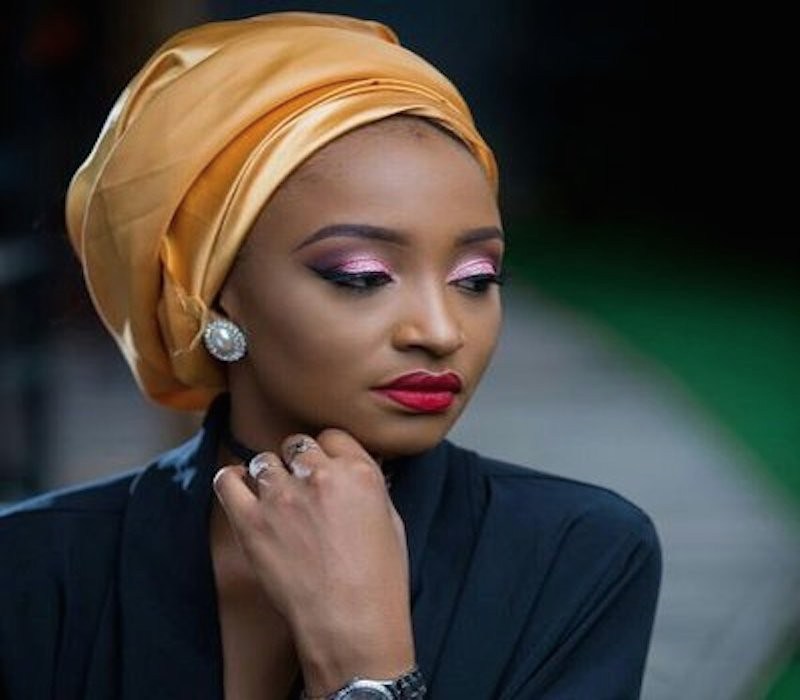
Kano Actors’ Guild has commended the state Governor Dr Abdullahi Ganduje, for lifting the ban on Rahama Sadau, popular female actress suspended from Kannywood for featuring in a romantic musical video.
Rahama, one of the leading actresses in Hausa film industry was expelled by the regulators of the Kannywood film industry, the Motion Practitioners Association of Nigeria (MOPPAN).
Her appearance in the music album by a musician “Classique,” was said to have been immoral and against the ethics of the Hausa film industry.
Chairman of the Guild Alhaji Alhassan Kwalli, said “the development was timely as stakeholders and practitioners in the Hausa movie industry are using films as a tool for national development.”
A statement issued by Rabiu Rikadawa, Assistant Secretary of the association on Monday, said Kwalli expressed gratitude to the governor for lifting the ban.
He also lauded Ganduje’s support to the Hausa Movie Industry and its practitioners over the years.
He said that Nigerian and the North in particular has good stories and cultures to exhibit to the world adding that this can be achieve with good movies and film making.
Rahama had written an apology letter to the state government and the Kano Emirate Council as well as (MOPPAN), expressing regrets for her action.
Rahama made her Nollywood debut in a new TV drama series titled, “Sons of the Caliphate.”
The 13-part drama series is produced by Mo Abudu’s EbonyLife TV.
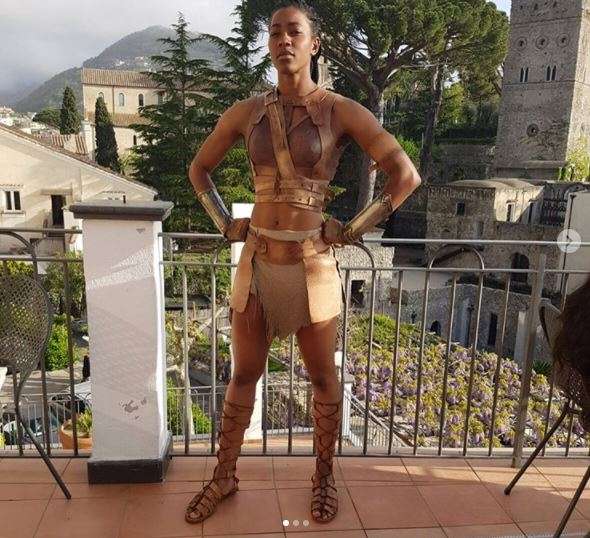
She made an appearance in the first act of the movie as one of the Amazons, who were called to battle the uninvited German soldiers.
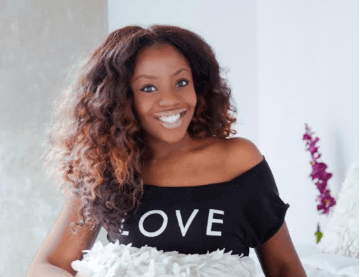
A heptathlete before an actor, the British Nigerian made her sports competitive debut for Nigeria at the 11th All African Games, which took place in 2015, in Brazzaville, Republic of the Congo.
So how exactly did Sasegbon end up making an appearance in one of the biggest movies of 2017?
Read her interview with Pulse Nigeria below.
How Moe Sasegbon got a role in “Wonder Woman”
“I did an audition. There were first of all scouting for just tall athletic looking women. So I went for the audition.
“I had to do three different auditions where I had to do different fight scene. I was with the sword and a shield and I got called back and got the part.”
Moe Sasegbon and other Amazons in “Wonder Woman”
Moe Sasegbon’s experience on set of “Wonder Woman”
“I can say it’s one of the most amazing things I have done till date. I was involved for about six months, that included training, like in the gym and a bit of stunt training as well.
So they were trying to create Amazon Warriors, so we had to look the part and train the part.
We had to be strong enough to look like Amazonian Warriors. And then we were in Italy working for three weeks. Being on set, watching the different scenery was an amazing experience.”
Moe Sasegbon
(Instagram/Moe Sasegbon)
On being a part of the 2017 “Justice League” movie
“Yes, we played Amazon Warriors in Justice League as well . It wasn’t as prominent as Wonder Woman because obviously Wonder Woman was about the Amazons.
We worked on that (Justice League) for about 10 days , we shot in the UK. It was the same kind of training process and I was in the background of that too.”
(Instagram/Moe Sasegbon)
Moe Sasegbon’s future plans for acting
“I think so, definitely in the future. For now the focus is obviously athletics because you have to give that your 100% focus.
In the future, yea, I can see myself going for an action role again, hopefully in Nigeria, if Nollywood goes down that direction.
If Nollywood ventures into superhero and action movies, I think that would be really fun to do. Something creative, something completely different from the norm in Nollywood so I would be interested in that.”
Moe Sasegbon
(Instagram/Moe Sasegbon)
Moe Sasegbon is currently working towards qualifying for the Commonwealth Games.
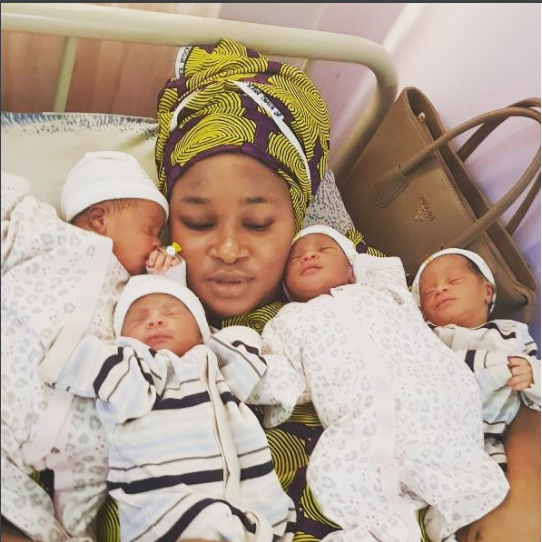
Abimbola Oluwatoyin Ashabi, politician and business woman is perhaps the happiest woman in the world at the moment and of course, she should be.
According to her, after many years of being without a child, she had begged God to have mercy and give her just a child. Surprisingly however, he had chosen to bless her with three more children, making it four.
The excited woman is now a mother to three boys and a girl and this news just goes to show that it is never too late for God to bless one.
She posted series of videos and photos on Instagram to testify to God’s goodness.
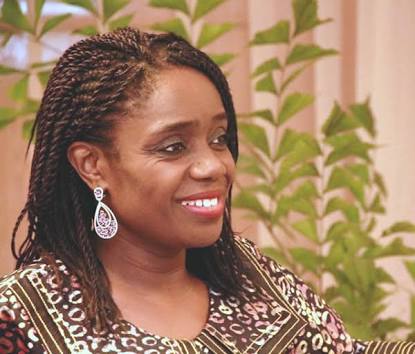
The United Nations has appointed Minister of Finance, Mrs Kemi Adeosun into the Investments Committee of the United Nations Joint Staff Pension Fund (UNJSPF).
In a statement signed by the Adeosun’s Special Adviser, Media and Communication, Mr Oluyinka Akintunde, on Sunday in Abuja, the minister would serve a one-year term effective from January 1, 2018.
According to the statement, UN Under-Secretary-General, Jan Beagle, in a letter said that the appointment was ratified at the 55 meeting of the 77th session of the General Assembly.
“The General Assembly decided to appoint you as an ad-hoc member of the Investment Committee for a one-year term of office, beginning from 1 January, 2018.
“I would like to take this opportunity to congratulate you on your appointment and wish you success in your work,” he said.
Also, the representative of the UN Secretary-General on the Investments Committee, Ms Carolyn Boykin, congratulated the minister on her appointment and welcomed her to the committee.
Boykin said that the purpose of the investments was to secure the pension entitlements of the international civil servants participating in the Fund.
“The fiduciary responsibility is to all parties concerned and it is the responsibility of the Secretary-General to ensure that those investments are managed to preserve the capital of the Fund.
“And to also obtain a long-term real rate of investment return that is in line with the actuarial assumptions, without jeopardising the capital of the Fund by taking excessive risks,” she said.
The UNJSPF provides pension, death, disability and the other related benefits for staff of the United Nations and other organizations admitted to membership in the Fund.
It is a multiple employer defined benefit plan governed by the United Nations Joint Staff Pension Board, the Staff Pension Committee for each member organization, and a secretariat.
The Fund was established through UN General Assembly resolution 248 (III), passed in December 1948 and came into effect on January 23, 1949 as a permanent retirement scheme.
It currently serves 23 member organizations, with 128, 262 active participants and approximately 75,000 retirees in nearly 200 countries.
According to the statement, Adeosun has accepted her appointment into the UN committee.
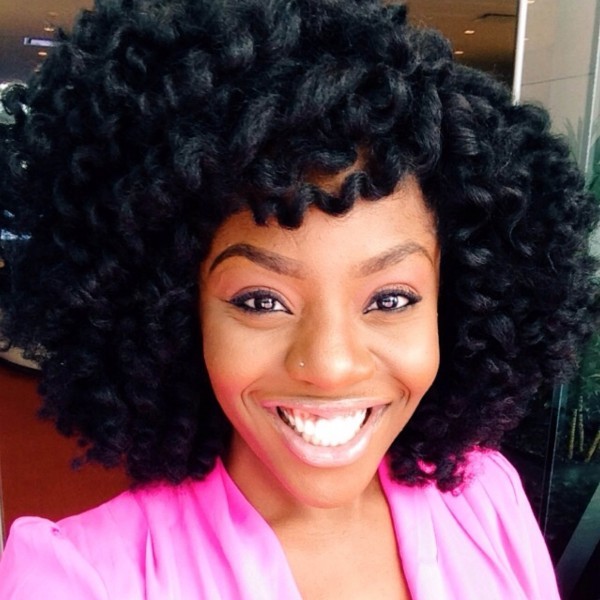
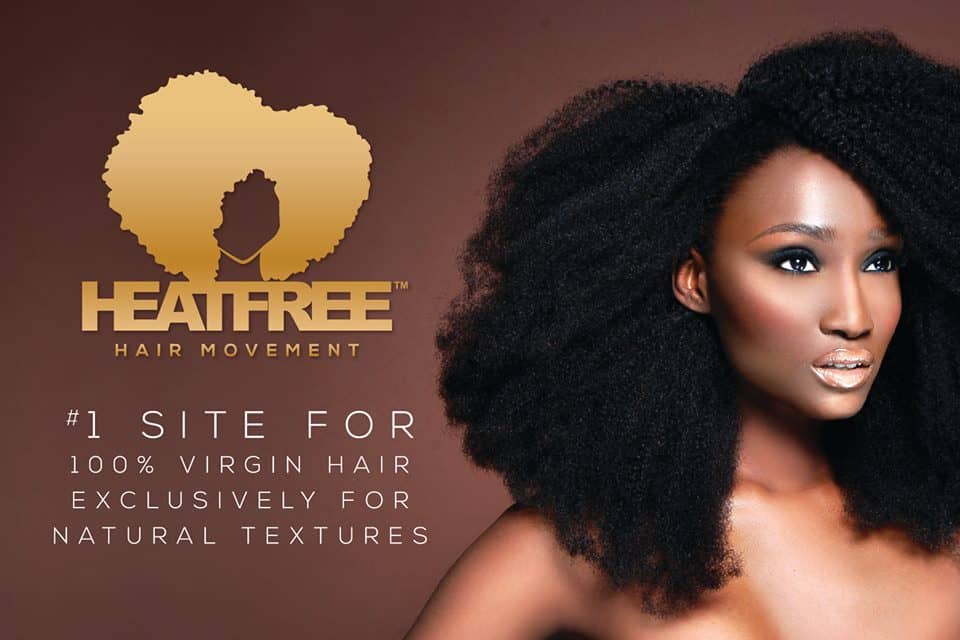
Ngozi Opara, founder of Heat Free Hair. The DC-based Nigerian entrepreneur is a leading provider of 100% virgin hair extensions designed to perfectly blend with a woman’s natural hair texture or curl pattern. By empowering women to embrace their natural textures through an innovative approach to protective styling, Ngozi is changing the face of the beauty industry. Heat Free Hair has once been selected as the 3rd place winner in She Leads Africa‘s annual pitch competition.
Read excerpts from her interview with She Leads Africa below;
Who is Ngozi Opara
I graduated from North Carolina A&T State University with a degree in Finance and Accounting. Keeping with my field of study, I worked as a financial analyst once I graduated although I always knew I wanted to be an entrepreneur. So I opened up a small hair studio in DC to tend to clients after work each day.
Prior to opening up my own business, I worked for eight different entrepreneurs to gain experience in business ownership and management. My interest and passion for the world of natural hair sparked from being natural myself, as well as working as a manager for natural hair care industry lead, Carol’s Daughter.
What inspired her to start Heat Free Hair
I owned a hair studio in Washington, DC. For a while back in 2011, 90% of my customers were using extensions to protect and grow out their hair. A majority of them also wanted to transition to free their hair of chemical processing and wanted to be natural.
When I noticed that during their transition with extensions they were reaching tremendous success in hair growth, but inherently experiencing breakage from heat on the portion of their hair left out, I felt like I was becoming an agent in one of the many issues surrounding black hair care, breakage.
I started thinking that there had to be some type of way for women to wear extensions as their protective style of choice, while also protecting all of their hair. Thus, the initial idea for Heat Free Hair was born.
How she started her entrepreneurial journey
I started to really save up for the launch of my business and budget my living expenses. I did this by keeping my personal expenses at a minimum while I was trying to reach my goal.
To get in the right mindset and gain motivation, I started to read a lot of success books and attend different conferences in order to learn, as well as to network with like-minded people. I used my savings from my finance job to launch the business & lived completely off of the money I earned doing hair.
How she prioritize what to spend the money raised on
At first I needed people to believe in something they hadn’t seen so I invested in good images of the product and a website. I didn’t have enough to fully stock the product so I initially offered it for preorder and eventually kept investing back into the business’ inventory.”
One thing she knows now that she wish she knew when Heat Free Hair launched?
There really isn’t anything I would go back and tell myself. I really do believe I was where I needed to be in life when I needed to be there. I learned the right lessons at the right time and because of that, I can stand comfortably and happily where I am today.
Obstacles along the road I traveled served as building blocks and I’m truly thankful for my journey and the development of my business.
Nigerian born actress, Sope Aluko, is part of the cast of the anticipated movie“Black Panther.”
Pulse Movies has shared seven things you should know about the actress.
1. Born in Nigeria, Sope is a multilingual, dual citizen of the Unites States of America and the United Kingdom.
2. Aluko portrays Shaman in “Black Panther,” a powerful primal leader who calls upon nature spirits for aid or guidance.
3. Her other movies include the 2011 “96 Minutes” and 2015 “Joy,” and the 2016 “Remember When.”
4. She speaks several languages, including Yoruba, French, Swahili, and Bahasa.
5. During shoot of “Black Panther,” she bonded with Chadwick Boseman, who plays the titular character in the Marvel movie.
“I call him my African Brother,” she told Popcorn Talk during an interview.
6. Sope is a wife and mom of two young boys. She lives in Los Angeles and Miami.
7. On her first day on set, the director of “Black Panther,” Ryan Coogler, made sure he got her name correct.
He also made sure the cast and crew got her name right. As an African actor used to having her name mispronounced, it made her cry and feel at home.
A scene in “Black Panther” movie (Marvel)
About “Black Panther”
“Black Panther” follows T’Challa who, after the events of “Captain America: Civil War,” returns home to the isolated, technologically advanced African nation of Wakanda to take his place as King.
However, when an old enemy reappears on the radar, T’Challa’s mettle as King and Black Panther is tested when he is drawn into a conflict that puts the entire fate of Wakanda and the world at risk.
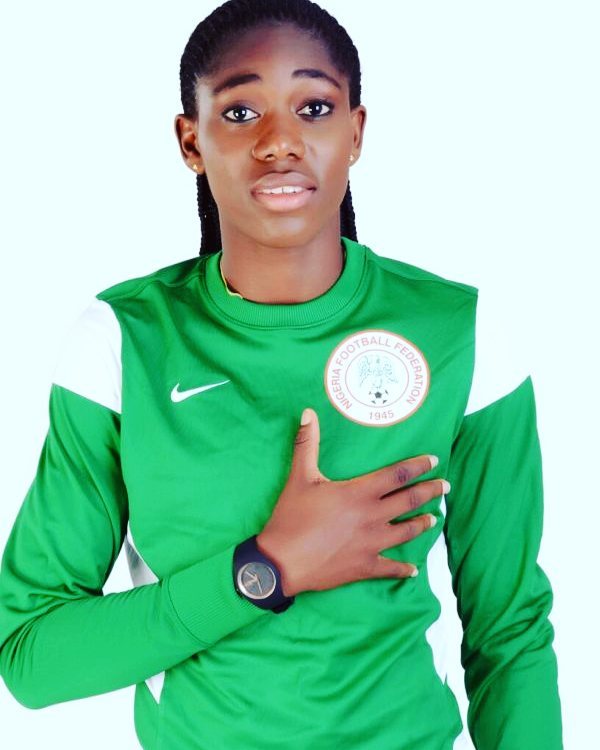
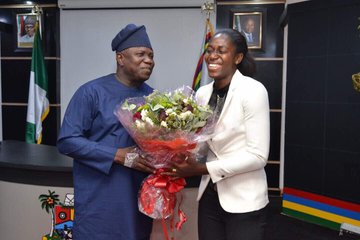
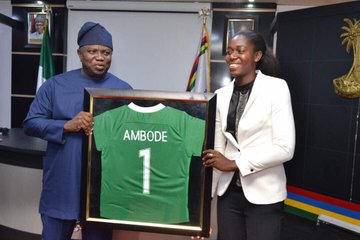
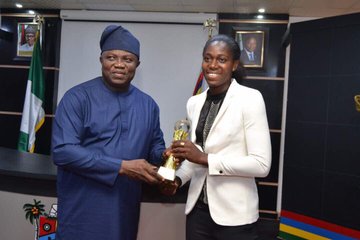
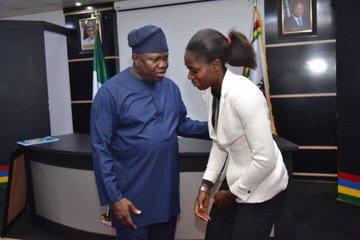
The Lagos State Governor Akinwunmi Ambode hosted 3-time African Female Footballer of the Year Asisat Oshoala at the Lagos House, Ikeja.
Ambode, on his Instagram, shared a photo of the two of them meeting. He wrote:
3rd time African Female Footballer of the Year, Asisat Oshoala, was our guest at Lagos House, Ikeja. Asisat is a sport ambassador of Lagos and we are proud of her achievements.
Governor Akinwumi Ambode yesterday at the Lagos House Ikeja appointed Asisat Oshoala as the new Lagos State Sports Ambassador.
Here’s what she shared on twitter:
Meet the Newly appointed LAGOS STATE SPORTS AMBASSADOR (Asisat Oshoala) . God bless Governor Akinwunmi Ambode , God bless Lagos State. Itesi Iwaju Ipinle Eko Lo Jewa Logun…..AMBO LE’KAN SI @AkinwunmiAmbode#ProudLagosian#FatherFather@followlasg
Meet the Newly appointed LAGOS STATE SPORTS AMBASSADOR (Asisat Oshoala) . God bless Governor Akinwunmi Ambode , God bless Lagos State. Itesi Iwaju Ipinle Eko Lo Jewa Logun…..AMBO LE’KAN SI @AkinwunmiAmbode#ProudLagosian#FatherFather@followlasg
Olubunmi Ajai (Jopa’s daughter), is a campaigner against domestic violence (DV), she also fights for the emancipation of women from the shackles placed on them by harmful cultures and traditions.
She is a blogger, Influencer and founder of GREENLANDS HAVEN FOUNDATION, a NGO that helps victims of domestic violence with emergency shelter and financial empowerment in the form of loans, grants and skills acquisition.
A former Domestic violence victim herself, she uses her experiences to teach other victims that they have the strength to leave the abuse and live fulfilling lives through her campaigns on social media, using the hashtag #LeaveTolive, which has now become a movement. Olubunmi is also an author and amazing mom .
She shares her journey with Esther Ijewere in this exclusive interview .
Childhood Influence
My childhood did not prepare me for my advocacy. I grew up in a happy home. My father and mother were happily married till my mother died on her 46th birthday. I did not grow up knowing about Domestic Violence in anyway as my father respected my mother and my mother reciprocated the respect. I grew up in a sheltered home, what you would call an ‘ajebutter’ home.
My parents came to England in the early 70s to school and left me and my two younger sisters, Yemisi and Seun, to be with our maternal grandma. Before then, we had been living in my paternal grandfather, Papa Idunmota’s house and I grew up with a lot of family around din those first few years. Then, when my parents came to England, we moved to Maami’s at Surulere where it was just us three, Mammi and our step grandfather, Papa Macauley, Herbert Macualey’s son. That was such an idyllic time of my life.
Most people who grew up with their grandparents will attest to this – grandparents spoil their grandchildren! I had an idyllic childhood but when my parents came back in the late 70s, I was brought up in a stricter environment. My mother was the shouter and beater while my dad was the quite disciplinarian.
I actually did not set out to do advocacy in DV. My initial NGO was set up to help indigent Cancer sufferers with their medical bills but it was difficult setting up a pool of fund. What I then started doing was to do fundraising here in England for charities that has to do with Cancer treatment.
My DV advocacy was a spur of the moment action. Yet another DV victim had been killed in Nigeria and it was trending on social media. I got tired of the talking and no action. From my experience, I knew that one of the factors that makes victims stay on is that they have nowhere to go.
A lot of families will not take back their abused children as it is ignominy for the victims, usually women to come back home. For example, the Yoruba concept of ‘dalemosu’ – meaning someone who has lived with a husband and comes back home is highly discouraged. So, with the help of my Facebook friends, we raised N1m in one week and with that, we rented a flat at Ajah to be our first shelter. We then went on to have other shelters in Ibadan, PH, Abuja, Iju and Sur-lere.
We also tackled another thing that shackles victims – finances. A lot of victims, usually women are financially independent on their abusive husbands. It is pertinent to state here that abuse is not gender specific. A man may also be abused by his wife but our society discourages men from speaking out so, we have very few cases of men reporting that they are abused. The abusive husbands would have initially told the victim to not work or even barred her from working. In some cases where the woman works, some abusive husbands insist on being the custodian and spender of the woman’s money.
To eradicate this financial dependency, we gave loans and grants for business set up. We also trained victims for free in things like sewing, make up artistry and set them up by buying them sewing machines and make up kits. We now hope to set up a formal skills acquisition centre in Lagos where various skills can be learnt.
Being A Domestic Violence Survivor And Advocate
I really cannot remember the exact moment that I decided to start speaking out about my DV experience. I evolved. When I left my ex, I did some soul searching and realized that I was responsible for some things that happened to me. One of which was that I was responsible for having accepted the abuse. I resolved to never be a victim again and to be the kind of woman that a man would not be able to abuse.
Part of that involves being assertive. I have evolved over the years from being a timid woman who accepted abuse by all, not just her partner but also her friends to being an assertive woman who gives all in a relationship and walks away when that is not reciprocated by the other person in the relationship.
Olubunmi Ajai
What And Who Inspire Me
Jane Tomlinson. She was a cancer patient who had been given the death sentence of having just a few weeks to live. She defied the odd and in the few years that she lived after that sentence, she did herculean tasks that healthy people could not do, to raise money for cancer related projects.
Oprah Winfrey. For her humanist approach to life.
Creating The #LeaveToLive Movement And Identifying With The Plight Of Victims
Ah… I have had to sort of caution myself as I became so invested emotionally in what these victims were going through. More often than not, the victims stay on after I and my team would have put things in place to help them so, I now, I try to rein my emotions in. I get a huge feeling of satisfaction and fulfilment when I help or hear that a DV victim have left their abuser. My advocacy is actually not totally altruistic as I do get a sense of pleasure and fulfilment in knowing that I have been instrumental in a DV victim leaving to live.
Greatest Reward
I have not yet gotten my greatest reward. My greatest reward would be that when I die, it would not just be my family and friends that would miss me. I want to be like Dorcas of the Bible. When I die and the whole world feels my absence, that would be my greatest reward.
Culture As A Challenge
Our culture. That is the greatest challenge that I have. Our Patriarchal culture. Timidity is also another challenge that I have. A lot of victims don’t know that they have the strength to get up and leave the abuse in order to live a great life. And of course, funding.
Where I See My Organisation In Five Years
I have registered a company limited by guarantee here in the UK. It is a kind of charity. In five years, I see myself being involved in anti DV activities here in Britain and in Nigeria. I see the NGO having a permanent structure for the skills acquisition.
I see the NGO being an employer of labour and a source of labour for these victims and also helping them to be employers of labour too. I see the British charity and the Nigerian NGO working hand in hand with each other to bring financial independence to DV victims.
Social Media As a Domestic Violence Awareness Tool And The Role Of Government
I am glad that with social media, a lot of awareness has been created but there is still a long way to go. A lot of victims don’t have access to SM and don’t have the awareness of DV issues. I want to do a documentary series to be aired on TV in Nigeria showing real life victims like me who have left the abuse and gone on to have great lives. CULTURE still shackles victims.
The government, through it’s various commissioners of women’s affairs and of culture need to embark on a sensitization project to sensitize members of the Nigerian society about the dangers of living with an abusive partner. The government also needs to provide emergency shelters for victims such as the one that the British government provided for me when I fled.
Grants should also be made available to victims to enable them be independent financially. Victims, especially female victims also need to know their rights. A lot of women don’t know that it is only the courts that can grant custody, that custody is not automatically given to the man, and that the child’s best interest is what the court looks at. A lot of women are terrified of losing their children and thus stay on in the abuse for the sake of the children
Skills Acquisition Centre And Other Projects
Like I said, I want to set up a skills acquisition centre, starting with Lagos, and then spreading to other states in Nigeria. I also want to work with the social services here in England to help DV victims, especially those of ethnic minority origins.
Giving up, never an option
No. Never. I do feel overwhelmed and wish I could do more than I am currently able to do but I have never felt like giving up. Infact, answering this question is the first time that I will be thinking of that as it has never even occurred to me. Like the singer sang, ‘we’ve only just begun’
Inspiration behind my book “Leaving to Live”
The book is called ‘Leaving to live’ and it is about how I left my life of abuse and went on to live a full live. It is a memoir and it serves two purposes. 1- that is to let people in abusive situations or even any sad situation know that they possess the strength to change their situation. If I can do it, so can they. The other purpose is to raise funding for my project – the setting up of the skills acquisition centre. The book is a honest account of my life with my ex, accepting my faults, working on them and how I then turned around my life by changing my behaviour to be able to earn respect ad find love and joy again.
Being a Woman of Rubies
I am not one for blowing my own trumpet so, I would like to leave that to the reader to decide if I am worthy to be called a Woman of Rubies or not.
Final Word For Women Who Are Presently Going Through DV But Are Afraid To Break Free and Speak Up
Please know that you have the strength to get up and go. Don’t give any excuses. Don’t stay for the kids. You deserve to be happy. Your kids deserve to be in a happy environment. If your enemy died of the abuse, your kids might be shunted around or abused. Stay alive for your kids. Stay alive for you. You can do it. Leave to live.
Just as in most parts of the world, Africa has its (unfair) share of people who still think women have no business being in sports. However, most women who believe they have a chance in the industry are waging a war against this mediocre group by participating in sports either as professional players/athletes or administrators.
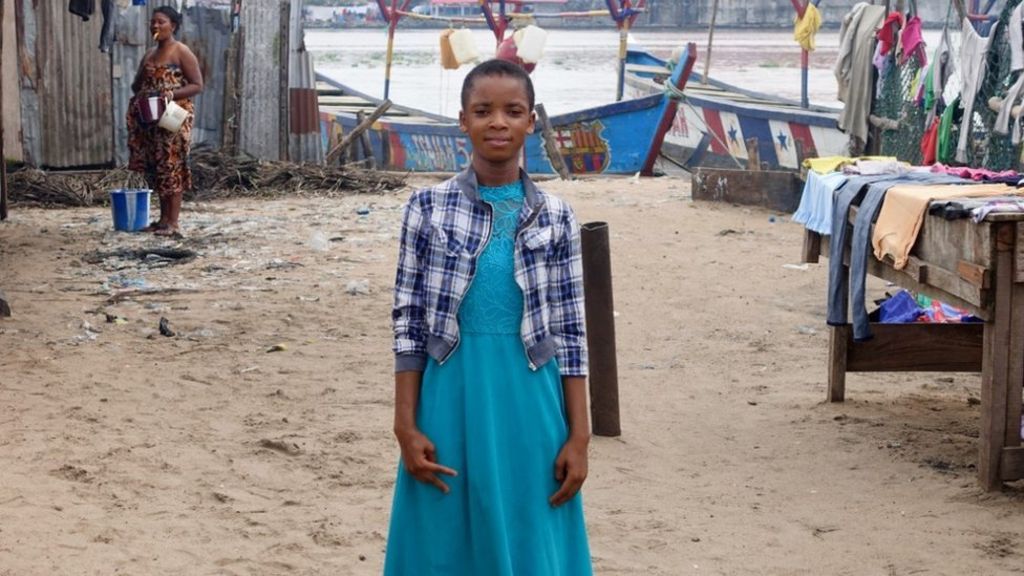
It might be hard to conceive, but 10-year-old Jessica Quachie from Liberia is indirectly fighting the good fight by playing football and helping change perceptions through it.
(Photo: BBC)
Quachie was born in West Point, Liberia’s biggest slum community where she started playing football at the age of six. Speaking with BBC, she said playing with boys gives her energy, and it was in one of the street matches with boys in the neighborhood that she was spotted by the Monvrovia Football Academy.
In 2015, the academy took her in as a pupil and trainee. She quickly became a diamond in the rough, not minding that an overwhelming majority of the trainees in the academy are boys. In addition to tournaments in Liberia, she has played with boys in international competitions, like one in Abidjan which had football agents and scouts from 11 European clubs in attendance.
(Photo: Monrovia Football Academy)
Although she won’t be joining any foreign club now due to FIFA’s ban on international transfers for players who are under 18, Quachie has had the privilege of showing off for scouts from Manchester United and AS Monaco.
Now able to read because of the education she’s getting through the academy, she’s working on becoming an excellent player. She also wants to make it clear that women can participate in sports and excel in them. Say whatever you will, Quachie is bent on achieving this through a career with her dream club, Real Madrid.
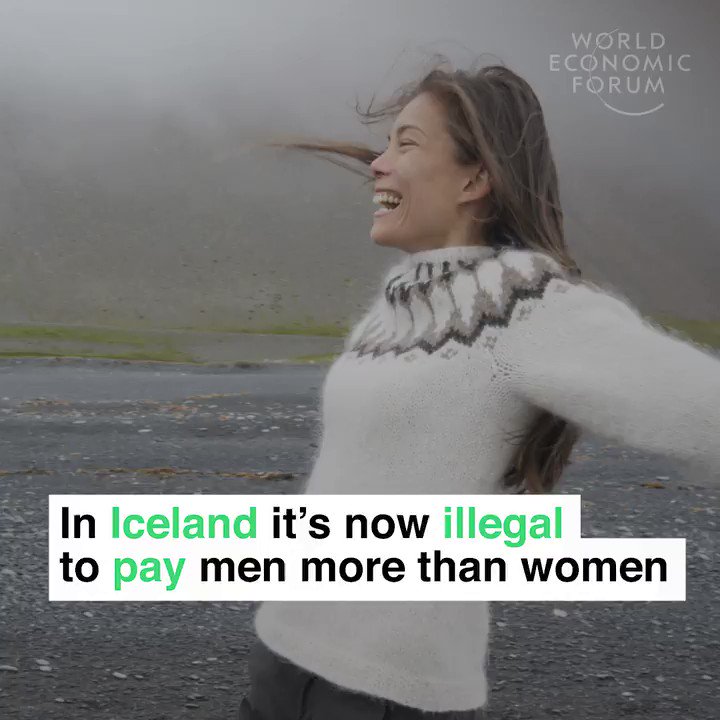
Iceland has kick-started 2018 by introducing a law making it illegal to pay men more than women in a bid to close a pay gap that exists in almost every country around the world.
Under these brand new rules, companies and agencies that employ over 25 people will need to obtain a Government certification of their equal-pay policies or face excessive fines.
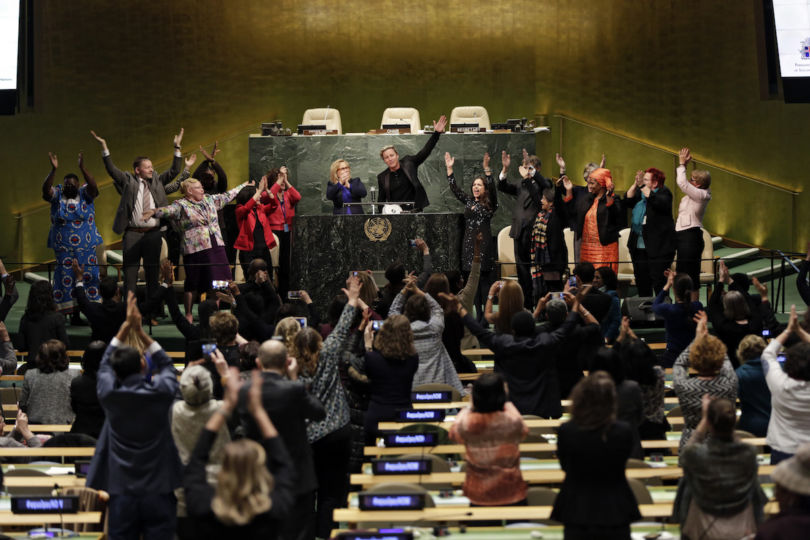
Champions of equal pay at the UN Women Global Equal Pay Coalition in New York, an event co-sponsored by the Missions of Iceland, South Africa and Switzerland (Photo: UN Women/Ryan Brown via Flickr CC)
The bill, which came into effect on January 1, makes the Nordic island nation the first country in the entire world to outright ban pay discrimination on the basis of gender.
It forms part of government plans to completely eradicate the gender wage gap by 2020.
Iceland has become the first country to make it illegal to pay women less than men
The government has introduced the Equal Pay Standard – if two people are doing jobs with the same score but not the same pay then the employer has got to fix this http://bbc.in/2qkXLxO
Dagny Osk Aradottir Pind, a board member of the Icelandic Women’s Rights Association, describes it as a “mechanism to ensure women and men are being paid equally.”
“We have had legislation saying that pay should be equal for men and women for decades now – but we still have a pay gap,” she told Al Jazeera news.
“I think that now people are starting to realise that this is a systematic problem that we have to tackle with new methods,” Pind explains.
“Women have been talking about this for decades and I really feel that we have managed to raise awareness,” she adds:
“We have managed to get to the point that people realise that the legislation we have had in place is not working, and we need to do something more.”
For the last nine years, Iceland has been ranked by the World Economic Forum (WEF) as the most gender-equal country in the world – followed by Norway, Finland, Rwanda and Sweden.
Yemen is the lowest-ranked of the 144 countries in the Global Gender Gap Report, which uses economic opportunity, political empowerment, health and survival to measure inequality.