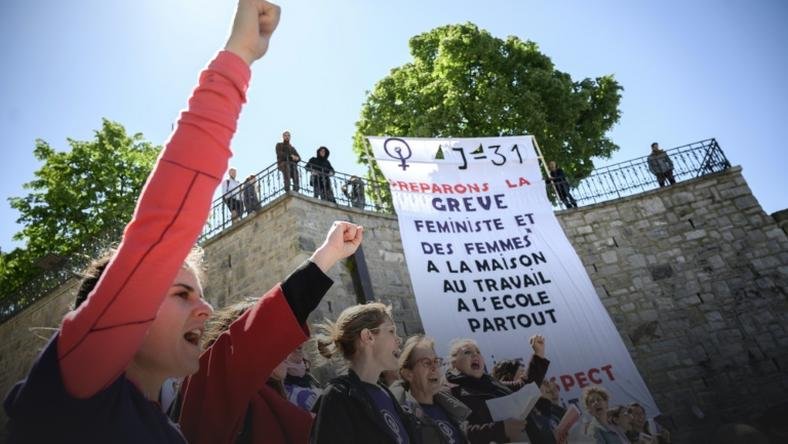
On June 14, 1991 — 10 years after equality between the sexes was enshrined in the Swiss constitution — half a million women walked out of their workplaces or homes to protest persistent inequalities.

Three decades on, however, unions and rights groups say things have barely improved.

They are calling on Swiss women to join a fresh strike, again on June 14, to demand “more time, more money, more respect”.

Women in Switzerland on average still make 20 percent less than men.

And for men and women with equal qualifications, the wage gap remains nearly eight percent, according to the national statistics office.

“Even if you take into account all of the regular excuses and you only compare women and men in the exact same position with the same professional experience, the fact remains that a woman in Switzerland is cheated out of 300,000 Swiss francs ($313,000, 266,000 euros) over the course of her career, just because she is a woman,” Switzerland’s largest union UNIA said in a statement last year.

Strikers will also be demanding zero tolerance for violence against women and more respect and better pay for women’s work, including through the introduction of a minimum national salary.

The idea of another nationwide women’s strike was born out of frustration at a bid to change the law to impose more oversight over salary distribution, which passed through the Swiss parliament last year

The final text only applied to companies with more than 100 employees — affecting fewer than one percent of employers — and failed to include sanctions for those that allow persistent gender pay gaps.

‘Women work for free’

Organisers have called upon women to snub their jobs, and also housework, for the entire day to help raise awareness about the vital contribution women make across society.

“Really, the objective is to block the country with a feminist strike, a women’s strike,” activist Marie Metrailler told AFP.

For those women unable to take a full day, the organisers urge them to at least pack their things and go by 3:24 pm — in recognition of the male-female pay disparity.

“After that, women work for free,” said Anne Fritz, the main organiser of the strike and a representative of USS, an umbrella organisation that groups 16 Swiss unions.

Gaining recognition of women’s rights has been a drawn-out process in Switzerland.

It was one of the last countries in Europe to grant women the right to vote, in 1971 — and in the conservative Appenzell region women only won that right in 1991.

And while Switzerland did enshrine gender equality into its constitution in 1981, it took another 15 years before the law took effect.

“In 1991, we determined that… nothing was moving. So we went on strike,” Geneva author Huguette Junod told AFP.

Around 500,000 women — a high number in a country that at the time counted fewer than 3.5 million female inhabitants — marched and organised giant picnics in the streets. Some women hung brooms from their balconies.

The large turnout was all the more remarkable given that work stoppages have been extremely rare in Switzerland since employers and unions signed the “Peace at Work” convention in 1937. It states that differences should be worked out through negotiation rather than strikes.

Junod, 76, recalls that many women were blocked from participating in 1991.

But, she said, “those who were not permitted to strike wore a fuchsia-coloured armband … and took a longer break”.

‘Illegal’

Organisers are bracing for a repeat of that situation, for while the strike has some support, the employers’ organisation flatly opposes it.

“This strike is illegal,” Marco Taddei, one of the organisation’s representatives, told AFP.

He stressed that the demands put forward “do not solely target working conditions”, and that the constitution “stipulates that a strike can only be used as a last resort.”

The unions disagree.

“What is illegal is wage discrimination and sexual harassment in the workplace,” Fritz said.

Recognising that many women will not be able to get away from work, organisers have declared purple the colour to wear this time to show support for the strikers.

Over the past three decades, womens’ rights advocates in Switzerland have made some gains. Abortion was legalised in 2002, and 2005 saw the introduction of 14 weeks of paid maternity leave.

But Switzerland still offers no paternity leave, and limited access to over-priced daycare is seen as a major hindrance to women’s full participation in the world of work.

Switzerland “is very conservative on the question of women’s rights,” Eleonore Lepinard, a sociologist and associate professor of gender studies at Lausanne University, told AFP.

The authorities have yet to commit to collective policies on day-care and elderly care, which would make it easier for women to enter, remain and thrive in the workforce.

Women’s forced absence from the workforce for years at a time “benefits men on the employment market and in terms of salaries”, Lepinard said.

She hailed women’s growing ability to speak up and make their grievances known.

The question, she said, is: “Do the politicians know how to listen?”

Credit: Pulse News

A graduate of a UK university – Anglia Ruskin University – has received a £60,000 out-of-court settlement after she sued her university over her “Mickey Mouse” degree.

According to BBCPok Wong graduated with a first in international business strategy from the university in 2013 but claimed the school “exaggerated the prospects of a career,” hence filing a suit for false advertising.

Wong said claims made in the university’s prospectus were untrue.

She told the BBC in 2018:

“They think we’re international students [and] we come here to pay our money for a piece of paper, for the degree. But actually we care about the quality, we care about how much we could learn. They exaggerated the prospects of a career studying with them, and also they exaggerate how connected they are.”

A spokesperson for the university said that they did not support the settlement, revealing that it was agreed with their insurer’s solicitors.

The County Court of Central London had ruled in favour of the university in 2018 and ordered Wong to pay £13,700 of Anglia Ruskin’s legal costs.

However, the university’s insurers wrote to Wong and offered to settle her £15,000 claim and also her legal costs.

Wong’s litigation “has been rejected numerous times and has never been upheld,” a spokesperson of the university said, adding that the school did not support their insurer’s decision.

“We consider that they acted negligently and against the university’s interests,” the spokesperson added.

The impact of Western civilisation in Africa is enormous and documented, from culture and religion to political structure. But Africa isn’t a country.

Some societies and tribes, somehow, have remained unaffected by the reach of civilisation and thus making their dressing, custom, traditions and lifestyle uniquely peculiar.

Till date, these tribes in Africa still exist in an uncivilised bubble, maintaining traditions long left behind by the rest of the world and providing a wealth of information for anthropologists seeking to understand the way cultures have developed over the centuries.

Here are the five African tribes unaffected by civilisation:

The Hamer Tribe

Women offer themselves to be whipped by men in Hamer tribe

Photo The Gridasia

The Hamer are located in south-west Ethiopia and in the Omo valley.

They live in huts and villages and have been able to preserve their unique culture, wherein young men jump over bulls in order to transition into adulthood and women offer themselves to be whipped by men who have recently been initiated.

They are Agro-pastoralists, meaning they grow crops and keep livestock. Many elements of their traditional religion are practised today. For instance, they believe that natural objects such as rocks and trees have spirits.

The Bayaka ‘Pygmy’ Tribe

Pygmy Tribe in the Ituri Rainforest

Photo Magnum Photo

The Bayaka are found in the southwestern Central African Republic and are reported to be constantly dwindling in their numbers.

The reason is that their natural habitat, which is the rainforest, is always under threat from illegal mining, genocide and deforestation.

They call themselves the people of the forest and they are masters at exploiting the resources of their environment. They are hunter-gatherers.

Dogon Tribe

Dogon tribe mask dance

Photo Flickr

The Dogon are an ethnic group living in the central plateau region of Mali. They are believed to be of Egyptian descent who have managed to preserve their culture over the years.

The majority of them live in rocky hills, mountains and plateaus. They are mainly into agriculture, leatherwork and craft.

The Dogon are also famous for their mask dances, wooden sculptures and architecture. Like many African societies, the Dogon are agriculturists, cultivating millet, sorghum, rice, as well as peanuts, onions and tobacco.

The Karo

Karo indigenes paint their bodies with a mixture of white chalk

Photo Behance

With an estimated population of 1,000 to 2,000, the Karo Tribe makes up some of the smallest indigenous groups left in Africa. The ethnic group occupies the Lower Omo Valley in Southern Ethiopia.

The Karo paint their bodies with a mixture of white chalk, yellow mineral rock, iron ore and charcoal to express beauty.

Another symbolic custom practised by this tribe is body scarification, a tradition down to express cultural identity and community status.

The Hadzabe

Hadzabe tribe

Photo Idstudio

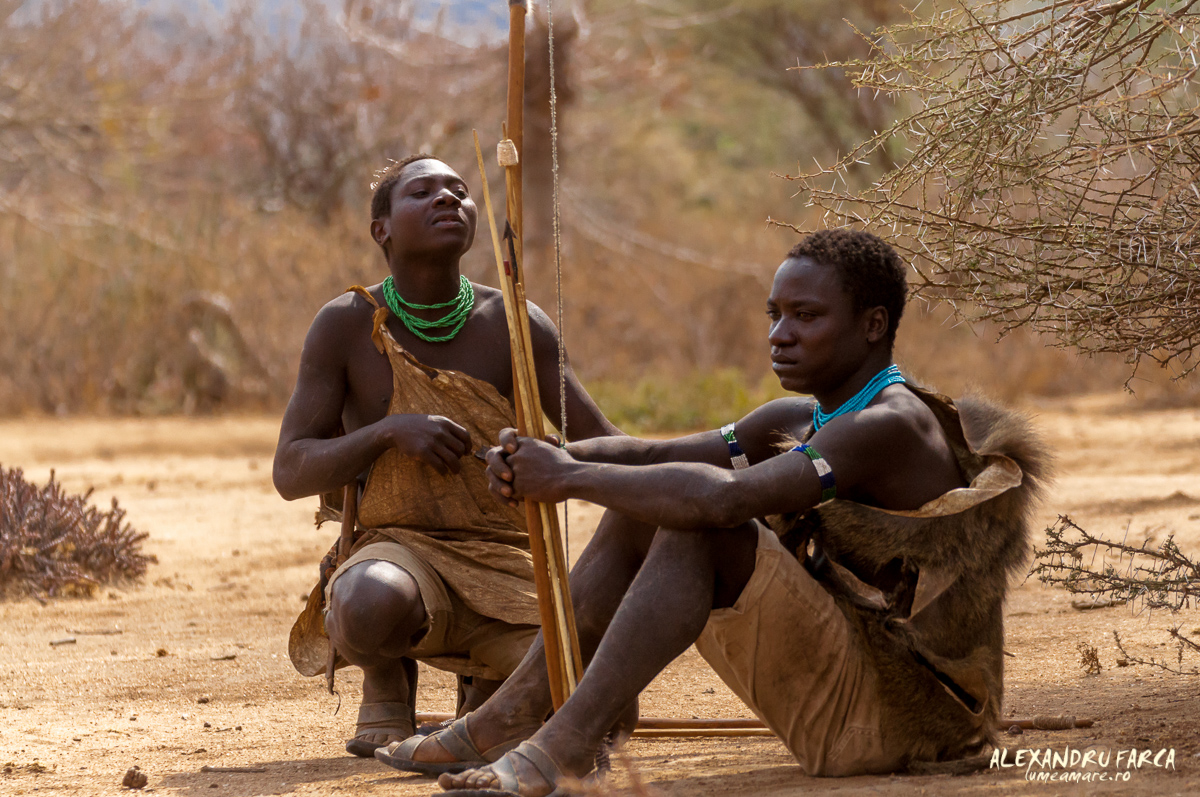
The Hadza tribe occupy the shores of Tanzania’s Lake Eyasi in the Great Rift Valley, whose way of life has remained the same for more than 10,000 years. One of the intriguing aspects of the Hadza tribe is their language.
They speak a distinctive click language which has led to the belief that they are related to the Khoisan of the Kalahari Desert.

This Tanzanian tribe mainly rely on wild fruits, tubers, and roots for food. They are also avid hunters who use bows and arrows to hunt antelope, buffalos and birds.

Source: Guardian Life

Last Friday, Oprah Winfrey paid a visit to West Side High School in Newark, New Jersey to not only surprise the students and staff with a pizza party, but to also give a $500,000 donation for its after school program called “Lights On.”

The program, which was started by the school’s principal Akbar Cook, provides students with a safe place to gather on Friday nights where they can play basketball, video games, shoot pool or practice cheers until 11 p.m. throughout the school year, CNN reports. Over the summer, the program runs three times a week. 

In addition to implementing the “Lights On” on program, Principal Cook also installed a laundry room in the school after finding out that students with dirty clothes were being bullied by their peers and, in turn, missing class. 

Winfrey posted a video about her visit on Facebook, saying, “When I saw what Principal Akbar Cook was doing for his students at West Side High School in Newark, NJ, I had to come see what it was all about and share some delicious O, That’s Good pizza.”

In a video posted by Cook, Winfrey announced her half a million dollar donation to the school, and added that she wants to encourage the community to “keep doing what you’re doing because what you’re doing is moving in the right direction.”

Cook’s work and influence at his school was first shared on a national platform when he appeared on the Ellen DeGeneres show last September. He tells NJ.com that since his appearance, his school has received gifts of detergent, clothing and toiletries from all over the world. 

“It’s crazy man,” said Cook, who also serves as the school’s varsity basketball coach. “I never thought anything like this would happen.” 

In March, DeGeneres invited the principal back on her show to further praise the work he’s doing and to give him a $50,000 check for his school. 

This past February, after sending Cook a personal letter, Newark’s former mayor and current presidential candidate Sen. Cory Book praised the principal on Twitter, saying, “His tireless work is an inspiration to us all.”

Principal Cook, thank you for making a difference! 


Serena Williams has been knocked out of the French Open 6-2, 7-5 by compatriot Sofia Kenin in the third round.

It was 37-year-old Serena’s earliest exit at the Slams since a third round loss to Alize Cornet at Wimbledon in 2014.  

Kenin, the 20-year-old World Number 35, will face eighth seed Ashleigh Barty of Australia for a place in the quarter-finals. Three-time Roland Garros champion Williams was attempting to equal Margaret Court’s record of 24 majors.

Credit: LIB

Publisher, Betty Irabor, who has battled depression and attempted suicide in the past, shared a thoughtful piece on her Instagram page on Sunday.

In her write-up, the 63-year-old appealed to anyone suffering depression to seek help and deal with the root cause of their hollowness. According to Irabor, getting married, pregnant or buying material things, would not make them feel any better when the root cause of their depression hasn’t been dealt with. She wrote;

I was about 12 when I first saw a Rolls Royce. It’s owner was a guest of mum. Did I show off on that day? I earned renewed respect in the hood on Akinwunmi street.. well at least for few days! Sigh!! Yesterday I took the liberty of posing by this vintage monster of a ride In Warri. Na pose I pose o, I didn’t say it’s mine before you people will come for me!!

I remember thinking while in the throes of depression that as soon as my new ride arrived I would feel better. I didn’t feel better. And that’s how it goes on; when I get married I will feel better, when I am rich I will feel better, when I have children I will feel better, when I get that designer bag I will feel better, when I move into my new house I will feel better.

Truth is, things or people don’t make us feel better until we fix the cancer within and own up to the fact that we feel hollow within and need help. We carry around burdens and pains that we need to offload so we can travel light. We cannot fake true happiness, it expires as soon as we are alone and the reality of what we are masking hits us. We can lie to the world about how well we are on the outside but we can’t deceive our selves…
Life is about finding joy in little abundance and trusting that our current situation is only a part of our long journey….This present challenge is only a comma in a sentence and not the full stop…

Focus on what truly counts and live one day at a time. Most of us dont have it all figured out… na packaging…

Don’t give up on yourself, believe in endless possibilities and don’t focus on what could have been…

This is your time, make it count.

Credit: LIB

A number of people are plagued with mouth odor and they might not be fully aware to what extent it makes people around them uncomfortable.

Bad breath typically originates in the mouth, where bacteria are ever present. When you eat, bits of food get caught in your teeth. Bacteria grow on these bits of food, releasing foul-smelling sulfur compounds.

The most common cause of bad breath is poor dental hygiene. If you don’t brush and floss often, the bacteria in your mouth continue to grow, and a thin film of bacteria known as plaque builds up on your teeth.

Here are a few ways to get rid of bad breath naturally;

1. Parsley

Parsley has a fresh scent and high chlorophyll content which suggests that it can have a deodorizing effect.
To use parsley for bad breath, chew on fresh leaves after each meal or buy a parsley dietary supplement

2. Green Tea

Green tea is an effective home remedy for bad breath because it has disinfectant and deodorizing properties that can temporarily freshen the breath. Mint has similar effects, so a cup of green mint tea may be an ideal breath freshener.

3. Fennel and Anise Seeds

Fennel and anise seeds have been used to freshen breath. In parts of India, roasted fennel seeds are still used as mouth fresheners, to cleanse after-dinner breath. They taste sweet and contain aromatic essential oils that give the breath a fresh scent.
Fennel and anise seeds can be eaten plain, roasted, or coated with sugar.

4. Yogurt

Yogurt contains healthy bacteria called lactobacillus and these healthy bacteria can help combat bad bacteria in various parts of your body, like your gut.
To use yogurt to fight bad breath, have one serving per day of plain, nonfat yogurt.

The number of women of color who own their own businesses rose by 8% last year. This increase is largely due to “poor treatment and the perception of being undervalued in the workplace,” according to a 2017 report by the Federal Reserve Bank of Kansas City. In fact, “a much greater gender and racial pay gap have led women of color to start businesses at a higher rate out of necessity and the need to survive,” the 2018 State of Women-Owned Business Report found. 

This is not surprising to me.

If I had to find one word to describe my journey of management and leadership as a black woman, I’d go with “lonely” ― not your typical sad lonely, but more of an alienated lonely. An “I’m literally the only person in the room with this hair texture and this skin color” lonely. An “I’m representing an entire race of people” lonely. How I am perceived matters.

Growing up, I watched the sitcom “Martin” religiously and admired the role that actor Tisha Campbell-Martin played as Gina, who worked as a top marketing executive. As clever and on point as that show was, what it didn’t portray was that, in real life, black female leaders are often one-of-one ― especially in meetings.

It’s really difficult to articulate how it feels to continually be the “only”in a meeting.

I’ve been a black “white-collar” professional since I graduated college in the mid-2000s. I remember the first day of my first real job. My boss walked me around the office and introduced me to my new team and the other employees. Everyone seemed really nice, but what I noticed after returning to my desk was that I hadn’t met a single minority in a leadership role. I knew I wouldn’t stay there long, and I was right. I was out the door and on to the next opportunity in under a year.

I moved into management early on in my career, and by the age of 24, I had staff reporting to me. I was the youngest middle manager at my company. That role opened me up to a bevy of opportunities, including global travel and board meetings — and that’s when it began. I was the “only.” I was not just the only woman, but 98% of the time, I was the only black woman. You know what I learned from those experiences? I learned that discrimination isn’t usually outright or blatant. In fact, it’s often very subtle.

I’ve had people enter conference rooms where I’m sitting, and when they see me, they say, “Maybe I’m in the wrong room,” as if to suggest that if I’m a part of the meeting, it must not be a leadership meeting.

Once, during a leadership retreat abroad, a chief executive pulled me to the side before the committee discussions began and said, “You know, you don’t need to talk during the retreat. You can just listen. Yeah, actively listen. No need for you to contribute.” Mind you, I was the person responsible for setting the strategic direction of the initiative. I was also the person solely responsible for the company’s recent massive growth. And yet, I thought, you don’t want me to talk?

When we’re the only person of our race at a certain level, we feel accomplished — but we also feel alone. It’s kind of like “yay me,” but at the same time, “why just me?”

Years of being the only black woman in the room made me feel visibly invisible. It didn’t matter that I broke sales and revenue records year after year, and it didn’t matter that my performance evaluations read “outstanding” across the board.

There is an unconscious bias that exists in business culture, whether people want to admit it or not. Companies can have all the diversity and inclusion trainings they want, but that doesn’t change the fact that black women (and men) are continually overlooked and discriminated against.

Companies need to realize that relatability is a real thing. Representation is a real thing. So when we’re the only person of our race at a certain level, we feel accomplished — but we also feel alone. It’s kind of like “yay me,” but at the same time, “why just me?”

People don’t really like to talk about race. But it’s there — hovering, always. I’ve sat in meetings where people dismissed my feedback or ideas as not being valuable or worthwhile, only to have someone of another race repeat the same messages or ideas five minutes later to ahas! and applause.

There’s a reason why black women are turning to entrepreneurship, and it’s not because we’re not qualified for management positions in the corporate world. It’s because we’re not seen.

What I’ve learned over the past 15 years is that mentors are vital. It can be a real challenge to go into a workplace day in and day out when you feel ignored or overlooked. Mentors are an invaluable support system for everyone, but especially for women and minorities. We need people to help us navigate our careers and help guide us as we continue to grow. There is a void of African Americans in leadership, and it can be very demoralizing to watch other people who do less advance quicker than we do.

I met my mentor, who was also a black female executive, at a professional development conference. She had turned an idea into a seven-figure business venture after walking away from corporate America five years prior. I’ll never forget the first thing she told me when we met for coffee.

“You will have to work 10 times harder than your white counterparts for recognition,” she said. “You will often question yourself and your worth. You will not receive the same pay. You will get frequent stares and looks. You will be disrespected, both blatantly and subtly. But never let it make you question yourself. Never. Go after every opportunity that presents itself. It will teach you resilience, and as a black woman, you’ll need that a lot.”

I now know to command my seat at the table. Even if they’re given a seat, women of color still need to command our place. Unfortunately, we have to do so diplomatically because minorities, specifically African Americans, are often viewed as hostile or aggressive when we speak up, whereas people of other races are seen as passionate and committed.


“There’s a reason why black women are turning to entrepreneurship, and it’s not because we’re not qualified for management positions in the corporate world. It’s because we’re not seen,” Keli Hammond writes.

I have also learned to create my own support system. Everyone needs allies they can trust, confide in and connect with on a personal level. Because black women are often unfairly stereotyped, it’s important for us to keep positive and supportive energy in our circles.

There’s no getting around the fact that race is going to be an underlying factor in business, and there are some very real barriers to advancement in traditional workforces for women of color. Thankfully, I discovered this early on, and with the help of my mentors, I learned how to advance despite the unfair challenges and stereotypes I’ve faced. Every morning, I remind myself of the most important lesson I’ve learned throughout my career: Although we may feel like others devalue our contributions, we must never devalue ourselves.

Keli Hammond is the author of “Craved: The Secret Sauce to Building a Highly-Successful, Standout Brand” and the CEO of B Classic Marketing & Communications. Learn more about her at KeliHammond.com.

Source: Huffpost

Last weekend Ashley Williams was in full Black Girl Magic mode when she graduated with her Master’s Degree and Law Degree in the same week from two separate universities, in two separate states. On May 18th she received her Master’s degree in Political Management from George Washington University in Washington, D.C. and on May 20th she received her JD from the University of Pennsylvania. And it wasn’t a dual degree program.

She began her Master’s degree at George Washington University in 2015 while working at the State Department as Special Advisor and Director of Special Projects to the U.S. Ambassador-at-Large for Global Women’s Issues.

“I was really interested in beginning a program that would allow me to build upon my undergraduate degree, love for politics, and allow me to continue working. I knew I needed to grow. The Political Management degree at GW was perfect,“ Williams told Because of Them We Can.

She was able to attend the program online with the option to attend classes in person when her schedule permitted. Not long after starting the program she applied to law school in pursuit of a life long dream.

“That fall I also applied to law school, which had been a part of my plan since high school. Both of my parents are lawyers, and I admired them and wanted to follow in their footsteps.”

Williams says her law school journey wasn’t easy. 

“I faced rejections from schools during two separate admissions cycles—once while I was working at the White House and once while I was at the State Department—but I was determined to go.”

She received a favorable letter from the University of Pennsylvania in January of 2016 and  started in the Fall of 2016, exactly one year after beginning her master’s program. 

“During my first year of school, I stopped my Master’s program so I could focus on law full time. The summer following my first year, I resumed my Master’s program and simultaneously did law and my Master’s until I completed my Master’s in December of 2018—which I did while I was studying abroad in Tokyo.” 

Williams was in Tokyo for three months where she was focused on the Japanese Supreme Court. She completed her JD requirements five months later in May 2019.

A lot of people wondered why I continued with my Master’s after starting law school, but both stimulated my mind in different ways. I was incredibly fortunate to be able to do both, but it did require sacrifice and discipline.”

Williams, who attended Georgetown for undergrad, said that she hopes her journey inspires others.

“No matter what, never give up and never feel like you aren’t enough. I hope my story inspires others to keep striving and remember that all of our possibilities are endless.”

There are endless articles and even a book about how often men try to teach women things we already know. Despite being a raft and adventure guide in the outdoor industry for most of my 20s, I often get approached by men half my age trying to teach me how to do things like setting an anchor. It both infuriates and cracks me up that they assume I need to be taught because I’m a woman. Especially when I started climbing before they were even born.

But I’ve recently realized there’s an even more annoying kind of mansplainer. He’s not the “teacher” type, but rather a seemingly curious man who wants to be “taught.” I call him the Faux Student.REAL LIFE. REAL NEWS. REAL VOICES.Help us tell more of the stories that matter from voices that too often remain unheard.Become a founding member

Every woman knows this kind of dude. He’s the mansplainer in disguise. Instead of teaching you something you already know, he wants you to spend your time and emotional labor educating him, often on the finer points of feminism. Only, spoiler alert: These dudes aren’t here to learn jack shit.

I hit my breaking point a couple of months ago when I wrote a super-personal post on Facebook about how I don’t trust male doctors anymore. Well, Faux Student had questions about this. That is, after he pointed out that this is a HUMAN ISSUE (all caps!), not a feminist one. Why do I “have to make everything about sexism!!!!!!!!!!” he asked.

A friend of mine jumped in, posted links to this article to back me up and answered all his patronizing questions. She finally got sick of it and blocked him, but I spent a good 20 minutes tap-dancing around his fragile male ego trying to explain that women in the U.S. die all the time because male doctors don’t listen to us. I even gave a dissertation-level argument backed up with hard facts. But Faux Student wouldn’t drop it. He just didn’t understand, OK?  

“Dude, STOP,” I wrote. “I’m not explaining feminism to you.” The empathetic (sorry — codependent) part of me that gives people way too many chances finally said that if he was genuinely interested, I could send him links to articles that explain what I and all the women were talking about on my Facebook post.

The next day, he messaged me a sorry-not-sorry apology. But you know what he didn’t do?

Ask for any of those links.

Not a single one.

Because he doesn’t actually care about this issue. He never did.

Every woman knows this kind of dude. He’s the mansplainer in disguise. Instead of teaching you something you already know, he wants you to spend your time and emotional labor educating him.

I used to be willing to enlighten any man who asked me about feminism. But in recent years, I’ve learned a much healthier approach from being in Facebook writing groups with women of color.

Like clockwork, every week or so, an ignorant white lady will say something insensitive or blatantly racist. A woman of color will call her out, and the white lady will invariably play the “That wasn’t my intent but please teach me” card, which then requires long, thoughtful responses from the WOC. These women do so with more compassion and patience than the lady deserves. But white lady usually tries to shut them down with the same gaslighting techniques men use to shut women down. The lesson usually ends with the white lady crying her fragile white tears and calling the WOC bullies.

“I’m trying to understand!” she’ll say right before swearing she’s not racist. This despite the fact that all white people have racism to unlearn.

Over time, I’ve witnessed that a lot of the women of color who had been doing all this free labor stop responding with comments and instead just link to articles that explain the topic at hand. Some have gotten so fed up that they’ve started to list their PayPal account info in the comments. After all, they’re saving these white women hours by providing resources they could and should have researched their damn selves.  

Some women refuse to engage at all and instead just say, “Google it.”

I’ve since taken this wisdom into my life as a feminist, and boy, has it been a game-changer. Because honestly, I’m too exhausted to spend my time educating the Faux Student.

For decades now, I’ve been reading numerous articles online about women’s issues, taking feminism classes, talking about feminism with women and men, protesting sexism on the streets, watching TED Talks, and straight up living it. I recently spent my whole Saturday with 5,000 women protesting sexual assault here in France while my guy friends slept in and enjoyed a leisurely weekend. I rarely meet men who actively educate themselves about feminism, read books or articles by women, or watch our TV shows and movies. 

Think about all the things I could do if learning about feminism (and all forms of social injustice) didn’t consume so much of my time! It’s an endless, exhausting but necessary time suck for us. And that’s just the beginning of our firewall!

I rarely meet men who actively educate themselves about feminism, read books or articles by women, or watch our TV shows and movies.

Then there’s all the unpaid labor women do at home, all the efforts we make keeping ourselves safe, the money and time we spend trying to recover from small or big doses of trauma we’ve already experienced. It’s a full-time job just existing as a woman.

In fact, just the other day, a man followed me home from the gym and harassed me the entire way until I stopped at the wrong apartment building and pretended to be going home (more mental energy wasted trying to outsmart the bad guys!). Once I did get home, I was shaking and livid for a good two hours afterward and couldn’t get any work done. He reminded me of all the other men who’ve followed me, sexually assaulted or harassed me, or simply scared the living shit out of me.

See why we’re so tired, guys? And why we don’t have time to educate your asses?

I find it insulting when men who’ve put zero effort into learning about women’s rights, much less fighting for them, ask me to take even more of my time and energy to explain it to them.

These exhausting men have made me realize just how much emotional labor it requires for a marginalized group to educate people outside said group, making me appreciate all the more the many people of color who’ve taken the time and effort to educate me over the years. Like them, I am willing to teach men who are open and respectful enough to have these sometimes hard conversations (I mean, we’re fighting for men too, duh). But I’m too tired, busy, and honestly, have zero fucks left to give those who don’t.  

For the Faux Student, I now say “Google it.”

Unless they want to PayPal me. Then I’m totally game.


By: Melanie Hamlett