When it comes to the clearing of skin, lemon is magical; it is one of the best ingredients that can be used to promote skin condition.

How to improve the quality of your skin naturally

The idea of having a flawless skin should not be confused with skin bleaching.

Simply because it is possible for every skin, irrespective of colour, to be made more beautiful and flawless.

Be that as it may, it can not be denied that every woman, and also some men, long to have a fresh glowing skin.

But owing to stress, lack of sleep, poor nutrition, and constant exposure to sun’s ultraviolet rays, it seems like their desire will be difficult to meet with reality.

However, there are hundreds of chemicalized products that comes with the assurance of making the skin glow in a couple of days.

So luring is their temptation that a good number of people yield to it without knowing the long-term effect these products will have on their skin.

It is, for this reason, we decided to show you the natural ways in which the skin condition can be made beautiful and healthy without incurring any possibility of an aftermath effect.

Read on to see the natural ways that you can use to improve the quality of your skin.

1. Lemon

When it comes to the clearing of skin, lemon is supreme. It is one of the best ingredients that can be used to promote skin condition.

Because the presence of citric acid in lemon helps keep the skin clear by removing dead cells. Also, its vitamin C content helps reduce dark spots by increasing the cell renewal process.

Owing to the fact that lemon also has bleaching properties that help improve the overall skin complexion, it is, therefore advisable for dark skin people to use it as rarely as possible.

How to use lemon to improve skin quality

Apply fresh-squeezed lemon juice to your entire face and neck and leave it for ten minutes: wash it with warm water afterward.

To soften and moisturize the skin, rub the slices of cucumber all over your body. Do this every day for effective result.

Apart from the above method, you can also squeeze the juice of one-half lemon and mix two tablespoons of raw honey in it.

Apply it on your face, leave it on for fifteen to twenty minutes and then rinse it off.

And to improve skin quality, mix two teaspoons each of lemon juice and sugar. Apply the mixture on your face, neck, and hands by scrubbing circularly.

Leave it on for ten minutes, then rinse it off with lukewarm water. If you can do this twice a week, you will be surprised at the result.

2. Honey

Honey is not just a skin moisturizer, it is, in fact, a great skin moisturizer.

The antibacterial properties of honey make it possible for the clearing of skin impurities as well as the removal of skin infection.

How to use honey to improve skin quality

Apply raw honey on your skin and let it dry; rinse it off with mild water. The water content in honey will make the skin soft and supple as it helps to moisturize it.

Alternatively, you can also mix two teaspoons of milk and one teaspoon of honey. Add to the mixture one teaspoon of gram flour and mix them together.

Apply it all over your face. Leave it on for twenty minutes and then rinse it off with warm water.

If you can do this once a week, you will appreciate the radiant quality of your skin.

3. Aloe Vera

Numerous are the benefits Aloe vera has on the skin. It has antibacterial properties that help kill bacteria that cause acne.

It also has anti-inflammatory properties that help in the soothing of irritated skin, and astringent properties that help heal scars.

In addition, aloe vera moisturizes the skin and stimulates new skin cell growth.

How to improve skin quality with aloe vera

Extract the gel from the aloe vera.

Use a cotton ball to apply the gel on your face

Let it dry for about half an hour, and then rinse it off with mild water.

Do this every day if you can and you will be grateful that you did.

4. Coconut oil

When it comes to antioxidants that prevent free radical activity, which is one of the reasons behind dull and lifeless skin, coconut oil is king.

It is also rich in antibacterial and antifungal properties that help maintain clear skin. Additionally, it helps to soften the skin as the oil permeates deep into underlying tissues of the skin.

How to use coconut to improve skin quality

Warm coconut oil in a microwave.

Apply the warm oil to your face, neck, hands and legs.

Massage gently into the skin for ten minutes; rinse it afterward with warm water.

It is okay to do this once a day.

5. Pawpaw

It is not without reason that Christopher Colombus refer to it as the fruit of angels.

Papaya, as it is also known, can not only be used to improve the texture of the skin, it can also help to maintain clear skin.

Like lemon, papaya has natural bleaching properties that help reduce the appearance of scars.

In addition, the enzyme papain that is present in it has antibacterial and wound healing abilities that help in the removal of dead damaged skin.

How to use pawpaw to improve skin quality

Cut pawpaw into small pieces and combine the pawpaw with one teaspoon each of sandalwood powder and honey.

Grind these ingredients into a paste and apply all over your face and neck.

Leave it for half an hour and rinse with cool water

Finish the treatment by applying some rose water on your face.

Do this, at least, once a week for effective result.

Note:

This should be made applicable to only light-skinned people because of the bleaching properties in it.

In conclusion, you should be reminded that what you eat, is what you are. In other words, what you eat ultimately reflects on your body, especially your face.

Try as much as you can to consume diets that do not only provide nutrients to your body but also bring about the repairment of damaged tissues, as well as the building of new cells.


After putting on an amazing fightback to beat Victoria AzarenkaNaomi Osaka wins her second US Open title in three years with a 1-6 6-3 6-3 victory, inside Arthur Ashe Stadium. Also bagging her third Grand Slam title overall.

The 22-year-old superstar, already the highest-earning female athlete in the world, adds another £2.3million in prize money to her fortune while she becomes the first Asian player to win three major titles, surpassing Chinese trailblazer Li Na.

After the match, Naomi recalling the differences between Saturday’s win and her first in 2018, said:

I feel like two years ago, I maybe would have folded being down a set and a break. But I think, all the matches that I played in between that time shaped me and made me or forced me to mature more. Especially all the matches that I’ve played here were very tough.

I think definitely I’m more of a complete player now. I feel like I’m more aware of what I’m doing.

“I wasn’t thinking about winning after a certain while,” Osaka said. “I thought, ‘I came here with a goal, I’m playing in the final, a lot of people want to be in this final, so I can’t lose 6-1, 6-0.”

She wore masks with different names for each of her seven matches to honour Black victims of violence, “The point is to make people start talking,” she says. “For me, just spreading awareness,” she added.

NEW YORK, NEW YORK – SEPTEMBER 02: Naomi Osaka of Japan wears a mask with the name Elijah McClain on it following her Women’s Singles second-round win against Camila Giorgi of Italy on Day Three of the 2020 US Open at the USTA Billie Jean King National Tennis Center on September 2, 2020, in the Queens borough of New York City. McClain was killed by police in Aurora, Colorado. Matthew Stockman/Getty Images/AFP


Naomi Osaka, of Japan, wears a protective mask due to the COVID-19 virus outbreak, featuring the name “George Floyd” while arriving on the court to face Shelby Rogers, of the United States, during the quarterfinal round of the US Open tennis championships, Tuesday, Sept. 8, 2020, in New York. (AP Photo/Frank Franklin II)


Sep 12 2020; Flushing Meadows, New York, USA; Naomi Osaka of Japan walks onto the court wearing a mask with the name of Tamir Rice prior to her match against Victoria Azarenka of Belarus (not pictured) in the women’s singles final on day thirteen of the 2020 U.S. Open tennis tournament at USTA Billie Jean King National Tennis Center. Mandatory Credit: Danielle Parhizkaran-USA TODAY Sports


Naomi Osaka, of Japan, wears a Trayvon Martin mask before a fourth-round match against Anett Kontaveit, of Estonia, at the US Open tennis championships, Sunday, Sept. 6, 2020, in New York. (AP Photo/Frank Franklin II)


Naomi Osaka, of Japan, wears a mask in honour of Breonna Taylor as she celebrates after defeating Misaki Doi, of Japan, during the first round of the US Open tennis championships, Monday, Aug. 31, 2020, in New York. (AP Photo/Frank Franklin II)

It’s definitely a final to remember!

Pearlena Igbokwe, a Nigerian-born media executive, has been appointed to Chairman of Universal Studio Group. As the new chairman, she replaces Bonnie Hammer, who will take a new role as Vice Chairman, as announced by NBCUniversal.

This makes Pearlena the first woman of African descent to head a major American television studio.

Universal Studio Group is a division of NBCUniversal, one of the world’s leading media and entertainment companies in the development, production and marketing of entertainment, news and information for a global audience.

According to a statement by Universal Studio Group, she will lead the company’s growing global television studio businesses and report directly to Jeff Shell, CEO, NBCUniversal.

Here are six facts about Pearlena Igbokwe:

  • She was the president of Universal Television, where she oversaw all aspects of the studio business and achieved record volume for the legacy studio. Some of the programmes under her purview include the critically acclaimed comedies “Russian Doll,” “The Good Place,” “Superstore,” “Brooklyn Nine-Nine,” and “Little America,” popular dramas “Good Girls” and “New Amsterdam,” and Dick Wolf’s new “FBI” and “FBI: Most Wanted,” among many others.
  • She served as Executive Vice President, Drama Programming, for NBC Entertainment, where she developed the top-rated new broadcast dramas.
  • Before joining NBCUniversal, she worked at Showtime for 20 years and was involved in developing a variety of hit series including “Dexter” and “Nurse Jackie.”
  • She currently serves as the Vice President of the Hollywood Radio and TV Society (HRTS) board and is a member of the Television Academy Executive Committee.
  • She earned a Bachelor of Arts degree from Yale University and an MBA from Columbia University.
  • Pearlena was born in Nigeria. She is married and has two children. She currently resides in Los Angeles, California.

For Mental Health Awareness week, BLACK ENTERPRISE is interviewing numerous individuals within the wellness community to talk about the racial disparities that affect the Black community in the hopes of creating a safe place to talk about mental health. 

Meditation apps have grown more popular as more Americans begin to prioritize their health and wellness needs. Despite their popularity, many of these apps are focused on a predominantly White audience and do not cater to the specific struggles that people of color face, specifically in this politically-charged climate.

After learning to cope with the recent onslaught racial injustice and police brutality, Katara McCarty sought out to create a meditation app for women of color.

McCarty is the founder of EXHALE, the first emotional well-being app designed specifically for Black women and women of color. The content is separated into five categories for daily mindful practice including affirmations, guided visualizations, breathing, and meditations. In light of the police shooting of Jacob Blake and recent protests, McCarty is providing the premium version of the app for free in September.

BE: How did you get the idea to create EXHALE?

McCarty: During the beginning of quarantine, I was proactive and began to amp up my self-care. I did more things to get still daily, find time to rest, commit to moving my body, and meditate more often.

As the news began surfacing about COVID-19 hitting Black and Brown communities disproportionately, my heart became heavy. Almost simultaneously, while that was occurring, the video of Ahmad Arbery went viral. I remember feeling an overwhelming sense of sadness, grief, and hopelessness for my community. The weight I felt was not unfamiliar, as I have felt this before with other tragedies due to systems of oppression my community has experienced. As we were reeling about this, we heard about Breonna Taylor’s murder, and the George Floyd murder was videotaped and going viral.

What we were seeing wasn’t new to me, but it felt incredibly insurmountable. I began to ask myself what I was going to do. How was I going to lean into my community and help? I got still, tuned in to myself, and listened for the answer. After several days, I got it! I would create an emotional well-being app for Black, Indigenous, Women of Color. Putting in the app the practices I’ve adopted in my everyday life that have kept me centered and grounded.

I created this app for BIWOC because most well-being apps are predominantly White-narrated, White-owned, and are overall White spaces. The uniqueness by which BIWOC has to weave through life, I believe, calls for a unique and specific curation that speaks to us and the weight that we carry because of racism, anti-blackness, misogynoir, and all systems of oppression.

Why was creating this kind of service for Black women important to you?

The uniqueness by which BIWOC weave through life, I believe, calls for a unique and specific curation that speaks to us and the weight that we carry because of racism, anti-blackness, misogynoir, and all systems of oppression. BIWOC are some of the most marginalized in our society. I was also raised by two Black women who took me in and adopted me after my biological mother abandoned me. Creating this app feels like a full-circle moment for me as I specifically give back to the community who stepped up, took me in, and raised me.

Your service is free for September. What prompted you to make that decision?

We launched our app on August 25th, two days after the shooting of Jacob Blake. When I heard Jacob’s family speak, specifically his sister, I could feel their pain and grief. I decided that I wanted to make EXHALE completely accessible to be a resource for us as we continue to navigate our collective grief, pain, fear, anxiety, and trauma.

Why is it important for Black people to incorporate mediation into their daily routine?

According to the American Institute of Stress, deep, abdominal breathing reduces stress and anxiety. For just 20 to 30 minutes each day, “deep breathing increases the supply of oxygen to your brain and stimulates the parasympathetic nervous system, which promotes a state of calmness.”

Our parasympathetic nervous system controls the predominant state our bodies should be during downtime, which should be 80% of the time. It’s the natural state we should be living in when not in danger. Our heart rate slows down, our breath is calm and relaxed, our digestive system is stimulated, and our hormones are balanced.

Yet BIPOC are often living in what the body perceives as danger due to racism and other forms of oppression. Our chest is tight. We’re tense. Our breath is short, we’re poised to fight, fly, or freeze, and it is making us sick. It is imperative that we tap into our breath, to reduce stress, to tune into our parasympathetic nervous system, and to heal.

When we experience stress and anxiety, we can use the power of our breath to come back to a state of calm. Tools that provide guided breathing techniques and mediations help individuals harness our breath to inhale calm and exhale stress and anxiety from body.

Taking the time for ourselves and focusing on our breath as BIPOC is both an act of reclaiming our power and an act of resistance. We may not be able to control what’s happening to us outside of our homes, the daily microaggressions and racism we’ll face, but we can control our breath. Our breath is in the moment, now, and we can use that breath to ensure we’re not holding the oppression we experience in our body. Deep breathing becomes an active tool to resist the toll that racism has on our bodies and minds.

Source: Blackenterprise

Academy Award-winning actress Regina King just made history at the 77th annual Venice Film Festival in Los Angeles by becoming the first Black female director to have a film screened at the conference, according to Variety.

King is the director of One Night in Miami, her directorial debut.

“Unfortunately, across the world, that’s how things seem to work. One woman gets a shot and if she does not succeed, it shuts thing down for years until someone else gets a shot,” said King, via Zoom at a One Night in Miami press conference earlier this week at the Venice Film Festival.

“I am so grateful for our film to be a part of the festival but I really, really want it to perform well. There’s so much talent out there—so many talented directors—so if One Night in Miami gets it done here, you’ll get to see a lot more of us.”

King said that the movie, which Amazon bought the rights to in July, was supposed to debut earlier this year, but the pandemic and the Black Lives Matter movement following the death of George Floyd added a new level of urgency to the film’s release.

“We thought we’d push it back because we didn’t know what the climate of going to theaters would be like,” said King. “And then a couple of months after the pandemic hit, [George Floyd died in police custody], and for all the producers and everyone involved, we were like, ‘This needs to come out now.’ I feel like fate always had it planned out this way, but maybe we’re lucky and we’re going to have the opportunity to be a piece of art out there that moves the needle in a conversation about transformative change.”

One Night in Miami, which made its world premiere this past Monday, is based on former journalist Kemp Powers’ fictional account of a real meeting in 1964 between a U.S. minister and political figure Malcolm X; Cassius Clay before his conversion and name change to Muhammad Ali; soul singer Sam Cooke; and NFL player Jim Brown.

The wine industry has been known for being notoriously white but there are many examples of Black entrepreneurs who have not only been able to enter the market but also find ways to thrive. These twin sisters have found a way to integrate culture with their love of rosé wine to create a new brand.

Nichelle and Nicole Nichols are the founders of Guilty Grape, a newly launched wine brand of rosé packaged in the micro-vineyards in Napa Valley at an affordable price. “As Black women and wine lovers, we became increasingly frustrated with the lack of Black representation and inclusion within the wine industry,” said the sisters in an email interview with BLACK ENTERPRISE.

“From marketing efforts to the type of wines being offered to our community (typically sweet wines), we noticed that the African American market was an afterthought in wine. Our culture deserves more, so we decided to join the other small groups of Black industry disruptors by starting The Guilty Grape to include those overlooked consumers.”

Coming from an entertainment background, the sisters wanted to create a brand that offered representation for other Black women who like to indulge in wine with their own business aspirations. “There is no easy access point into the wine industry, but it was abundantly clear that our mere presence was disruptive to the norm,” they added.”Between being young, Black, female, finding the right resources, and building the right relationships —there were many hurdles.”

The brand plans on expanding its collection to include Chardonnay and Cabernet options at a later date.

Depression can be debilitating and is very different from just feeling unhappy. Usually, there is a reason for unhappiness such as being rejected or not getting the job you wanted. Depression is a pervasive feeling. It’s almost as if you are in a black tunnel with no light. Hope disappears and the things you used to find enjoyable become a chore. Even winning the lottery would not snap someone out of depression and it is never a good idea to tell someone who is depressed to sort themselves out and pull themselves together. Unfortunately, it isn’t that simple, but there are ways to alleviate the symptoms of depression.

1. Practice Mindfulness
A depressed mind tends to mull over all that is wrong and worries unnecessarily about all the negative possibilities that may emerge in the future. This negative thought cycle reinforces misery and is not helpful in managing to overcome depression. Mindfulness involves focusing on the present moment and is a skill that needs to be practiced. More often than not, our brains are full of thoughts and focusing on the present moment seems unnatural for our minds. Practice on engaging your senses in the moment. Focus on touch, taste, sight, sound and smell. Engaging the senses leaves less time for worry.tely, it isn’t that simple, but there are ways to alleviate the symptoms of depression.

2. Stop the Negative Self Talk
Depressed people tend to see the world in a negative way. When things go wrong they blame themselves and when they go right, they put it down to luck. Depression reinforces self doubt and feelings of worthlessness. Monitor your inner negative talk and make allowances for this type of thinking by reminding yourself that your thinking is that of a depressed person, not a healthy functioning person. Don’t take your thoughts seriously when you are feeling low. Acknowledge the thoughts but this doesn’t mean you have to believe them. Keep perspective.

3. Distract Yourself
If possible, do your best to distract yourself from over thinking. Your thoughts are your enemy when depression sets in. Play with a pet or go for a walk. Read a book if you are able to concentrate or finish a puzzle. Do anything that takes your mind off your fears and worries. Keeping busy is an effective way to overcome depression.

4. Connect with Friends
This can be one of the hardest things to do when feeling depressed but it is one of the most rewarding activities. Force yourself to go out. Isolating oneself from others may seem a good idea but put a limit on it and then get out there again. This can have a huge positive effect on your mood.

5. Forgive Others
When we hold a grudge, we are the ones that feel the anger. The person whom we are angry with is probably merrily going about their business completely oblivious to your feelings. Don’t allow others to have this power over you. They have may have caused you grief in the past, try not to allow that grief to continue – it only affects you, not them. Find a way to forgive – they are not worthy of your time. Lighten the emotional load and you will improve your mood and help you to overcome depression.

6. Get Enough Sleep
Sleep and mood are closely connected. Inadequate sleep can cause irritability and stress, while healthy sleep can enhance well-being. Studies have shown that even partial sleep deprivation has a significant effect on mood.Take steps to ensure adequate sleep will this will lead to improved mood and well-being. The quality of your sleep directly affects the quality of your waking life, including your mental sharpness, productivity, emotional balance, creativity, physical vitality, and even your weight. No other activity delivers so many benefits with so little effort so aim for between 7.5 and 9 hours sleep per night.

7. Exercise
Regular exercise has benefits for helping to overcome depression. Exercise releases endorphins which improve natural immunity and improve mood. Besides lifting your mood, regular exercise offers other health benefits, such as lowering blood pressure, protecting against heart disease, cancer and boosting self-esteem. Experts advise getting half an hour to an hour of moderate exercise, such as brisk walking at least three to four times per week.

8. Don’t give up
Depression can make you want to hide away from the world and disappear. It’s okay to take some time out but give yourself a time limit and then do something productive to improve your mood. Depression can be well managed (I know this from personal experience) and there can be a wonderful life beyond depression. Hang in there and keep the faith.

Although the above suggestions can be effective, depression that perseveres should be investigated further and seeing a Doctor to chat over any symptoms is a step in the right direction.


Ifeoma is a Law graduate of Obafemi Awolowo University (OAU) and currently rounding off her Law school post graduate studies at Nigerian Law School, Kano.

She loves meeting new people, has an interest in acquiring new skills and she has a passion for fashion designing.

She shares her Ruby Girl story with the team.

1. Let’s meet you. Who is Ifeoma Laura?

I am Udeh Ifeoma Laura, a graduate of Law from Obafemi Awolowo University, Ile-ife, currently rounding off my Law school post graduate study at the Nigerian Law school, Kano.
I love to meet people, make dresses and learn new things, acquire new skills .I also love children…. when they’re not crying.

2. A favourite quote?

“No matter what you’re going through in life, eat! Problem no dey finish “

3. What new thing have to learnt or been involved in since the pandemic?

I wanted to learn about Blockchain but Law School is very very demanding and although I’ve looked at it several times, I can’t say I’ve actually learnt it. Either ways, I’ll not stop trying.
However, the pandemic has taught me that our plans are nothing in the sphere of things and thus, we must cherish everything we have and live like it’s our last. Because it’s really one chance at life we have.

4. You are a graduate of Law, what prompted you to venture into the Fashion industry?

I’m very good with anything that has to do with handiwork. I learn very fast too. I picked up sewing in my SS3 although, I’ve been sketching since junior secondary. So, sewing came easily and I learnt it on my own. I was self taught. For now, I’ve not commercialized it but I have that in mind. I’ll definitely make money out of it because I like money.

5. How were you able to juggle education with fashion designing?

It wasn’t an issue for me because I wasn’t doing it in school. I was only sewing for myself and family ; so it wasn’t really a distraction .

6. What has the COVID-19 pandemic affected you?

My Law School!
We’ve resolved to doing online classes and I personally do not like online teaching. It’s really not my forte, especially for a period of 4 months! It really affected my routine and plans but this too shall pass and there’ll be good stories to tell.

7. As a Law graduate, what was your best and most challenging moments back in school?

My final year was Glorious! Glory to God!
My result was fantastic, I was heading an association and we won Best Chambers of the year. Heading the Chambers was the most challenging time of my life and coupled with my Academics, it was a whole lot of load to carry. Thanks to God, I aced both and I’m happy I had that experience.

8. What was growing up in a Nigerian home like? Did it contribute to things you do now?

Growing up has my fondest memories. I’m blessed with fantastic parents and uncles , aunties, relatives and grandparents who care so much . Raising me was a collective effort and it really shaped who I am now because , everything that I do and believe in now can be traced to my family. They did a great job!

9. If you were to be the President of the Nigerian Bar Association,what would you change?

The first thing; the RPC ( Rules of professional conduct)
I’ll call for a new RPC to meet contemporary needs.
My next interest will be the Nigerian law school, it’s grades and marking system.
These 2 will be my first projects. Others will follow .

10. One thing you’ll like to change about yourself?

My patience. I have too much patience for one human being. I’ll like to divide it into 10 and give some people; especially Lagosians.

11. Mention 3 women who inspire you and why?

My Mother: There’s only one word that describes her, and it’s Excellence! She’s an all rounder. There’s nothing she can’t do.

My Eldest Sister Obianuju:
She doesn’t settle for less. She’s a fighter and a goal getter. Nothing can stop her from doing what she sets her mind to do.

Beyoncé: She works way too hard and way too good. She has no competition and she’s perfect in my eye.
I love her doggedness and resilience with work and with family. She’s a Queen.

12. Where do you see yourself in the next 5 years?

  1. Honestly, out of Nigeria and in the United Kingdom.

Dear young one, there’s so much ahead of you. Don’t let social media fool you, nothing comes easy. Anything worth doing, is worth doing well. School is not scam ; Take your life seriously and enjoy it while you have it.
The world is your stage, go out and Win!

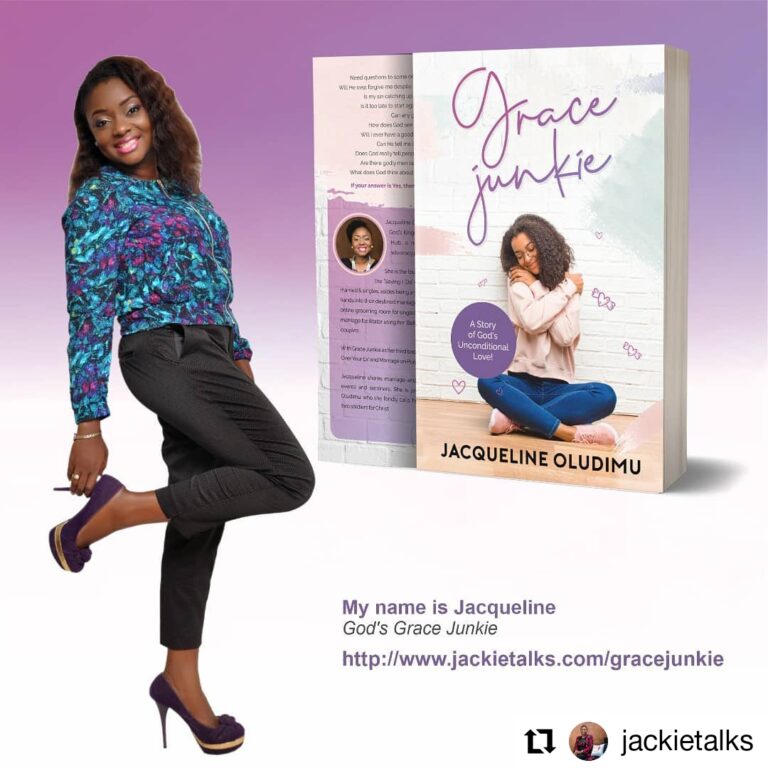
Grace Junkie is an autobiographical and inspirational book by author Jacqueline Oludimu, also known as The Marriage Evangelist. Jacqueline takes you on a vivid journey of her experience of the redemptive Grace of God. From her childhood, dating in the church, failed engagement(s), pre-marital sex, and abortions up till her marriage, one thing remained evident in her life- the depth of the Father’s love for her. Her life was preserved and she was ultimately led by Abba into living a life on purpose.
Jacqueline is a Christian Life Coach and SYMBIS (Save Your Marriage Before It Starts) certified pre-marriage facilitator, convener of “Saying I Do” conference and her autobiographical debut is packed with life hacks to help every woman fully embrace the love of God. To understand that regardless of how reckless your past has been, God is always happy to transform your pain into purpose.
Grace Junkie is set to officially launch on the 12th of September 2020. Currently, it has been read as far as the United States of America, the United Kingdom, Canada with a plethora of positive feedback from readers.
What people are saying about Grace Junkie
“I am a quarter way through and I’m quaking! It is a lot! I see the liberation anointing on this book. I do clearly! My heart is beating so fast and I am quickly renewing my commitment to parenting God’s way and with wisdom and keen observation etc. Just so so deep, unraveling dimensions. Too many lessons already – Debola Deji-Kurunmi
“This book is for anyone who struggles to believe that God can still love them, despite their past. Jackie rips the veil between the preacher and the one who is preached to; she shares her own journey openly and honestly, in a way that shows off the Grace of God. As you read it, put yourself in her shoes, remember all the times God has shown up for you and, most importantly, know that nothing can separate you from His love.”– Omotayo Adeola
“Whilst reading, I smiled at a couple of junctions, pausing to pray at others. It’s amazing how God takes us through fire and we come out with burns turning into scars yet we shine. Even those scars fade away over time and the marks are there just as reminders and nudges to help pull the next person(s) through. This book is surely going to take the reader on a roller coaster of emotions – more importantly not just informing but equipping. Well done Jacqueline!.”- Aderonke Abiona
“ You have a truly compelling story. Very humbling reading as you share on abuse as a child, father’s absence, mother’s resolve at a career, sex education and it’s lack, therefore, disappointment, premarital sex, abortion, broken engagement ‘S’, dating in the Church. The book is a good read, an easy read as well. An open one, as your husband gave his blessings to allow you to share experiences with your past relationships. I enjoyed the flow of the story, made it so cool to read. This sentence caught my attention, ‘The protection of one child is the protection of many.” – Adenike Oyetunde
Print copies of the Grace Junkie are available in the following locations;
Nigeria:
Roving Heights: 28 Ogunlana Dr, Surulere 100001, Lagos, Nigeria
Amazon worldwide: www.amazon.com
E-books are available on Kindle
You can also purchase on www.jackietalks.com/gracejunkie/
*For inquiries, please reach out to Jacqueline via*
Follow *her* on;
Instagram:@jackietalks
Twitter: @jackietalks
Facebook:  Jacqueline Oludimu

In my years of law practice, I’ve discovered that a lot of entrepreneurs make the mistake of putting off all legal issues until they are threatened with a lawsuit. They tend to engage professionals only after a problem has arisen. There is a saying that ‘prevention is better than cure.’ This is quite true. It costs you less to prevent a legal issue from arising than solving it when the issue has arisen

Legal practitioner and author, Ifeoma Ben is the founder of Legal Business Network (LBN), a platform that assists enterpreneurs to build legally protected businesses. She’s also the founder of Justice Vault Foundation (JVF), a non-profit organisation that offers free legal services to the less privileged.

Prior to obtaining a Law Degree from the Imo State University, Owerri, and a Masters Degree in Law from the University of Lagos, Akoka, she had obtained a Bachelor of Arts Degree in Religious Studies from the University of Calabar. An associate of the Chartered Institute of Arbitrators, United Kingdom (CIArb), a graduate of the Institute of Chartered Secretaries and Administrators of Nigeria (ICSAN), Nigerian Institute of Management (Chartered) (NIM) and member of the National Association of Catholic Lawyers (NACL), she has served as the Assistant Secretary of the Human Rights Committee of the Nigerian Bar Association

(NBA) Lagos Branch and is currently the Assistant Secretary of the NBA, Lagos Branch.

In this interview with NGOZI EGENUKA, Ifeoma, who is a partner with Eminence Solicitors, shares her passion for helping entrepreneurs gain clarity about the legal aspects of their businesses among other issues.

What really endeared you to legal profession?
MY Father read Law (though not practicing law). While growing up, I always enjoyed his conversations and argument with lawyers; I loved the way they presented and analysed issues and I loved the boldness in the way they spoke. They always talked about Law being a noble profession and I said to myself that I would be a Lawyer.

Even after obtaining a Bachelor of Arts Degree in Religious Studies, I was still determined to read Law, which has been my dream course and I’m glad I achieved the dream. I love the Legal Profession; I love solving legal problems and helping people meet their legal needs.

What’s the key focus of the Legal Business Network (LBN)?
The Legal Business Network (LBN) is an entity set up to address the legal problems entrepreneurs face in their businesses. It aims at enlightening and educating entrepreneurs on the legal aspect of business, helping them build legally protected businesses. LBN also organises conferences and trainings for lawyers on topical issues, equip them with business skills and educate them on how to leverage technology to build a 21st century law business.

Recently, the Legal Business Network organised a conference, which focused on leveraging technology to build a profitable law practice. Issues on law firm management, data protection and privacy by law firms, design thinking in law practice, how technology can be used to improve work process and service delivery in law firms, how specialisation and technology can enhance visibility in law practice, building a career in emerging technology-driven practice were addressed.

We also focus on seminars for startups and entrepreneurs, addressing various subjects on law and business, such as legal issues in online business in Nigeria; how to build a legally protected business; taxation; legal issues in real estate transactions; franchising as a pathway to entrepreneurial success in Nigeria. One of the seminars centered on media and entertainment business and discussed issues bordering on creation, protection and merchandising of entertainment brands and products. Legal issues in digital entertainment and social media; contractual relationship between players in the entertainment industry; the role of lawyers in entertainment contracts were also covered.

How important is the knowledge of law in running a business, especially for entreprenurs?
A lot of entrepreneurs fail in their businesses because they failed to get it right from the start. A lot of businesses fail because they do not pay attention to the legal aspects of their businesses. In my years of law practice, I’ve discovered that a lot of entrepreneurs make the mistake of putting off all legal issues until they are threatened with a lawsuit. They tend to engage professionals only after a problem has arisen. There is a saying that ‘prevention is better than cure.’ This is quite true. It costs you less to prevent a legal issue from arising than solving it when the issue has arisen.

Are there ways lawyers can help entrepreneurs build legally protected businesses?
The first is in creating a better business setup. A lot of start-ups are confused as to the appropriate corporate structure to use for their business. The decision on how to form your business will influence several aspects of the business, which includes how profits and losses are shared, how the business pays taxes and who runs the business. You need to have a legal expert by your side when you are starting a business so as to ensure that you are taking the right step in your business. Based on your needs, a lawyer can help steer you in the right direction in selecting the legal structure for your business.

Lawyers can help entrepreneurs make better business decisions; business owners usually do not have the time to study provisions of the law relating to their business, so they make legal mistakes. Having business lawyers on retainer helps you make informed business decisions in accordance with the law.

In business transactions, entrepreneurs often enter into negotiations and sometimes do not have clear-cut agreements. In some cases, we find out that there was no valid contract only when the matter goes to court. It is essential to have a Legal Advisor who ensures that these contracts are properly reviewed before you sign them. Other aspects lawyers can help are in transactions with other businesses, dispute resolution, intellectual property protection and others.

What legal advice would you give to a business owner and how accessible and affordable are legal services?
Every business needs a legal advisor; businesses should build relationship with a good lawyer early enough in the life cycle of the investment. Your legal advisor will get to know the intricacies of your business and give legal advice when necessary. In fact, every business should have a budget for legal services. Be wise, seek legal counsel and protect your business from liabilities.

Your expertise as a lawyer has seen you engaged in pro bono services under your NGO. What informed that decision?
Justice Vault Foundation was born out of the burning desire to provide legal services to the less privileged in society. I have been a very active member of the Nigerian Bar Association, Lagos State Branch, and had the opportunity to work as the Assistant Secretary of the Human Rights Committee of the Nigerian Bar Association (NBA), Lagos branch (2017-2019). We worked diligently in achieving the objectives of the Committee in decongesting the prisons.

When I was serving as a member of the Human Rights Committee, we often visited the various prisons in Lagos State and took briefs of some of the inmates. Whenever we visited the prisons, we interviewed the inmates and we discovered that some of them had no reason to be there; some of them were arrested when the police raided their area. A lot of them were awaiting trial and some have not even been taken to court. When we followed up on some of the cases and entered appearance for them in court, a lot of charges were struck out, as there were no evidences to prove the cases.

My experience sparked the fire in me to set up an organisation that will fight for the protection of human rights, especially for those who do not have anyone to speak for them.

Not many lawyers today will engage in pro bono services, especially with the cost implications. How have you been able to fund your charity?
In Justice Vault Foundation, we are working on collaborating with international organisations and other organisations with similar objectives. With my experience in pro bono services under the Human Rights Committee and also under the National Association of Catholic Lawyers, it is always a difficult task. We spend a lot of time and money in defending such cases, but the joy of rendering service to God and humanity will keep driving us.

What do you enjoy most about law practice?
I focus more on corporate and commercial law practice. I love meeting creative business owners and I help them figure out the big legal picture for their businesses and answer their legal questions. I consult for a lot of business owners and help them build businesses that are legally compliant and avoid liabilities; I love helping people solve their problems. I help entrepreneurs gain clarity about the perfect business organisation for their businesses, structure their businesses, enlighten them about legal aspects of business so that they can avoid losing their businesses and investments for going against the provisions of the law. It gives me joy to take people from the state of confusion to being happy and productive.

What keeps you going in your practice? Do you think there are laws that need to be adjusted, rectified, to serve common purpose?
The joy of solving clients’ problems is a great motivation in my practice; I feel fulfilled when my clients are happy and satisfied. Some of our laws need to be reviewed in order to serve the real purpose for which they were enacted. With particular reference to corporate law, the principal legislation is the Companies and Allied Matters Act 1990, which is about 30 years old. The Senate recently passed a Bill for an Act to repeal the Companies and Allied Matters Act 1990 and enacted the Companies and Allied Matters Act 2020. The Bill when signed into law by the President will facilitate the ease of doing business and boost investment in Nigeria.

What challenges have you faced in this profession?
As a Lawyer who works for a lot of startups and entrepreneurs, I often come across startups, who complain about not having sufficient funds to pay for legal services; a lot of them consider legal services as expensive. Some of them do not even have a budget for legal services and they tend to run to a lawyer only when there’s a problem on ground, instead of taking preventive measures. It then becomes difficult to strike a balance between helping startups build legally protected businesses and remaining profitable in law practice.

Regarding gender based violence, what’s your advice to women on seeking justice?
Everybody, including women, have the right to fight for their rights. When women’s rights are infringed upon, they have the right to seek justice. Most of the gender-based violence such as rape, wife battery, domestic violence are criminal offences prohibited by law and offenders are liable to be prosecuted in accordance with the law.

Women should always stand up for their rights. Women have the right to live free from violence, to own property and the rest. These rights are enshrined under the constitution and international documents such as the Universal Declaration of Human Rights. So, to me, promoting women’s right means fighting for justice.