Category

womenofrubies

Category

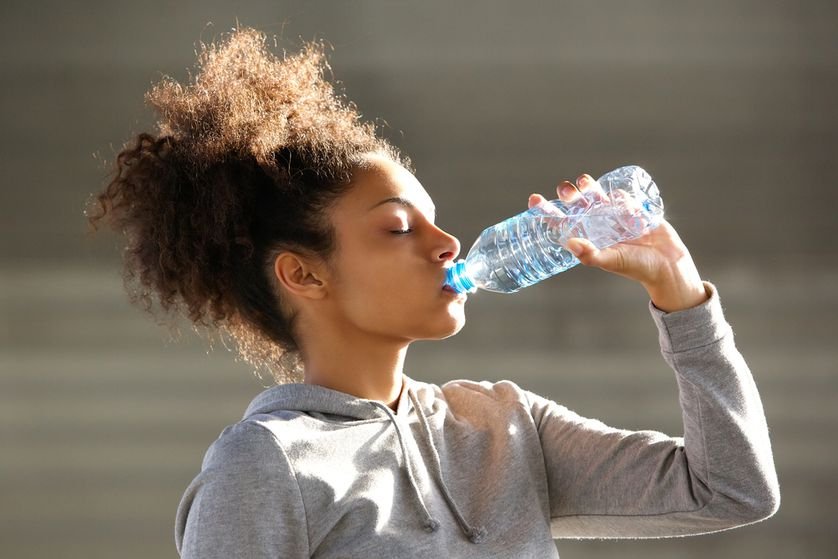
Water is a fundamental human need. Each person on Earth requires at least 20 to 50 litres of clean, safe water a day for drinking, cooking and simply keeping clean. Like the popular Naija saying by our own famous Fela “water e no get enemy”.
Our focus here will be on the life-changing reasons to drink more water. Do you know that any point in time you feel thirsty or experience the sensation of thirst, you are already dehydrated? That thirst is your body calling for re-hydration.

So why must we drink more water?
1. IF YOU DON’T DRINK WATER, YOU WILL DIE. It is that important. It depends on our environment, we can survive only a few days without water, probably a week. We can live much longer without food. It is mandatory that we prioritise the consumption of water far more than we currently do.

2. HELPS LOSE WEIGHT: Most times when we think we are hungry, we are actually thirsty. Our body just starts turning on all the alarms and gives us signals when we ignore it. For those of you trying to drop some pounds, staying hydrated can serve as an appetite suppressant and help with weight loss.

3. BE LESS IRRITABLE: Research says dehydration can affect your mood and make you grumpy and confused. To stay happier and think clearer, drink more water.

4. PREVENTS CANCER: Yes, that’s totally right – various research says staying hydrated can reduce the risk of colon cancer by 45%, bladder cancer by 50%, and possibly reduce breast cancer risk as well.

5. FOR BETTER PERFORMANCE: Proper intake of water increases the performance of an athlete. Water composes 75% of our muscle tissue. Dehydration can lead to weakness, fatigue, and dizziness. These conditions can reduce our efficiencies and output.

6. HAVE LESS JOINT PAIN: Drinking water can reduce pain in your joints by keeping the cartilage soft and hydrated. This is how glucosamine helps reduce joint pain, by aiding in cartilage’s absorption of water.

7. FLUSHES OUT WASTE AND BACTERIA: Our digestive system needs water to function properly. Waste is flushed out in the form of urine and sweat. If we don’t drink water, we don’t flush out waste and it collects in our body causing a countless number of problems. Also combined with fiber, water can cure constipation.

8. ‎ HELP PREVENT HEADACHE: Sometimes headaches can be caused by dehydration, so drinking water can prevent or alleviate that nasty head pain. Next time your head hurts, try drinking water.

9. MAKES YOUR SKIN GLOW: The skin is the largest organ in the body. Regular and plentiful intake of water‎ can improve the colour and texture of your skin by keeping it building new cells properly. Drinking water also helps the skin do it’s job of regulating the body’s temperature through sweating.

10. NOURISHES THE BODY: Water is essential for the proper circulation of nutrients in the body. Water serves as the body’s transportation system and when we are dehydrated it makes it difficult for things to go around the body

Pic credit ; Bing

Fashion Designer and singer, Mo Cheddah has opened up on her struggle with clinical depression and how after dealing with it for years, she decided to get help.

According to her, mental disorders, including depression, are still not regarded as serious health problems in the country.

“Depression is a medical illness contributed to by an interplay of both biological factors, that is, genetic predisposition, hormones and neurotransmitters and environmental factors such as adverse life events.

“Due to lack of awareness, many people do not know that they or someone they know have depression and try to cope with it sometimes for years without the necessary help.

“Although, knowledge of existence of mental health problems is improving with education, information dissemination through the media and NGOs, the level of this awareness is still quite low. In general, psychological illnesses are not regarded as `serious’ problems.

“There is also a lot of stigma and discrimination attached to people who have psychological disorders. People usually seek help when symptoms become severe, incapacitating or embarrassing,” she said.

The consultant psychiatrist also urged the governments and relevant stakeholders to put more attention and resources, including trained staff, into developing and equipping the Primary Health Care (PHC) system.

She said that most of the detection and initial management of depressive disorders need to be at the primary healthcare centres in the rural and semi-urban communities.

See her posts below

The Federal Government of Nigeria has increased maternity leave for women from three to four months and this was disclosed by Minister of Labour and Employment,Senator Chris Ngige at the ongoing International Labour Conference (ILC), in Geneva, Switzerland, on Tuesday, 5th of June.

Senator Ngige also told delegates that employers of labour in the public and private sectors in the country have been barred from sacking women from work either due to their marital or maternity status, Vanguard reports.


Employers of labour (in Nigeria) are, by regulation, requested to provide workplace crèches for nursing mothers for ease at work place.

In the public service, government recently increased the period for maternity leave from 12 to 16 weeks; to allow enough recuperation for both baby and mother, especially in the area of breast feeding.

In addition, all disciplinary proceedings against any female staff, which might have been taken during the period of her maternity leave shall be put in abeyance till the expiration of the leave.

Employers of labour are also barred from removal of women from work due to their marital or maternity status, illegal labour migration, contract staffing and labour casualisation which affects most women, are being reformed through policies and regulations at national, bilateral and multilateral levels.”

The ratification, domestication and implementation of the Maternity Protection Convention No. 186 are conscious efforts to ensure that more women enjoy maternity protection in the country.”

However, the minister informed that a lot needed to “be done in terms of putting in place appropriate legislation, policies and practices to deal with the gender gaps that inhibit the greater participation of women in the labour force.”

He added that the most effective method of eliminating gender inequality from the workplace lies in vigorous opposition to employers’ discriminatory conducts, policies and harassment in all forms wherever and whenever they occur.

“Women who fall victim to these abuses are encouraged to oppose such through legal actions and reporting to Labour Inspectors. The infusion into Labour Inspection Guides Laws and Code of Practice, with severe sanctions and serious punitive measures are prescribed as future deterrents.

In this respect, we will need the Technical Assistance of the ILO in the area of gender audits, considering the good news that the ILO has in her pool, over 80 certified Audit facilitators. We can adopt the Train the Trainers (TOT) approach in this regard.”


To address gender inequality and youth unemployment in Nigeria, Mr Ngige told delegates that the federal government drew up and has been implementing an Economic Recovery and Growth Plan (ERGP).


Source: fabwoman.ng

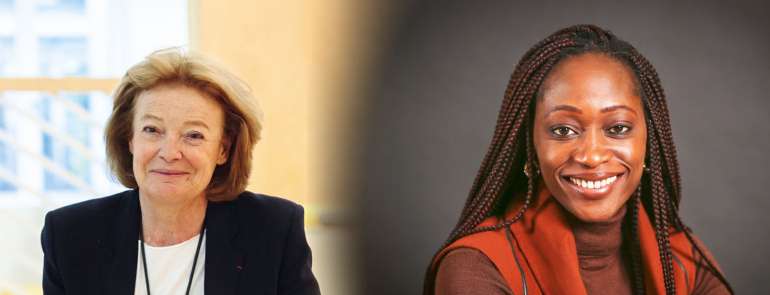
Hafsat Abiola, Nigerian activist for human rights, civil rights and democracy was appointed June 5, 2018 as the Executive President of Women in Africa (WIA) Initiative. This is a key step for the global platform dedicated to the economic development and support of leading and high potential African women. The founder, Aude de Thuin, and Hafsat Abiola share their thoughts on this significant step for the Initiative.

Aude, why has Hafsat been appointed at this time?
This is the stage of maturity. Since the beginning of WIA Initiative, I have always said that I would give my place to an African woman, because it is in the logic of WIA to have an African President. It is with women that Africa will develop in trust and in complementarity with men.

Hafsat Abiola, why did you accept?
I believe in the vision of Women in Africa Initiative . Women are the greatest untapped resource the continent has. So I want to help lead the organization that is working to harness their potential. It could very well be the game-changer that unleashes the long-anticipated rise of the continent.

Aude, why did you choose Hafsat?
First, because of her personality. She was one of our first WIA Ambassadors, and joined WIA Council a year ago. Secondly, because of her career as an activist for human rights, civil rights and democracy, and values so close to ours made her the ideal candidate. Finally, for her analysis and her vision of the role of women in the economy. All this combined made it obvious that she is the right person at the right place.

Hafsat, what are you main goals as president for 2018 and the two coming years?
My goals for 2018 are understandably modest. It is primarily to learn. To learn how the organisation currently operates, to meet our partners and listen to their vision and interests, to engage with our members across the continent and learn what they see as the biggest opportunities and the toughest challenges. In the coming year, my focus will be on building out the structure for the future and beginning to tie that structure to performance. I’ll be focusing on ensuring that we have ambassadors in all the countries of Africa, that we have active councils in at least a third of these, and that we expand the network of partners that we engage on behalf of our members.

Hafsat, how will your background contribute to the development of WIA Initiative?
In some ways, it seems that everything I have done in my life was preparing me for this role. A little over two decades ago, I got involved in advocating for democracy in Nigeria at a time of military rule. I was in my early twenties and due to the particular circumstances, I was one of the spokespeople for the movement. It entailed traveling around the world, working with a diverse community of organizations and associations to push for the global community to support the Nigerian people’s demand for democracy. Since then, I founded an organization that is dedicated to the empowerment of women and young people in Nigeria and then served for seven years as a member of cabinet in Nigeria’s industrial state, Ogun State, where I was responsible for the Millennium Development Goals and later the Trade & Investment portfolios. As a result of these experiences, I have built quite a broad network of relationships with global and local leaders, organizations, foundations, and governments from Washington DC to Ouagadougou that will be useful to WIA Initiative now as it seeks to expand its footprint and impact.

Aude, what are the challenges of this new presidency?
Hafsat becomes Executive President and CEO of Women in Africa. The main office will be based in Lagos, Nigeria from next October. Paris will keep a representative office, just like Casablanca. Hafsat will be in charge of the “vision” for Women in Africa and, as such, in charge of the programs and all the contents of the summits, whether global or regional, and the digital platform. She will be the spokesperson and interface with the pan-African and global partners who accompany us. She will chair the Council and expand the network of our ambassadors. She will be accompanied by the team in place, composed of seasoned professionals, and she will complete this team as WIA grows. In the short term, in addition to being the spokesperson for WIA Marrakech 2018, Hafsat will contribute to the program whose generic theme is “Watch Africa with confidence and Believe in its talents”. Hafsat will also put together the second regional summit to be held in Lagos at the end of the year with the WIA team.

Hafsat, what do you think the current assets of WIA Initiative are?
The organization has a great network of women across Africa and around the world as well as strong relationships with companies and organizations, especially in Europe. Internally, we have a dynamic team that is committed to delivering results for Women in Africa, which means that there is no limit to what we can achieve, so long as we remain focused on our goal, which is to ensure the rise of the women of Africa.

Aude, what role will you play now in WIA Initiative?
I am 67 and I will keep a promise made to my family to slow down my intense life of work: I will bring my vision, to help Hafsat and her team apprehend the specific job which was mine during years ; I will also nurture the relationship with major French and international partners that I have known for a long time. And suggest names of speakers because through my intense daily readings, I spot incredible talents that I will submit to the group “program” who will then decide, under the authority of Hafsat. I want to continue writing too, because I still have a lot to say about what I see in this ever-changing world, who is so unwilling to really welcome women as true economic partners, capable of having a vital role in the evolution of our societies.

Hafsat, how do you consider the sharing of experience with Aude?
I have profound respect for Aude. Well before she founded Women in Africa Initiative, I followed her work at the Women’s Forum for many years. I was always impressed and inspired by her achievements and have long wished to work with her, which was why I didn’t hesitate to accept the invitation to become an ambassador for Nigeria for Women in Africa and later to join the board and now to serve as the President/CEO of this laudable organization. I expect ours to be a strong partnership built on a shared belief in the promise of women in Africa, complementary strengths and the deepest commitment to realizing this promise.

Aude, what is your assessment of WIA Initiative nearly two years after its global launch?
I am proud of what we have achieved, because we organized a recognized world summit in Marrakech in September 2017, and a first regional summit in Dakar last April, which will be followed by a second in Lagos at the end of the year. We have also developed a leading African database and strengthened the network we had. But there is still so much to do. We are developing a digital platform connecting leaders, entrepreneurs and investors. We want to connect our members with young talents through a mentoring program. We are finalizing our website and have included a pure-player media to showcase the women we spot. And thanks to our partner Roland Berger and the sponsorship of Société Générale bank, our Foundation, WIA Philanthropy launched our second call for applications to receive in Marrakech next September 54 women entrepreneurs, one by continent and/or one from the diaspora. We will present them to investors, connect them with our community and the media so that the world will see how African women are creating new business models, all significant for the future of the continent. Whether in the fields of health, nutrition, education, energy, water, technology, finance, women are major players in this economy that Africa is in dire need of, and we want to make it known loud and clear.

Hafsat, what are the crucial needs according to you for African women in terms of career development, entrepreneurship, empowerment?
In Africa, women need know-how, finance, enabling policies and other forms of support. They need more than lip service. They need services and projects that are relevant and carefully designed to address the real challenges they face.

Aude, after these two years of experience, what advice as a woman leader do you want to give African women?
Whether in Africa, France or anywhere in the world, my advice to women is to have more self-confidence. They must know that the world would be different without them, and that they are the future of their countries. As far as Africa is concerned, the whole world knows that it is through women that things will move. The world is waiting for them and needs them.

Source:  Women in Africa
US born college basketball player of Nigerian descent, Arike Ogunbowale, made headlines when she helped her team, the Notre Dame Fighting Irish win the NCAA championship.The win gave her team their first women basketball title since 2001.

In a semi-final match against Uconn, Arike had beaten the team with a 2-pointer with just 1 second left.

Arike got her team the championship when she scored a 3-pointer with just 0.1 second to go, a feat widely described as a ‘shot of a lifetime,’ in her game against the Mississippi State Lady Bulldogs.

Her shot will reportedly go down as the greatest last-second shot in championship game history as she was named the tournament’s most outstanding player.

Born in the United states to Gregory and Yolanda Ogunbowale, her father reportedly used to be a footballer in Nigeria and once served in the Nigerian Army before he relocated to the United States. Her mother, Yolanda, was her grade-school basketball coach.
Born to parents that are sports oriented, it is no surprise that Arike excelled in her career even while growing up.
She won four Wisconsin State Cup championships during her club soccer days with Lake Country United (2010-12) and FC Milwaukee (2009)

Actress and fitness enthusiast Damilola Adegbite has unveiled her official website and she’s got some lovely new photos too.
The mum of one is describing herself as an Actor, Mother, Entrepreneur, Humanitarian and Fitness Instructor.


She says:
”I am a proud mother, entrepreneur, actor and Exercise-to-music instructor. My love for the arts is innate. From an early age, I loved playing dress up and pretending I was a different person each time. Acting gives me the liberty to “live different lives” and I find that very exciting. My passion for health and fitness started during one of my most trying times. I began to look for better ways to take care of my body, and for healthy solutions to the distressing physical and mental symptoms I was experiencing. I am now on a continuous journey to strengthen my BODY and MIND while promoting FITNESS and WELLNESS particularly in women.
See the new photos below.

Saudat Salami, Founder & CEO of Easyshop Easycook is recognized as one of the pioneers of the online grocery business in Nigeria.

Her company, Easyshop Easycook delivers fresh groceries to your door. Saudat is a passionate and innovative entrepreneur who has worked hard to keep her business going over the past 10 years. To date, she has employed over 25 people.

“My company’s goal is to be at the forefront in the development of the agriculture value chain and food safety standards in Nigeria,” says Salami.

“At Easyshop Easycook, we believe that food waste could be reduced and food prices can be far cheaper than it is now if we have pack houses, cold chain storage and delivery infrastructure spread across the country.
She continues: Innovation should not be limited to web-enabled applications; we should encourage innovations in other areas as well.
Secondly, wealthy people from our continent need to do more to support young people. We should not keep waiting on international aid, Silicon Valley or Bill Gates.
Let Africans save Africa.

Whether in health, technology, agriculture, and business – we have enough rich men and women that can fund innovation hubs, accelerators and pitch competitions to help solve the problems of Africa. What are we waiting for?”
EchoVC Partners Olaide Olusoji-Oke, who recently joined the company’s board of directors, said: “We are excited to back Saudat and her team.

We have been tracking her progress over the last few years and have been consistently impressed by her ability to build trust across the entire supply chain.

Her understanding of the business is unrivalled (she has done this for over a decade) and her unique insights into behaviours in the offline market exhibited by farmers, traders and consumers are invaluable. We believe she represents the type of elite entrepreneur we love to support.”


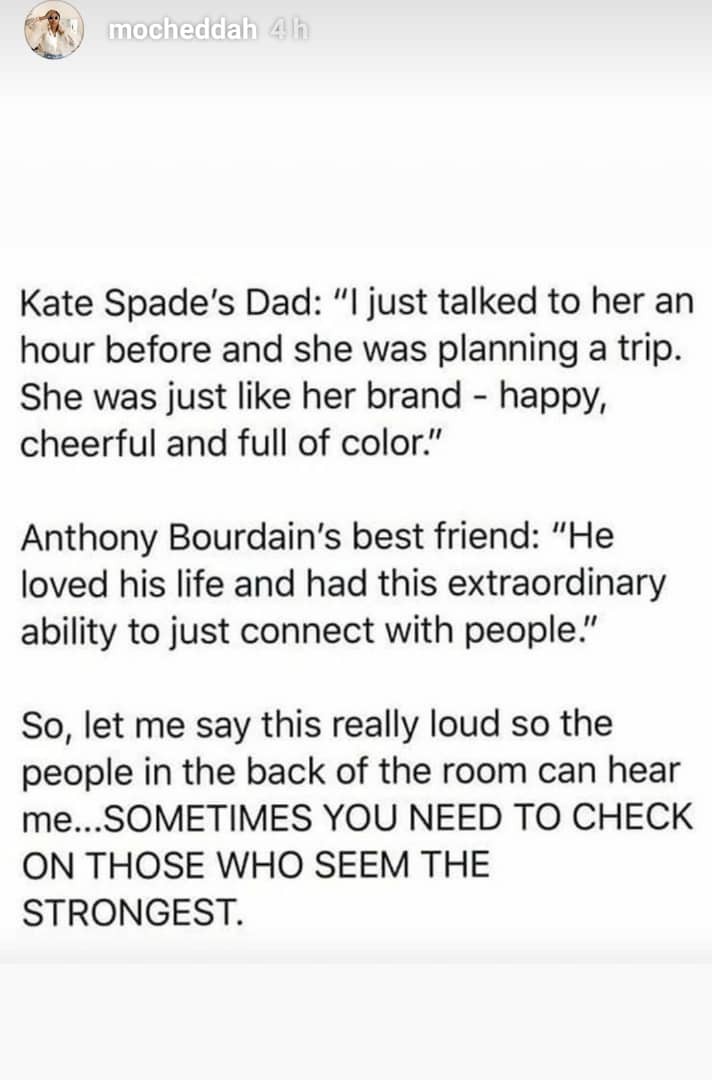
Iconic fashion designer Kate Spade was found dead in what is said to be an apparent suicide Tuesday morning in her New York apartment.
According to CNN, the 55 year-old businesswoman whose body was found by her housekeeper, allegedly hung herself in her apartment leaving behind a suicide note.
The designer who was a senior fashion editor at the fashion magazine Mademoiselle, started Kate Spade New York in 1993, opening her first shop in the city three years later and has since then gone to be a household name.
Kate Spade New York issued an official statement on their Twitter confirming the death of their founder.f

According to a report by The Wall Street Journal, Instagram might just start letting users post videos that are up to an hour long.The move, described as tentative – which means they could back down on the move – would have users post videos longer than 30 seconds, like on YouTube or Facebook.

The feature, the report said, “will focus on vertical video” like is the type seen on stories.
It’s unclear if the feature will be allowed only in the stories section, or if the vertical video will be brought to the feed.

Oluwatoyin Sanni is the Group CEO of United Capital Plc, a leading African Investment-Banking Group, which provides capital and financing solutions to African governments, companies, and individuals.She was the African Business Woman of the Year at the All African Business Leaders Award (AABLA 2017) and also the first female that won the PEARL Award for the most outstanding CEO the same year. In this interview with KEHINDE OLATUNJI, she speaks on her life as a mother, author, wife, pastor and stockbroker among other things.

You are a notable CEO, author, stockbroker, and chartered secretary among many other things, what drives you?
My driving force is the convictions I have that every human being came to this world for a purpose. I have a very strong sense of purpose and I especially believe that women, aside the fact that we are frequently wives, mothers, sisters which makes the society to rely on us, does not mean we do not have our own individual mission. I believe every woman should take the time to connect with our Maker and confirm what is her purpose in life and set to fulfilling it.

It is often said that irrespective one’s background one could still achieve a lot, how has your background contributed to your success?
I was born into a family of seven, my late father was an accountant and my mother was a businesswoman, I studied Law at the University of Ife and graduated at the age of 18. I worked at the Ministry of Justice as a prosecutor after which I joined the financial industry and I have been in this industry for a couple of decades. I have been in investment banking for about 18 years. I qualified with the Institute of Chartered Secretaries and Administrators and also qualified with the Chartered Institute of Stock Brokers, which I am a Fellow. However, I would like to attribute my success to a combination of sources: My Heavenly Father who is the source of all wisdom, my late mother who was a serial entrepreneur and irrepressible survivor, my late father who was a role model when it comes to financial discipline, ethics and governance. The wealth of experience gained from my rich and extensive working career cannot also be left out.

It is said that women are not given enough space in politics, governance, business and other key areas in leadership, do you agree with this?
I totally agree with you that women do not seem to have the same opportunities that men may have had and that is across major areas in leadership and politics. It is also clear in financial inclusion and this narrative has to change. It is especially hard for a woman to achieve much without ambition due to the limiting beliefs and societal bias, which would hardly allow anything to be handed over to her which she had not first actively pursued or striven for.One of the initiatives I am part of which is Women in Finance is an initiative that engages policy advocacy to ensure that the government put in place policies that would be favourable towards the economic advancement of women. This initiative was established in 2016 with a view to becoming a strong voice for the financial empowerment of women, it is a networking platform for women. Part of its mission is to advance the cause of women, pursue financial inclusion, advance financial literacy, engage policy makers on initiatives that will grow the economy and be favourable to women and promote gender parity in the country.

Having highlighted the mission of Women in Finance can you tell us what steps the organisation is taking to achieve this task?
We develop skills in women and we do this through workshops and seminars for the development of financial skills. Though it is not every woman that will work in the financial industry or be in a finance role, however, I am convinced that every woman should be financially literate. Financial literacy is a passion I have and worked on, both on the platform of Women in Finance, and also in the financial literacy committee which runs across our financial industry where I am the Chair. We also extend the hand of fellowship to the male counterpart; it focuses on creating financial literacy in every Nigerian. I must admit that there is a low level of financial literacy among our women.
It is believed that every woman should understand basic principles of keeping track of their monies, delayed gratification, saving a proportion of their earnings or income, discipline of budget that enables them to know how far they should go in terms of spending so that they can have something put aside for the future. Women should be in control of their financial destiny. It is surprising that some women cannot balance their checkbooks; you will be surprised how many women don’t even know how the bills in the house get paid, I am not suggesting that they should insist on paying the bills where the man can or insist on paying a particular portion of the bill, but it is good for us to have a good understanding of how much is consumed in electricity, water and other things and have an idea on how this bills are settled.

How do you balance work with home and every other thing you are involved in without getting dilapidated?
I guess one of the things that help me is planning; with disciplined planning any woman can multi-task and I believe that every woman should multi-task. Also, I support myself with capable assistance many of which are women and I think that they are good people to work with. Surrounding ourselves with capable people to support us both at work and at home is very important and that has helped me a lot.
I have never involved myself in anything I don’t believe is part of my mission in life. This gives me the drive, commitment and willingness to sacrifice and enables me to keep doing what I do without regrets. I love and enjoy every part of my life. My work is not a chore or job to me, it is a big part of my mission, my life’s work. It all fits together nicely. Also, being a pastor enables me to fulfill my goal of helping others maximise their lives and being a wife and mother is not only a joy, it also helps to demonstrate to younger women that they, too, can combine all these roles and maximise their lives.
Writing books, articles and posts closes the gap by providing a platform for remote mentoring. Beyond the above, I enjoy tremendous support, encouragement and understanding from my husband and children who are all equally purpose-minded. Finally, I have amazing assistants at home, work and in church to whom I delegate everything not requiring my personal attention and who are also growing and learning from me so that they, too, can lead people in the future. It’s an entire ecosystem.

How do you relax and what time do you devote to writing?
When I am working on a book project I set aside time everyday to work on the project. My writing desk is very close to my bed, when I am working on a project I will not go to bed until I have put in a number of hours that I have committed to work on it. I read a lot. I love to watch movies and, as I raise my children, we get used to going to the cinema together, sometimes we stay at home to watch the movies together. I enjoy music a lot, I listen to music, I sing and I jog and walk for exercise.

In 2017, you got the award for the most outstanding CEO, what are the criteria for winning this award?
The award is a recognised Capital Market Award that reviews and gives award to private companies across the country. It was the first time in the 22 years history of the award that a female CEO would emerge as the CEO of the Year. The Pearl Award committee have a highly respected board which comprises of former SEC DGs. They have a very credible award committee which reviews the performance of Nigerian CEOs year after year, they look at the financial performance of the company, the brand perception of the company, the returns of the company, they rank the CEO across all these different areas, they also rank within the sector which you operate and based on these different rankings a winner emerges.
In that particular year, United Capital which I run won five awards, we won the best Corporate Governance Awards, Sectorial Awards for Financial Services, the Highest Dividend Yields award, the CEO of The Year award and the Most Outstanding Company of the Year award. I believe that rating my performance and the performance of the company across all those indices earned us the awards.

Advise to women aspiring to achieve great things
The first thing to every young woman is to believe in yourself, don’t let anybody put you down or underestimate what you are capable of. I tell women that there is no female brain and there is no female spirit, so the person on the inside of you is as brilliant, capable and powerful than anybody could imagine. Against the background of your confidence in yourself and what has been put in you, work as hard as you possible can, demonstrate to everybody that you are not asking for special favours.
I like one of the things that Meghan Markle said recently. She said: “Women deserve a seat at the table and, if that is taking time coming, create your own table.” So I tell any young person to do the best to get a seat at the table and peradventure the seat is slow in coming consider inventing your own table. Change the game if you need to in order to win. People usually say that all that is needed to do is to play hard at the game, but if you play hard and you are not winning, perhaps you are playing the wrong game and you should play the game in which you are equipped to win; there are always alternative games.

As you climb the ladder of success what is your advise to companies who think less of women?
Companies need to understand that there are hidden treasures in the other 50 per cent of the population that they often do not consider when they are recruiting. Women are skilled and increasingly better equipped in terms of education, professional qualifications. They are a flexible band and they possess lots of leadership and management skills. Companies should give women the opportunities to prove themselves, they won’t disappoint them on the contrary we will pleasantly surprise them.

What role do you think the government can play in this?
We have to start from the protection of the girl child. Government needs to ensure that our schools are safe for the girl child and the community is also safe for them. The should provide adequate security for them and make sure that our daughters are not kidnapped, abused or prevented from going to school because that is where it starts. They should make sure that employment practices are fair and not discriminating also, the judiciary needs to protect women who have been discriminated against and our laws must be fair and even- minded all the time.
In closing, I will like to encourage all of us to believe in Nigeria and recognise that there is plenty of room for our dreams to be fulfilled even in this nation and to understand that our economy can grow again and women have a big part to play in the development.

By Kehinde Olatunji

For Guardian