

Women of Rubies

Category

self development

Category

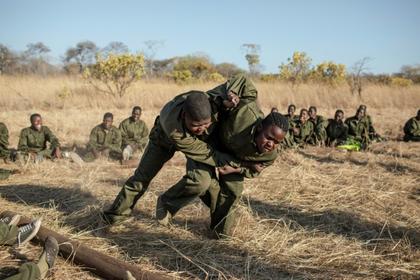
She didn’t consider quitting — she even smiled as her finger was bandaged, before returning to the brutal military-style training.

“I’m happy, that’s why I am not crying. I’m trying to be an Akashinga girl,” the 22-year-old said.

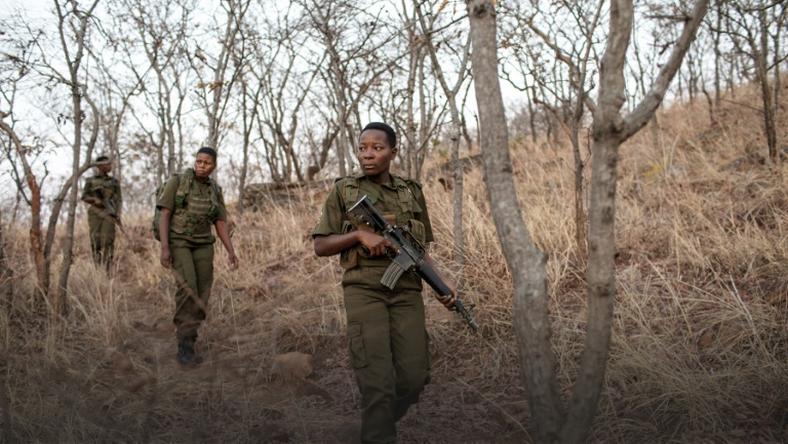
The rangers, armed and dressed in khaki combat gear, track and arrest poachers in five reserves, all former trophy hunting areas, encompassing 4,000 square kilometres (1,545 square miles) near the Zambian border in northern Zimbabwe.

If recruited, Mutero would become one of an elite few — out of 500 applicants, only 80 will make it into the ranks of the Akashinga, or “brave ones” in local dialect.

Being brave will certainly count in her job of helping to protect the wildlife against poachers who are often heavily armed.

But all the women are also “survivors”, selected for the ranger recruitment programme for having overcome adversity, often abuse, in their past.

Mutero married young and moved to South Africa with her husband and daughter, where she was physically abused by her mother-in-law.

She returned to rural Zimbabwe to raise her daughter alone and broke as her husband refused to send money.

“But now I am here to empower myself to take care of my child,” she said, proudly talking of the importance of the country’s wildlife and its conservation.

Mutero made it into the last 160 potential recruits, who faced a series of gruelling tests of their physical and mental strength in the Phundundu Wildlife Area.

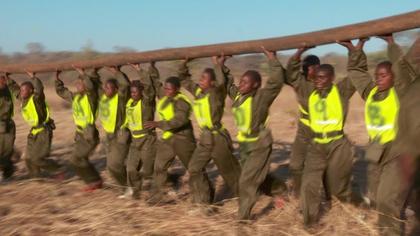
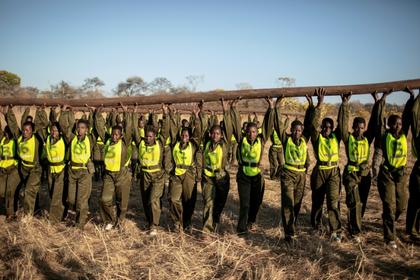
Over several days, the women raced under the beating sun, wrestled each other and a dozen even lifted a giant tree trunk over their heads.

Only the toughest make the cut.

‘The toughest’

Damien Mander, 39, a former military sniper in the Australian army who also worked in the private security sector in Iraq, started the programme in 2017 as part of the non-profit International Anti-Poaching Foundation that he founded.

“We were trying to create an opportunity for the most marginalised women in some of the toughest regions, in one of the poorest countries on the continent,” he said.

“They are all survivors of serious sexual assault, domestic violence, AIDS orphans, single mothers, abandoned wives.”

“We didn’t want great CVs, actually we wanted scrappers. People that knew what it was like to have to fight to survive, and that’s exactly what we got,” he told AFP.

“What we didn’t realise is we were getting the toughest.”

Hardships faced by the women in rural Zimbabwe also steel them for life on the frontline against poaching, says one of the trainers Paul Wilson, also a former soldier.

“These guys are used to walking a long way with a 20-litre bucket of water on their head, spending all day digging or hoeing in the field, carrying large amounts of firewood… these girls know how to work,” he said.

More than ‘biceps and bullets’

Mander said that his time in Iraq had helped him understand that “law enforcement isn’t about biceps and bullets”.

It is more about establishing relationships and longterm ties with communities, he said, adding the women also had the ability “to naturally de-escalate tension”.

All Akashinga rangers come from villages near the area they patrol, so they can work with the locals and have a vested interest.

“We have gone from having anti-poaching units fighting against the community, to having a community fight for what we believe in,” Mander said.

The women rangers plough up to 90 percent of their earnings into their families and local community, compared to 30 to 40 percent for men, he added.

“The biggest thing that we’ve seen is we haven’t had a single incidence of corruption with women,” he said.

‘Increasingly militarised’

It has been working.

Before the Akashinga started patrolling the area, around 8,000 elephants were killed there over 16 years.

Since they arrived two years ago, elephant poaching has dropped 80 percent, according to the International Anti-Poaching Foundation.

The women have made 115 arrests — without them firing a single shot.

But it is dangerous work.

“Conservation is becoming increasingly militarised,” Mander said.

“More and more poachers are coming in here with weapons and they are willing to kill elephants and the people that are protecting them.”

Mander said that he hopes to have “a small army of 1,000 women” protecting 20 reserves by 2025.

Lives transformed

Ranger Juliana Murumbi, a member of the first Akashinga class, said that she had held her own against men during specialised training to become an instructor earlier this year.

“I managed to challenge the men in physical training, in the long run, the push-ups, the sit-ups, the drags,” she said.

“So I think we are just the same because what they can do, I can do.”

Nyaradzo Auxilia, another ranger, said that the programme was “totally transforming the standard of life of all women” involved, including herself.

“My husband used to abuse me. I can just simply say he was an abusive man. He was very violent to me,” the 27-year-old said.

She fled with her child, and is now one of many Akashinga able to support themselves.

The rangers earn between $300 and $1,200 (270 euros and 1,100 euros) a month, depending on their role.

“They can now stand on their own. They can now not depend on someone else — they can move on without being abused or facing that cruelty from the men,” she said.

That’s a future that Mutero can now look forward to — despite the broken finger, she passed the test and next year will start the final six-month training programme to become an Akashinga ranger.


Credit: AFP, pulse.ng

No one expects to get a ton of sleep when they have a newborn at home, but most of us believe that we’ll get more sleep when the kids are older.

New research suggests that’s a myth that sets parents up for frustration because parents (particularly mothers) are still sleep deprived four to six years after bringing a baby home.

The study examined the sleep patterns of 4,659 German parents who had a child between 2008 and 2015 and found that parents’ sleep duration and satisfaction don’t recover to pre-pregnancy levels until the first child is in first grade.

Parents of older children often feel like they shouldn’t be as tired as they are since they no longer have a baby at home, but this study proves that sleep deprivation doesn’t end when your child starts sleeping in a big kid bed. It continues, and we can’t address the problem if we don’t acknowledge it.

“While having children is a major source of joy for most parents it is possible that increased demands and responsibilities associated with the role as a parent lead to shorter sleep and decreased sleep quality even up to 6 years after birth of the first child,” says Dr. Sakari Lemola, of the Department of Psychology at the University of Warwick.

And moms get less sleep than dads, a trend that starts right away and lasts until elementary school. Researchers found that in the first three months after a baby is born, mothers sleep on average one hour less than before pregnancy. In those first three months, dads lose out on about 15 minutes.

“Women tend to experience more sleep disruption than men after the birth of a child reflecting that mothers are still more often in the role of the primary caregiver than fathers,” says Dr. Lemola.

By the time the kids in the study were 4 to 6 years old the moms were still missing out on about 20 minutes of sleep, while dad’s sleep deficiency remained steady at 15 minutes below the pre-kids duration.

“We didn’t expect to find that, but we believe that there are certainly many changes in the responsibilities you have,” Dr. Lemola told The Guardian, explaining that kids may stop crying at night as they grow up, but they may wake up feeling sick or due to nightmares, and that stress related to parenting can also keep parents up at night.

First-time parents lose the most sleep compared to more experienced parents, the research notes, and in the first one and a half years of a child’s life, breastfeeding moms lost more sleep compared to bottle-feeding moms.

It may seem kind of bleak to think that you’ll still be losing sleep when your child is in kindergarten, but it’s important for parents to know this so we can set realistic expectations and give ourselves grace when we need it.

You can have a 4-year-old and be almost as tired as you were when they were 4 months old. It’s okay if you need to sneak in a nap today, or if you fall into bed tonight with your mascara on.

There’s nothing wrong with you, there’s nothing wrong with your kiddo. It’s just a part of parenting.

The good news is, parents don’t get more sleep deprived the more kids they have. Whether you have one under six or three under six, you’re still only going to lose 20 minutes.

If you are feeling really sleep deprived, don’t be afraid to ask your village for help. If your partner, co-parent, a grandparent or trusted babysitter can stand in for you overnight, let them help you and get the sleep you need.

One day your kids will sleep through the night, but it’s okay to ask for help until that day comes.

Source: Motherly

With perseverance and determination, a 54-year-old man has inspired many across the globe with his exceptional story after his daughter graduated from college through his 20 years of hard work as a garbage collector. Tatay Cristito Quimado sat for an interview on GMA News to discuss his daily routine as a garbage collector, detailing the challenges he encounters collecting other people’s thrash and often getting injuries from broken glasses. And he had to endure all these in order to put all four of his children through school.

Quimado reveals that his work is not easy but says he does it for his family because he believes education is the only thing that he can leave them. As a garbage collector, he barely makes anything substantial to provide for his family but he says he’ll continue to do his best to provide for them. His recent interview shows his daughter, Jenny, who recently graduated with a degree in Nutrition and Food Technology, who expressed how grateful she is to her dad and how proud she is of him. Jenny notes that she’s not ashamed to mention that her father is a garbage collector.

Quimado, a proud father revealed he is so happy that he was able to send his daughter Jenny Rose Quimado, to college. But Tatay Cristito still has to send the rest of his children to college as well.

“Parenting is a huge job that comes with so much responsibilities,” says Mrs. Oluwabusayo Adebowale, Director, Inspired Kids Network. You, out of love, desire to give the little humans in your life the best you can afford, you vow to propel them to heights you never attained and see that they become the best that they can be.

This can make parents place perfectionist demands on children. So many parents fall into the trap of comparing children’s developmental milestones. Nothing crashes a child’s self-esteem as fast as direct or indirect comparison with another. The truth is, when you start comparing your child to others, you’ll lose sight of the unique attributes of your child. Children are unique and special in their own way.

“Frankly speaking, the educational system of our country Nigeria has also contributed to this problem, as the emphasis on paper qualification or certification over actual abilities is a major sponsor. Even schools have bought into this philosophy as even toddlers write exams and are graded by position. For this reason, so many parents are desperate to see their children measure up on paper.”

Adebowale said that recently, a mother on a support community for mothers she belongs to, recounted how her husband met a home-schooled toddler who blew his mind away with his knowledge level. “This young child of 21 months could identify his colours, shapes, numbers and could communicate in long fluent sentences. Her husband suddenly felt that their 22-two-month old son who could count up to 30, loved to sing, knew his alphabets and could communicate in a few words was not measuring up. This is the story of many parents, they begin to place unreasonable expectations on children instead of celebrating their uniqueness and letting them learn at their pace.

“They start getting worried that a three-month old isn’t sitting, a 10-month old isn’t walking, a one-year-old has just two teeth, an 18-month-old isn’t talking fluently and so on. Parenting on the overdrive places undue pressure on children to perform. What then happens when they are not able to perform?

“I remember my elder brother slunked into depression and began to contemplate suicide because he had an extra session in the university. Can you blame him? We were brought up with the notion that you were as good as your performance. I hear my dad’s voice in my head now and some of his words ‘Bury your head in your books!’ ‘Why should you come second in class? Does the first person have two heads?’ My father did the best he could at the time, given what he knew. However, we have to do better with the children God has committed into our hands.”The parenting enthusiast and mum noted that some children actually go through the motions and amass knowledge but are oblivious on how to apply it unfortunately.

She continued: “Isn’t that why we have graduates with sparkling certificates in Nigeria who cannot defend their certificates with commensurate practical output? The purpose of knowledge is for life application. Life is more practical than theoretical; if your children have practical wisdom then the theories will just be a piece of cake. Can we teach our children to know things first for the purpose of learning, put the brakes on perfectionism and comparison while celebrating their every effort?

“As a parent its always easy to talk about the things your child is doing right while parading them as a trophy, but what happens when the child doesn’t meet the set expectations? Personally, I think the real challenge of parenting is loving and celebrating our children through their low points. Children who have not learnt to assess challenges and failures well will grow into adults with low self-esteem.

“I strongly believe that if we can groom self-confident children who don’t see a fall as their end, but will rise back with dignity no matter how hard they fall, then we have tried. As parents we need to examine our motives always as over-driving perfectionism parenting could be played out even subconsciously,” Mrs. Adebowale concluded.

While the United Nations has called for concerted efforts and investments in the girl- child education, health, safety and 21st-century skills, no fewer than 44 underprivileged girls in the rural and urban slums of Lagos State have been empowered in different skills.

The empowerment scheme under the Project #40 for 40 Girls Initiative, organised as a give-back to the society under the aegis of Action Health Incorporated (AHI) had girls from different areas such as Mushin, Iwaya, Yaba, Bariga, Makoko among other areas benefit from life skills training including beads making, baking and pastry; wig-making, household agents, make up and other business skills, as they were given start up kits and capital to start up their businesses. This is line with the United Nations International Day of the Girl Child held on October 11 every year, to address the challenges girls face as well as empower them.

The Convener, Project 40 for 40 girls, Adeola Olunloyo, lamented that the Nigerian girl child is often neglected, stressing that there are many girls who are out of school without support from their families and government, thereby making them easy prey to sexual abuse.

She revealed that the unfortunate ones are often abused while they become single mothers without means of getting income to feed themselves and their children, which are the girls the project targets. “These girls that were selected are out-of-school girls, some of them did not finish primary or secondary school, but a few of them have their Senior Secondary School Certificate (SSSCE). The challenge they are having is that many of them are not doing anything, they don’t have help from home and they are easy preys to be sexually abused and exploited, seven of them for instance are single mothers, they already have children that they cannot even cater for,” she divulged.

Olunloyo also lamented that out of school girls are often neglected, noting that while there are calls for youth development, the target is always on graduates who have the needed qualification for jobs, while “these ones cannot even compete with those ones that already have qualifications, they are really at the lower rung of the ladder and they need help to be uplifted out of the situation they are in right now.”

She further called on the government and corporate organisations to invest in youths to make the world a better place for younger generation, rather than investing in things that would only entertain thereby endangering the future of the country. “Right now, if we have millions of girls who are underdeveloped, it means half of Nigeria’s capacity is underdeveloped. So government needs to invest in young people, invest more in providing services that give them information to develop themselves and aspire. For those who cannot go to school, let them learn news skills and let them receive resources to set up their own businesses and they will contribute a lot to their communities and the society at large,” she added.

The Executive Director, Action Health Incorporated, Adenike Essiet, said it is necessary to recognise that people should be given the opportunity to excel, noting that for every woman that has been empowered, the government has lessened the burden of poverty on its shoulder and the economy. “Every girl given an opportunity is contributing to the economy of Nigeria and the economy of the world. My plea to every other Nigerian is to provide and opportunity for any girl down the road. The girls are looking for the opportunity for education, skill learning and to be the best they can be. If we provide that kind of environment they sky is the limit for every girl,” she said.

Commending the initiative, a Community Leader in Bariga, one of the areas where the girls were chosen from, Bamigbade Silas Adedola, said the initiative to empower girls is a good direction because most of them have lost hope of living. “When you teach one girl you are teaching a nation and once these girls are trained and empowered, we won’t have lots of bad eggs on the streets,” he said.

The Duchess of Sussex, Meghan Markle has described the past year as a member of the royal family as ‘hard’ and said her British friends warned her not to marry Harry.

The US-born former actress said she had tried to cope with the pressures of her new life, since marrying the Duke of Sussex in May 2018, by putting on a ‘stiff upper lip’ but she was not prepared for the intensity of tabloid interest.

She told ITV documentary Harry & Meghan: An African Journey: “It’s hard. I don’t think anybody could understand that, but in all fairness, I had no idea, which probably sounds difficult to understand … but when I first met my now-husband my friends were really happy because I was so happy, but my British friends said to me, ‘I’m sure he’s great but you shouldn’t do it because the British tabloids will destroy your life”.

Meghan, 38, said that, as an American, she ‘very naively’ thought this did not make any sense, adding: “I’m not in tabloids. I didn’t get it, so it’s been complicated”.

Watch video below

ITV News

@itvnews

Meghan admits she was ‘naive’ over British tabloids and reveals she was warned ‘they will destroy your life’ https://www.itv.com/news/2019-10-20/harry-and-meghan-an-african-journey/ 

Meghan admits she was ‘naive’ over British tabloids and reveals she was warned ‘they will destroy…

The Duchess of Sussex has admitted she was naive about the British tabloid press and revealed she was warned they “will destroy your life”. Mum Meghan told ITV’s Tom Bradby the year since marrying…

itv.com

ITV News

@itvnews

‘My British friend said to me ‘I’m sure he’s great but you shouldn’t do it”

The Duchess of Sussex reveals she was warned not to marry Prince Harry because ‘British tabloids will destroy your life’ https://www.itv.com/news/2019-10-20/harry-and-meghan-an-african-journey/ 

Embedded video

2,198 people are talking about this
Credit: fabwoman.ng

American supermodel, Bella Hadid is the world’s most beautiful woman and it has been confirmed by science.

The 23-year-old scored a whopping 94.35 percent on a rating scale that measures physical perfection.

Hadid was found to be 94.35 percent “accurate” to the said equation.

“Her eyes, eyebrows, nose, lips, chin, jaw and facial shape were measured and came closest to the ancient Greeks’ idea of perfection,” Daily Mail writes.

The “Golden Ratio of Beauty Phi” is a mathematical equation that defines beauty in accordance with classic Greek calculations.

Measurements of facial proportions are done going by standards that Greek scholars applied while trying to define beauty with scientific formula.

Pop diva Beyoncé coming closely at the second spot with 92.44 percent perfect followed by actress Amber Heard with a score of 91.85 percent and singer Ariana Grande with a score of 91.81 percent.

According to the publication, the list was compiled by using computerized mapping techniques by Harley Street facial cosmetic surgeon, Dr. Julian De Silva, who uses this technology in his work.

“Bella Hadid was the clear winner when all elements of the face were measured for physical perfection,” said the facial cosmetic surgeon who runs the Centre for Advanced Facial Cosmetic and Plastic Surgery in London.


Credit: fabwoman.ng

Eleven-year-old girl, Naomi Oloyede has gained worldwide acclaim after she spoke at a recent UN conference.

She addressed the UN Office on Drugs and Crime international conference in Vienna, where she called for a better life for children all over the world.

Oloyede addressed the High-Level #Education4Justice Conference during the UNODC.

Oloyede said:

“In the world, we live in, corruption and organised crime have been the order of the day. Hardly days pass by without us hearing breaking news on corruption. What to do to fight corruption? As a child, I will resist the temptation of peer pressure. I will learn how to say no to wrongdoings. I will quickly exclude myself from groups planning or committing in my society and I will report to the authorities.

“We should have good government. Government that will not engage in corrupt practices. Government that will provide us with enabling environment. As children, we want to grow up in a place where there is peace, where there is power,  and where the rule of law is respected. The future of children and the youths is in the hands of our policymakers. So, I want to plead with you to join hands together to make our world a better, safe and inclusive place.


UNODC’s Doha Declaration Global Programme

@DohaDeclaration

Every child should grow up in a safe and just world!🕊️

11-year-old Naomi Oloyede from Nigeria 🇳🇬 addressed this week’s High-Level Conference and urged us all to and make the 🌏 a better, safer and more inclusive place.

Embedded video

1,126 people are talking about this

48-year old Kiko Davis is the majority stockholder of Detroit-based First Independence Bank, one of the top 10 largest Black-owned banks in the United States. This makes her the only Black woman in the country who owns a bank.

During an interview with Rolling Out, she said that what makes her unique as an African American female leader is her ability to genuinely connect with people and inspire a culture of synergy. “It’s a God given talent that comes naturally,” she said. “People tend to lend the very best of themselves when they feel leaders are passionate about them and their environment.”

Her inspiration

Kiko says that she is greatly inspired by Shirley Chisolm, the first Black congresswoman and the first major party Black candidate to run for president in 1972. She says her favorite quote by Chisolm is, “In the end, anti-Black, anti-female, and all forms of discrimination are equivalent to the same thing: anti-humanism.”

She is also inspired by her late husband, Donald Davis. After his untimely death, she created a foundation in his name to perpetuate his legacy building efforts and initiatives that he envisioned and developed.

How to win

Kiko says that taking risks is very important if you want to become successful. “Without risk,” she says, “there can be no reward… Your mistakes will bring invaluable knowledge that will ultimately become your strategy for winning.”

She also strongly believes in maintaining a positive attitude, and attributes her success to prayer, eating healthy, and exercising.

For more details about Kiko’s company, First Independence Bank, visit www.firstindependence.com or connect with her on LinkedIn at www.linkedin.com/in/kiko-davis-ba9756139


Culled from blackbusiness.com

I was as prepared as I could be for my body to run the marathon that is childbirth, yet it turned out to be more like a sprint.

You see, I gave birth in a car—and I felt invincible.

During pregnancy, I chose to create a positive experience. I sought all the research I could. I watched birth videos and documentaries, read birth stories, learned about the stages of labor, recorded coping techniques, drank red raspberry leaf tea, and ate all the dates. I sought care, prepared my cookies and teas, gathered breastfeeding cream, a pump, and belly bind. I folded baby’s diapers and clothes, praying for those important first weeks.

Perhaps the most important thing I did was to join a due date group with like-minded mamas to learn and grow with, and to share all the information, research and tips we could.

Much of my preparation was mental and spiritual prep-work. I read tons of books about birth, including faith-based books about labor, a practical guide to an “emergency” birth, and a natural pregnancy and childbirth guidebook. (And yes, I did end up using knowledge of each of these resources!)

Each of my two births were very different. With my first child’s birth, I did not know much about birth or my options. My water broke at the onset of labor and I labored grudgingly in the one hour car ride to the hospital. Once there, I begged for an epidural.

This time around, though, I approached labor differently.

I chose to experience unmedicated labor, even though it isn’t an easily understood decision. There were so many unsolicited opinions from people about what I should do with my body, and it was hard to not feel bombarded with all of the negative talk surrounding birth. But by having the support of the due date group and learning the wisdom that has been passed down in generations about childbirth, I wasn’t deterred in my decision.

I knew that I needed to focus on not being overtaken by the potential overwhelm of birth. I remembered that I had a right to informed consent and that I could find kind of positive help I needed to give birth the way I knew I needed to. I chose to memorize biblical and positive affirmations to recite during birth to help calm myself through the contractions, and focus on what’s at hand, rather than panic.

Labor began

The day my son came, I woke up before the sun at 4am and headed for the bathroom. I felt nauseous and achy like I was going to throw up and have diarrhea all at once. It was a very distinct, disgusting feeling throughout my body. Yet even with that feeling, I was in denial that labor was really starting.

My water was intact, and I was expecting my water to break at the onset of labor, as it did with my first. I was having some contractions, although extremely erratic. They were not consistent with clockwork, but they didn’t stop, either. I would have a contraction that lasted five seconds, then a break for 20 minutes. Another contraction, this time for 20 seconds, and a break for seven minutes. I tried using an app to track and time the contractions for a bit, but ultimately that proved to cause more anxiety than peace.

So I turned the app off, and focused on being present. I was so calm. I let the contractions come and go. My family didn’t even know I was in labor until they woke up with the sunrise! (I didn’t want to wake everyone up—silly me, being in active labor!)

I was grateful to labor on my own in a quiet house in the early pre-dawn hours before the house and outside world woke up. I kept my composure, breathed through contractions, read and prayed, and let the birth process happen on its own.

When the contractions did not stop, I realized this was the real thing.

Once everyone was awake, I realized that I should probably be doing more to prepare, like get to help! We haphazardly packed a bag and rushed out the door to drive an hour to the place chosen to have our baby. I was not excited for that long car ride. I remember laboring in the car before, and it was miserable for me. I also knew how quick my past labor had been, and had this deep feeling, perhaps a mother’s intuition, that we wouldn’t make it to our destination in time.

I knew that this labor was progressing very quickly, and the baby was going to be born soon. Yet we went.

Giving birth in the car

My family got into the car and we drove, planning to meet more family at the hospital to take over the care of our toddler for a few days.

I labored in the car for 40 minutes until the ring of fire came. I knew what this meant: He was crowning, and we had to park. I tried to get into the best squat position I could, facing the seat, relieved that the car had stopped at this point. I repeated my affirmations over and over, and tried to focus on staying as calm as possible.

And he was born in the car, in the back of a small town grocery parking lot.

My baby was 6 pounds and 6 ounces, born at 9:15 in the morning, as I was facing the seat backward and squatting in the passenger seat of the car.

I didn’t really push. A combination of by body’s contractions and gravity seemed to do all the work. I was squatting upright, and the baby to just sort of plopped out. Head first into the car seat, with my hand to guide his head down, and a bit of the cord and fluids followed.

I attempted to squat fairly awkwardly in the seat to hold my fresh son and rub the vernix into his sweet skin. We were in love, and I felt invincible. I immediately felt relief of all the pain and tension. The rush of oxytocin and hormones from birth made me feel on top of the world. (In that moment, I almost forgot that my toddler was in the backseat watching, eyes wide open—he was so quiet!)

The ambulance was called, we were checked out, and all was well. I waddled to the ambulance while the EMTs held towels around me and baby. They needed to take me to the hospital to make sure we were okay. I sat in the back of the ambulance stroking my baby, relieved to have more space to stretch out.

At the hospital, we sat in a room for a while until they figured out what to do with us, since the baby was already here. We stayed overnight and I reflected on the birth as I could.

Reflecting on my car birth

In some ways, I was sad. This is not what I wanted first moments with my son to be like. Although I was prepared for birth and felt incredible afterward, I felt sort of exposed to the world during the process. My body was depleted—and ultimately, my baby was born in the car (not exactly something that was on my bucket list).

I felt grief for the way (or rather, place) that my labor happened. But I was also thankful for a powerful, unmedicated birth. I grieved the loss of expectations, while being thankful for the reality. And that’s okay.

I did it. We did it. This birth was a sprint, not the marathon so many women talk about.

Nothing about my labor and contractions were predictable. I did not have much knowledge about birth before I was pregnant, but the preparation during my pregnancy helped me feel more at ease. Despite the situation, I didn’t feel that it was challenging. I felt able, or at least as able or prepared as any mother can be, for labor.

The feeling of being in labor is indescribable—the juxtaposition between pregnancy and postpartum, the time in labor where you are in the hyphen of here and there, a time that forever changes your life and family.

It was truly vulnerable and powerful—an unusual presence of two feelings that left me over-the-moon. As soon as my son was born, the feeling of pain was gone, just like that. And in its place was exhilaration; a rush of adrenaline and awe. I did it completely on my own, in the front passenger seat of the car!

Our bodies are absolute miracles. I grew into a mother of two that day, and with that, my new mission was born: to help other mothers learn and experience the feeling of being empowered by your birth and labor, not in fear of it. I decided to become a birth and postpartum doula, to empower, coach and be alongside other mothers in their own journey in birth and motherhood.

Source: Mother