

Category

Interviews&profile

Category

Melissa Harville-Lebron never imagined that her entrepreneurial pursuits and ambitions would lead her to make history as the first African American woman to solely own a race team licensed by NASCAR.

Harville-Lebron, a 47-year-old single mother raising her three biological children as well as her siblings’ four kids, started her career in the entertainment industry as an intern at Sony Music. In 2005, she launched her own music label while working for New York City’s Department of Correction office. Nearly a decade later, she suffered from a severe asthma attack that forced her into early retirement and inspired her to take the risk of launching a multifaceted entertainment company, W.M. Stone Enterprises Inc., in 2014.

A RACE TO HISTORY

Harville-Lebron says her journey into auto racing began unexpectedly when she took her sons to a NASCAR experience event at Charlotte Super Speedway in hopes of deterring them from taking up such a dangerous hobby. Instead, the experience only piqued her sons’ interests and eventually led to her investing hundreds of thousands of dollars to develop her own team.

“I got invited to a NASCAR experience and I brought my boys along thinking that it would discourage them from driving,” she told Black Enterprise. But “it did not work that way.” They drove 149 mph and 150 mph during their first session and loved every minute of it while she watched in awe.

Nonetheless, seeing the passion and joy that her sons had for racing compelled Harville-Lebron to want to help them follow their heart. However, as she explored the sport’s history, she noticed its notorious lack of diversity. There were little to no drivers of color, let alone an owner. That motivated her all the more to fill the gap.

Melissa Harville-Lebron (center) with her sons Eric (left) and Enico (right) Lebron. (Provided Photo)

She created E2 Northeast Motorsports under the umbrella of W.M. Stone Enterprises, Inc. The E2 Northeast Motorsports team became the first multicultural team to race competitively in NASCAR, with four black and Latino drivers — two in the camping world truck series and two in NASCAR’s Whelen All-American Series. Two of the drivers are brothers and Harville-Lebron’s sons, Eric and Enico.

Besides making history, Harville-Lebron celebrated another victory on Feb. 16, when her team ran its first official race in the Camping World Truck Series (NCWTS) at Daytona. Scott Stenzel started the race in an E2 Northeast Motorsports Chevrolet, marking his return to the NCWTS following a three-year hiatus. He came in 15th place at Daytona International Speedway.

In a statement released earlier this month, Harville-Lebron called it an “honor” to partner with Stenzel and the NCWTS team, Copp Motorsports. “This team truly exemplifies diversity, that is sure to attract a younger multicultural fan base. It’s an honor to announce that Stenzel is now a part of this racing family.”

In addition to granting opportunities to people of color, Harville-Lebron wishes to see more become sports owners, particularly of NASCAR teams. “It’s important for our culture to push generational wealth to our children. It’s important to lead by example. All too often our children see negative images of our culture and I think it’s very important for people of our culture actually succeeding in business,” she said.

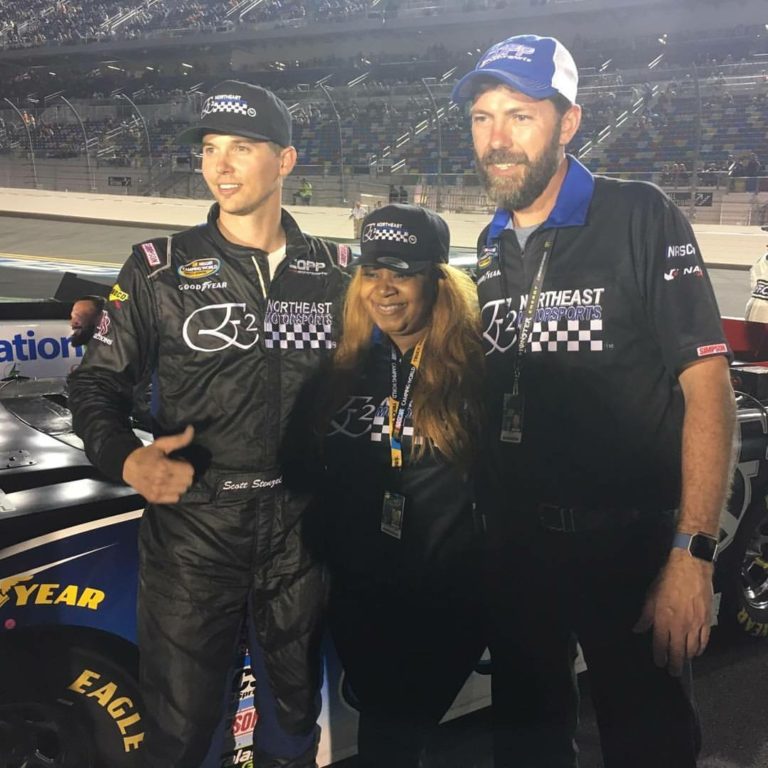
Melissa Harville-Lebron (center) with Scott Stenzel (left) and D.J. Copp (right), owner of Copp Motorsports and Crew Chief. (Provided Photo)

According to a representative from NASCAR, while  Harville-Lebron is the first black women to be the sole owner of a NASCAR team, Jennifer Satterfield-Siegel  is the first women of color to co-own a NASCAR team.

Editors’ Note: This article has been updated and edited to correct Melissa Harville-Lebron’s age. It incorrectly stated that she was 37 years old. She is 47. The article also previously stated that her team came in 18th place at Daytona International Speedway. The article has also been updated to reflect that she is the first black women to solely own a NASCAR racing team. 

Credit: birminghamtimes.com

Peju Ugboma is the Founder/CEO of I Luv Desserts and also runs a blog, The Service Critic where she reviews restaurants. A graduate of Microbiology from the University of Lagos, she was the Head of Business Strategy at First Independent Global before resigning and setting up her business. Certified from Gastronimicum, Agde and Le Notre in France and The Taste Lab in the United Kingdom, Peju wants to launch a training school for aspiring chefs, baking enthusiasts and home cooks. In this interview, this ardent Manchester United fan talks about dumping Microbiology for dessert making, turning a huge business mistake into a best seller and three things women-owned businesses must do and avoid to stay successful.

Making desserts is a pretty unique concept, what led you down this path?
I cannot honestly tell you why I chose desserts, but it possibly stemmed from watching chefs on TV do amazing stuff with butter, sugar and flour. I would watch on TV and wish there were places locally to buy them. I still remember the first time I went to a store on Awolowo Road in Ikoyi and saw a white forest gateau, I was in cloud nine.

When I started out, I knew only a handful of people who were doing desserts commercially for events back then. There were lots of cake makers but proper desserts connoisseurs weren’t available locally. I knew to be able to do it the way I saw it on TV, I would require at least basic knowledge in basic baking techniques, so I enrolled in a baking school locally for one month and the classes were very hands on. I also bought loads of books to help out. By the end of the first month, I knew I wanted more of the real stuff. I searched locally for a proper culinary school but nothing was available so I had to look outside Nigeria.

You switched from microbiology to dessert making, what informed this decision?
To be honest, Microbiology was never my first choice. I come from a home where daddy’s words were the law. My dad initially wanted me to study Medicine but I didn’t score high enough in JAMB to study it.

Secretly, I was quite pleased, but I dared not show it outwardly. I had just about enough points to study microbiology. If I could have chosen my own course, it most likely would have been the arts. I hated Chemistry and other science subjects.

Peju Ugboma, Founder/CEO of I Luv Desserts and blogger, The Service Critic
When I finished from university, I knew I was not going to do anything with the Microbiology, so I tried my hand at different things but I didn’t find any job exciting enough to keep me occupied till I went to work in a customer service training company.

I loved it enough to stay for a few years before I moved in a completely different direction into learning about business strategy. I learnt very quickly and was fully dedicated to it because I needed to grow up. I eventually got restless there after about two years. My husband (then boyfriend) knew how excited I was watching baking shows on TV, so he always encouraged me to try it out. Then I quit my job and went for my first baking course and 12 years later, I am still at it.

You were once a 9-5 employee for over five years, what would you say is the difference between entrepreneurship and full-time employment?
Entrepreneurship is a full time job, especially when you are a start-up. You eat, drink, sleep and dream your new business.

In my candid opinion, entrepreneurship is way harder because you are responsible for other people’s livelihood. People are dependent on you so you have to strive to make sure things are done properly. If you don’t have a dime for yourself, you must provide for others.

When I started out, I was the baker, cleaner, delivery personnel, phone operator, shopper, everything! When you are in paid employment, you have a job description but with entrepreneurship, you are a one-man army.

In your opinion, what are some of the key issues startups face, especially in Nigeria?
I know you have probably heard funding many times but I disagree. The main issue a lot of startups face is knowledge, the knowledge of how to run and manage a business properly.

You have a business idea, it looks good on paper and we run with it without adequate checks, research and even proper training on know-how. We start, then get stuck and eventually throw in the towel until the next best thing comes along. Access to funds is also another big problem.

I am very anti-get a loan from a bank to start a business, the interest rate will almost cripple whatever you have gathered. I am a firm believer in starting small and dreaming very big. Electricity is also a big problem. I know this is a third world problem but it’s a huge challenge in my line of work.

A large chunk of our generated income goes on power generation. I would also say human power because in my industry, retaining excellent staff who are dedicated to the job with great work ethics are very few and far between. Artisan turnover is quite high.

Your company pioneered frozen cookie dough in West Africa, tell us about that?
The cookie dough project came about when there was some kind of ban on importation of goods into Nigeria. Before then, when you go to the freezer aisle of most supermarkets, there weren’t any locally manufactured brands of cookie dough stocked there. It got me thinking and research started on producing cookie dough locally.

The idea behind the frozen cookie dough was to create convenience and save time for the average home baker whilst still enjoying freshly baked cookies in the convenience of your home. All you need to do is place dough balls on trays and bake for 15 minutes.

The whole process took about 24 months from inception to product testing, sourcing packaging and licensing from NAFDAC. We rolled out and gradually started retailing in stores. We were stocked in about 22 stores in Lagos and Abuja then we hit a brick wall. I think it was largely because we had lapses in our marketing strategy and supply change management.

I am no longer ashamed to say that it failed the first time it launched, it was quite humbling and I refused to talk about it for a while but I have learnt a whole lot from this experience, because this kind of experience, as humbling as it is, helps you build resilience. We are back to drawing board trying to retrace our steps to understand why it didn’t work in the first instance. Hopefully, it will work out better and stay in the market for as long as we have projected it to stay.

How important is mentoring for women especially those in business?
I have often heard women say it was a waste of their time, but in my own case, it was one of the wisest decisions I took. If you are in business, whether man or woman, you need mentoring. It is hard enough running your business solo, with you being the all in one CEO and ‘Jackie’ that does even the most menial of jobs.

Personally, I have benefitted from having a mentor who not only guides me as regards my business but spiritually and even issues regarding the home-front.

When I am asked how I chose a mentor, happenstance, I came across her by accident and I prayed that I was choosing the right person. The first question she asked was “what are you bringing to the table.” I was stunned. When I asked her why she said that, she wanted to know how serious I was about our relationship. I have since nicknamed her iya-aje because of how tough she gets when she needs me to do something.

Tell us something that has influenced your life and career positively today?
It took me a while to figure this out, but life became much easier when I got an understanding of Proverbs 3:5-6. It says trust God with your heart, lean not on your own understanding, in all your ways acknowledge Him and He will straighten all crooked path before you. As hard it may be, I have chosen to trust Him.

As a member of BTS Welfare Hub, what do you do specifically for women?
BTS Welfare Hub is a faith-based group, it doesn’t cater to just women, but to the needs of the downtrodden. The hub takes care of a range of things like visiting old people’s homes, orphanages, cerebral palsy centers, poor communities and visiting the streets to encourage someone. An average visit to a poor community will include sharing the word, praying with the people in these communities, encouraging and then giving out presents and food.

As a former business strategist, briefly tell us three basic things women must do/avoid when running a business?
First, separate purses; your business account is not your personal account; you should not draw funds from the business account just because you can. I believe you should pay yourself a realistic salary. If the business is unable to pay you a salary, create an IOU, which can possibly go towards your equity in the company, there must be some sort of reimbursement for the work you do.

Second, whilst I believe you shouldn’t hire too soon, I also believe that it is important to delegate so that you don’t burn yourself out. Micromanaging when you delegate is a killer of creativity. You need to prioritize what is important, what can be delegated and what you can afford to put on the back-burner.

Finally, don’t be afraid to make a mistake or be too cautious to take a risk. I know it is not always easy to accept when we assume we have failed at something but it shouldn’t define who we are.

One of my biggest sellers at the moment, the cheesecake popsicle came about as a mistake I made when mixing one of our products. Now I am grateful that it happened, I acknowledge that it’s not all mistakes that have a somewhat happy ending but use whatever mistake as a stepping- stone to better yourself.

If you could influence change, what would you want to do for Nigerian women?
If I could influence change, I would like to start with reorientation, reorientation of the mind, that being a woman is not a limiting factor. I can be anything I want to be if my mind is aligned to it and I am willing to put in the work.

A lot of our parents did some form of damage in us with a limiting mindset, that no matter what we do or achieve, the kitchen is where we will end up as women. I would also love for women to truly support one another, not just using it as a buzzword but also actually bearing one and other up. These are little things we can be deliberate about it.

What do you do to relax? What is your guilty pleasure?
Relaxing is relative nowadays, as an entrepreneur, shutting down, mind body and soul is hard. So the easiest thing for me nowadays is reading and eating out. I also love watching football but nowadays the team I support isn’t doing well so it is a bit of a drag. My absolute guilty pleasure is travelling to new places, learning new cultures and experiencing new culinary adventures.

What should we expect from you in the next five years?
Whenever I am asked this question, I get a bit overwhelmed. Whilst I understand the need to plan for the future, I have learnt to take it one day at a time, planning five years in advance in my books is a wrong pressure trigger.

So I will change from the next five years to tomorrow or in the near future; I want to co-own a properly run internationally certified culinary academy in Nigeria and an online culinary school because that’s where the business world is gearing up to. I pray for sustenance, God’s grace and grit to carry forth.

Source: Tobi Awodipe for Guardian

Tiera Guinn Fletcher is an African American engineer who graduated from MIT in 2017 and works for Boeing. She is one of the designers and structural analysts building the Space Launch System for NASA which is set to send people to Mars.

Fletcher was born in the greater Atlanta area in Georgia. Her interest and attraction to math and science began at the age of six and was cultivated by her parents. Her mother Sheila, was an accountant and her father was a construction worker. Her parents encouraged her to calculate things and measure things in her daily life. These exercises – including coupon clipping, totaling up grocery receipts, and learning about the applications of architecture – challenged Fletcher and set her apart from other kids her age. At eleven years old, Fletcher zeroed in on her interest in Aerospace engineering while participating in an aerospace program put on by Lockheed Martin. Fletcher went on to study aerospace in college at MIT.

Fletcher lives in New Orleans, Louisiana where she works on the assembly of the Space Launch System. She was married in July 2018 to Myron Fletcher, another aerospace engineer who also works at Boeing. Both she and her husband share an interest in influencing young people to join the world of STEM along with increasing the diversity of STEM fields.

Fletcher attended Wheeler High School in Marietta, Georgia. During her senior year of high school, Fletcher received an internship at NASA in Langley, Virginia. She also landed a research internship at the Georgia Institute of Technology in 2014. The internship involved assisting in the research of landing performance in aircraft. Through these internships her interest in the field grew and she solidified her choice in pursuing aerospace engineering as a major in college and an eventual career.

Fletcher attended Massachusetts Institute of Technology (MIT) and graduated with a 5.0 GPA and received her Bachelor’s of Science in Aerospace Engineering in June 2017. She participated in a mentorship program to help other students at MIT, this helped instil confidence in herself and her capabilities.

After her first year, Fletcher participated in undergraduate research studying design optimization of aircraft at MIT. Her second year, she again participated in undergraduate research, this time studying Network Analysis. During her junior and senior years of college, Fletcher participated in two different internships at Boeing. From June 2015 to June 2016 Fletcher was a Systems Engineering Intern at Boeing where she helped design, test, and collaborate with other professionals on Boeing products. The following year from June 2016 to June 2017 Fletcher was a Design engineer and Stress Analyst Intern at Boeing where she helped with the design process and analysis of the Space Launch System for NASA.

Fletcher was offered a job at Boeing as a Structural analysisEngineer. At Boeing, she is one of the lead engineers and designers working on the Space Launch System for NASA which aims to put humans on Mars. The Space Launch System is the fastest rocket ever created and the largest. The area that Fletcher works on is the exploratory upper stage of the spacecraft which helps the craft complete its ascent phase. She is part of the Engine Section Task Leading team responsible for this, of which she is the youngest member.

Fletcher received the 2017 Good Housekeeping‘s Awesome Woman Award which recognizes women who are impacting the world for the better by overcoming social constraints and influencing the world around them.

Also in 2017, Fletcher received the Albert G. Hill Prize at MIT which recognizes students in their junior or senior year who have excelled academically and impacted the environment at MIT in a way that improves campus climate for other minorities.

In June 2018, Fletcher participated as a keynote speaker at Impact’18 in Krakow – where speakers discuss innovations and business models to share with the world what work they are doing.

On November 8, 2018, Fletcher won the Most Promising Engineer – Industry Award at the 2019 Black Engineer of the Year Awards.

Source: Wikipedia

At the age of 33, Nthabeleng Likotsi is the executive chairperson of the Young Women in Business Network (YWBN), which she and nine other board members started in 2009. The company, managed by women from different professions and industries, is connected by one goal: to provide economic empowerment for all female professionals and entrepreneurs.

On the formation of YWBN, Likotsi said, “I asked myself what it meant to be a black young woman in South Africa. And the truth of the matter was that not much is happening for black women,” she said.

She did research and found that stokvels (community-based informal saving groups) contributed billions to the economy yet had no way of harnessing this financial power. Likotsi saw that these groups could be elevated into the investment space, if they were given the opportunity and support, and so could become a much-needed resource for many households across the country.

This gives an insight into Likotsi’s overarching goal: to create black wealth. She realised that this could only be achieved through a bank that understood and was dedicated to a black entrepreneurial clientele. This led to the formation of a YWBN cooperative financial institution, which currently has 420 shareholders from age 16 to 75 and has collectively generated R4,2 million in investment.

In the past year, and as the chairperson of the YWBN Co-operative Bank, Likotsi has furthered the cause by working to meet South African Reserve Bank requirements in order to propel YWBN from being a cooperative to a mutual bank. On Friday, 15 June 2018, she and veterans of the 1956 Women’s March trooped from the Union Buildings to the South African Reserve Bank to submit their application.View image on Twitter

View image on Twitter

Nthabeleng Likotsi@MissNthabeleng

✊🏽
✊🏽

We can’t register the first Women Owned Bank in South Africa and not have a courtesy visit to the Governor of South African Reserve Bank (SARB)Mr. Lesetja Kganyago and the Registrar of Banks Mr. Kuben Naidoo

The YWBNmutualBANK team#15June20182,7752:48 PM – Jun 11, 20181,285 people are talking about thisTwitter Ads info and privacy

On the march, Likotsi told Huffington Post that they were taking a public stance against the lack of access for black women in the financial sector.

“There is a lot of preparation that goes into getting a licence to run a mutual bank. The requirement is that you should have between R10 million to R15 million, just for the application – excluding the capital expenditure and operational costs, among others,” she said.

“Our theme is built around the women of 1956, who fought for political freedom. We can’t expect them to still fight for us. They are handing over the baton to us, the younger generation.”

She also stated that she is confident that the YWBN Mutual Bank will be fully operational in 2019. “There is no space for negativity. We will not fail.”

Nthabeleng Likotsi@MissNthabeleng

🙏
🙏
🙏

WOW!! it’s been a long journey and totally looking forward to seeing it grow from strength to strength #Right2bOurOwnBankers #YWBNmutualBankLehumo Thelele Maimela@Less57@MissNthabeleng Is determined to have her co-operative turned into the first black female-owned mutual bank in south Africa.

Wow this is the most best thing I’ve heard wow Nthabeleng breaking boundaries head on wow CONGRATULATIONS wow. #WomenInFinance #WomenEmpowerment
44:23 AM – Jun 14, 2018Twitter Ads info and privacySee Nthabeleng Likotsi’s other Tweets

The economic might of stokvel saving groups

To understand why Likotsi sees potential where many others have not, it is important to understand the market she seeks to tap into and represent.

Stokvels are about “the power of a collective”. This collective comes together to pool money for a common aim, thus mobilising like-minded individuals towards achieving financial and social goals. Historically these short-term to medium-term goals included debt repayment (43%), emergency savings (44%), education (25%), groceries (31%), clothing (18%) and other (16%), according to the 2017 Old Mutual Savings and Investment Monitor.

However, stokvels have evolved: According to National Treasury Economist Olano Makhubela, 60% of stokvels are investment-driven, while 18% are investment clubs. Furthermore, stokvels are popular even with high income earners: 42% of households with incomes of R40 000 and above belong to one or more stokvels, according to the same Old Mutual survey.

With these investment groups going into areas such as property and equity, the financial sector cannot underestimate this growing informal sector but would have to find avenues to service it differently from traditional formal investments.

With these investment groups going into areas such as property and equity, the financial sector cannot underestimate this growing informal sector.

Who is Nthabeleng Likotsi?

Born in Botshabelo, Free State province into a family of businesspeople, Likotsi gained her leadership and community service capabilities from her parents and siblings. This spirit is what bolstered her as she shunned a career in accounting to venture into business and change the country’s economic outlook. She has a Master’s Degree in Entrepreneurship from Wits Business School, a post-graduate Certificate in Accounting from the University of Johannesburg, and a Certificate in Entrepreneurship from the Centre of Entrepreneurship at Wits Business School.

Likotsi is recognised in the international business community and she was awarded the 2013/2014 Women Leadership Award at the third Africa-India Partnership Summit in 2013. She is also an independent non-executive director of various companies, such as Apex Valves and Ubuntu Plastics, among others.

Credit: thisisafrica.me

The May magazine cover for MediaRoomHub is out and to commemorate the Children’s Day, they have featured Success Adegor. Success’ story is not only unique, but it’s also a wakeup call for us all to make education a priority for every Nigerian child.

A few weeks ago, a viral video of a little school girl, Success, surfaced on the internet where the smart and outspoken primary school girl was being questioned by her neighbor, Stephanie, as to why she was returning home rather too early from school on that fateful day. In an outburst, Success said she was sent away for not paying her examination fee.

Of course, situations such as this call for concern amongst many Nigerians as there are so many similar cases out there. Thus, within the space of 24 hours, celebrities and individuals alike raised funds in order to ensure that Success remains in school and yes, they made it happen.

According to MRH,The Success incident came with a lot of controversies which prompted us to travel to Sapele to interview her and her parents. Thus, in this conversation with us, Success talks about how she met Stephanie, whether or not her parents appreciated Stephanie thereafter, how the incident was actually one of several others in the past, how some public figures used her situation for publicity, her future ambition, how she feels about stardom and more.Visit www.mediaroomhub.com for more.

Credits:
Editor-in-Chief: Azuka Ogujiuba – @azukaogujiubaContent writers: @ocheibi_abigail & @realoneowoyemiSuccess outfits: @ruffntumblekids @nmaclothingcoPhotography/videography: @onahclassicproduction


The first Mnet Face of Africa and renowned supermodel, Oluchi Onweagba-Orlandi is no stranger to the limelight as she found international fame at an early age. Wife, mother, businesswoman and now founder of LuLu, she sat down with GUARDIAN WOMAN to talk about what it means to be woman amongst other things.

What does being a woman mean for you personally?
I have always wondered what it truly means to be woman. Not “a woman” but “woman.” You don’t choose to be born female, you literally wake up one day and realise that you are.

Oftentimes it is because growing up especially in Nigeria, there is a constant reminder of what you should do, how you should act, what you should think simply because you are not male.

By: Tobi Awodipe for Guardian

Mariam Momodu Is an international trade lawyer, Ph.D. candidate, education advocate and CEO of Get In Education Consulting. She  obtained her  degree in law from the University of Ibadan, Nigeria in 2012 and went on to become the  first female president of the law faculty students’ association in over 30 years of the association’s existence. In addition, she also graduated with the best result ever recorded from the law faculty in Ibadan in 35 years and won about 10 prizes upon graduation. To date, her academic record has not been beaten. However, the law students association has had another female president since my tenure. In 2015, Mariam  obtained a Master of Laws (LL.M.) degree from the University of Cambridge, where she was awarded the prestigious Commonwealth Shared Scholarship and the Cambridge Trust Scholarship. She is now  a Doctoral Candidate at the University of Toronto Faculty of Law. Where she  specialize  in international trade law. Last year, she was awarded the most prestigious scholarship for doctorate candidates in Canada, the Vanier Canada Graduate Scholarship., making her  the only black person from the University of Toronto to be awarded that honour and   one of the 6 scholars of African descent in the whole of Canada that was given this award.

The scholar whose Inspiring story went viral weeks back shares her journey with me in this mind blowing interview.

Growing Up

I was very fortunate to be raised in a family that valued education. My father died when I was very young, but my mother was determined to provide the best education that she could afford. My siblings were also my mentors as they encouraged me to excel in my chosen endeavours and always provided the necessary resources.

I would read my sister’s novels, read books I found in my brother’s rooms and devour books that my mother would borrow weekly from the British Council Library. I remember when I turned 10 years old, I was asked what gift I wanted… I asked for more novels and books and I got them. Apart from being very academic, I have always been interested in looking for ways to improve my community.

In addition, I have been blessed to have encouraging teachers who took an interest in my education and always went beyond the average to ensure I succeeded. From Mrs. Obajimi of Sonbeam Preparatory School, to my teachers at the International School Ibadan, teachers at the Educational Advancement Centre, Ibadan as well as the lecturers at the faculty of law, University of Ibadan and the Nigerian law school. My teachers always encouraged me to be inquisitive and achieve my dreams, so I credit them for a lot of the success I have achieved today.

Mariam Momodu at the Arab and African Youth Forum

Breaking 30 years record at the  University of Ibadan

When I graduated from the University of Ibadan in 2012, I graduated with a 6.7/7 which is the highest CGPA ever recorded from the law faculty in over 30 years. I am eagerly waiting to meet the student who will break the record, as it is long overdue!

In reality when I entered UI, my goal was to graduate with a 7.0, a perfect score from the law faculty. I remember confiding in two senior students about my goals and they laughed at me! They told me it was impossible and if I was going to make a first class from the law faculty, the best I would obtain was a grade close to 6/7. Once I got that negative feedback, I realised I was being like Joseph in the Bible who was sharing his dreams with the wrong people. I decided to keep this dream in my head and continue to work.

I eventually did not finish with a 7.0 largely because I was involved in politics in my 4th year (and that took a lot of time from my studies) but I am proud to say that in my 3rd year, my CGPA was 6.96/7 and in my 5th year, my CGPA was also 6.9/7. So even though I aimed for the moon and did not hit it, at least, I fell among the stars and was able to break the existing record. My academic record in the University of Ibadan opened the door for me to obtain a masters in law from the University of Cambridge on a Commonwealth Shared Scholarship. I would also argue that my grades from university continue to open doors for me today.

I really love that I went to the University of Ibadan. I am the first to admit that the education sector in Nigeria needs a lot of work (and the change needs to start from the government) but I must admit that despite difficulty with funding and so on, University of Ibadan is one of the schools in Nigeria that continues to uphold a very high standard of education. I knew the current vice-chancellor while I was a student and he was one of the people who, in my experience would listen to students’ concerns. I have maintained a relationship with him and my professors in the law school and from time to time I communicate with them to give feedback on my progress or to ask for advice.

I was happy that the school administration shared my story and more importantly, I was very humbled when I read messages from people who were inspired by my story.

Canadian Scholarship & it’s impact as a black woman in a foreign land

I was ecstatic when I received the Vanier last year. We could not announce the award for a while, so I was just sitting on good news! When I applied for the scholarship, I hoped I would win because winning the scholarship will send a signal to other people like me that they too can succeed in academia no matter who or where they were.

The Vanier is a very competitive scholarship that ranks students based on their leadership potential, academic record as well as the potential of their doctorate research. Candidates go through several rounds of application starting from the faculty level to the university level and then national level. I am very thankful that I was nominated by my faculty as this started the process. Apart from my research potential, I really believe my application stood out because of my academic record as well as my leadership experience.

As a student and even after I graduated from University, I always pushed myself to make improvements no matter where I was. In primary and secondary school, I was selected as the head-girl because of my leadership potential and in University I was also elected as the President of the Law Students’ Society, the first woman to be so elected in over 30 years.

For me, leadership has always been about service and trying to make my immediate environment better and it was quite interesting to see that my past leadership experience played a huge role in getting the scholarship.

As a black woman, I am happy to hold the forte for black women, women and anyone from a minority background who has a dream. There are so many challenges along the way for many of us. If I tell the story about the struggles I faced in the first year of my PhD, this article cannot contain it! The Vanier was a big boost for me and I am glad that winning the scholarship has inspired others to reach for more no matter where they come from!

Reaction to my story going viral

This is actually the first time I am thinking of it as a viral story! I would say the reception has been very positive. Many people have asked how they can achieve the same or similar goals and I am inspired to continue to provide support to other people through my company Get In Education Consulting (www.getineduconsulting.com) as well as on a personal basis.

My Inspiration

I think I am inspired by problems. I describe myself as an “extra” person because I am always thinking of the next problem to solve. Any Nigerian that is immune to the problems of the country needs to wake up! My core areas of interest are international trade (particularly intra-African trade and improving connectivity in Africa) ,which is the core of my PhD Thesis , as well as education, which is the core of the business I run at GetIn Education Consulting.So, I am inspired to act when I see problems as my interests are driven by the problems that need to be solved in these areas.

Apart from my family, I am also inspired by people who have overcome adversity and are giving back. Dr. Deola Olubamiji is one of my mentors and people like her inspire me to do more.

Reward

I think the greatest reward is seeing someone say “you inspired me to pursue XYZ”. A lot of people reach out to me online, particularly on Instagram @mariammomodu_ and they tell me how I inspired them to pursue their dreams, study hard or achieve a goal and this is very rewarding.I was also very happy when another woman was elected as the president of the law students’ society in UI, because it showed that the glass ceiling had been broken there.

Challenges of being a female  scholar trying to break boundaries both home and abroad

I have faced several challenges and I am still facing several!  One of the biggest challenges has been adjusting to a new environment with new expectations. Academia is a constant learning curve for me. So, I need to really know how to conduct myself as an academic and ensure I am ticking the right boxes that will make me competitive after school. Funding is also a big challenge for many people, but thankfully, the Vanier came through!

On Giving up

There have been so many moments! January this year I had to prepare for an examination that would determine whether I progressed to the next level of the PhD. It was very intense and there were many days I questioned if I was doing the right thing, but in the end, I came out successful. Also, during the PhD, you have to apply for grants, submit papers and apply for workshops. I am successful with many applications, but I also face rejection. Initially, I used to be bothered by rejection, but now, I know the path to success is filled with rejection, so I have to persevere no matter how I feel.

Being a Woman of Rubies

I am a woman of rubies because I am not defined by what I own or what you can see. I am so much more. I am a woman who keeps striving to make an impact on her environment by touching one life at a time with the hope of making my corner of the world better.

Advice for  women who are scared to break boundaries and be more

If the voice in your head is not encouraging you, then don’t listen to it! A lot of times, we are holding ourselves back because we think we are inadequate when we are actually more than enough. Research has shown that black women are more likely to have feelings of inadequacy compared to many other groups of people and these feelings of inadequacy have has been described more technically as imposter phenomenon.

 I know fear can be crippling, but you have to find a way to overcome it. What I do is to keep myself accountable by sharing my dreams with those who understand my vision. I have mentors that encourage me and chastise me as needed. I am also learning to live “uncomfortable”. This means that I am constantly reaching for things that I think are difficult to achieve no matter how I feel.

Appreciation of Black Women

I think black women need to stop waiting to be appreciated. Instead we need to just be who we are “boss babes!” You don’t need anyone’s permission to excel. Neither do you need permission to be proud of your achievements. Where you need to, demand your accolades, demand that promotion and so on, but do not wait for external validation before you appreciate yourself.

If I could change one thing  in the Education Sector

Education should be fun. Students should be excited to go to school because there is something for them; something that can relate to. If I could change one thing, I would change the kind of syllabus we have in many universities in Nigeria. I would work to decolonise our syllabus and make it contextual to Africa and the 21st century. Oh, I would also ensure that 30% of Nigeria’s budget for the next 30 years is dedicated to education.

How to reach me

I enourage readers to visit www.getineduconsulting.com and read all the free resources we have available, as well as inspiring stories that can get you started on your journey to using education as a tool to change your life. Also follow @getinedu on Instagram and Twitter as well as @mariammomodu_ on Instagram

Bolaji Oluwadunsin Precious is a final year student of Federal University of Technology Akure, Ondo State. She is also the CEO of Dunsin Craft Collection Company @Dunsincrafts, a fashion brand aimed at using creativity to advance fashion and style. It specializes in using Ankara fabrics to make several products such as Souvenirs for events and conferences, Laptop bags, Handbags, Backpacks, Document holders, Notepads, etc.

She has trained about 200 females in the art of Crafts with Ankara to make up to 8 products in 2018.

Childhood

I was born in Ibadan but grew up with my dad at Abeokuta. My parents got divorced when I was 3 and my dad took custody of all 5 of us. I’m the 4th child.

After few years, my mum took custody of my younger sister and I. Growing up wasn’t so adventurous.

Inspiration behind Dunsin Craft Collection

The fear of poverty inspired me. There is a saying that ‘Worst situations bring out the best in people’…. I am a living example. I channelled that energy into what I love, Craft. I can make so many things with my hands, that’s why there is “Collection” at the end of my brand name.


Training of over 200 females in the craft of ankara..

I trained over 200 females in the craft of Ankara and the impact has been very strong. Months after the training, about half of them called me and chatted me up to express their gratitude and to also informed me of their progress. DCC is already working on a platform where we can do more.

The reception so far…

It has been amazing! The African fabrics (Kente/Ankara) has always given our products uniqueness and beauty!! Everyone, I mean everyone that sees the Ankara designed products are always wowed and show interest in them.


Inspiration

I am always inspired by women doing great things (Oprah Winfrey, Linda Ikeji, Michelle Obama, Alakija). I make researches online to see products other African countries make and I get motivated.

Greatest reward

Recognition as the Number one Accessory Designer in Ondo state. Top blogs and Website carried the feat.

Challenges

The major challenge I face, is balancing academics with business. I’m in my finals at FUTA.  Others are financial which has made me put in for grants and apply for international applications where my business can be funded for more exploits.

On winning the Entrepreneur Of The Year award

I am encouraged to do more. To aspire more. To keep pushing. If I could get this award, I know greater things are on the way.


On giving up…

I have entertained the thought of giving up countless times. I would tell myself “why don’t you just marry a rich man” …. Lol. But then, the fear of marriage scares me sometimes, so it’s not an option. There are times when I would have less than a thousand naira in my account and make no sale for weeks. It’s been God holding me up.I just want to be like those I look up to and to inspire a lot of ladies too.

I am a Woman Of Rubies

My goals. My vision. My strength. My feminine power. My determination. My fighting spirit. My ability to keep moving forward even when nothing made sense.

Final word for women aspire to go into my line of business

Nothing is ever easy. So expect difficult situations. Always plan, so nothing takes you by surprise. Don’t stop believing in yourself, its dangerous. Run from anything/anyone negative. Eat and rest. Ask for help when you need it. Go out and connect with other entrepreneurs. Your biggest client might be into tech. Make research on what you do regularly. Love and Pray.


– DCC is a fashion brand aimed at using creativity to advance fashion and style. It specializes in using Ankara fabrics to make several products such as Souvenirs for events and conferences, Laptop bags, Handbags, Backpacks, Document holders, Notepads etc

Contact us :Facebook : Dunsin craft collections DCC Twitter : @DunsincraftsTel No :08107795747

Adefunke Anurukem is the Managing Director of Auto Dome Limited, one of the very few female entrepreneurs operating in the male-dominated Nigerian automotive industry. She talks about the challenges and motivation in a business majorly run by men

Let’s meet you please
My name is Adefunke Anurukem, an alumnus of Olabisi Onabanjo University (OOU) and Fate Foundation and Education Development Centre (EDC). I am the Managing Director of Auto Dome Limited. Auto Dome is a one-stop shop for all automotive needs. Our services include automobile sales, provision of after sales services, fleet management, logistics and sale of car care products. I am also the current president of the Women in Automotive Sector Association (WASA), our aim is to bring together all women in the automotive business and discuss our challenges, fears, future aspirations, and proffer solutions. We provide assistance and empowerment to new women entrepreneurs in the automotive business.

How many years have you been into this business?
I have over 17 years experience working in the automotive industry in Nigeria. I worked with several Nigerian automotive franchises before branching out and starting Auto Dome in 2010.

How has the exchange rate affected the automobile business?
Our business is solely dependent on foreign exchange, since most of the cars are produced and assembled outside the country, as a result, exchange rate fluctuations over the past few years have significantly affected the Automobile industry, with the 2015 devaluation of the Naira being the worst hit. Another challenge faced by the automotive industry is the increase in Custom duties, which has significantly increased the cost of doing business. In the face of these challenges, we at Auto Dome have had to re-strategise and optimise our business processes in order to stay afloat.

How has your experience been like in relation to the number of years you’ve been in the industry?
The business climate in Nigeria is ever evolving. When we started Auto Dome in 2010, we had our own fair share of challenges. We made some mistakes, because we were naïve in some areas of our operations. Initially, our focus was solely on car sales, but after careful analysis of clients’ demands over the years, we have added a range of services and products.

Now that we are over eight years in the business, we are looking at opening more branches nationwide and signing a franchise deal to represent a reputable international brand here in Nigeria. One key factor in setting up a business in any industry is to have first-hand industry knowledge, product knowledge, and understanding of government policies and how it affects your industry. In my experience, business has been challenging, interesting, tasking, but very fulfilling, in spite of all the odds against business owners in Nigeria. Everyday comes with its own unique challenges that you must device a unique ways to solve. However, solving tasking problems in business expands your capacity to face more and get good results

How did you grow the business and what were the challenges?
Growing the business has been solely by the grace of God and passion for what I do. Whether it’s car sales, servicing, leasing, fleet management or selling care products, were solving problems and adding value. As an ambassador of my brand, the most important thing has been to identify customer needs and provide solutions that best suit them. By doing these we have been able to grow the business over the years. Challenges growing up were majorly pressure from the society seeing you as a woman and setting limits on how far you can reach. Moreover, I have always loved to challenge myself and tread where others are afraid to tread. I try to not see any limit to what I can achieve, and that has continued to give me the energy to conquer challenges.

What are your inspiring feedbacks?
Oh! I’ve had some interesting feedbacks in my time.
You hear things like, “Wow! A woman selling cars? “You behave like a man!’ At first I used to feel offended but as I grew in the business I began to see it as a compliment. Also some clients have come back and said “I find you very professional in your dealings.” Some of the most important customer feedbacks, however, are expressions of satisfaction with products and services, repeat purchases from clients and good referrals. These are key for us and we get loads of such.

Where do you see your business in the next five years?
In five years, we would have opened more branches, in at least three more Nigerian cities and have become a franchise holder for Nigerian-assembled automobiles with specifications cutting across the board, thereby adding to economy growth in the country.

What’s your advice to younger ones?
Keep your eyes on the ball. There are a lot of distractions out there, but remain focused and have a plan. Don’t go into business because you want to outdo the other person. Develop a passion for what you do, because when the tough times come that’s what will sustain you. Lastly, always have a CAN DO spirit and believe in yourself because the sky is just the starting point.

What is your motivation?
Firstly, God, because without him I am nothing. I also have a solid family support, without their constant love and affection, I would have been much more affected by the highs and lows of business life. Thirdly, myself, I am a self-starter, you are the only one who can pull yourself from your inner strength genuinely. Finally, I have other mentors, accountability partners and colleagues in the industry that I look up to. I also read articles, books and reviews of selected role to stay motivated.

To what extent have you leveraged on technology in growing your business:
I cannot over emphasize how much technology has helped in growing our business. In the early years sales were made mostly by personal contact. In that regard, a lot of staff were required to go out and look for prospective clients, which in itself proved quite difficult, because information was not readily available. However, with the improvements in digital technology, business can be done faster and at lower operational costs. The advent of interconnectivity and globalization (the early days of the fourth industrial revolution) has been phenomenal! We have been able to transact business successfully with numerous customers all around the world, thereby growing our clientele base. It is so amazing that we have even made major sales off of WhatsApp Status updates!

I am sure there are still a lot of positive technological advancements to come and we at AutoDome will continue to strategically position ourselves in order to harness its power to achieve our aims and objectives in this business.

By: Maria Diamond for Guardian

Nkechi Idinmachi is the Creator and Marketing Communications Manager at Pages&Ink Limited, an organisation focused on working with SMEs to enable them leverage digital tools to grow their businesses online, attract their target customers while also delighting them into becoming happy promoters of their organisations’ products and services. Having overcome the obstacle of feeding her preemie baby with multiple food allergies, she’s showing other mums the way on her Instagram page @babychefng and through her upcoming Cookout, helping them take charge of their children’s nutrition with her numerous baby friendly, allergen free recipes made with Nigerian food ingredients. She is also the founder of Herlibrary for Learning and Empowerment Foundation, an NGO that builds libraries, provides books and learning resources for public schools in eastern Nigeria. They recently completed their pioneer Library project at Udo Primary School, Ogbunike, Anambra State. Idinmachi is a graduate of Obafemi Awolowo University with a degree in German Language, a certificate in Integrated Marketing Communications from IE Business School, Spain and a certificate in Child Nutrition and Cooking from Stanford School of Medicine. In this interview with IJEOMA THOMAS-ODIA she shares her passion for being an entrepreneur while combining with her duties as a mum.

How important is leveraging on digital tools to growing a business? 
The importance of digital tools in growing a business cannot be over-emphasised. It is the most affordable, convenient and effective way for any business to boost its visibility. I have seen first- hand how a business can go from local to international in a few short months by strategically leveraging digital tools. When I resumed at my previous place of employment, their only digital footprint was a redundant website. I created and infused fresh content, redesigned the website and began optimising it for search engines. Shortly afterwards, we began to receive calls from huge facilities management companies in the USA, South Africa and from other companies abroad who were bidding for FM contracts with multinationals and were in search of a partnership with a Nigerian FM company. This demonstrated to me the efficiency of digital tools in providing business owners the best chances for competition, survival and opportunities beyond their reach.

What led you to setting up Pages and Ink Limited?
Shortly after getting married in 2016, it became clear that my husband and I both had crazy schedules which saw us leaving the house as early as 5:00am and not getting home till about 8:00p.m. I was frightened by the thought of bringing a child into that chaotic routine and so I decided that I would resign just before we were ready to start a family. My husband was reluctant initially, knowing how driven and ambitious I am. He didn’t want me feeling frustrated and unfulfilled as a stay-at-home mum, but I began planning an exit strategy, anyway.

At the time, my job role as a Marketing Communications executive for one of Lagos’ top facilities management companies gave me a lot of fulfillment, so I decided to develop my skill sets further in the field and took an online course in Integrated Marketing Communications, from IE Business School. After registering the business, Pages and Ink Limited, I spread word about it and landed my first clients. I would get home at 8:00pm and work till 2:00 am on my “side hustle” and then leave the house a few hours later to my full-time job. By September of 2016, I realised I had made over twice my salary from my “side hustle!” I think it was then that my husband believed that I was determined to make “working from home” work. Then the miracle happened. I informed my boss of my decision to resign and he asked me what my reasons were and I told him about my new company. He was happy and requested I consult for the company. I am very grateful to Mr. Wole Aderogba for the opportunity, which marked the official beginning of the journey.

Do you think businesses need online presence to thrive?
According to a recent research, 45 per cent of global consumers say they shop for goods and services online. The trend has grown exponentially in Nigeria as more people now increasingly shop from their homes and offices. With the current trend, if you are a “brick and mortar” business without an online presence, it won’t be long before your competition that has gone “click to brick” takes over the market. Creating a comprehensive online presence is the key to building a thriving, sustainable business. However, it isn’t enough to just be present online, you must be active and leverage on digital tools – optimise your website for search engines, get social, create relevant and appealing content, engage your online community. Put out valuable information to establish your brand as an expert in your industry. You have to invest the necessary time if you want to be successful in building a formidable online presence.

As a ‘Mumpreneur’, how would you describe this concept?
This means that I am a full-time entrepreneur and a full-time mum. It is my way of promoting self-employment and showing other qualified women who have left their professions to become full-time mothers that they don’t have to feel stuck. There is a way to juggle home and a professional career if one chooses to.

What was your drive as the founder of Herlibrary?
I grew up in the village in Anambra State, South-Eastern Nigeria. Like most places in that region, there’s sadly not much going on in terms of development and empowerment of the girl child. The ultimate achievement expected by your parents and peers is (thankfully) a university education and a husband; better still, one from “the abroad”. Books saved me; they opened my eyes to opportunities beyond my background and enabled me to dream big.

With a decline in reading culture, what is the impact of your project with the NGO? 
I don’t quite agree that the reading culture in Nigeria is declining. With the growth of mobile users, I think it is growing instead as people are constantly on their phones reading. We read blogs, Instagram captions, twitter posts, e-books and other digital content because they are available. I strongly believe that if books are made available to young Nigerians, books that pique their interest, they will read. This is why my NGO, HerLibrary, is doing our best to provide books from a varied genre in the rural communities in eastern Nigeria, to expose them to a world beyond their background. We also run book clubs where they read mostly fictional books that teach kids about entrepreneurship.

As a marketing communications expert, what is your advice to business owners with dwindling sales and at the verge of packing up?
Get digital, define your niche and target market, create terrific content that would be appealing to them, get social and engage. Learn the best practices and use them. Be consistent, it’s hard but totally worth it.

What is your advice to women on pursuing their dreams and managing the home-front?
My advice is to just try; it is not enough to dream or wish. You have to do the work and put in the effort. Getting organised and scheduling activities and tasks in your home will give you the sanity and peace of mind to pursue your dreams. Stop undermining yourself. You can do it. Start small if you do not have the means to go all out. Do what you can, where you are, with what you have, without excuses. The best time to do it is NOW and yes under your present circumstances. If it gets overwhelming, step back a little bit and attack it again.

How do you unwind?
NETFLIX. I enjoy watching reality shows, cooking shows. I love to read, too. I am currently reading Lioness Arising by Lisa Bevere. It’s a great book and I highly recommend it to every woman who wants to make an impact.

What is your philosophy of life?
Everything I am, everything I have is from God and for him. It’s in him that I live and move and have my being. Without him, I am nothing.

By: Ijeoma Thomas-Odia for Guardian