Author

Women of Rubies

Browsing

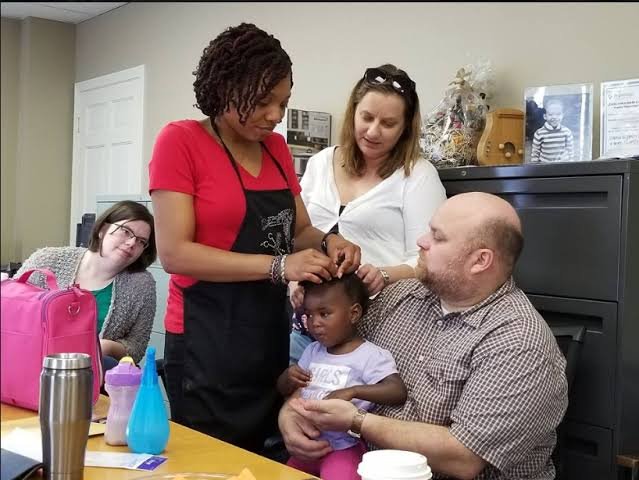
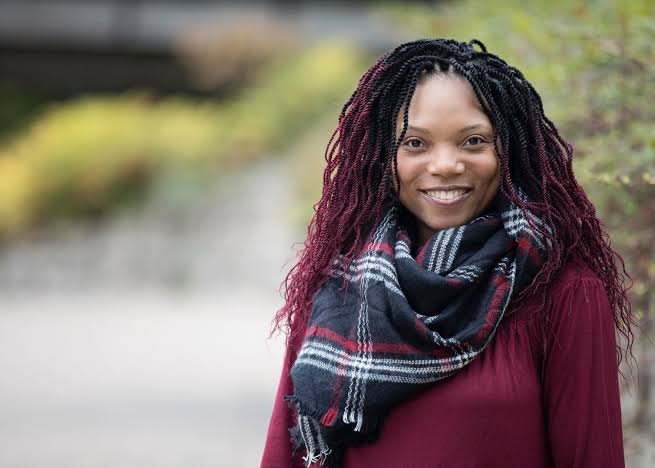
Tamekia Swint started Styles 4 Kidz after she noticed more white parents were choosing to adopt Black children.

Embedded video

Beautés Afro@Beautesafro

« Black hair School for adoptive moms » It matters 495K8:36 PM – May 19, 2019160K people are talking about thisTwitter Ads info and privacy

“They’re not familiar with the [black] hair,” she told 60 Second Docs. “I saw that this might be something where I can empower them.” The documentary has been viewed more than 3.5 million times since its May 15 premiere, according to Popsugar.

She started the company in 2010 with three clients. Since then, she’s served more than 500 families. Swint offers several styles ranging from $40 to $150. She also hosts workshops for parents who want to learn how to do their children’s hair.

The mother-of-one claims the parents are eagerto learn about Black hair.

“I saw the need for this kind of service as more whites and other non-black families adopted black children,” Swint told Oak Park in March. “A big misconception a lot of blacks have about whites adopting black children is that they don’t care about these kids and that’s just not true.”

Laura Basi, mother to a pair of twins, is thankful for Styles 4 Kidz because Black hair resources are scarce in her country.

“I want to learn how to care for my children’s hair and this is the best place for me to learn how to do that. I live in Batavia where there’s not any place I can take them for hair care,” Basi said. “Adopting these two has been a positive experience for my family. We adopted them when they were five days old.”

The organization also allows Basi to socialize with other parents.

“I know soon it will be time to send them to school and that is something my husband and I are discussing now,” she continued. “I know there are things I won’t be able to relate to when it comes to blacks and that’s why I am learning as much as I can, from as many people as I can.”

The kids are also enthusiastic about their new hairdos.

“We’ll go there and give them haircuts and braid hair. You would be amazed how much self-confidence these children gain once their hair is looking good,” said Swint. “Seeing the smiles on their faces when we leave is a wonderful feeling.

Credit: blavity.com

Cardi B‘s application to catchphrase ‘okurrr’  to be used mostly for merchandise has been  officially rejected. 

According to Mail Online, Government officials have officially rejected her application to lay claim to the word, which is popularly pronounced with the Rs rolled.

Back in March, the 26-year-old rapper and mother of one submitted an application to catchphrase ‘okurrr’ including the commonly misspelled ‘okurr.’ Unfortunately, the US Patent and Trademark ruled that the slogan fell under the category of ‘widely-used commonplace expressions.’ It’s a valid argument, given that the phrase has existed in minority communities for years.


They also explained that it ‘is a slogan or term that does not function as a trademark or service mark to indicate the source of applicant’s goods and/or services.’

Credit: LIB

Gospel singer, Sola Allyson has shared her sexual assault stories as a child growing up.

Triggered by Busola Dakolo’s recent rape allegation against Pastor Fatoyinbo, the gospel singer said, ‘I was abused a lot. Different ways at different stages. I almost got used to it. I am still healing. because I speak ! It hurts but I speak’.

The singer said she paid a visit to her mum to relive some of her childhood sexual abuse encounters and here’s what she wrote;

I was at my Mother’s today… There had been issues, since my childhood. But that story, for another time… So, I was asking her questions, out of pain.. Then, this conversation below took place:

Me: “Do you know that your cousin, when you left me at shdgrigofn, molested me?” I was in primary school. Over 30 years ago… I remember everything clearly… I was confused. What would I say? How would I say it?

Her: Eyes wide!

Me: “Do you know that Mr. Thshdudidj nearly raped me? The one that used to come to your shop…” Her: Eyes wider, mouth agape, “why didn’t you tell me?” Me: “Tell you? How? When there was no connection and it showed you didn’t like me? Kò possible nao!” Me: “That man that used to come and take beer and peppersoup in your shop, after I served him one day, brought out his penis that I should play with.” I was like 14-15. I ran away from the shop. You didn’t bother to ask why, you only punished me by depriving me of food for days because, “that’s where you get money from.” Her: No words

Me: “Do you remember that time when….” And so on

Her: No words, looking what-do-I-say kind of. I love her!

We talked about other things… I felt a lot better. The anger I’d been feeling for days subsided… I’m still healing. I was abused a lot. Different ways at different stages. I almost got used to it. I am still healing. Because I SPEAK! It hurts but I SPEAK!

This is my story. This is my song. Told in this way I choose. Sung in this form I deem fit. But I SPEAK! For the sake of my kind, who have been made “sick” by abuse of all sorts. Not for you? Please move on. I’m not begging for “fanhood”! It is not only for Busola’s sake that we are doing this. It is for our women, our daughters, our sons, our future! She murdered her privacy to SPEAK. She risked it all… Yes, I believe her. You won’t listen to my music again? If it is because of this, it’s ok. I wish you well. But you will be replaced by millions others from here, from distant shores and islands! Where I’m going is far. Everything in Creation backs me up as I stand and SPEAK for the TRUTH, only.

SPEAK, Child, therefrom your healing begins!

Credit: LIB

Late Dr Ameyo Adadevoh has been posthumously honoured by The Economic Community of West African States (ECOWAS) for her role in reducing the spread of Ebola virus.

Adadevoh was awarded winner of the 2018 ECOWAS Prize of Excellence.

The award was presented by President Muhamadu Buhari, at the 55th Summit of the ECOWAS Authority of Heads of State and Government on Saturday in Abuja and received by her son Bankole Cardoso and her niece Niniola Soleye.

Credit: fabwoman.ng

A young Ghanaian woman who gained the attention of major eye balls globally for the superior quality of work she produced for her PhD in Mathematics for the University of Glasgow, UK, has successfully graduated.

Angela Tabiri, a young female math-goddess who made headlines for the higher quality of work she produced for her PhD in Mathematics for the University of Glasgow in the UK, has successfully graduated as a doctor of Mathematics. She earned media attention when her PhD thesis in Mathematics for the university was first shared by globally revered Ghanaian, Ben Dotsei Malor.

Upon successfully graduating with a PhD in Mathematics, Dr. Angela Tabiri, has become an inspiration to young women especially young girls in Africa who either want to or are pursuing courses that would eventually lead to careers in the Science, Technology, Engineering and Mathematics (STEM).

While Mathematics is generally regarded as a no-go area for most women, Dr. Angela Tabiri, has challenged this narrative after successfully graduating with a PhD in Mathematics.

Tens of people including love ones have expressed their sense of pride for Dr. Tabiri’s rare achievement after super proud friends shared her remarkable feat via Facebook in photos, along with captions:

Like most math geniuses, Dr. Angela Tabiri would use the knowledge and skills acquired in solving problems including finding solutions to diseases, researching into its causes and developing long lasting solutions to critical world problems.

Credit: yen.com.gh

George Mason University is renaming the largest building on campus after the 100-year-old former NASA mathematician Katherine G. Johnson. 

She overcame racism and sexism to help lead the United States into a new era of space exploration, but few knew her amazing accomplishments until the movie Hidden Figures came out.

Katherine G. Johnson Hall will be the new name for the former Bull Run Hall. The university will also create a scholarship in Johnson’s name.

“Katherine G. Johnson Hall will be a powerful symbol of what can be achieved, no matter the obstacles, when students of all backgrounds are given the opportunity to succeed,” said Mason President Ángel Cabrera, one of the dedication ceremony speakers. “Katherine Johnson represents the idea of striving to fulfill one’s full potential. Her name on this building, and her remarkable story, will inspire future generations of scientists and engineers.”

She worked at NASA Langley Research Center in Hampton, Va. for 33 years and performed complex calculations and flight path analysis in the early years of the space program, including Apollo 11 flight to the moon in 1969. 

Her achievements were seen in the 2016 Oscar-nominated film Hidden Figures.

Johnson is 100 years old and was not able to make it to the dedication, but her family attended.

“For mom to be in Virginia, and have a building named after her, and to have the history as to why they chose her, has just been amazing,” her daughter Katherine Johnson said.

The movie “Hidden Figures” tells the story of Johnson who overcame racism and sexism to put rockets in space.

The movie poster was enough to blow away Olena Bromell.  “I was shocked. I looked at the poster and I was like, is that a black woman? Is that a rocket behind her?

“And she went and did math. She did math so well that the engineers were like, whoa, wait a minute!”  Bromell, a rising sophomore at Woodson High School in Fairfax, has been part of a Mason’s STEM summer program since she was in sixth grade. Several of the young people in that program attended the dedication ceremony. Bromell got to read a passage from Katherine Johnson’s book when she corrects a man’s calculations  at NASA.

“His face begins to turn the color of a cherry cough drop. I was right and he was wrong,” read Bromell.

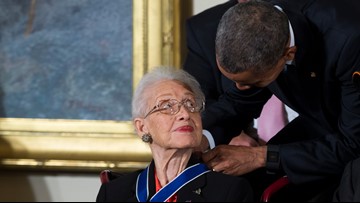
Johnson has NASA facilities named in her honor and received the Presidential Medal of Freedom in 2015.

Obama Medal of Freedom

Photo by: APPresident Barack Obama presents the Presidential Medal of Freedom to NASA mathematician Katherine Johnson during a ceremony in the East Room of the White House, on Tuesday, Nov. 24, 2015, in Washington. (AP Photo/Evan Vucci)

Of course, it’s an honor for Katherine Johnson and her family to have an academic building named after her. But the people it’s really going to impact are the students.

 “It means that I can do this, it means that I can do whatever I set my mind to, and I’m going to!” exclaimed Bromwell. 

The Katherine Johnson building is home to many academic programs including The Virginia Serious Game Institute.

Credit: Wusa9.com

Dr Venita Simpson became the first Black woman in Baylor College of Medicine’s history to finish a neurosurgery residency.

The wildly accomplished Navy Lieutenant Commander has joined the 1% of Black women neurosurgeons in the U.S., according to Because of Them We Can

She’s served in the Navy for 13 years and is slated to return in the near future. She’ll now be working for the Navy in Portsmouth, Virginia.

“When I knew I wanted to go to medical school, my high school guidance counselor told me to be realistic. Even though I had a 4.0 GPA, she recommended another student of privilege for the scholarship I was applying,” she told Because of Them We Can.

“When I originally applied to Neurosurgery I did not match, but I dug my heels in, got back on the grind and matched the second time around. Never let anyone tell you what you can’t do. God is always in control and has a plan far greater than you imagined if you keep faith.” 

Baylor College of Medicine has been around since 1956 and is known for its connections to prestigious cancer hospitals and massive amounts of funding for research.

Before getting to Baylor, Simpson earned a doctorate from Georgetown University. She finds much of her inspiration from Dr. Alexa Canady, the first woman and Black woman neurosurgeon in the U.S.

“I was inspired to go into medicine since I was seven-years-old after I had surgery. I was just amazed at all the gadgets in the hospital. I fell in love with Neurosurgery after witnessing Deep Brain Stimulation for Parkinson’s Disease and movement disorders and how life changing a seamless placement of electrodes in the brain could alter and enhance someone’s life,” Simpson told Because of them We Can.

“Dr. Alexa Canady resonated with me more so because not only was she Black, she was a woman. In a field dominated by white men it can be intimidating, but she persevered and I definitely have pulled strength from her.”

Simpson was featured in a fun Washington Post article last fall where she jokedthat she “left a patient open on the table” while trying to vote for the first time in Texas.

Credit: blavity.com 

Melissa Harville-Lebron never imagined that her entrepreneurial pursuits and ambitions would lead her to make history as the first African American woman to solely own a race team licensed by NASCAR.

Harville-Lebron, a 47-year-old single mother raising her three biological children as well as her siblings’ four kids, started her career in the entertainment industry as an intern at Sony Music. In 2005, she launched her own music label while working for New York City’s Department of Correction office. Nearly a decade later, she suffered from a severe asthma attack that forced her into early retirement and inspired her to take the risk of launching a multifaceted entertainment company, W.M. Stone Enterprises Inc., in 2014.

A RACE TO HISTORY

Harville-Lebron says her journey into auto racing began unexpectedly when she took her sons to a NASCAR experience event at Charlotte Super Speedway in hopes of deterring them from taking up such a dangerous hobby. Instead, the experience only piqued her sons’ interests and eventually led to her investing hundreds of thousands of dollars to develop her own team.

“I got invited to a NASCAR experience and I brought my boys along thinking that it would discourage them from driving,” she told Black Enterprise. But “it did not work that way.” They drove 149 mph and 150 mph during their first session and loved every minute of it while she watched in awe.

Nonetheless, seeing the passion and joy that her sons had for racing compelled Harville-Lebron to want to help them follow their heart. However, as she explored the sport’s history, she noticed its notorious lack of diversity. There were little to no drivers of color, let alone an owner. That motivated her all the more to fill the gap.

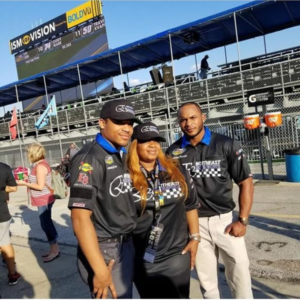
Melissa Harville-Lebron (center) with her sons Eric (left) and Enico (right) Lebron. (Provided Photo)

She created E2 Northeast Motorsports under the umbrella of W.M. Stone Enterprises, Inc. The E2 Northeast Motorsports team became the first multicultural team to race competitively in NASCAR, with four black and Latino drivers — two in the camping world truck series and two in NASCAR’s Whelen All-American Series. Two of the drivers are brothers and Harville-Lebron’s sons, Eric and Enico.

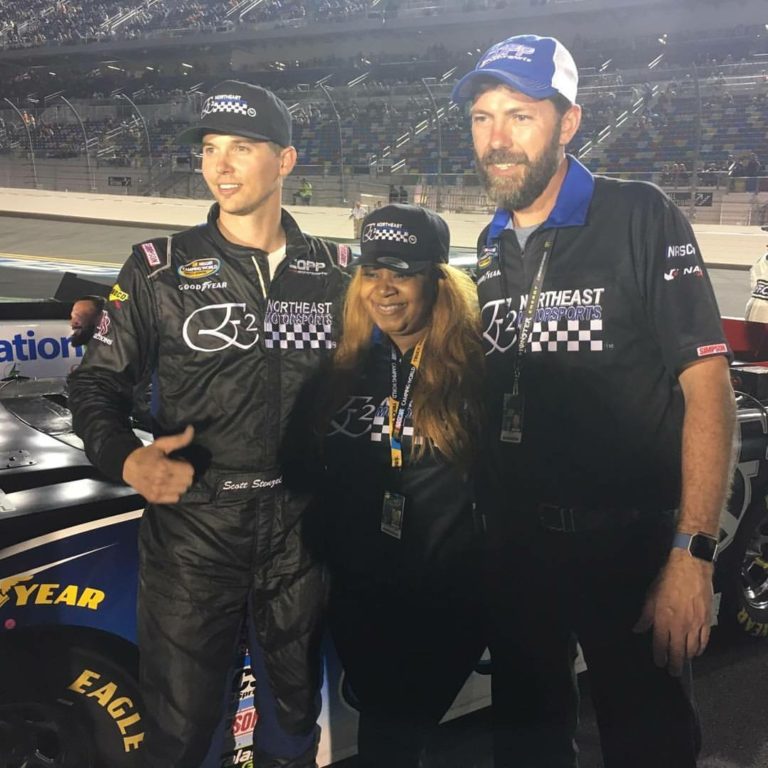
Besides making history, Harville-Lebron celebrated another victory on Feb. 16, when her team ran its first official race in the Camping World Truck Series (NCWTS) at Daytona. Scott Stenzel started the race in an E2 Northeast Motorsports Chevrolet, marking his return to the NCWTS following a three-year hiatus. He came in 15th place at Daytona International Speedway.

In a statement released earlier this month, Harville-Lebron called it an “honor” to partner with Stenzel and the NCWTS team, Copp Motorsports. “This team truly exemplifies diversity, that is sure to attract a younger multicultural fan base. It’s an honor to announce that Stenzel is now a part of this racing family.”

In addition to granting opportunities to people of color, Harville-Lebron wishes to see more become sports owners, particularly of NASCAR teams. “It’s important for our culture to push generational wealth to our children. It’s important to lead by example. All too often our children see negative images of our culture and I think it’s very important for people of our culture actually succeeding in business,” she said.

Melissa Harville-Lebron (center) with Scott Stenzel (left) and D.J. Copp (right), owner of Copp Motorsports and Crew Chief. (Provided Photo)

According to a representative from NASCAR, while  Harville-Lebron is the first black women to be the sole owner of a NASCAR team, Jennifer Satterfield-Siegel  is the first women of color to co-own a NASCAR team.

Editors’ Note: This article has been updated and edited to correct Melissa Harville-Lebron’s age. It incorrectly stated that she was 37 years old. She is 47. The article also previously stated that her team came in 18th place at Daytona International Speedway. The article has also been updated to reflect that she is the first black women to solely own a NASCAR racing team. 

Credit: birminghamtimes.com

Wife of singer, Timi Dakolo, Busola, has accused controversial clergyman and founder of the CommonWealth of Zion  Assembly COZA, Biodun Fatoyinbo, of sexually assaulting her when she was much younger.

In an explosive interview with YNaija, Busola, the mother of three, recounted how the clergyman who has been embroiled in a number of sexual assault related cases, Ese Walter being the most prominent, allegedly raped her in her mother’s house while she was still in secondary school. In her interview, Busola recounted how the clergyman also allegedly tried having sex with her inside his matrimonial home when she came in to help his wife, Modele, when she had their first child. 

Recall that Timi Dakolo recently launched an attack on the clergyman, anonymously. He called out the pastor, accusing him of taking advantage of women in his ministry and leaving them broken emotionally. Read hereand here.

Read the interview as reported by YNaija below and watch the full interview below

ON MEETING BIODUN FATOYINBO FOR THE FIRST TIME

Busola Dakolo was born and lived most of her early life in Ilorin. The first time she left Ilorin was for secondary school at Suleja and that time away allowed her really find her Christianity. She joined and rose to become the vice-president of the Gifted School Academy Suleja’s fellowship and embraced a conservative approach to Christianity, growing to become distrustful of churches and fellowships that tried to copy worldly trends as a way to reach people outside the church. She returned home for the holidays to find that her sisters had started attending a non-denominational ‘youth club’ that embraced all kinds of people and focused on worship and fellowship over doctrine and legalism. It took a while but  her sisters convinced her to go by telling her she needed to meet different kinds of people, especially former prostitutes and cultists that have given their lives to Christ.

Busola reluctantly joined her sisters for the youth club, but she wasn’t comfortable there, partly because of the way they worshipped and because I was the youngest person there. After the service, there was a first timers call, and Busola stood up and introduced herself, explaining her initial skepticism and how their worship had changed her mind. After the service, the pastor of the club, a much younger Biodun Fatoyinbo came looking for her after the service. 

Pastor Biodun wasn’t yet married ( though he was engaged to his current wife) and the Commonwealth of Zion Assembly (COZA) wasn’t yet a church, it was called Divine Delight Club.

He expressed his surprise at how bold she was for someone so young and encouraged her to keep speaking up for herself. He also managed to convince her to sing at their next meeting before she left back for school. To sell this idea, he offered to personally rehearse with her, mentioning that he played the keyboard. This was before mobile phones and internet, so Busola’s sister had to take her to Fatoyinbo, who was living with his parents at the time. 

Though Busola remembers the song they rehearsed, their rehearsal was uneventful, and at the next meeting she performed, her performance moving enough that a former cultist who was attending the club public renounced his past and embraced Christianity. After, the members of the club affirmed her and Fatoyinbo convinced her through gifts of books and cassette tapes to keep attending their club when she was back home from school. 

Returning to school and the more conservative worship environment she was used to was harder than she had anticipated. For the rest of her secondary school year, she struggled with guilt, shuffling between her role in the conservative Fellowship of Christian Students (FCS) and the more liberal world of Fatoyinbo’s COZA. She felt she was living a dual life. Eventually she graduated and returned home to find that Divine Delight Club had grown into a church headed by Fatoyinbo, and her sisters had convinced her family to join the church. It felt like the only option she had to join as well. 

A YEARNING FOR UNDERSTANDING LEADS TO RAPE

Busola had embraced conservatism because she’d grown up in a polygamous family and she wanted some control over her own life in service of something bigger than herself. Her father was largely absent in her life and her mother had tried to shield them from the financial difficulty that came with parenting her and her sisters alone but she saw and it affected her deeply. Conservative Christianity gave her purpose and the structure she desperately craved. She joined the choir at COZA as a way to integrate into the church and rid herself of the discomfort she felt towards the church. Being in the choir made her visible and eventually Fatoyinbo would take an interest in her, inviting himself to her home under the guise of getting to know her better.  

The first time he visited, he asked if she’d join him on an errand run. Her mother was concerned but didn’t really push when Busola insisted that she wanted to go. They drove in his white Mercedes Benz and finally spoke for the first time. Though she was normally guarded around men, Fatoyinbo was charming, using his knowledge of her family and the absence of her father to gain her trust. Before long, he was visiting the house regularly, engaging her in ways her unavoidably distant sisters weren’t. 

Fatoyinbo showed up at her house unannounced. It was a Monday morning early enough that Busola Dakolo was still in her nightgown. Her mother had traveled with her sisters and were absent at service the previous sunday. He didn’t say a word, forcing her onto a chair, speaking only to command her to do as he said. It took Busola a while to come to terms with what was about to happen, and it was why she didn’t struggle or make a fuss when he pulled down her underwear and raped her. She remembers he didn’t say anything after, left to his car, returned with a bottle of Krest  and forced her to drink it, probably as some crude contraceptive. She remembers him saying. 

“You should be happy that a man of God did this to you.”

At this time, his wife had just given birth to their first child, Oluwashindara. 

AFFLICTION STRIKES A SECOND TIME

Busola spoke up because her husband, the singer Timi Dakolo put up a social media post on Instagram accusing Nigerian clergy of condoning rape and sexual assault. People had approached him anonymously about Pastor Biodun Fatoyinbo targeting underage girls for sexual relationships and he felt obligated to publicly speak up on their behalf. His posts had created intense backlash and support and sparked rumours about who the subject of his post was and who the victims were. This wasn’t the first time Timi Dakolo had spoken up about sexual assault and he was aware of what had happened to her from the beginning of their relationship. 

What motivated her to speak up about her rape was a social media post from an anonymous account that had insinuated that she had been promiscuous as a teenager and had affairs with pastors when she lived in Ilorin and questioned the paternity of her children.  

The reality was, rather than the fabricated promiscuous teenager, Busola Dakolo was an isolated girl, terrified of Fatoyinbo whose salvation story heavily featured his past as a cult member. She was too terrified to tell her sisters or mother about his violence, stewing in silence for a week. Her sisters were active in the church, and to avoid suspicion she followed them to church the next Sunday. She remembers he spoke about grace during the service and after, Modele Fatoyinbo asks that she come to help her with her new baby, something she had never done before. It was normal for church members to come serve at the pastor’s house so her sisters allayed her protests. 

Feeling she had no options, she went to her pastor’s house, Fatoyinbo tried to isolate her later that night from his wife and their daughter by insisting she slept in the family’s guest room. She managed to thwart his plans, appealing to the pastor’s wife to let her sleep in their master bedroom. 

“No one ignores me.” 

He would tell her this the next morning, smacking her butt. It was an ominous enough statement that Busola became apprehensive and tried to leave for her house once it was past twilight. It was the first of many threats she would get from the flamboyant pastor. Fatoyinbo would insist on dropping her off at home, even though she protested several times. Instead of dropping her off at the junction as he had promised, he detoured, driving her away from safety and towards a secluded spot. He threatened her the entire drive, making proclamations about how he owned her and how he was angry that he had thwarted her the night before. He opened the car, pulled her out of the passenger seat and raped her a second time in the space of a week. First behind the car, then moving her to the bonnet for ease of access. 

She didn’t fight, she had lost all her will to. She’d protected her virginity for so long that having it forcefully taken this way broke her. He guided back into the car when he was done, and told her he loved her, speaking of how he’d told his pastors that men of God raped women, that there was nothing special about what he did. He dropped her off outside her home as though everything was normal. She bathed immediately after and didn’t leave her room for three days, but while her siblings were worried about her, no one made any connections between her sudden mood and her married pastor. Busola’s family was a ‘church family’, a family so involved in church activities that their home was routinely used as a hostel for visiting ministers and guests of the church. Fatoyinbo had exploited that, and did it again when he showed up the next Sunday, to ask why she hadn’t gone to church that Sunday. She was afraid of drawing attention to herself, so she went to church the next Sunday, and kept going, even though she left the choir and began to voice her dissent towards Fatoyinbo. 

THE BEGINNING OF RELIEF

A dream was the catalyst for Busola opening up for the first time about Fatoyinbo raping her. Her elder sister had relocated to Lagos, and she pleaded to visit, drained from avoiding the pastor. In Lagos, her sister who she believes has the Sight, told her about a dream she had had, where she’d seen Busola crying, blood on a chair and Fatoyinbo smiling. She asked her pointedly, breaking months of silence and starting a flood of admissions about the rape and everything that had happened. Her sister convinced her to return to Ilorin and together they told her other sisters and her brother, who was studying at the University of Ilorin. Her brother flew into a rage, grabbing a pocket knife and taking her to Fatoyinbo’s house. He was able to intercept them before they reached his house, and together with Wole Soetan, who she suggests is now the pastor of the COZA Portharcourt branch, convince them to return home and that Fatoyinbo would follow. 

The pastor and two of his church members would eventually come to pacify her family, blaming the devil and Soetan even promising to leave the church to show how little tolerance he had for promiscuity. After Soetan would confide in Busola that he couldn’t leave the church because he felt Fatoyinbo was ‘weak’ and needed spiritual guidance and support. He convinced her siblings to keep the rape and assault from her mother.  Numb to all emotion, Busola pretended to concede and after two weeks of constant visitation from the pastors and the unspoken implication that Fatoyinbo was an alleged reformed cultist with a lot to lose if news of her rape went public, she returned to the church to protect her family and project normalcy. It was clear to her at this point that she would never feel comfortable within organized religion. 

Fatoyinbo continued to target Busola in the intervening months, organizing prayer sessions and specialized deliverance sessions with guest pastors to help ‘repair’ her ‘bondage’ and suggesting to her that the violence he had meted towards her was a problem they both had in common and needed communal deliverance, Busola would find out that Fatoyinbo had been telling church members that she wasn’t ready for a relationship when the pastor’s cousin befriended her. Their time would eventually develop into a relationship and she would confide in him about what had happened to her. 

With his help, she would leave the church and join another congregation.  

Credit: LIB

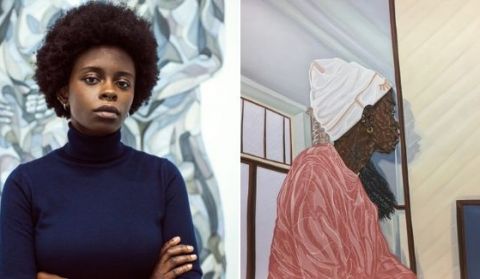
Toyin Ojih Odutola has gained a lot of popularity over the years for her pen ink drawings, which raise pertinent questions about the construct of blackness. Now, with a recent sale of one of her stunning pieces, she’s officially the third highest selling Nigerian artist of all time. 

After moving from Nigeria to America at the age of five, Ojih Odutola became aware of her blackness and began questioning her identity. Due to the shock of this transition, she used art as a coping mechanism, and over time, it transformed into an “investigative, learning activity” for her. 

Speaking with Vogue about how art helped her escape, Odutola said:

“I was obsessed, capturing everything I saw and being fascinated with the incredibly simple task of looking at something and transmitting it onto paper. It’s an immediate magic.”

Yesterday at the Sotheby’s, Toyin sold one of her fantastic drawings, titled ‘Compound Leaf’, for £471,000 (roughly N215 million), making her the 3rd highest selling Nigerian artist of all time — behind fellow female artist, Njideka Akunyili Crosby, and the legendary Ben Enwonwu.

Check out more of her work right here: 

Credit: konbini.com