Patricia Obozuwa is the Chief Communications and Public Affairs Officer for GE Africa, a position she has held since April 2012 when she built the communications and public affairs functions.
Patricia leads a team of communicators across Sub-Saharan Africa, building and protecting GE’s brand and image on the sub-continent. She established GE Africa’s corporate social responsibility platform, GE Kujenga, aimed at empowering people by building and elevating innovative ideas that are solving Africa’s challenges. In 2016, Patricia established the ‘GE Lagos Garage’ a hub for advanced manufacturing skills development that has produced over 250 graduates in Nigeria to date (December 2018).
She is the founding co-hub leader of the GE Women’s Network for Sub-Saharan Africa. Prior to joining GE, she was Head, External Relations, Nigeria and Corporate Communication Leader, Sub-Saharan Africa at Procter & Gamble (P&G) where she pioneered the public relations function and built the West Africa communications team from scratch. Before joining P&G in 2005, Patricia was the Arts and Sponsorship Manager for the British Council in Nigeria.
Patricia is a Board Director of The Water Trust (US-Headquartered Non-Patricia is a Board Director of The Water Trust (US-Headquartered Non-Profit Organization) and is also a member of the Lagos State Industry Advisory Board for the Yaba ICT Hub/Cluster project and she is on the jury of the “Africa Excellence Awards” since 2016h Guardian class teacher at her local churcurney, how she always puts well-an Woman to talk about her career journey, how she always puts well-qualified women forward and improving the pay gap between women and men.
You are described as a global thought leader in communications and public affairs; could you tell us what this means for you?
I suppose this is because of my leadership roles in communicating for some of the biggest companies in the world, a lot more people are interested in what I have to say these days. I am passionate about reputation building and I take as many opportunities as I can to share what I’ve learned from my 24-year career. I tend to offer my opinion through written articles, videos, on panels and other speaking opportunities.
Take us through your career journey and your remarkable switch from accounting to arts and then communications?
I studied Accounting at University, but I never worked as an accountant. My first real job was working as an Assistant Curator at a Nigerian Art Gallery called Nimbus. It was just opening at the time, but it grew to become very popular. I often refer to this period as the most blissful two years. Being surrounded by beautiful art and meeting lots of interesting people across all spheres of life could really be addictive. It was during my time at Nimbus that I got exposed to the work of the British Council and I applied for a job there as soon as the opportunity opened up.
For almost six years, I managed the British Council’s arts programme for Nigeria and implemented some of the most rewarding initiatives across music, drama, literature, art, and photography, all strategically aimed at changing perceptions of the UK in a way that appealed to young professionals, a new target demographic at the time. This is where I started to consciously build my communications expertise in a structured manner.
I started honing my skills in formal and creative writing, managing press briefings, posting stories on our website, updating arts information, and bringing all of that together with my arts strategy to build the image of the British Council in Nigeria. This experience and accomplishments put me in a good position for my next job at Procter & Gamble where I built the West Africa Communications and Public Relations function and the team from scratch.
I worked there for a little under seven years before moving to my current role at GE. The company had just renewed its focus on emerging markets and carved out GE Africa from the previous Middle-East & Africa region. And I was hired in 2012 to lead Communications and Public Affairs, building the function, team, strategy and messaging for GE Africa.
Tell us what your job entails at GE Africa?
I lead a team of communicators across Sub-Saharan Africa, building and protecting GE’s brand and image on the sub-continent. I set the communications and public affairs direction and strategy for GE in Africa to support our business objectives. And as part of the global communications leadership team, I also have a responsibility to contribute and deliver on GE’s global communications approach and strategy.
Along with my team, I communicate GE’s position on industry matters through media and thought leadership activity while also dealing with any issues that may arise. But to deliver successfully on all these responsibilities, my biggest job is to empower and inspire our team of communicators across the different countries to deliver on the company’s objectives.
In such a complex region, with several languages, cultures, laws, and histories, it is important that you have the best people on the ground, communication leaders in their own right, who understand the culture and nuances – not just to execute plans but also contribute to the broader strategy for Africa. At the senior leadership level, you can only accomplish so much alone. Excellent results come from having a highly motivated team of leaders and the ability to lead and influence others to deliver results for the company.
Holding such a position cannot be without its challenges, what are some you have faced and how did you overcome?
That would probably be navigating multiple cultures, languages, and personalities to deliver excellent results.
In communicating for a company across Africa and playing a broader people leadership role for the company, there is much more diversity than there are similarities. But I overcome this by focusing on inspiring, motivating and empowering the right people in each region to lead and deliver results. My biggest challenge in life is to be the best I can be. People expect a lot from us, and we expect a lot from ourselves. The real test is to navigate through career, relationships and personal values amidst expectations of others and myself, keeping a clear head, staying focused and remaining grounded.
Tell us a bit about your background and upbringing; would you say it has contributed to your person and success today?
I come from a large family and I’m one of the youngest. My parents were amazing, and they instilled the principles of hard work and personal achievement in all of us. Beyond having the most amazing parents, my many siblings served as excellent role models to follow and with that came a great deal of accountability. In my family, there was always the unwritten rule that even though everyone is extremely supportive of the other, each person must find their own personal abilities and chart their own path to success. My twin sister, Felicia who doubles as my best friend, has been an important supporter and critic. We constantly challenge each other to be better and I can count on her for good honest feedback. I also get a lot of advice from my other siblings. My mother as well who always thinks I’m awesome; this is a major confidence booster.
You sit on the board of a US-based non-profit, The Water Trust. Can you tell us more about this?
I joined the Board of Directors in December 2018. The Water Trust is a US-headquartered non-profit organization that has been improving water, hygiene, and sanitation in rural communities in Africa for the past 10 years, building latrines, teaching hand-washing and driving other sanitary habits. Today, its operations are primarily in Uganda, helping parents understand why kids need clean water to stay healthy; changing behaviours, to help save lives; and most importantly, empowering people to take better care of themselves.
In terms of impact, The Water Trust has either built or refurbished over 330 water points in rural Uganda, benefitting 200,000 people. It is rewarding for me to be able to give back to society in this way. I should also mention that on our board, four of us out of nine non-executive directors are women. Now isn’t that a good example of gender diversity?
Would you say you are fulfilled?
I am content and I am happy. I have the most amazing family and wonderful friends. I love my job and the company I work for. Its values align with my personal values of leadership and integrity. I serve on the board of a non-profit that is positively impacting hundreds of thousands of households. I have met and worked alongside some of the most inspiring people in the course of my career. I feel blessed by the opportunities I have been given in life.
With your wealth of experience garnered over the years, would you ever consider going into entrepreneurship? Yes, that’s certainly an option. The discipline and rigour you need to succeed in the corporate world is certainly a good foundation for entrepreneurship. However, whether in a company or as an entrepreneur, my passion is in helping people, corporations and even countries to show and demonstrate their best attributes in order to achieve their objectives, whatever they may be. This is what I’ve been privileged to do throughout my career, and this is what I drive through speaking engagements, capacity building for communications professionals and volunteer work.
Do you think today’s women have broken the ‘glass ceiling’?
I believe we have broken it in several isolated cases. An exemplary story is that of Rwanda where the women in parliament form almost 70 percent of the number. Some companies have taken concrete steps to ensure women are promoted to leadership.
At GE, where I work, we take this very seriously and we have instituted programs that have yielded excellent results in attracting, retaining and promoting women into leadership positions. But globally, across all spheres of life, we still have a long journey ahead of us. I read in a McKinsey report that just 23 percent of executives in Africa are women and an even smaller 5 percent are at the CEO level.
In Rwanda where women are so well represented, we apparently make just 88 cents for every dollar a man makes. So there has been quite a bit of progress but we still have a long way to go.
What would you advice a woman that wants a seat at decision making tables? Be diligent in whatever you do and do it with excellence. This is the entry point for both men and women. You need to be “faithful with the little” to be entrusted with great things. Focus on the job or task at hand while aspiring for bigger things. Seek out the right mentors. You can learn from their experience, mistakes, and wisdom. It gets you there faster than having to experience everything yourself and it helps you avoid pitfalls. Have confidence and a strong conviction about your abilities while being very self-aware about the areas you need to develop. Have the courage to lead even when you haven’t been formally asked. This is easier if you are willing to take on unpopular or undefined tasks. You are more likely to be appointed to a leadership position when people have already experienced your leadership. And my appeal, lift other women up as you climb. The more women are at the top, the more women are motivated to get there.
What do you think of mentoring for women and how important is it for career women?
Finding the right mentors is important for any career and especially for women. We tend to have a lot more to prove and we are often in that unique position of juggling responsibilities of childbearing, playing the lead role in raising our families alongside growing our careers.
Personally, I don’t believe one mentor can help me with all aspects of my career. I have had the opportunity to learn from some of the most amazing women who were more senior to me and had greater experience in their career, but I have also had some of the best mentorships from peers who were skilled in areas that I needed to develop.
How are you using your voice and position to help and encourage other women?
I mentor a lot of women and I frequently speak on gender balance, both from an advocacy position and in capacity building for women. But I don’t believe that talking is enough. We must also take action and fix gender balance issues when we spot them. I make the effort to ensure that women are well represented in any programme I’m responsible for.
Whenever I find myself in a position to either appoint or sponsor someone for a leadership role, I always put a well-qualified woman forward. And at times that I have spotted a pay gap between a woman and a man doing the same job or role, I have either fixed it myself or advocated for it to be fixed. My proudest achievement to date in this regard has been engineering a 90 percent pay increase for a highly talented woman who had negotiated a significantly less salary than her male peer.
If you could influence change, what change would you like to see for Nigerian women?
I would like to see a much stronger balance of genders in the corporate world, not just at junior levels, but in executive management and boards. That’s my vision. In addition to this, when qualified women are promoted to an executive level, I want to see them being given the power and the agency that should naturally go with such positions.
Lastly, when women are represented and have the power and agency, I want to see them being paid at par with their male equivalents. This applies not just to Nigeria, but also everywhere in the world. Awareness has significantly increased and there has been some progress in women’s participation but we are still a long way off from gender balance in corporations, in politics, and in Nigeria as a whole. For us to make any real progress, not just women, but men need to join in advocating and promoting gender diversity. We have to be intentional and start taking concrete actions to create the gender-balanced future that we want to see.
What do you do to relax? What is your guilty pleasure?
I deeply value being able to separate myself from all the madness around me and catch some “alone time.” That’s when I recharge my body, mind and spirit, a prerequisite for me to stay productive and positive. I love music. I love African literature and I love Nigerian art. From my years of working in a gallery, I got accustomed to being surrounded by beautiful art. For me, relaxing involves any one or a combination of these things. Netflix is definitely a guilty pleasure.
Who and what inspire/drives you to be better?
My faith is very important to me and is the biggest driving force in my life choices, my work ethic and my day-to-day interaction with others. I’m not perfect, of course. I’m still very much a “work-in-progress.” But I try to be the best I can possibly be, and I try to give to the world the very best of myself, talents and abilities.
Tell us about your style, what look would we likely see you in?
My style or my look is generally classic and polished. Although I deviate from that every now and then. But you’re unlikely to see me in an over-adventurous hairstyle or revealing clothes. I tend to stick to the tried and tested.
Credit: Guardian Woman, Tobi Awodipe


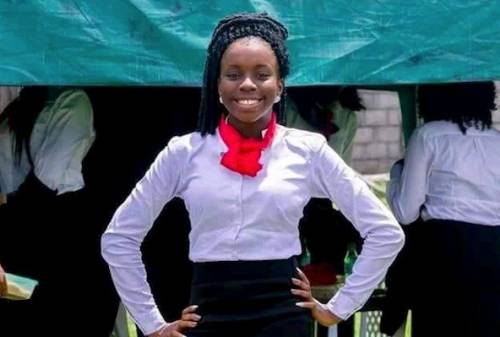 Nigerian girl, Ugboaja Chizobam Stephany, has emerged the youngest, best candidate ever recorded by the West African Examination Council (WAEC).




 Gospel singer, Kenny Saint Best is over the moon as her daughter graduates from High School in flying colors.