

Women of Rubies

Tag

Marketing Strategy

Browsing

Your business is getting noticed. People like your posts, watch your videos and visit your website. Yet the enquiries and sales you hoped for are still slow.

This is a common challenge for entrepreneurs: brand visibility creates attention, but that attention needs a clear path to becoming trust and a purchase.

Potential customers need to understand what you offer, see evidence that you can deliver and feel confident taking the next step. Here is how to build that connection.

1. Make Your Brand Message Easy to Understand

When someone discovers your business, can they quickly tell who you help and what you help them achieve? A beautiful website or active social media page can attract interest, but unclear messaging leaves potential customers guessing.

Your brand message should explain:

  • Who your product or service is for.
  • What problem it solves.
  • What benefit customers can expect.
  • How they can buy or enquire.

For example, “We empower entrepreneurs” communicates an intention. “We help women entrepreneurs strengthen their brand messaging and prepare for media opportunities” gives a potential customer more information to work with.

Review your bio, website introduction and service descriptions. Make sure they communicate the same core offer in language your customers understand.

2. Create Content That Answers Buying Questions

Content can help people move from discovering your brand to considering your offer. To support that journey, address the questions customers ask before making a decision. These might include:

  • Is this suitable for someone at my stage?
  • What does the service include?
  • How does the process work?
  • What will I need to provide?
  • What makes this approach relevant to my problem?

A consultant could explain what happens during a strategy session. A product business could demonstrate how an item works. A training provider could show the skills participants will practise and where they can apply them.

Useful content gives people enough information to assess your offer. It also creates opportunities to demonstrate your expertise before asking for a sale.

3. Support Your Claims With Credible Proof

Potential customers want reassurance that your business can deliver what it promises. Build customer trust by sharing evidence such as genuine testimonials, examples of your work, case studies and relevant experience.

A strong case study explains the client’s starting point, the work you completed and the outcome you can substantiate. It helps readers understand how your expertise applies to a situation they recognise.

Use specific language. If you helped a client refine their positioning and secure media coverage, explain those results accurately. If you do not have sales data, focus on the outcomes you can verify. Share client feedback with permission and preserve its meaning. Clear, honest evidence makes your marketing more persuasive.

4. Give Interested Customers a Clear Next Step

Someone may be interested in your business and still leave without taking action because the next step is difficult to find. Match your call to action to the content and the customer’s likely readiness.

For example:

  • A service explanation can invite readers to book a consultation.
  • A product demonstration can link directly to the product page.
  • An event announcement can lead to registration.
  • An educational article can guide readers to a relevant service.

Once they click, make sure the destination answers the questions that matter. Include the offer, what is included, pricing where appropriate and how to proceed. Check the process on a mobile phone. A confusing form, broken link or unclear payment instruction can interrupt a customer who was ready to buy.

5. Use AI to Support Your Marketing Process

AI can help business owners organise ideas, draft content and repurpose useful material. It works best when you provide the knowledge and direction behind the message. Start with actual customer questions, your experience and an accurate description of your offer. You can then use AI to help turn that material into a blogpost, email or social media caption.

Review every draft for accuracy, tone and relevance. Keep examples specific to your work and make sure any claims are supported. A manageable approach is to develop one useful idea each week and adapt it for the channels your audience uses. This can help you maintain consistency while leaving time for enquiries, delivery and customer relationships.

6. Build Trust Through the Customer Experience

Your marketing makes a promise. The customer experience shows whether you can fulfil it. Pay attention to how you respond to enquiries, explain your process, set expectations and communicate during delivery. These interactions influence whether customers feel confident working with you.

If you promise a response within two business days, follow through. If a project is delayed, communicate early. If a customer raises a concern, address it clearly and respectfully. Reliable service strengthens the credibility your content is trying to build. It also gives satisfied customers a reason to recommend your business.

7. Make Customer Retention Part of Your Growth Strategy

Existing customers already have experience with your business. Maintaining those relationships deserves a place in your marketing plan. Depending on your offer, you could follow up after delivery, provide useful guidance, explain a relevant next service or invite feedback.

Keep the communication helpful and appropriate. A follow-up should show that you understand the customer’s needs, rather than simply asking them to spend again. Repeat purchases and referrals can reveal whether your business is creating lasting value. They also help you identify which offers and experiences customers appreciate most.

8. Measure What Happens After People Notice You

Reach and engagement show how people encounter your brand. To assess whether visibility is supporting sales, track the actions that follow. Useful measures include website visits to service pages, qualified enquiries, consultation bookings, purchases, repeat business and referrals.

Look for where the journey slows down. If people engage with your content but rarely enquire, review your offer and call to action. If enquiries arrive but few become customers, examine pricing clarity, suitability and the information people receive before deciding.

These patterns can help you improve the process instead of simply increasing how often you post.

Turn Attention Into a Stronger Business

Brand visibility gives potential customers a chance to discover you. Clear messaging helps them understand your value. Credible proof and reliable service help them develop trust. An accessible buying process makes it easier to act. Start by reviewing one offer: its message, supporting evidence and next step. Improving that path can make your existing visibility more useful to your business.

Learn How to Strengthen Your Marketing and Personal Brand With Hava Maloku

Putting these strategies into practice takes clarity, consistency and a marketing process you can manage alongside running your business. This is where Hava Maloku’s expertise connects to the conversation.

Hava Maloku is the Founder and CEO of Maloku Marketing, bringing more than 15 years of experience in marketing, customer retention and business growth, including work at LinkedIn, Expedia and LegalZoom. Through her company, she helps organisations connect their marketing efforts, customer experience and growth strategy to build stronger, more sustainable businesses.

Her session will explore how to use AI for idea generation, content development, research, repurposing and consistency while keeping your voice and expertise at the centre. For entrepreneurs looking to build customer trust through their marketing, these skills can help make sharing useful, relevant content more manageable.
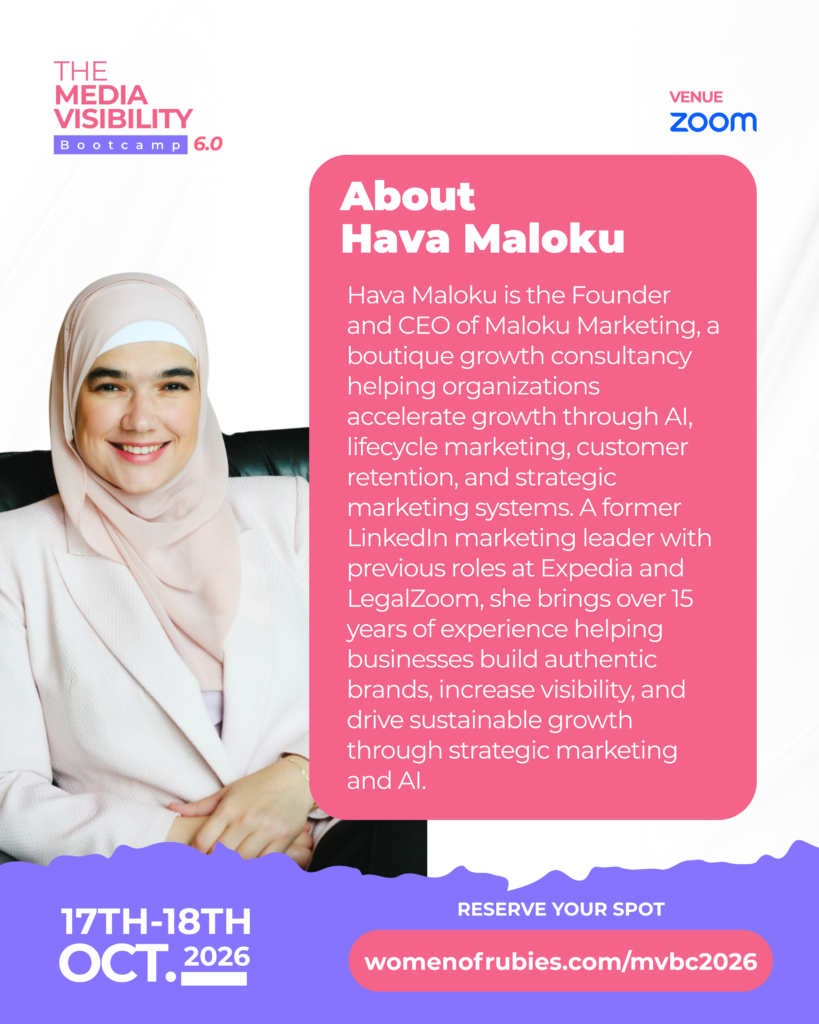
Hava Maloku, Founder and CEO of Maloku Marketing, speaker at Media Visibility Bootcamp 6.0.
Learn from Hava Maloku how AI can help you build a personal brand without becoming a full-time content creator.

Connect With Hava Maloku

Explore more of Hava’s work and insights on marketing, personal branding and business growth:

LinkedIn | Instagram | Website

Join Media Visibility Bootcamp 6.0

Ready to communicate your value more clearly and build a more intentional approach to visibility? Join Women of Rubies virtually on October 17–18, 2026, to learn from Hava and other experts across marketing, communications, business strategy, technology and leadership.

Explore the programme and reserve your spot at womenofrubies.com/mvbc2026.

Princess Adetola Oluyede has built her work around a challenge many businesses face today: gaining attention is one thing, but turning that attention into meaningful business results requires strategy.

A marketing strategist and entrepreneur, she is the founder of House of PAc Media, a full-service marketing agency and diaspora media brand amplifying African voices across Canada. She is also the co-founder of Studyplace, an educator monetization platform. Across these ventures, her work centres on strategic storytelling, content and brand positioning, with a focus on helping brands and events connect with their audiences and convert visibility into sales.

As businesses compete for attention across increasingly crowded digital platforms, Princess Adetola’s approach reflects an important shift in marketing. Visibility is valuable, but the number of people who see a brand does not necessarily determine its commercial success. A business may generate strong engagement, attract a growing audience or receive significant exposure and still struggle to convert that attention into enquiries, registrations or sales.

The difference often lies in what happens after the initial attention is gained.

Building Visibility With a Clear Business Purpose

For entrepreneurs and growing brands, there can be pressure to remain constantly visible. Social media has made publishing easier, but it has also created an environment where businesses can become focused on producing content without considering how each piece contributes to a broader objective.

Princess Adetola Oluyede’s work focuses on connecting visibility to business goals. This means looking beyond how frequently a brand appears online and considering whether its audience understands what it offers, who it serves and why its work is relevant.

When those elements are unclear, increased visibility may produce attention without creating meaningful action. Strategic marketing brings greater intention to that process by ensuring that storytelling, content and brand positioning work together rather than operating as separate activities.

For brands and events, this can mean developing messaging that attracts the right audience while also providing a clear reason for that audience to remain interested, engage further, or eventually make a purchase.

Using Strategic Storytelling to Strengthen Brands

Storytelling has become an important part of how businesses communicate, particularly as audiences increasingly expect brands to demonstrate personality, purpose and relevance rather than rely solely on promotional messages.

Effective brand storytelling, however, requires more than simply sharing a founder’s personal journey or posting behind-the-scenes content. The story must connect with the people the business is trying to reach and help them understand the value behind the brand.

This is where strategic storytelling becomes particularly important. A business can use stories to communicate the problem it solves, demonstrate its impact, highlight customer experiences and explain the motivation behind its work. When those stories are connected to a clear brand position, they can strengthen recognition and make the business easier for its audience to understand and remember.

For Princess Adetola, storytelling forms part of a broader marketing strategy designed not simply to generate attention, but to create connection and support conversion.

Creating Content That Connects and Converts

Content remains one of the most accessible ways for businesses to build relationships with potential customers, but producing more content does not automatically produce better results.

A strong content strategy considers what an audience needs at different stages of its relationship with a brand. Some content may introduce the business, while other content educates, establishes credibility, answers questions or addresses concerns that may prevent a potential customer from taking the next step.

This approach shifts the focus from publishing for the sake of remaining active to creating content with a defined purpose.

For entrepreneurs, that distinction can be significant. Instead of asking what they should post each day, they can begin thinking more strategically about what their audience needs to know, what perceptions they want to build and how their content supports the larger objectives of the business.

Why Brand Positioning Matters

Brand positioning is another important part of Princess Adetola Oluyede’s work. In competitive markets, businesses need more than visibility to distinguish themselves. Their audiences must be able to understand what they offer and why that offer is relevant.

Clear positioning helps a business define its place in the market and communicate its value consistently. It influences messaging, content, storytelling and the overall experience people have when they encounter the brand.

For entrepreneurs who are investing in greater visibility, strong positioning can also help ensure that increased attention reinforces the right message. Being widely known is less useful if potential customers remain uncertain about what the business does or why they should choose it.

Bringing storytelling, content and positioning together creates a more cohesive marketing approach. Visibility attracts attention, storytelling builds connection, content develops the relationship, and positioning gives the audience clarity about the value being offered.

Amplifying African Voices Across Canada Through House of PAc Media

Princess Adetola Oluyede’s work through House of PAc Media also reflects her commitment to amplifying African voices within Canada.

As both a full-service marketing agency and diaspora media brand, House of PAc Media operates at the intersection of marketing, media and community storytelling. Its focus on African voices contributes to a growing media landscape in which diaspora communities are building platforms to tell their own stories and create greater representation.

For African entrepreneurs, professionals and organizations operating in Canada, this kind of platform can play an important role in ensuring that stories are communicated with an understanding of the communities and experiences behind them.

Princess Adetola’s work therefore extends beyond helping businesses market themselves. It also contributes to creating greater space for African stories and perspectives within Canada’s media and marketing ecosystem.

Building Opportunities for Educators Through Studyplace

Her entrepreneurial work also includes Studyplace, an educator monetization platform she co-founded.

The platform reflects another aspect of Princess Adetola’s interest in helping people translate knowledge and expertise into economic opportunities. As professionals increasingly explore ways to package and monetize their knowledge, platforms that support educators in building income from their expertise are becoming part of a broader knowledge and creator economy.

Across House of PAc Media and Studyplace, there is a consistent connection between communication, positioning and value creation. Whether the audience is discovering a brand, attending an event or paying for expertise, people need to clearly understand the value being presented to them before they can act on it.

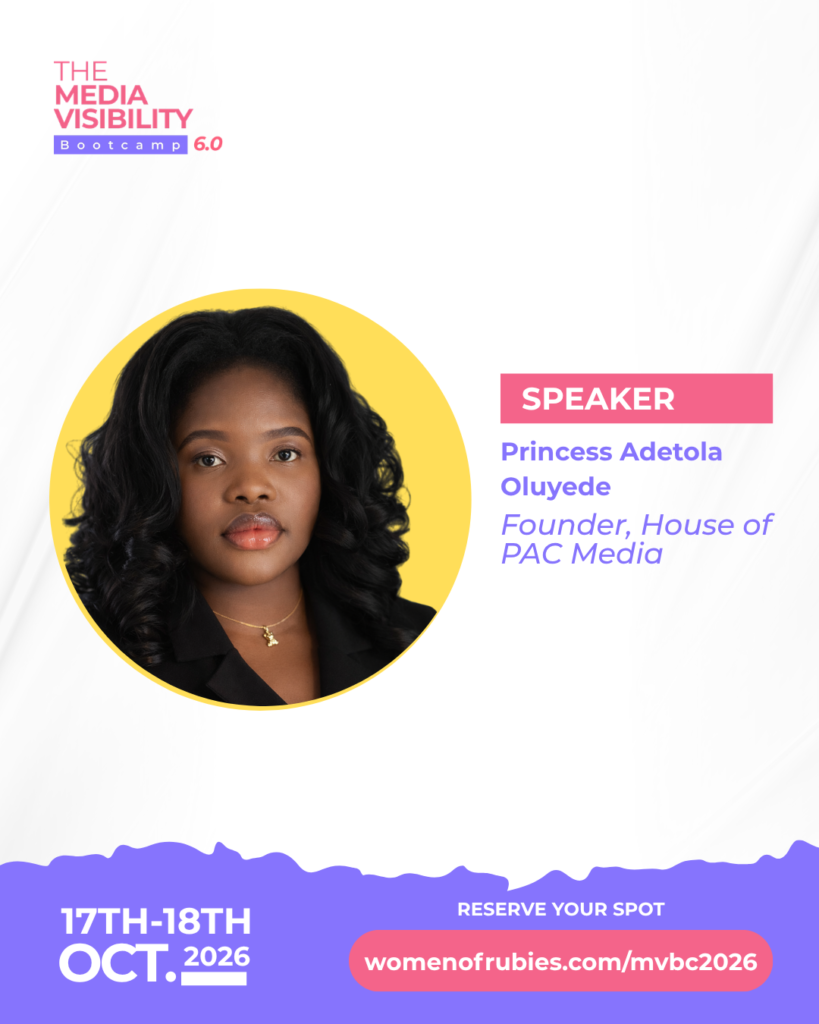
Princess Adetola Oluyede, panelist at Women of Rubies Media Visibility Bootcamp 6.0
Princess Adetola Oluyede joins the Women of Rubies Media Visibility Bootcamp 6.0 as a panelist, bringing expertise in strategic storytelling, content, brand positioning and turning visibility into sales.

Bringing a Conversion-Focused Perspective to Media Visibility Bootcamp 6.0

Princess Adetola Oluyede will bring this marketing and entrepreneurial perspective to the Women of Rubies Media Visibility Bootcamp 6.0, taking place virtually on October 17–18, 2026.

As one of this year’s panelists, her contribution will add a commercial dimension to the conversation around visibility. For entrepreneurs and professionals working to increase their profile, gaining attention is an important step, but the ability to translate that attention into stronger relationships, customers and business opportunities is equally important.

Her experience in strategic storytelling, content and brand positioning will contribute to a broader conversation about building visibility with intention and ensuring that marketing efforts are connected to measurable goals.