For many entrepreneurs, the product becomes the centre of every conversationabout their work. They explain what they sell, who it serves and why someone should buy it. Yet the knowledge behind that product can be just as valuable.
Vivian Kaye’s journey offers a useful example. The Ghanaian-Canadian entrepreneur founded KinkyCurlyYaki, built it into a seven-figure business and developed a public presence that also encompasses speaking, media appearances and education.
Her story invites founders to consider a question: beyond your product, what do you want people to recognise your expertise for?
A business rooted in personal experience
Born in Tema, Ghana, Vivian moved to Toronto as a toddler. Before launching KinkyCurlyYaki, she worked in several industries and established Vivian’s Decor & Designs, a wedding décor business she started in 2006.
The idea for her next venture emerged while she was working as a decorator. She struggled to find high-quality extensions that matched her natural hair texture and allowed her to present herself professionally without changing that texture.
She recognised that other women shared the same need. Vivian launched KinkyCurlyYaki in 2012. According to her account, the business reached six-figure revenue in its first year and seven figures in 2016. It was acquired in 2022.
That origin gives her founder story a clear foundation: a specific need, personal understanding of the customer and a solution built around that experience.
Bringing the founder’s expertise into view
Vivian’s website presents her as a business and empowerment expert, keynote speaker and television personality, alongside her identity as KinkyCurlyYaki’s founder.
Her speaking and educational work covers entrepreneurship, e-commerce, confidence and empowerment. She also shares business knowledge through her YouTube series, Mind Your Business. Her website lists appearances and coverage across outlets including CBC Radio, Cityline, The Globe and Mail and The New York Times.
These activities give audiences several ways to encounter her work. Someone may discover her through a product, hear her in an interview or learn from her at an event. The distinction matters: running a business creates experience. Sharing that experience helps others understand where your expertise lies.
The visibility lesson for founders
Women of Rubies’ takeaway from Vivian’s journey is to make the knowledge behind your work more accessible. A founder’s story can explain why a business exists. Educational content can demonstrate how the founder thinks. Interviews and speaking opportunities can introduce that knowledge to people who may never have encountered the product.
This does not mean every founder needs to pursue every platform. It means choosing places where your experience can contribute something useful. If you understand a customer problem deeply, explain it. If you have learned from a difficult business decision, share the lesson. If you have developed a process that helps people, show what makes it effective.
These are practical starting points for communicating your value.
Start with one lesson you can share
Think about a challenge you have solved in your work. What did it teach you that another person could use?Turn that insight into a post, a short video, an article or a relevant speaking topic. Connect it to a concrete example so people can understand the experience behind your advice.
Vivian Kaye’s journey illustrates how a founder can have several dimensions to her public identity. Her business is part of her story, alongside the knowledge and perspective she brings to wider conversations.
For women building their brands, that is an invitation to share more of the expertise they already have.
Explore more founder stories and practical visibility lessons at womenofrubies.com.
A powerful story needs a way to reach the people who could connect with it. Mo Abudu’s career offers a compelling example of what happens when a clear purpose is supported by years of work and platforms built to carry that purpose further.
As the founder and CEO of EbonyLife Group, Abudu has helped create spaces for African stories across television, film and cultural experiences. Her journey connects storytelling with an equally important question: where will audiences encounter the work?
Creating space for African conversations
Abudu entered media as the creator, executive producer and presenter of Moments with Mo. The programme brought African experiences and conversations to television, giving her a platform to explore the continent through its people and their stories.
She later launched EbonyLife TVin 2013, followed by EbonyLife Films in 2014. These ventures expanded the ways she could develop and share African narratives, moving from presenting conversations to building a broader production business.
For founders and creatives, this progression offers a useful point of reflection. A purpose can remain consistent while the way it reaches people evolves. An interview, a publication, a film or a physical venue can each introduce that purpose to a different audience.
Bringing Nigerian stories to international audiences
In June 2020, Netflix announced a multi-title partnership with Abudu’s production company, EbonyLife. The agreement included plans for original series and licensed films, with announced adaptations of works by Nigerian writers Lola Shoneyin and Wole Soyinka.
The partnership created another route for Nigerian storytelling to reach viewers internationally. It also reflected the production work EbonyLife had built over time. Our visibility takeaway is that reach and readiness belong together. A wider platform can introduce your work to more people, while a strong body of work gives potential partners something concrete to assess.
EbonyLife Place London: a physical home for culture
Abudu’s vision now includes EbonyLife Place London, which celebrated its opening on October 8, 2026. The venue brings together cinema and cultural experiences, creating a London destination for African and Black creativity.
AFP’s reporting describes a cinema, restaurant, lounge, boutique and artworks within the space, with public opening activities taking place that weekend. The project extends a concept Abudu previously established in Lagos.
For this story, the significance is the connection between creation and access. A physical destination gives people another way to discover films, fashion, art and culture. It turns a storytelling mission into an experience audiences can enter.
Visibility lessons for founders and creatives
At Women of Rubies, we draw three practical lessons from this journey.
Be clear about your purpose. What do you want your work to communicate? A clear answer helps people understand why your business, project or story matters.
Build work people can discover. Document your projects, explain your contribution and keep your professional materials current. Make it easy for someone encountering you for the first time to understand what you offer.
Pursue relationships that expand your reach. Consider the publications, communities, organisations or collaborators whose audiences could benefit from your work. Approach them with a clear connection between what you create and the people they serve.
These are our editorial observations, rather than a formula that guarantees the same results. Abudu’s career also reflects the sustained business and creative work required to develop and deliver her vision.
What could help your work travel further?
You may already have a valuable service, completed project or story that deserves another introduction. Start with one piece of work. Explain the need it addresses, show what you contributed and identify an audience that would find it useful. Then consider the platform or relationship that could help you reach them.
Mo Abudu’s journey invites founders to think about both the work they create and the spaces through which people discover it.
Explore more inspiring profiles and practical visibility insights on womenofrubies.com.
A story published years ago can still find an audiencethat changes its future. For Zimbabwean author Sue Nyathi, the Netflix adaptation of The Polygamist brought international attention to a novel first published in 2012.
Her journey offers a compelling example of what can happen when an established body of work reaches a new platform. It also holds a practical lesson for women building businesses, personal brands and creative careers: the work you already have may deserve another spotlight.
Who Is Sue Nyathi?
Born and raised in Bulawayo, Zimbabwe, and now based in South Africa, Sue Nyathi is an author whose professional background includes finance, investment and economic development consulting.
She studied finance at the National University of Science and Technology in Zimbabwe, later completing a master’s degree in Finance and Investment. Alongside her professional career, she continued writing, making space for creativity beyond financial markets and analytical work.
Her writing also appeared in the Sunday Mail’s “Steaming Off” column in Zimbabwe. Readers responded to her articles about love and relationships, sharing their own experiences and encouraging her to write a book.
After relocating to Johannesburg in 2008, Nyathi pursued publication more actively. Her debut novel, The Polygamist, was published in 2012. Her other books include The Gold Diggers, A Family Affair and An Angel’s Demise.
Across her work, she explores relationships, migration, family tensions and the social realities that shape people’s lives.
From a Published Novel to a Netflix Hit
In June 2026, The Polygamist made its Netflix debut as a 22-episode series based on Nyathi’s novel. According to Netflix’s report published on August 4, 2026, the adaptation had reached No. 1 in 21 countries and the Top 10 in 62, accumulating 27.6 million views.
The attention translated into renewed demand for her writing. Sales of The Polygamist tripled following the series’ debut, while her other books also benefited from the increased interest. A story that had been available for more than a decade was now reaching people who might never have encountered it on a bookshelf.
The Visibility Lesson: Give Existing Work New Ways to Be Discovered
At Women of Rubies, our takeaway from Nyathi’s journey is that visibility can create fresh opportunities for work that already exists.
For an author, that may mean a screen adaptation. For an entrepreneur, it could mean introducing an established service to a different market. For a consultant, it might involve turning a useful framework into a workshop or building a partnership that brings their expertise to a new audience.
These opportunities differ in scale, but they raise the same question: who has yet to discover the value of your work? Nyathi’s story does not offer a formula for a global breakthrough. It does show how a new format and distribution platform can connect existing work with new demand.
What Women Building Brands Can Apply
Start by reviewing what you have already created. Consider a successful project, a useful resource, a service clients appreciate or a story that still matters.
Then ask yourself:
Is its value clear to someone encountering it for the first time?
Could another format make it easier to discover or understand?
Which platform, community or partner could introduce it to a relevant audience?
Is there a clear next step for people who want to buy, book or learn more?
Visibility becomes more useful when attention has somewhere to go. Make it easy for new audiences to find your work and take action.
What Deserves a Second Spotlight?
Sue Nyathi’s Netflix breakthrough began with a story written years before its screen adaptation. For women creating and building, that is a reason to look again at the work already in your hands. Your next opportunity may involve presenting it differently, sharing it more widely or finding a partner who sees its potential.
What have you created that deserves to reach more people?
Explore Sue Nyathi’s books and author journey at suenyathi.co.za.
This feature is part of Women of Rubies’ “The Visibility Behind Her Success” series, exploring women’s achievements and the lessons their journeys offer for building visibility.
Joanna Griffiths, founder of Knix, offers women entrepreneurs a valuable lesson in brand visibility: understanding your audience gives you something meaningful to communicate.
She founded Knix to address an overlooked need in intimate apparel, particularly for people experiencing leaks. In her account of the brand’s origins, Griffiths identifies customer feedback, inclusivity and breaking taboos as guiding principles behind her work.
For women building businesses, her story raises a useful question: does your message reflect what your audience actually needs?
In this edition of The Visibility Behind Her Success, Women of Rubies explores Joanna Griffiths’ founder story and the practical lessons entrepreneurs can apply to their own storytelling, content and brand positioning.
The customer need behind Knix
On Knix’s official website, Griffiths explains that frustration with limited innovation in underwear, particularly for people experiencing leaks, inspired her to develop leakproof underwear. She identifies customer feedback, inclusivity and breaking taboos as guiding principles in building the brand.
That account provides the foundation for this case study. The lessons below are Women of Rubies’ analysis of how entrepreneurs can apply a similar focus on customer understanding to their own communications.
Your business may operate in a completely different industry. The useful question remains the same: what does your audience need that existing conversations, products or services are overlooking?
Brand visibility lessons begin with listening
Creating content can become a cycle of deciding what to post, producing it and moving on to the next idea. Listening gives that process a clearer direction.
Customer questions, enquiries and feedback can reveal what people need explained before they feel ready to buy. They can also show where your messaging assumes knowledge your audience does not yet have.
For example, a consultant may describe her service as “strategic business support.” Her prospective clients may be asking something more specific: “How do I explain what I do without confusing people?”
That question offers a stronger starting point for useful content.
Review your recent enquiries. Look for one question that appears repeatedly and answer it in a post, article or short video. Use language your customers recognise.
Explain the problem your work solves
A clear brand message helps people connect a product or service to a situation they understand.
For your business, try completing this sentence:
“I help [a specific audience] address [a specific problem] through [your product or service].”
Then check whether your website, biography and social profiles communicate that same idea.
You can still share your qualifications, awards and experience. Give those credentials context by explaining how they help you deliver value.
A reader should be able to identify whom you serve, what you help them achieve and how to take the next step.
Use your founder story to give your work context
A founder story becomes useful when it helps people understand your decisions.
What did you notice? What prompted you to act? What did you learn from the people you wanted to serve?
These questions can produce a story with more substance than a list of milestones. They also help you connect your personal experience to your business purpose without sharing every private detail.
Consider explaining one decision that shaped your work. Perhaps you changed a service after hearing the same frustration from several clients. Perhaps an experience revealed a gap you wanted to address.
Tell that story clearly, then connect it to what your audience can expect from your business today.
Turn customer understanding into useful content
Listening should influence what you create.
If customers repeatedly ask how a service works, explain the process. If they struggle to compare options, offer a straightforward guide. If they misunderstand your role, show a practical example of what you help someone do.
Build your next three posts around:
A question your audience frequently asks.
A concern that makes them hesitate.
An example that explains the value of your work.
Protect customer privacy and seek permission before sharing identifiable stories or testimonials.
Useful content can help people assess whether your business is relevant to them. It also gives your visibility a purpose beyond attracting attention.
Make the next step easy to find
Once someone understands your value, make it simple to act. Your article, profile or service page should direct readers towards an appropriate next step. That might be viewing your services, booking a consultation, making an enquiry or purchasing a product.
Choose a clear action that fits the content. A practical educational article may lead naturally to a related service page; a product demonstration may lead to the product itself.
Review the journey from your social profile to your website. Can someone quickly find the information they need and understand how to work with you?
What women entrepreneurs can apply today
The lesson we take from Griffiths’ founder story is that customer understanding deserves a place in your visibility strategy. Start with one action this week: identify a recurring audience question, create a useful answer and connect it to the work you do.
Over time, this can help you develop a clearer message, more relevant content and a stronger explanation of your value. What is your audience telling you that could shape your next idea?
Build visibility around the value you bring
At Women of Rubies, we help women communicate their expertise and impact through storytelling, media positioning and visibility support. If you need help shaping your founder story or explaining what makes your business valuable, contact Women of Rubies through our Work with us pageto discuss support for your brand.
Want to apply these lessons to your own brand? Join Media Visibility Bootcamp 6.0, taking place virtually on October 17–18, 2026, to learn practical approaches to communicating your value and building visibility.
This article is part of “The Visibility Behind Her Success,” a Women of Rubies editorial series examining the lessons behind women’s work in business and media.
Your business is getting noticed. People like your posts, watch your videos and visit your website. Yet the enquiries and sales you hoped for are still slow.
This is a common challenge for entrepreneurs: brand visibility creates attention, but that attention needs a clear path to becoming trust and a purchase.
Potential customers need to understand what you offer, see evidence that you can deliver and feel confident taking the next step. Here is how to build that connection.
1. Make Your Brand Message Easy to Understand
When someone discovers your business, can they quickly tell who you help and what you help them achieve? A beautiful website or active social media page can attract interest, but unclear messaging leaves potential customers guessing.
Your brand message should explain:
Who your product or service is for.
What problem it solves.
What benefit customers can expect.
How they can buy or enquire.
For example, “We empower entrepreneurs” communicates an intention. “We help women entrepreneurs strengthen their brand messaging and prepare for media opportunities” gives a potential customer more information to work with.
Review your bio, website introduction and service descriptions. Make sure they communicate the same core offer in language your customers understand.
2. Create Content That Answers Buying Questions
Content can help people move from discovering your brand to considering your offer. To support that journey, address the questions customers ask before making a decision. These might include:
Is this suitable for someone at my stage?
What does the service include?
How does the process work?
What will I need to provide?
What makes this approach relevant to my problem?
A consultant could explain what happens during a strategy session. A product business could demonstrate how an item works. A training provider could show the skills participants will practise and where they can apply them.
Useful content gives people enough information to assess your offer. It also creates opportunities to demonstrate your expertise before asking for a sale.
3. Support Your Claims With Credible Proof
Potential customers want reassurance that your business can deliver what it promises. Build customer trust by sharing evidence such as genuine testimonials, examples of your work, case studies and relevant experience.
A strong case study explains the client’s starting point, the work you completed and the outcome you can substantiate. It helps readers understand how your expertise applies to a situation they recognise.
Use specific language. If you helped a client refine their positioning and secure media coverage, explain those results accurately. If you do not have sales data, focus on the outcomes you can verify. Share client feedback with permission and preserve its meaning. Clear, honest evidence makes your marketing more persuasive.
4. Give Interested Customers a Clear Next Step
Someone may be interested in your business and still leave without taking action because the next step is difficult to find. Match your call to action to the content and the customer’s likely readiness.
For example:
A service explanation can invite readers to book a consultation.
A product demonstration can link directly to the product page.
An event announcement can lead to registration.
An educational article can guide readers to a relevant service.
Once they click, make sure the destination answers the questions that matter. Include the offer, what is included, pricing where appropriate and how to proceed. Check the process on a mobile phone. A confusing form, broken link or unclear payment instruction can interrupt a customer who was ready to buy.
5. Use AI to Support Your Marketing Process
AI can help business owners organise ideas, draft content and repurpose useful material. It works best when you provide the knowledge and direction behind the message. Start with actual customer questions, your experience and an accurate description of your offer. You can then use AI to help turn that material into a blogpost, email or social media caption.
Review every draft for accuracy, tone and relevance. Keep examples specific to your work and make sure any claims are supported. A manageable approach is to develop one useful idea each week and adapt it for the channels your audience uses. This can help you maintain consistency while leaving time for enquiries, delivery and customer relationships.
6. Build Trust Through the Customer Experience
Your marketing makes a promise. The customer experience shows whether you can fulfil it. Pay attention to how you respond to enquiries, explain your process, set expectations and communicate during delivery. These interactions influence whether customers feel confident working with you.
If you promise a response within two business days, follow through. If a project is delayed, communicate early. If a customer raises a concern, address it clearly and respectfully. Reliable service strengthens the credibility your content is trying to build. It also gives satisfied customers a reason to recommend your business.
7. Make Customer Retention Part of Your Growth Strategy
Existing customers already have experience with your business. Maintaining those relationships deserves a place in your marketing plan. Depending on your offer, you could follow up after delivery, provide useful guidance, explain a relevant next service or invite feedback.
Keep the communication helpful and appropriate. A follow-up should show that you understand the customer’s needs, rather than simply asking them to spend again. Repeat purchases and referrals can reveal whether your business is creating lasting value. They also help you identify which offers and experiences customers appreciate most.
8. Measure What Happens After People Notice You
Reach and engagement show how people encounter your brand. To assess whether visibility is supporting sales, track the actions that follow. Useful measures include website visits to service pages, qualified enquiries, consultation bookings, purchases, repeat business and referrals.
Look for where the journey slows down. If people engage with your content but rarely enquire, review your offer and call to action. If enquiries arrive but few become customers, examine pricing clarity, suitability and the information people receive before deciding.
These patterns can help you improve the process instead of simply increasing how often you post.
Turn Attention Into a Stronger Business
Brand visibility gives potential customers a chance to discover you. Clear messaging helps them understand your value. Credible proof and reliable service help them develop trust. An accessible buying process makes it easier to act. Start by reviewing one offer: its message, supporting evidence and next step. Improving that path can make your existing visibility more useful to your business.
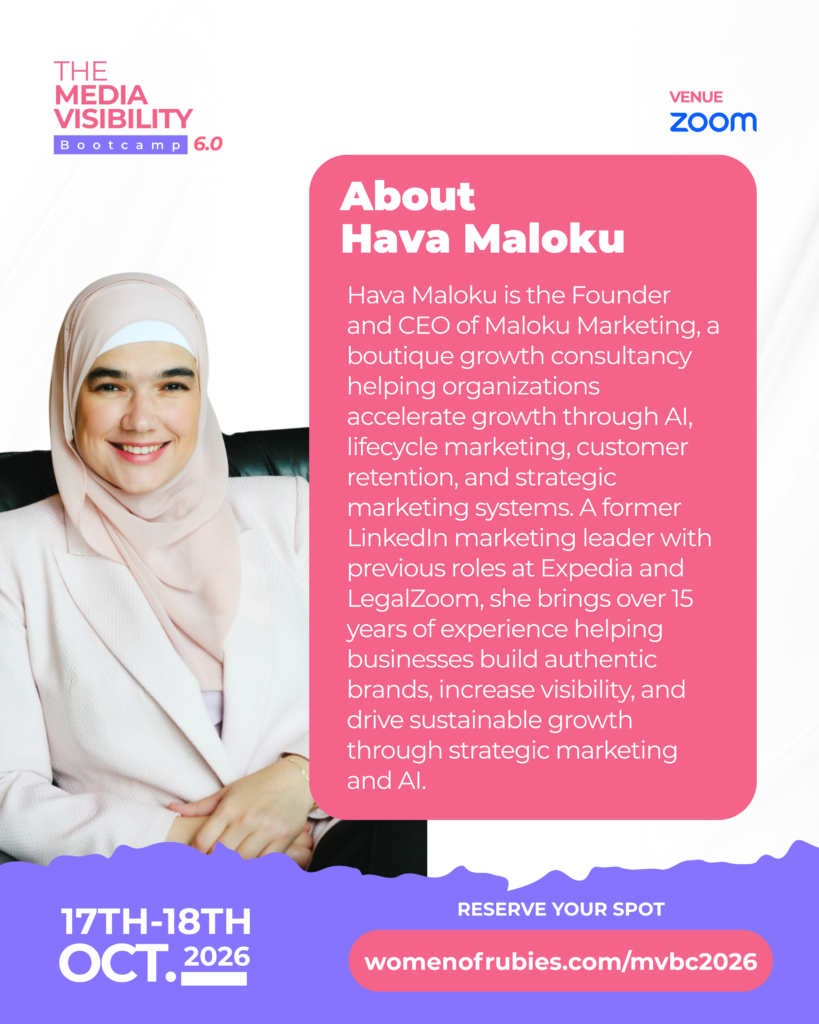
Learn How to Strengthen Your Marketing and Personal Brand With Hava Maloku
Putting these strategies into practice takes clarity, consistency and a marketing process you can manage alongside running your business. This is where Hava Maloku’s expertise connects to the conversation.
Hava Maloku is the Founder and CEO of Maloku Marketing, bringing more than 15 years of experience in marketing, customer retention and business growth, including work at LinkedIn, Expedia and LegalZoom. Through her company, she helps organisations connect their marketing efforts, customer experience and growth strategy to build stronger, more sustainable businesses.
Her session will explore how to use AI for idea generation, content development, research, repurposing and consistency while keeping your voice and expertise at the centre. For entrepreneurs looking to build customer trust through their marketing, these skills can help make sharing useful, relevant content more manageable.
Learn from Hava Maloku how AI can help you build a personal brand without becoming a full-time content creator.
Connect With Hava Maloku
Explore more of Hava’s work and insights on marketing, personal branding and business growth:
Ready to communicate your value more clearly and build a more intentional approach to visibility? Join Women of Rubies virtually on October 17–18, 2026, to learn from Hava and other experts across marketing, communications, business strategy, technology and leadership.
myEKI Marketplace, a leading hub for local and global commerce, has joined the Women of RubiesMedia Visibility BootCamp as a sponsor, reinforcing its commitment to empowering women in business and media.
The BootCamp, organized by Women of Rubies, is designed to equip women with essential skills to amplify their personal and professional brands through media exposure and strategic storytelling. The program will feature expert-led sessions on media strategy, public relations, and maximizing visibility in today’s competitive landscape.
Known as the #1 Largest Hub for Local & Global Commerce, myEKI Marketplace serves vendors, riders, shippers, and customers, offering a one-stop platform for everything from vendor listings to international shipping and classified ads. Their sponsorship of this impactful initiative highlights their dedication to community development and fostering opportunities for women to thrive.
“We are excited to have myEKI Marketplace on board as a sponsor for the Media Visibility BootCamp,” said Esther Ijewere, Founder of Women of Rubies. “This partnership is a celebration of shared values—empowerment, innovation, and the belief in the transformative power of visibility. With myEKI’s support, we’re creating a platform for women to amplify their voices and create lasting impact.”
myEKI Marketplace’s sponsorship also includes a special campaign, giving women the opportunity to win tickets to the BootCamp. This initiative not only supports women’s participation but also encourages a wider audience to engage with the mission of Women of Rubies.
“At myEKI, we understand the importance of visibility in driving success,” said [Spokesperson Name, Title]. “We are proud to sponsor the Media Visibility BootCamp and support women who are breaking barriers and redefining industries.”
About myEKI Marketplace
myEKI Marketplace is a full-service platform designed to meet the diverse needs of local and global users. From vendor listings and local deliveries to international shipping and classified ads, myEKI integrates these features into a seamless, user-friendly experience.
For updates on the BootCamp and details on how to win tickets, follow myEKI Marketplace and Women of Rubies on social media.
At the recent Women of Rubies Media Visibility BootCamp, Erica Effah shared invaluable insights on how startups can harness the power of content marketing to drive growth and maximize brand visibility. Drawing from her expertise, we have outlined five key strategies that startups can implement to unlock the full potential of their content efforts. Let’s delve into these actionable tips to supercharge your startup’s marketing strategy.
Craft Compelling Content Tailored to Your Audience
To stand out in today’s crowded digital landscape, startups must create content that resonates with their target audience. Erica emphasized the importance of understanding your audience’s preferences, interests, and pain points. By crafting content that addresses their needs and provides value, startups can build credibility, foster engagement, and ultimately drive growth.
Embrace Authenticity to Build Trust
Authenticity is the cornerstone of effective content marketing. Erica highlighted the significance of staying true to your brand’s values and voice. Authentic content not only resonates with your audience but also builds trust and credibility. By sharing genuine stories, experiences, and insights, startups can forge deeper connections with their audience and differentiate themselves from competitors.
Harness the Power of Visuals to Captivate Audiences
In today’s visually-driven digital landscape, compelling visuals are essential for grabbing attention and conveying your brand message. Erica stressed the importance of incorporating high-quality visuals into your content strategy. Whether it’s eye-catching graphics, striking images, or engaging videos, visuals have the power to captivate audiences and drive engagement. Startups should invest in visually appealing content to enhance brand visibility and leave a lasting impression.
Maintain Consistency Across Digital Platforms:
Consistency is key to building a strong brand presence and staying top-of-mind with your audience. Erica emphasized the importance of maintaining a consistent content strategy across various digital platforms. By establishing a regular cadence of content creation and distribution, startups can reinforce their brand message and nurture relationships with their audience. Consistency breeds familiarity, trust, and ultimately, growth.
Measure, Analyze, and Iterate for Continuous Improvement
Effective content marketing requires continuous evaluation and iteration. Erica highlighted the importance of measuring key metrics to gauge the performance of your content efforts. By analyzing data and insights, startups can identify what resonates with their audience and refine their content strategy accordingly. Whether it’s adjusting the frequency of posts, experimenting with different formats, or optimizing for SEO, ongoing iteration is essential for driving growth and maximizing brand visibility.
In addition to the strategies shared, startups can leverage various tools to enhance their content marketing efforts and ensure maximum impact. Here are some recommended tools:
Content Creation Tools:
Canva: A user-friendly design platform for creating visually appealing graphics and images.
Adobe Spark: Enables users to easily create stunning graphics, web pages, and short videos.
Grammarly: Helps ensure your content is free from grammatical errors and maintains a professional tone.
Hemingway Editor: Provides feedback on readability and offers suggestions to improve clarity and conciseness in your writing.
Keyword Research Tools:
Google Keyword Planner: Allows you to discover relevant keywords and assess their search volume and competition level.
SEMrush: Provides comprehensive keyword research insights, competitor analysis, and SEO recommendations.
Moz Keyword Explorer: Offers valuable data on keyword opportunities, search volume, and keyword difficulty.
Ahrefs: Helps identify trending topics, conduct competitor analysis, and track keyword rankings over time.
By incorporating these tools into their content marketing strategy, startups can streamline content creation processes, optimize their content for search engines, and ultimately drive growth and brand visibility in the competitive digital landscape.
Women of Rubies is proud to announce our much-awaited Media Visibility Bootcamp, an event designed to empower and equip aspiring women entrepreneurs with essential skills to amplify their brand’s presence through media channels. Let’s introduce you to our esteemed lineup of speakers who are trailblazers in their fields. Each speaker brings a wealth of knowledge and experience, ready to share valuable nuggets to help you unlock the power of media visibility. Get ready to be inspired and informed as we delve into the details of this transformative event!
An Expert in Media Strategy with over 10 years of experience in media strategy and branding, Estheris a force to be reckoned with in the industry. As the founder of Women of Rubies, she will reveal the secrets behind crafting compelling media campaigns that capture attention and drive results. Get ready to learn the art of storytelling to resonate with your audience and boost your brand’s visibility.
2. Tosin Ajibade, Founder- Olorisupergal
Tosin Ajibade, also known as Olorisupergal, is a Nigerian media entrepreneur, blogger, and influencer. Through her popular blog, Olorisupergal.com, she has become a leading figure in Nigerian media and entertainment. With a strong social media presence and engaging content, Tosin has amassed a large following and has been recognized with numerous awards for her contributions to the industry. She will share practical tips and tricks to harness the power of social media marketing and create an engaged community around your brand.
3. Brenda Okorogba, Founder-MomentswithBren
A multi-award-winning service and learning experience designer, Brenda is the founder of Momentswithbren Consulting, a professional training and coaching company. Known for creating targeted learning solutions, Brenda has helped diverse students and professionals secure significant funding, transition into dynamic careers, and develop their leadership abilities. She will share tips on how to use thought leadership to expand your reach in the digital landscape.
Nora is an exceptional content creator and LinkedIn influencer. With a decade of experience in content creation and storytelling, she helps businesses gain visibility and increase revenue. Nora’s rapid growth on LinkedIn, where she’s nurtured a community of over 100,000 individuals, is a testament to her expertise and influence.
5. Gusi Tobby, Brand Strategist & Founder- Girl Hub Africa
Gusi Tobby is a social impact strategist, communications expert, and PR and Media relations specialist. She’s made significant contributions in diverse industries such as Finance, Fashion & Lifestyle, Social Development, and Telecoms. She’s the founder of Girl Hub Africa, Nigeria’s largest all-female volunteering organization, focused on closing gender disparities. From crafting compelling pitches to establishing fruitful media relationships, she will share the PR strategies that lead to meaningful visibility.
6. Chichi Uchendu, Founder- Six Figure Mom
Chichi Uchendu is a passionate advocate for financial literacy and a skilled Digital Marketing Consultant. Through her platform, “Six Figure Mom,” Chichi teaches women essential principles of financial literacy, equipping them to take control of their financial future. In her role as Team Lead at Dynamics Virtual Assistant, she helps businesses across the globe leverage the power of online platforms. She will share tips on how to make money.
With such an exceptional lineup of speakers, our Women of Rubies Media Visibility Bootcamp promises to be an event like no other. Mark your calendars for a day filled with invaluable insights and actionable strategies to unlock the true potential of your brand through media visibility. Don’t miss this opportunity to learn from the best and join us on August 11th and 12th on Zoom. Be prepared to take your brand to new heights with our inspiring speakers leading the way!