


Artificial intelligence is changing how leaders create content, communicate ideas and remain visible. Tasks that once required several hours can now be completed in minutes. Leaders can use AI to organize their thoughts, research unfamiliar subjects, analyse information and adapt content for different audiences.
However, increased access to technology has also created a new challenge. When everyone can produce more content, publishing frequently is no longer enough to make someone memorable. Leaders must still demonstrate original thinking, sound judgement and a clear understanding of the people they want to reach.
The real conversation about AI and leadership is not whether leaders should use technology. It is how they can use it without losing the voice, values and human perspective that make people trust them.
AI Has Changed the Visibility Landscape
Digital visibility once depended heavily on access to media platforms, production teams and professional resources. AI has reduced some of those barriers.
A business owner can now generate content ideas, summarize research, prepare interview questions and repurpose a presentation without employing a large communications team. This provides more people with an opportunity to contribute to public conversations.
At the same time, it has increased the volume of repetitive and impersonal content online. Audiences are exposed to more information, but not necessarily more insight. The leaders who stand out will not simply be those who use the most technology. They will be those who bring genuine experience, informed opinions and emotional intelligence to the technology they use.
AI Should Support Your Voice, Not Replace It
AI can help a leader express an idea more clearly, but it cannot replace personal experience. Your professional journey contains lessons, observations and perspectives that a tool cannot automatically reproduce.
This is where valuable thought leadership begins. Before using AI to create content, identify what you genuinely want to say. Consider the experiences that shaped your position and the practical knowledge you can contribute.
You can then use technology to strengthen the structure, improve clarity or explore another way of presenting the idea. If the tool determines the entire message, your content may sound polished but disconnected from you.
Visibility becomes valuable when people can recognise your thinking across different platforms. Your audience should encounter the same values and perspective whether they read your article, watch your interview or listen to you speak.
Leadership Still Requires Independent Judgement
AI can process information quickly, but speed should not be confused with judgement. Leaders remain responsible for verifying information, considering context and understanding the possible consequences of what they publish.
This is particularly important when discussing sensitive issues, making business decisions or communicating information that may influence other people.
A confident answer produced by an AI tool may still be incomplete, outdated or inaccurate.
Responsible leadership requires you to ask:
- Is this information accurate?
- Does it come from a credible source?
- Is important context missing?
- Could this message be misunderstood?
- Does it reflect my values?
- Am I prepared to take responsibility for publishing it?
Technology can support decision-making, but accountability cannot be outsourced.
Use AI to Create More Space for Strategic Thinking
The best use of AI may not be producing more content. It may be creating more time for thoughtful work.
Leaders can use AI to support routine tasks such as:
- Organizing research
- Developing an initial content outline
- Summarizing lengthy information
- Turning a presentation into shorter content
- Identifying recurring audience questions
- Preparing for an interview
- Reviewing content for clarity
- Creating different versions of a message
The time saved can then be used for deeper thinking, relationship building and conversations that require human attention.
Efficiency becomes valuable when it helps you focus on the work that technology cannot do on your behalf.
Ask Better Questions
The quality of AI-generated information often depends on the quality of the instructions provided. This makes curiosity an increasingly important leadership skill.
Leaders should be able to move beyond basic questions and examine the assumptions behind an answer. Ask what information is missing. Consider who may be affected. Explore perspectives that challenge your initial position.
Better questions can also produce stronger interviews, articles, podcasts and public conversations. They allow leaders to move beyond surface-level commentary and contribute ideas that help audiences understand an issue more deeply.
Podcasting Can Build Thought Leadership
Podcasting provides leaders with space to explore ideas that may be too complex for a short social media post. A thoughtful conversation can reveal how someone reasons, what questions they consider important and how they respond to perspectives different from their own.
This makes podcasting a powerful platform for leadership visibility. Linda Du demonstrates this through Moonshot Radio, a technology podcast exploring the ideas, innovations and unconventional thinkers influencing the future. Its conversations examine subjects including artificial intelligence, digital identity, biotechnology, immersive storytelling, algorithms and the human implications of technological change.
Rather than treating technology as a collection of tools, the podcast asks broader questions about the kind of future people are creating. That approach strengthens thought leadership because it connects innovation to human experience.
Turn One Conversation Into Multiple Visibility Assets
A podcast episode or interview should not end after it is published.
One substantial conversation can become several visibility assets, including:
- Short video clips
- Written articles
- Quote graphics
- Newsletter insights
- Social media posts
- A resource page
- Talking points for future interviews
- Material for a presentation or workshop
AI can help identify key themes and organize these assets. However, a person should still review the content to ensure that the speaker’s meaning, tone and context have been preserved.
Repurposing allows important ideas to reach people who prefer different formats. It also gives the original conversation a longer and more useful life.
Build Recognition Around Clear Ideas
Strong visibility is not created by speaking about every trending subject. It develops when people begin to associate you with a clear set of ideas, experiences and values.
AI can help you identify patterns across your existing content. You may discover that certain themes appear repeatedly in your interviews, presentations or written work. Those patterns can become the foundation of your thought-leadership platform.
Ask yourself:
- What subjects do people regularly seek my perspective on?
- Which professional experiences give me credible insight?
- What questions am I prepared to explore consistently?
- What values should remain visible in my work?
- What do I want people to remember after encountering my content?
The answers can help you create a more focused visibility strategy.
Protect Trust in an AI-Driven World
Trust will become more valuable as it becomes harder to distinguish between original work, automated content and manipulated media. Leaders should be transparent about how they use technology, particularly when it affects other people’s work, images or words.
They should also avoid using AI to imitate another person, manufacture expertise or present unverified information as fact. A leader’s reputation is built gradually through consistent behaviour. One careless piece of content can create questions about credibility that extend far beyond the original post. The goal is not to avoid AI. It is to use it with judgement.
The Future of AI and Leadership Is Human
AI will continue to influence communication, business and public visibility. The leaders who benefit most will be those who understand both its capabilities and its limitations. They will use technology to support their work while continuing to develop the qualities that people value in leadership: curiosity, courage, accountability, empathy and independent judgement.
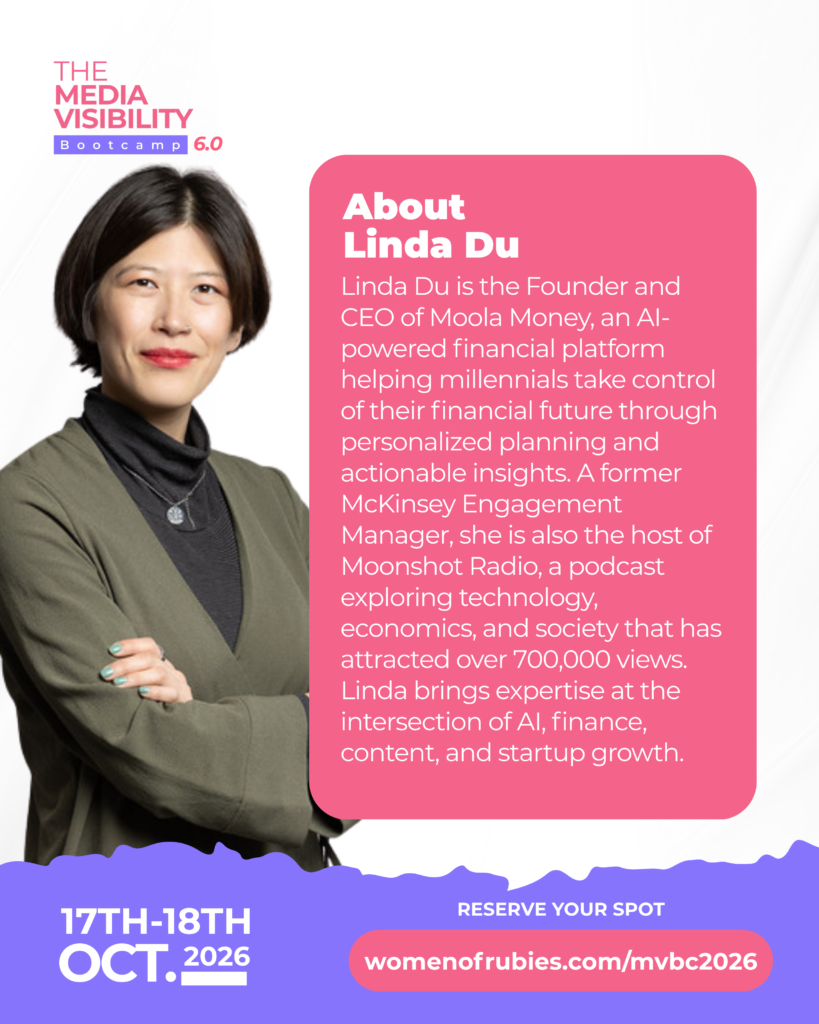
Linda Du is an entrepreneur, investor and host of Moonshot Radio. Alongside her work in financial technology, she explores artificial intelligence, innovation and the human questions emerging from technological change. Her podcast brings together founders, artists and thinkers working across frontier ideas.
Her work shows that visibility does not have to be built by chasing attention. It can be built by asking meaningful questions, creating thoughtful conversations and giving people a reason to return to your ideas.
Learn More at the Media Visibility Bootcamp 6.0
This article gives more insight into Linda Du’s expertise and the perspective she will bring to the Media Visibility Bootcamp 6.0.
The two-day virtual experience will help attendees strengthen their voices, communicate their expertise and build visibility that supports meaningful professional and business goals.
The Media Visibility Bootcamp 6.0 will take place virtually via Zoom on October 17 and 18, 2026.
Reserve your access at womenofrubies.com/mvbc2026.
Connect With Linda Du
Learn more about Linda’s work and connect with her online:
LinkedIn: Linda Du
Moonshot Radio: Listen on Apple Podcasts
Social platforms and media: Linda Du’s official links