Women of Rubies

Category

Interviews&profile

Category

Hello WORriors, it’s #WomanCrushWednessday, and our Woman Crush is Njideka Crosby Akunyili!

Born in Enugu, Nigeria, Akunyili Crosby is a visual artist based in Los Angeles, California. She was just 10 years old, when she moved to, Lagos, to attend one of the country’s most prestigious boarding schools, Queens College. With this, her first taste of a multicultural – the  Nigerian, British, and American popular culture was born, which contributed to the similarities between her work and the work of pop-culture artists.

It is interesting to note that she is the daughter of the late Dora Akunyili who was the Director-General of the National Agency For Food and Drug Administration and Control of Nigeria (NAFDAC). Even with a well known mother in Nigeria, Akunyili Crosby has made a name for herself by clearly taking her part in the artistic world. She has won multiple award an today, her name is known not only in Nigeria, but in the United States and other parts of the world as well.

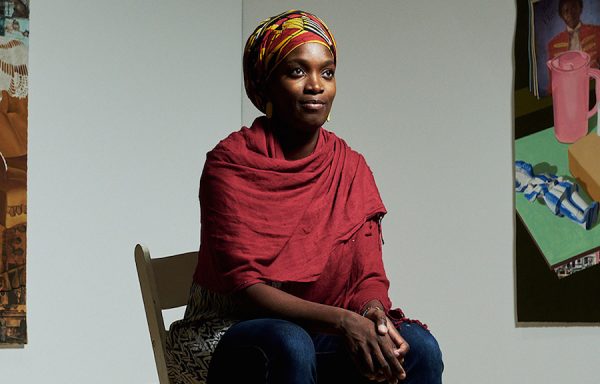
A portrait of Ms. Akunyili Crosby with layered images, made in collaboration with the artist.

A portrait above of Ms. Akunyili Crosby with layered images, made in collaboration with the artist. Photo: Photo And Illustration: Maxine Helfman For The Wall Street Journal.

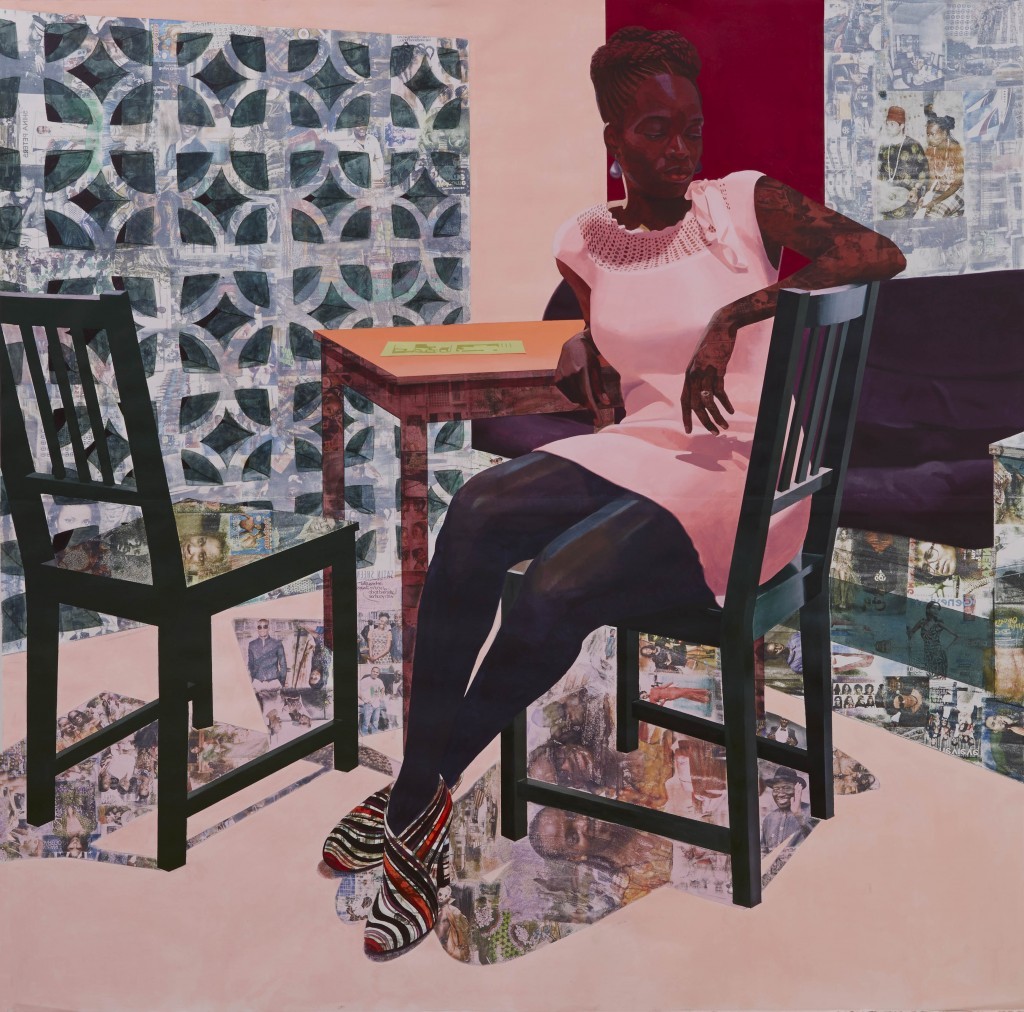
She adds photo transfers and fabrics to bring in different aspects such as hair styles, fashions, architecture, and furnishings from the two cultures.


Predecessors (left panel), 2013, Acrylic, transfers, colored pencil and charcoal on paper, 7 ft. × 7 ft.
Predecessors (right panel), 2013, Acrylic, transfers, colored pencil and charcoal on paper, 7 ft. × 7 ft.

Akunyili Crosby studied biology and art at Swarthmore College, where she met her  husband and fellow artist Justin Crosby. She pursued her MFA at Yale, which is when her artistic breakthrough occurred.

“The Beautyful Ones Are Not Yet Born” Might Not Hold True For Much Longer, 2013, Acrylic and transfers on paper, 5.5 ft. × 7 ft. Courtesy of the artist

She adds colourful paint, fabrics, acrylic, photos, cut-outs from Nollywood films, advertisements, and Nigerian fashion magazines, to create vibrant paintings and collages that dance across the borders of her different identities. She is influenced by writer Chinua Achebe who brings the English language to fit his culture. In an interview with W Magazine, Akunyili Crosby explained that she uses an approach similar to Nigerian author Chinua Achebe, who sometimes portrays characters speaking in their own dialects, which remains untranslated, you need to search for its true meaning by yourself, something also similar to what Chimamanda Adichie books does.

In her work, Akunyili Crosby cracks English and uses it to create a transcultural, syncretic space.

We celebrate Njideka Akunyili Crosby.

Chaymeriyia Moncrief


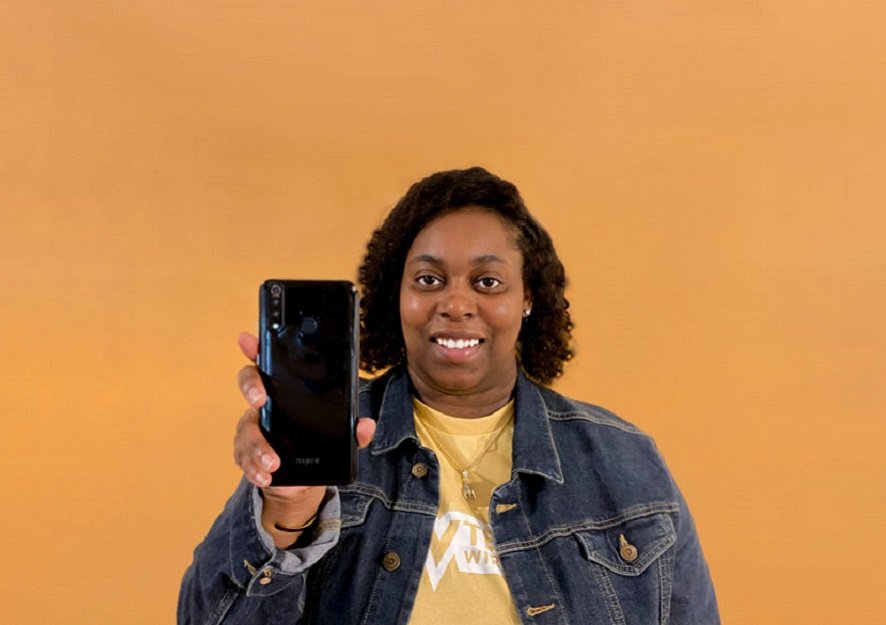
Chaymeriyia Moncrief is a tech entrepreneur from Alabama, USA. She is the founder and CEO of the prepaid wireless carrier, Tesix Wireless™ Network.

At 24, Moncrief, turned down a $4.4 million offer for her company, and therfore raised over $5 million which her telecom company at the end 2019 had a $10 million valuation. Now, she is 25 years and has ventured into smartphones and electronics.

But this isn’t the first company Moncrief has started; she has been hard at work from an early age.

“I do have a branding agency and that is what I started at 12 years old, as a designer, and it officially turned into a business at 16,” Moncrief told WSFA12.

Pic Credit: nspreelectronics.com

“I am a huge thinker and big dreamer,” she said.

Moncrief is the first African-American woman to launch her own line of smartphones, according to blackbusiness.com. Her electronic brand is called NSPRE™ Electronics featuring smartphones and other electronics.

She studied Business Management and Computer Science in Alabama State University.

In 2016, she launched a Branding Studio before stepping into the world of technology at 24 after

Before her present endeavors, she had earlier launched a branding studio.

Moncreif relates her bad experience with a cell phone company.

“You go in and they say your phone bill is going to be $98, but you are getting a $150 or $200 bill. I think the final straw for me was a $235 bill, and that is when I said I want my own company,” she told WSFA.

She went on to create her business Tesix Wireless, a telecommunications company that announced its launch in 2018. “The name [Tesix Wireless] comes from two things: Technology and sixteen because sixteen is when I started my entrepreneurship journey. The name has a personal meaning to me,” Moncrief said.

Chioma Uzoma is a public health educator, founder, the Medvocacy initiative (TMI) Africa.


Vaginal Candidiasis

Vaginal Candidiasis is a common Fungal/Yeast Infection that affects at least 3 out of every 4 women.
Research has shown that 75% of women will experience this at least once on their lifetime, hence the need to discuss this issue.
Vagina Candidiasis affects the Vagina and the Vulva (The tissue surrounding the Vaginal Opening in Women).

It normally presents with symptoms such as:
•Vaginal Rashes
•Vaginal Redness
•Vaginal Irritation
•Swelling
•Cheese-like, odourless discharge.

The Major cause is the Fungus *Candida albicans*.
This organism is responsible for most Vaginal yeast infections.

Your Vaginal naturally contains a balanced mix of *Yeast* and *Bacteria*.
Certain *Bacteria* (e.g *Lactobacillus acidophilus) help keep this yeast in check, because candidiasis infection will only set in when there is an overgrowth of Yeast cells.

Unfortunately, this balance can be disrupted. Overgrowth of the Yeast cells causes the Signs and symptoms of Vaginal yeast infection.

*CAUSES*
▪︎Indiscriminate Use of antibiotics:
In a bid to prevent Sexually transmitted infections, most women resort to taking Antibiotics after unprotected Sex.
Wide Spectrum Antibiotics kills a wide range of bacteria including the healthy Bacteria *Lactobacillus acidophilus* meant to keep the yeast cells in check.

▪︎Use of Contraceptives high in estrogen/ Hormone therapy increasing hormonal levels.

▪︎Pregnancy :This is due to changes in the Hormonal Balance/Hormonal Imbalance.
It should be treated in pregnancy as the infection may be transmitted to the Unborn child during delivery, causing *Oral thrush*.

▪︎Uncontrolled Diabetes

▪︎Impaired Immune System:

-Women constantly on Corticisteroids.

-Women with immunodeficiency virus (HIV).

*PREVENTION*
▪︎Regular intake of Unsweetened yogurt (These are rich in *Lactobacillus acidophilus*

▪︎Cutdown on Sugar Intake

▪︎Avoid unnecessary Antibiotics intake.

▪︎Wear undies made with cotton and avoid wearing extremely tight undies.

▪︎Avoid *Douching*: The Vagina is Self-cleansing, you dont need to jet water with soap into your Vagina to wash it. This only removes the healthy bacteria and hence overgrowth of the yeast cells causing infection.

▪︎Avoid Using scented or harsh feminine products as they cause irritation to your Vagina.

▪︎Avoid extremely hot tubs and water baths.

▪︎ Avoid staying in wet clothes.

*TREATMENT*
Self Medication is not adviced so you should see a qualified Medical expert immediately you notice these symptoms.

*Note*:
If infection becomes recurrent, lasts for more than 3 weeks or occurs more than 4 times in a year, do not ignore as it may be an indication for underlying ailment e.g Diabetes, Compromised immune system. Ensure to make an appointment with your Doctor.

*P.S*: Vaginal Yeast infection can be transmitted Sexually from a male who is infected with *Candida albicans*, to a female and vice versa.
However, it is not classified as a Sexually transmitted infection because anyone can be infected. At the onset of puberty, one can get infected without necessarily being sexually active.

FOR MORE INFORMATION/COUNSELLING:

*Contact*:
📞/ Whatsapp
07067125522

Northern Nigeria number one skincare therapist and one of the most successful in the country, Maryam Ali Adamu, Chief Executive Officer of Aljism Skincare Products and wife of Yusuf Gidado Idris, son of former Secretary to Government of the Federation during the General Sani Abacha regime has revealed her passion in life. In a recent interview with Potpourri she said her mission in life is to make women both beautiful and powerful.

On making women attractive, she said, “I believe no woman is unattractive as long as she has flawless skin. The skin is the largest organ in the body hence what a person consumes is equally as important as what they apply on their skin. I used to be troubled by skin problems like acne, spots, discolouration and sunburn. I decided to study skincare after my Masters in Law in England in order to find a solution to my own skin problems. Shortly after my two and a half years programme, I was able to start my own skincare line, using everything I learnt and it has been success story so far.”

When she came back to Nigeria after her programme in England, family and friends encouraged her to help other people by producing and selling skincare products to make others equally flawless. She started producing and selling skincare products in November 2017. She has helped thousands of men and women clear their skin problems.

Today, she is the most successful skincare therapist in Northern Nigeria. Her brand, Aljism Skincare has become a household name. You can hardly bump into 10 northern women without at least 8 knowing Aljism Skincare Products and its CEO, Maryam Ali Adamu.

On making women powerful, the Yobe State-born entrepreneur believes women must shed the toga of merely being comfortable as housewives, sisters or daughters and take their stand among men to control their destinies.

According to Maryam, the best way women can rise above mediocrity and pity is to support one another.

“Women have always been thought to compete with one another but I encourage the opposite. I believe collectively, women have a better and stronger impact in society. Due to the scarcity of women in business in the northern parts of Nigeria, the reality is raising one another up and encouraging and patronizing one another, is the greatest way to balance the equation.

“Women’s table has more strength when balanced by one another. Competing doesn’t allow growth rather it creates segregation. The stereotype of women not supporting women needs to be reversed. Women who support other women are more successful in business. Breaking the stereotype of women only serving as baby-making machines must become a thing of history,” she said.

Maryam Ali Adamu is a graduate of Business Administration and Law from the Coventry University, England. She’s from Yobe State. She is the daughter of Dr Ali Adamu (PhD) Standford and former Executive Secretary of the National Primary Education Commission during the General Sani Abacha regime and presently a business mogul into Oil and Gas.

Source: Vanguard


The highest top paid female athletes according come from Tennis players to Forbes. And Japanese Naomi Osaka has made about $37million from the past year.

Sharapova and Serena Williams were the top earners of the decade before Osaka came on the scene. The three are now the only women to rank among the 100 top earners in sports since 2012.

Naomi Osaka celebrates her win over Serena Williams at the 2018 U.S. Open, which kick-started her career as the most marketable female athlete. GETTY IMAGES

The 22 year old, has earned $37.4 million over the past 12 months from prize money and endorsements. That’s $1.4 million more than Williams has earned in the same period. The previous record was $29.7 million back in 2015 by Maria Sharapova.

The money Osaka has earned has put an end to Williams 4 year streak as the world’s highest-paid female athlete.

“I’m really interested in seeing a young business grow and adding value to that process,” Osaka told Forbes last year. “I tasked my team with finding brands that align with my personality and my interests.”

Tennis superstars Sharapova, Li Na, Williams and now Osaka are the only women to rank among the 100 top earners in sports since 2012. Every year since Forbes started tracking data, the highest-paid female athlete every year has been a tennis player, with Steffi Graf and Martina Hingis the top earners for most of the 1990s.

Osaka spoke to Forbes about her most recent marketing campaign with Bodyarmor that was just launched last week, “I always look outside tennis to see how other athletes are training and conducting themselves,” she says. “It’s no secret that some of the athletes that I have looked to in shaping my career are non-tennis players. I’m a big basketball fan, and what James Harden has done in the NBA over the last few years has been amazing. He’s definitely one of the most exciting players in the league, so being a part of this spot with him was really fun. I was also lucky enough to shoot this campaign on the same day as Skylar [before the pandemic], so we got to spend some quality time together. She is really down-to-earth, and we got along great.”

L-R, Adegoke Olubisi (CEO), Tito Ovia (Head, Public Growth Sector), Dimeji Sofowora (CFO), image credit: Forbes

Tito, like her cofounders – Goke Olubusi and Dimeji Sofowora – realised the need to improve healthcare systems in Africa, using technology and decided to establish Helium Health.

African hospitals have been operating  manually, from taking notes on paper about patients, all of which has resulted in a major lack in efficiency and accuracy, Sometimes the record are not properly taken or well stored which can result to loss.

This prompted the young Nigerian entrepreneurs Adegoke Olubusi, Tito Ovia, and Dimeji Sofowora to launch Helium Health, a healthcare technology provider working in several African countries.

The young trios are 2019 Forbes 30 Under 30 honorees, who recently secured a $10 million investment from a series of funding.

Impressively, Helium Health is already  used by 5,000 doctors, with data from 500,000 patients across West Africa and currently attends to over 145,000 visits from the region.

Tito and her co-founders have said their goal, with Helium Health, is to drive a technological revolution in African healthcare, not just in the medical records space, but every part of the industry.

At the beginning, they had to secure the trust. “You are twenty-something-year-old kids, you are not doctors, and you tell them you want to run their hospital,” said Olubusi.

Olubusi, who serves as the company’s CEO, added. “When we think about the extent of the challenges and problems that we can solve in the healthcare sector in Africa, there could be a million ways in which this can help us grow.”

“This new round means that we have more firepower to be able to expand the reach of our product way beyond Nigeria, Ghana and Liberia where we are now,”

“Imagine if a hospital sees a 1000 people a day,” Olubusi says. “How do you count a 1000 people every day with specific issues they need taken care of when you’re doing everything on paper?”

“The demand is incredible, we’ve had over 250 hospitals sign up,” Olubusi says. “More than half of them have never worked with us before.”

Olubusi, a Johns Hopkins graduate and  with his high school friend Dimeji Sofowora (CFO), and Tito Ovia (Head of Growth), whom he’s known since college. The three of them had studied abroad, had returned to Nigeria and were looking for a problem to solve. They decided to focus on healthcare because it was a sector that desperately needed modernization.

“It doesn’t matter if you’re rich or poor, if you get in an accident and there isn’t a strong emergency department, you will die,” Olubusi says. “Because of the COVID-19 situation, now these countries are having to face the harsh reality of not investing in their healthcare sector.”

We  love this.

Cynthia Kudji, and her daughter, Jasmine have just graduated from medical school at the same time.

Dr.  Kudji, who’s originally from Ghana, West Africa is a single mom. She put her dreams of becoming a doctor on hold when she was pregnant with her daughter at just 23-years-old, then went on to become a nurse and worked as an RN and Nurse Practitioner for almost a decade before deciding to attend medical school.


Both are now graduates of the University of Medicine and Health Sciences (UMHS) St. Kitts and Maine and Louisiana State University (LSU), respectively, with medical degrees in Family Medicine for Cynthia and General Surgery for Jasmine.

In an interview with The UMHS Endeavor, Dr Kudjie explained that she initially had no plans to enter the medical field due to a lack of representation in the field.

“I remember when we were young there were TV shows like The Cosby Show and A Different World,” she said to UMHS. “Seeing African Americans in college or being successful was like firsts. So, for me, it wasn’t like ‘Oh, yes, I want to be a physician’. It was more like, ‘Oh, no, can I really do this? Or, ‘Am I smart enough to do it?”

Dr Kydjie and her daughter definitely had challenges as nontraditional students with Jasmine having to adjust to being so far from her mother.

“I think initially it was difficult because my mom and I have always been really close so I had to get used to the distance, we had to learn how to FaceTime and Skype each other, so we were Skyping each other every day and whenever I had struggles and she had struggles, we just had to learn to communicate from a distance,” the younger Dr. Kudji said. “But I think over time we figured it out.”

They both credit the support of close family and friends in addition to faculty members.

“I always tell people we laugh together, we study together, we cry together,” said Jasmine. “I think medical school is one of those experiences that you don’t truly understand until you’re in it. Sometimes people struggle to find someone who relates to their struggles, so for that person to be my mom was extremely helpful.”

Image source: Google


Skincare can be kept simple. You should follow a routine for the skin, one that suits its type. These are three basic tasks any skin type, for a busy morning routine.

Washing the face with cold water

For that glow after a night nap, wash you face with cold water. Even if you are not stepping out of the house, washing your face and keeping it clean, is the first step towards achieving a naturally-glowy look. This would not strip your skin to dryness and would give it a refreshing look.

Use a moisturizer

Right after a wash, you need a moisturizer to help seal in moisture. The best time to slather in a moisturizer is when your skin is damp, according to research from a Dermatology Academy. Moisturizing is not a night care routine alone. A face moisturising cream will be handy.

Don’t forget a Sunscreen

The next best thing you can do is apply some sunscreen. If you only had time for one skincare product each morning, it should have some amount of sunscreen. Shea butter acts as a natural sunscreen if you know it, or you might want a store bought sunscreen product which is fine and suitable to your taste. But ensure to keep it simple.

In the 1950s, Helen Williams made history in the United States when she became the first dark-skinned African-American fashion model to cross over into mainstream advertising.

Yet, it was the French who accepted her instead of the Americans who considered her to be “too dark.”

Williams would surmount the challenges that came with the color of her skin, rising to fame in Paris and New York in the late 1950s and early 1960s and paving way for other dark-skinned models.

Born in East Riverton, New Jersey in 1937, Williams studied dance, drama, and art before becoming a stylist at a New York photography studio.

There, her beauty caught the attention of Lena Horne and Sammy Davis Jr, who frequented the studio to do press shots. The two encouraged Williams, then 17, to take up fashion modeling.

And that was how she was able to break into a stereotyped industry like fashion in the 1950s, working with African-American magazines like Jet and Ebony.

But there was a problem – her dark skin color did not attract many industry folks in America, as non-white models were largely excluded from mainstream fashion. Even within the African-American modeling scene, ladies were expected to be light-skinned.

“I was too dark to be accepted,” Williams once recalled. Facing discrimination while trying to extend her career with other modeling houses, Williams moved to Paris in the 1960s, where she was embraced.

France had a different outlook on black beauty and soon enough, the African-American beauty was modeling for big fashion designers like Christian Dior and Jean Dessès.

“By the end of her tenure she was making a staggering $7,500 a year working part-time and had received three marriage proposals from her French admirers, one of whom kissed her feet and murmured, ‘I worship the ground you walk on, mademoiselle’,” writes arogundade.com

Williams later returned to America, hoping things had changed for models like her. But when she went searching for a new agent in New York City, she realized that there had not been any major change.

Told to wait two hours in the reception of one agency, she was later told that the agency already had a black model and she was not needed. Having had enough of the bias of the fashion industry, Williams took her case to the press.

Some influential media personalities took up her case, exposing the plight of black fashion models in the country and drumming home the need for change.

Eventually, the situation improved, especially for Williams, and she got booked for ads for major brands such as Loom Togs, Modess, and Budweiser.

Her rate also shot up to $100 an hour. Finally, the beautiful, talented and inspirational woman had broken the color barrier in the modeling industry. As more black models became more visible, cosmetic companies began doing a lot of research aimed at developing products for African-American women.

Retiring from modeling in 1970, Williams continued her career in fashion as a stylist. Her courage, however, paved the way for other black models like Naomi Campbell, Tyra Banks, Duckie Thot, among others.