Category

Interviews&profile

Category
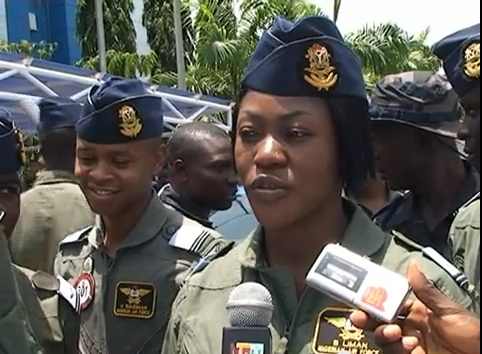
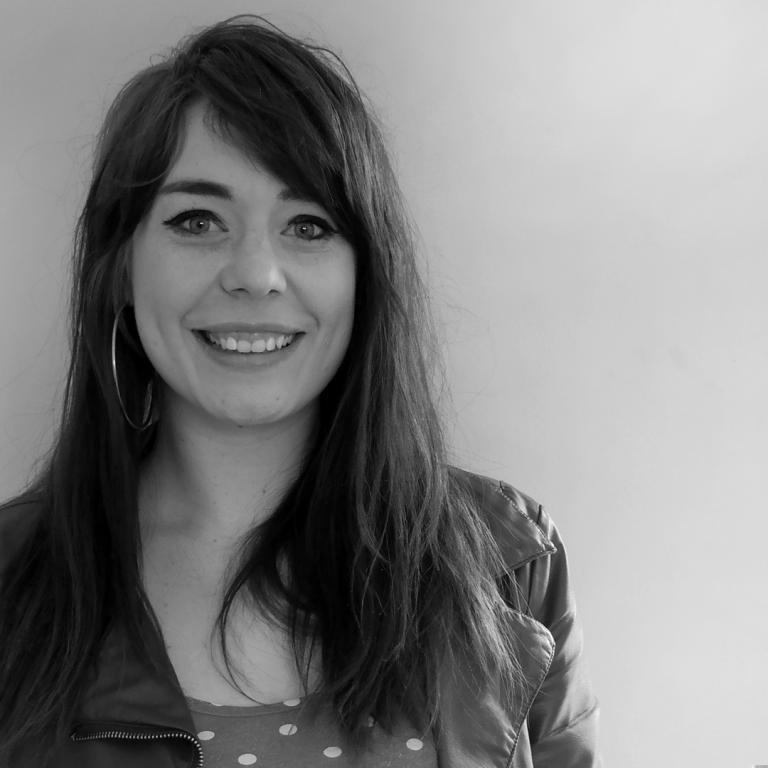
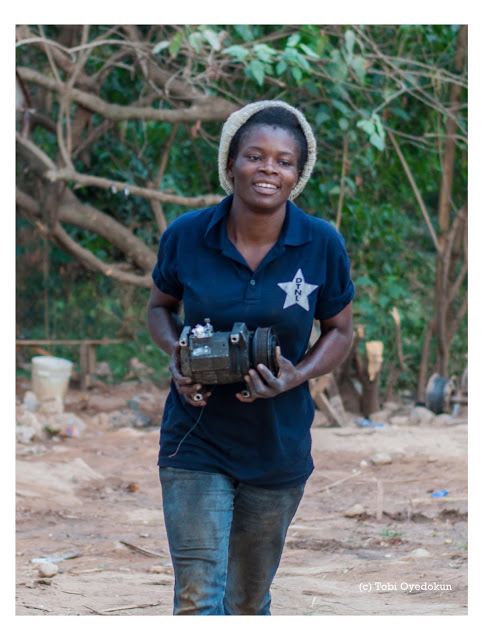
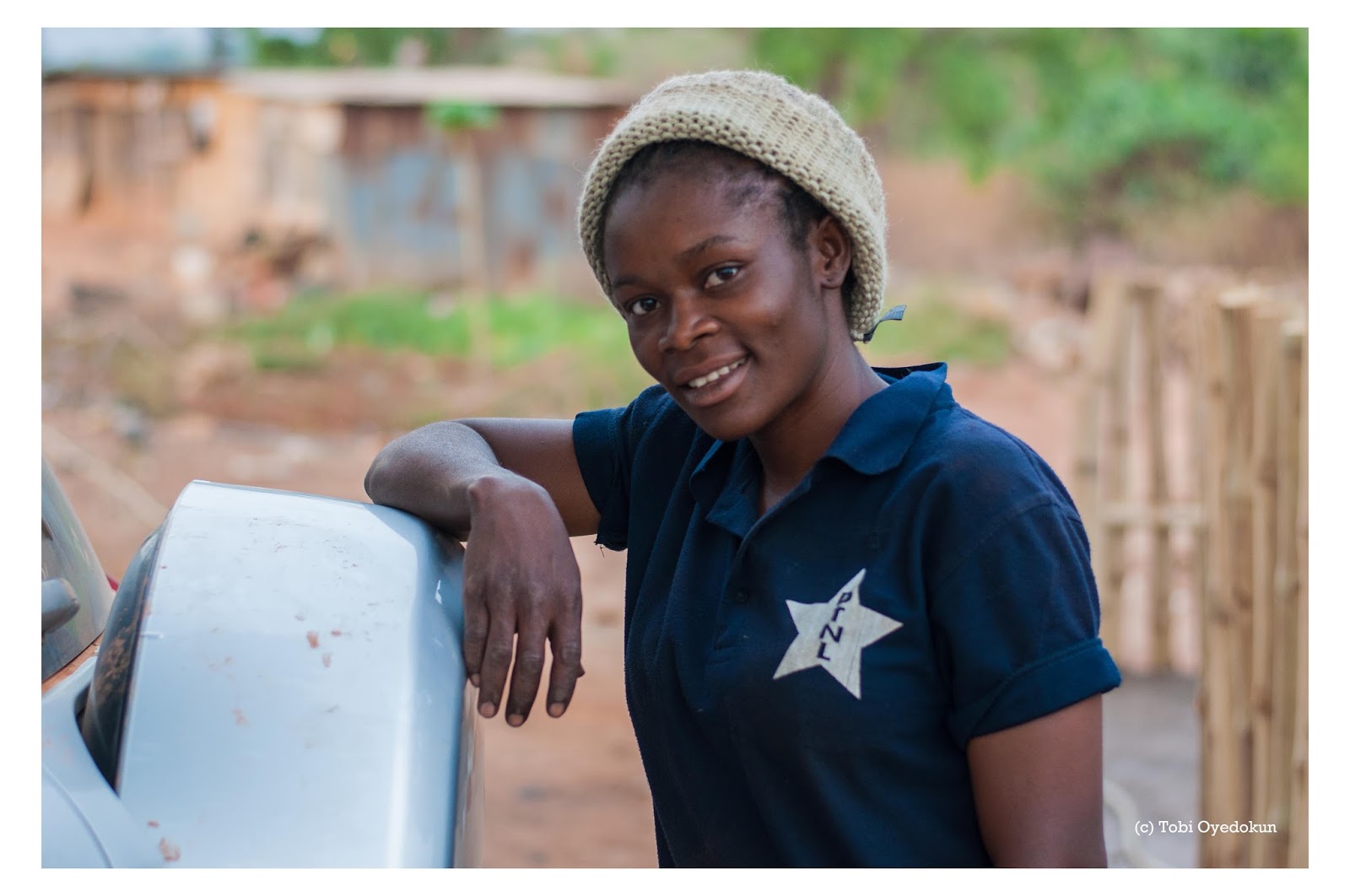
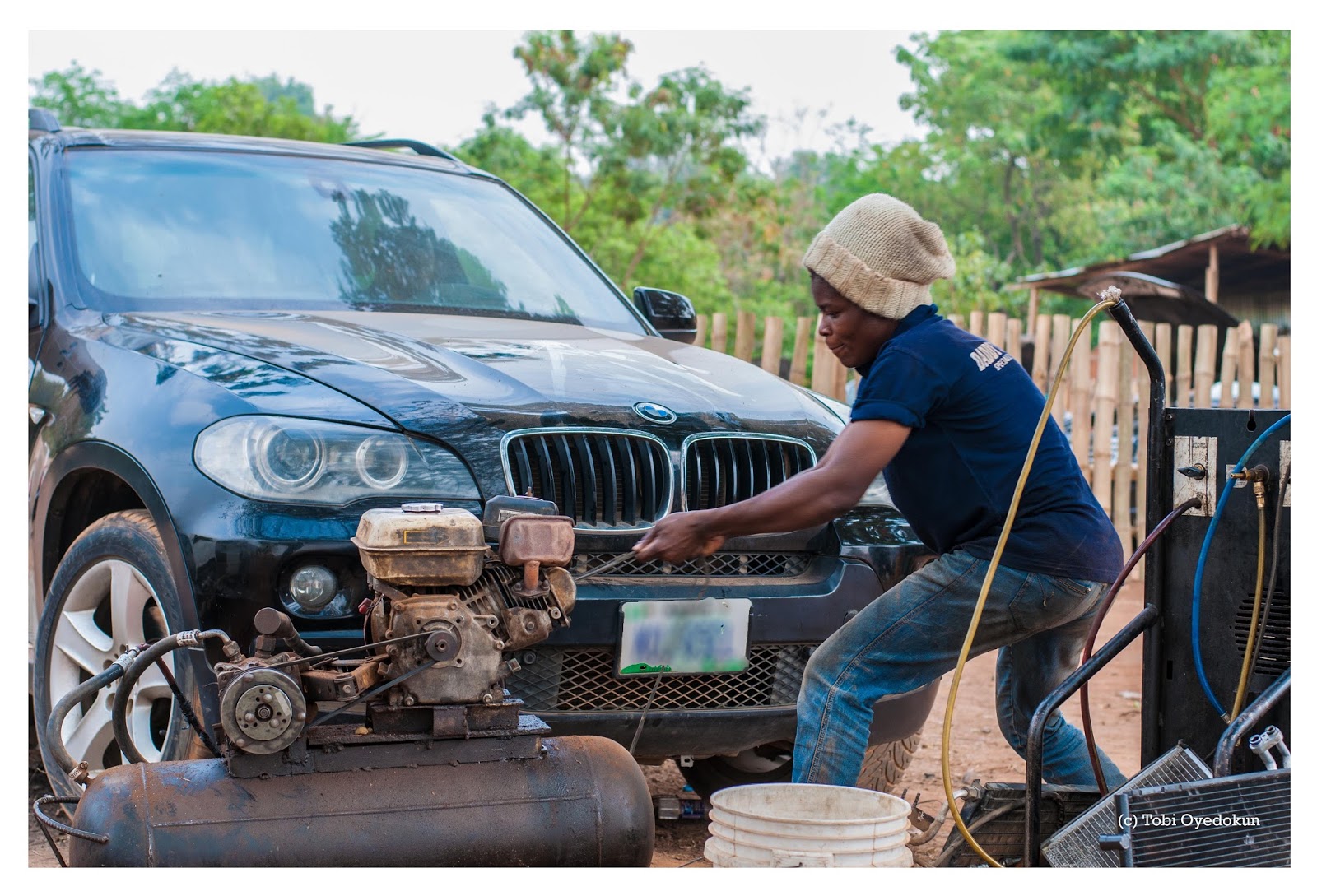
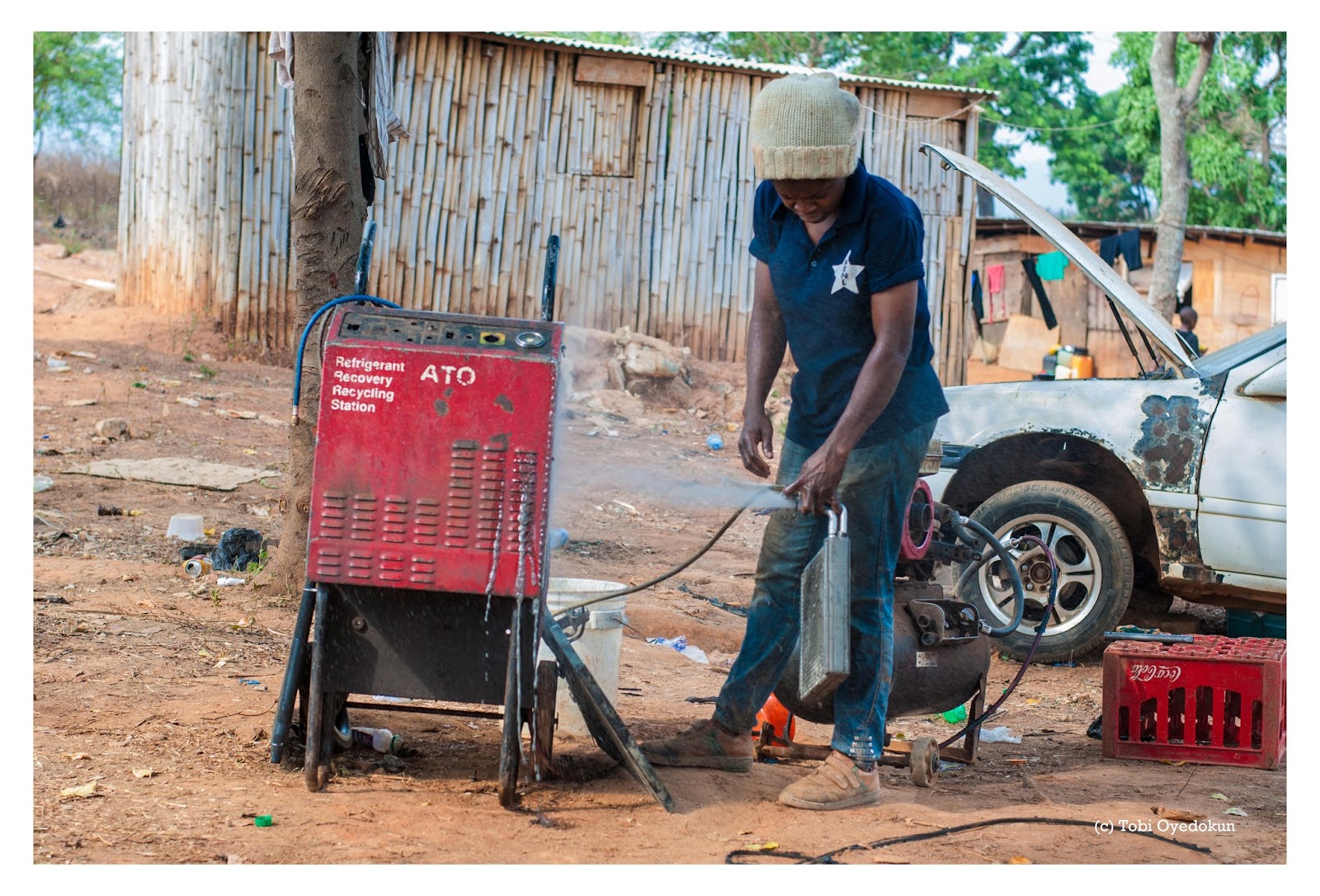
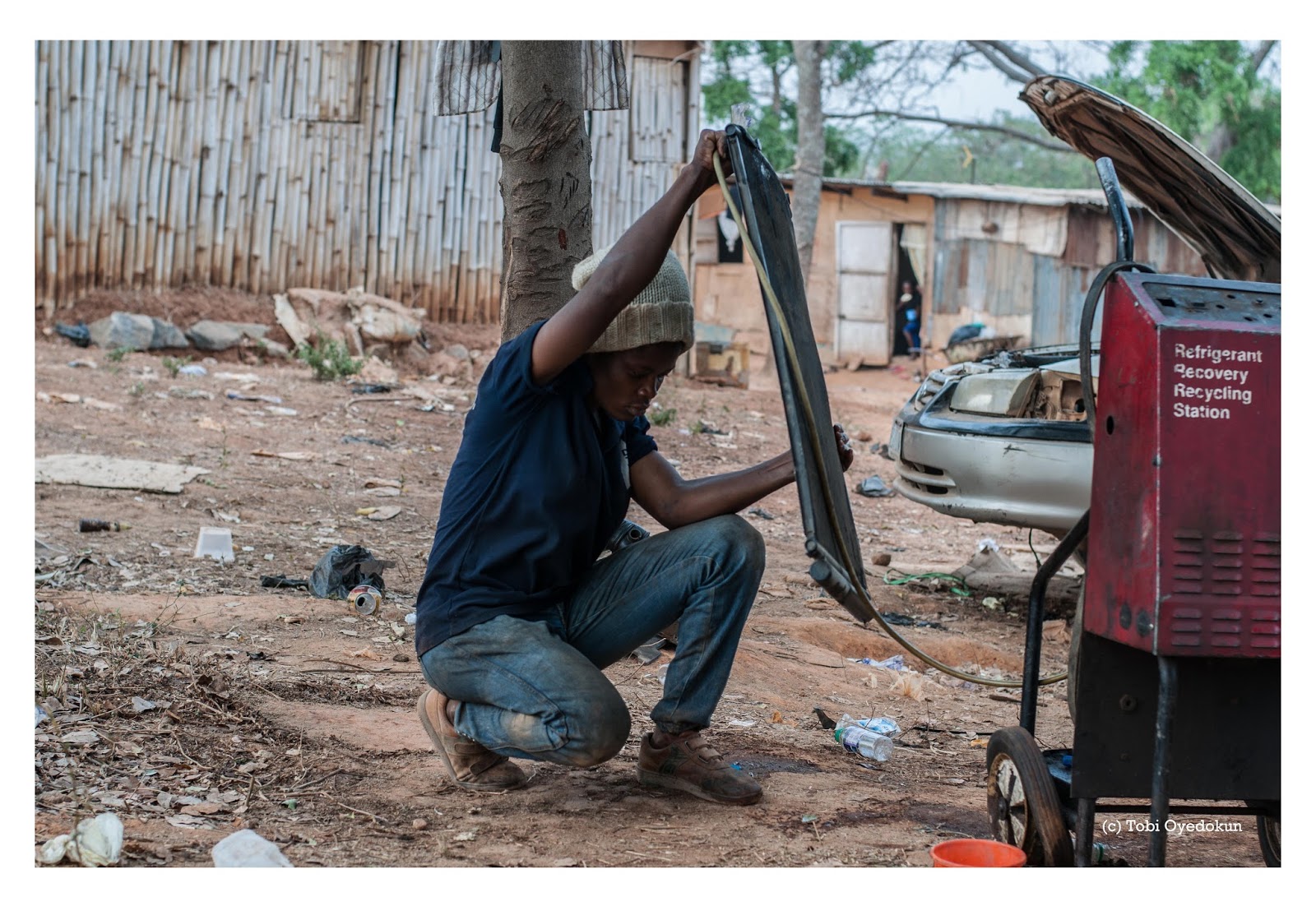
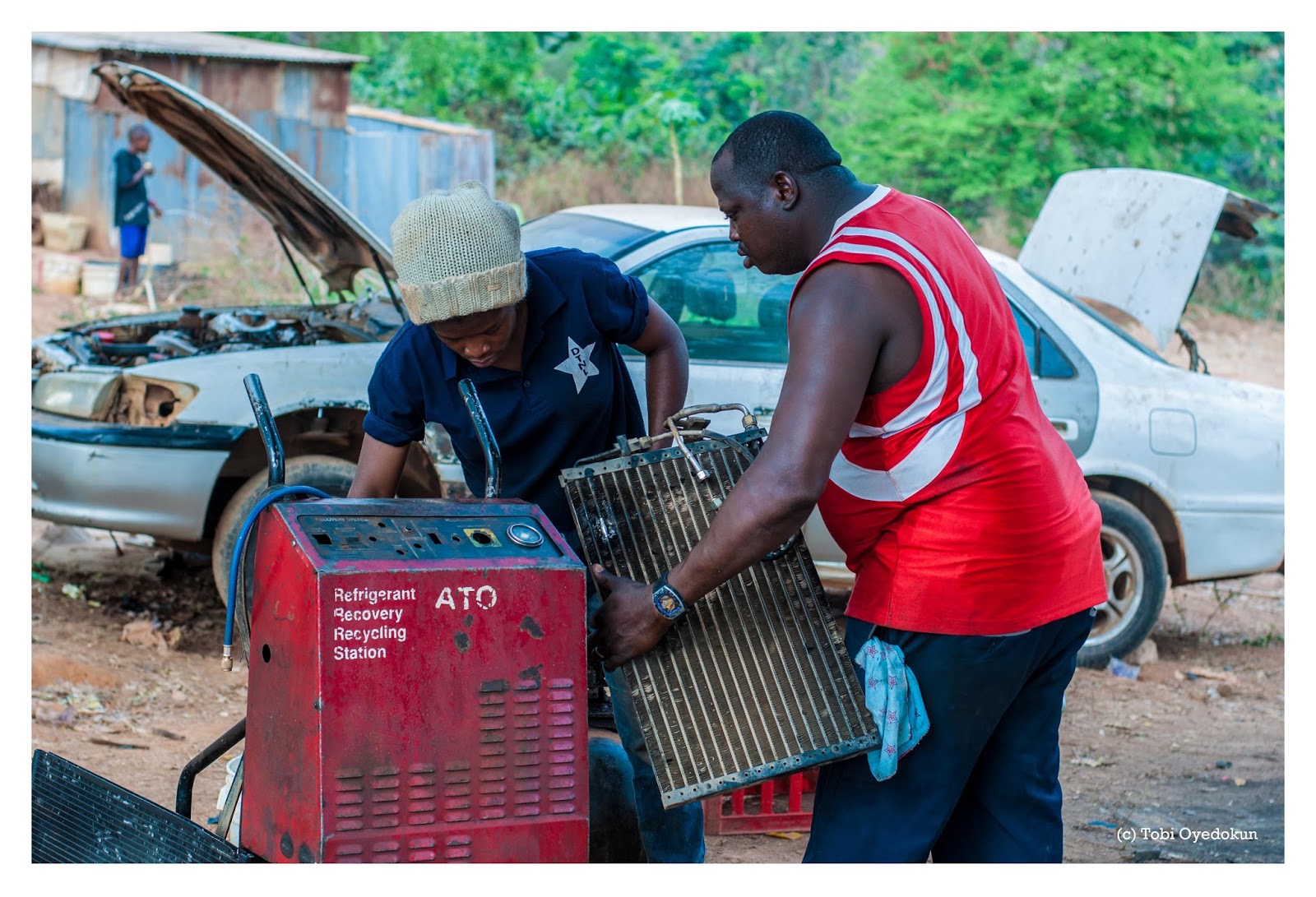
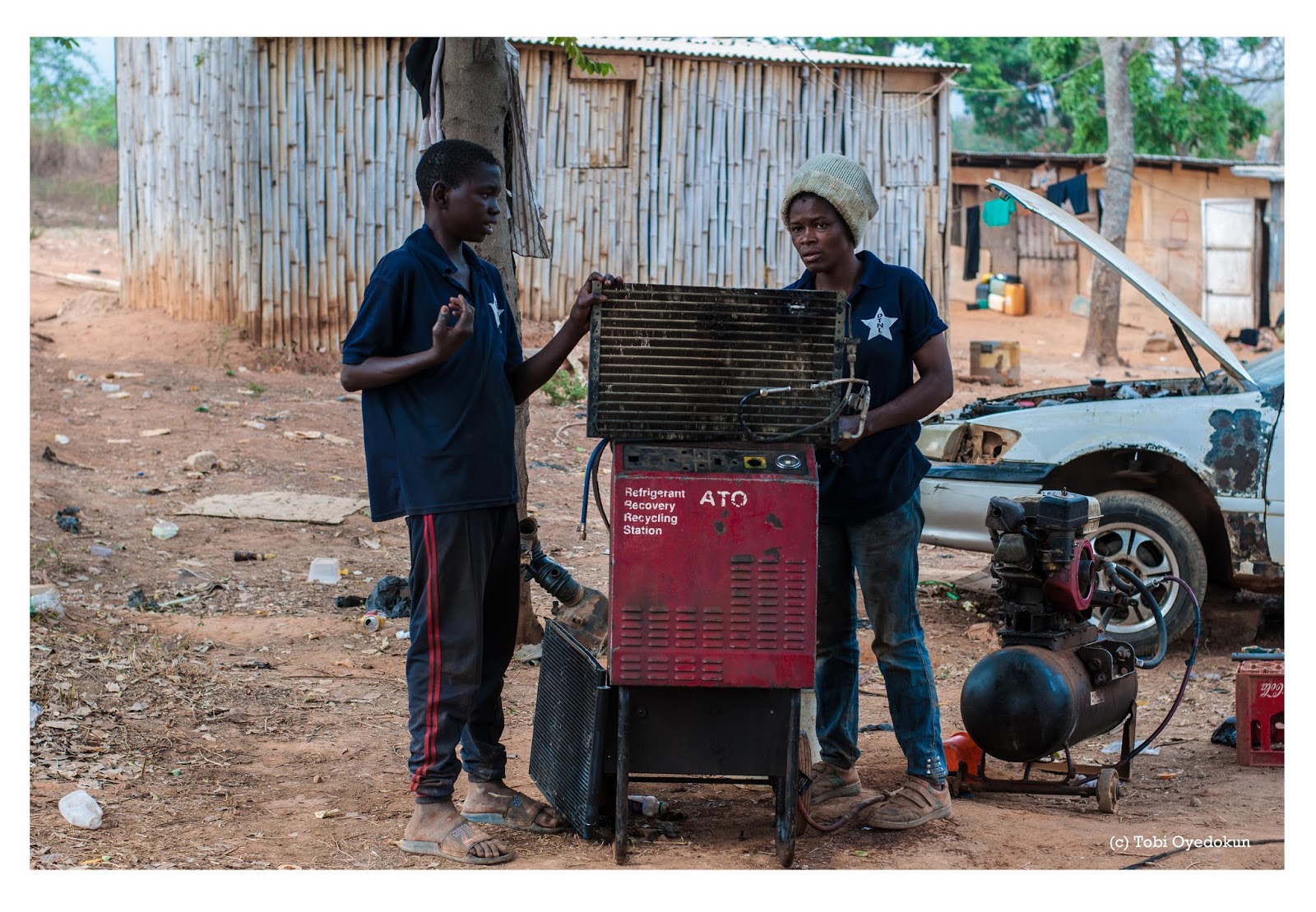
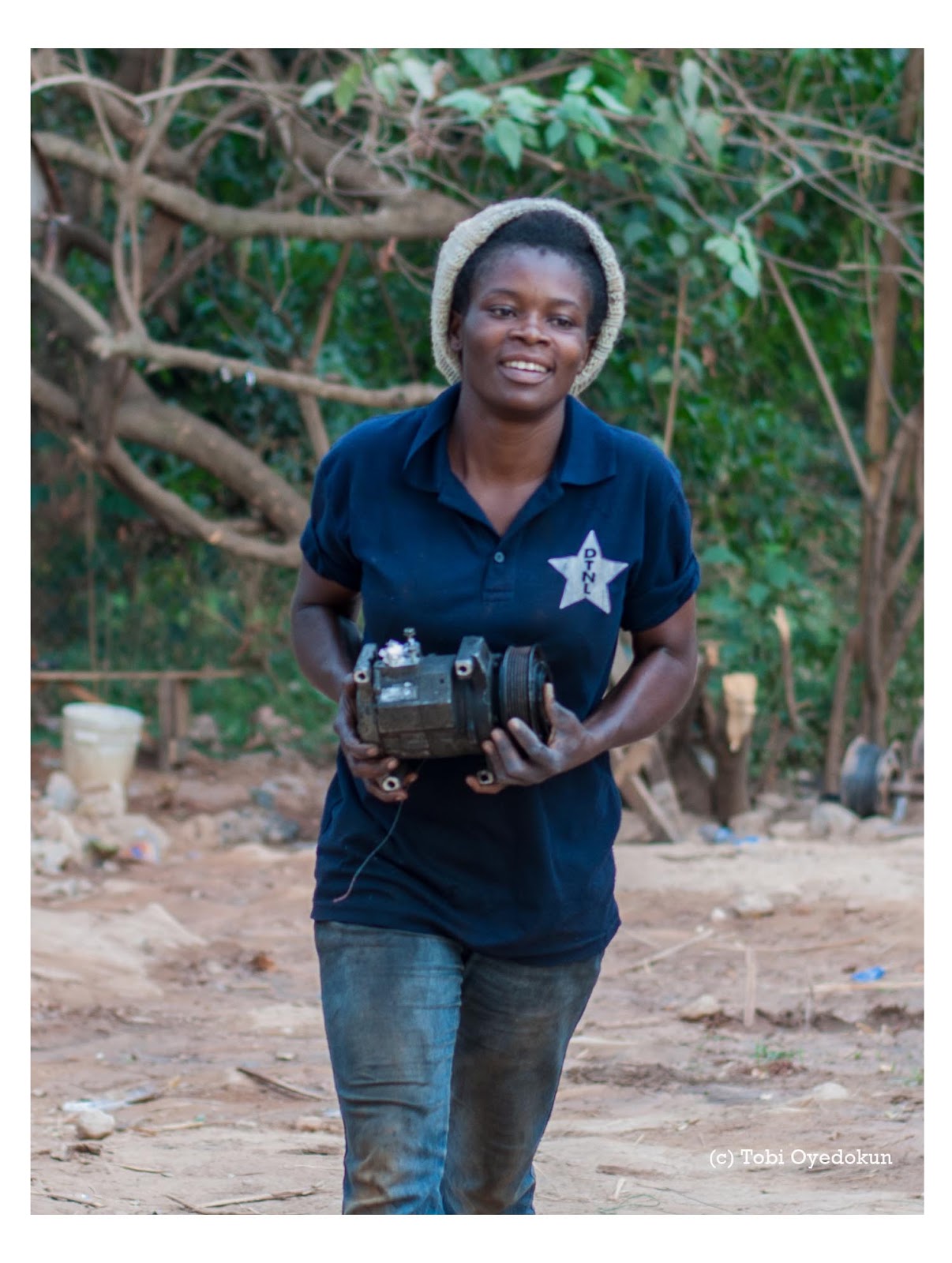
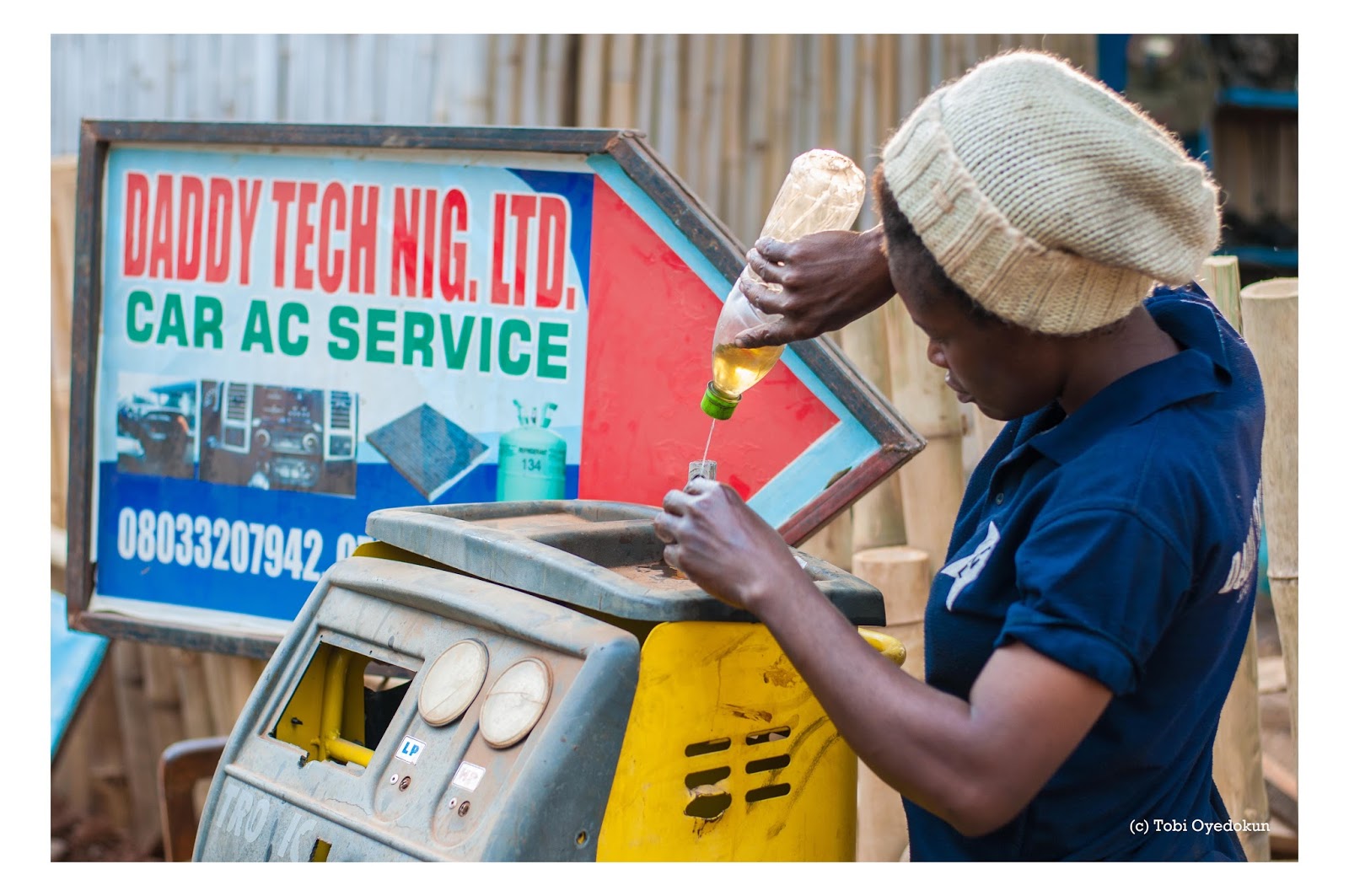
My name is Grace Stanley a.k.a Becky; I am 27 years old from Akwa Ibom State in Nigeria. I am an automobile engineering apprentice at DADDY TECH Nigeria limited in a Abuja, Nigeria”
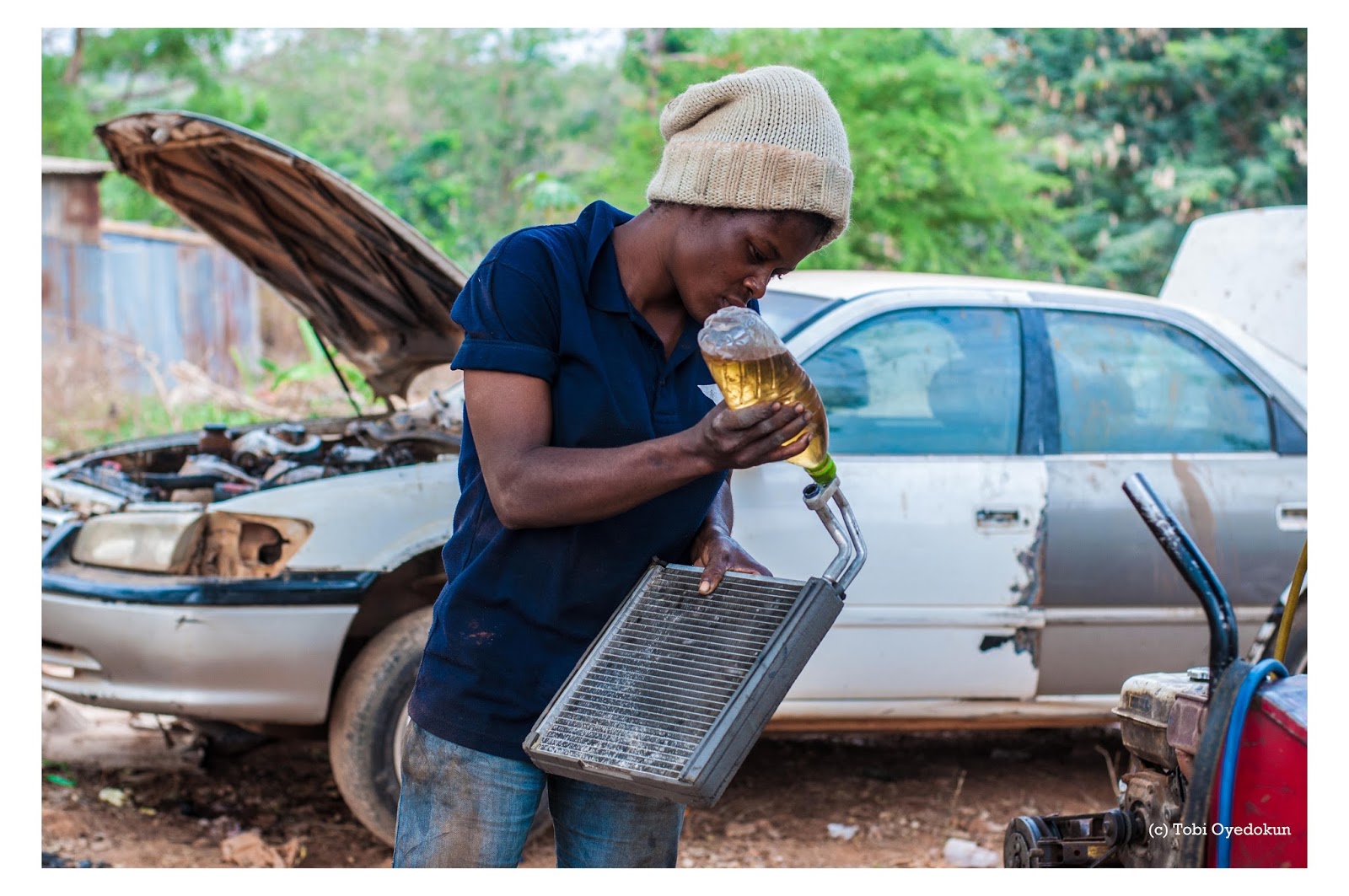
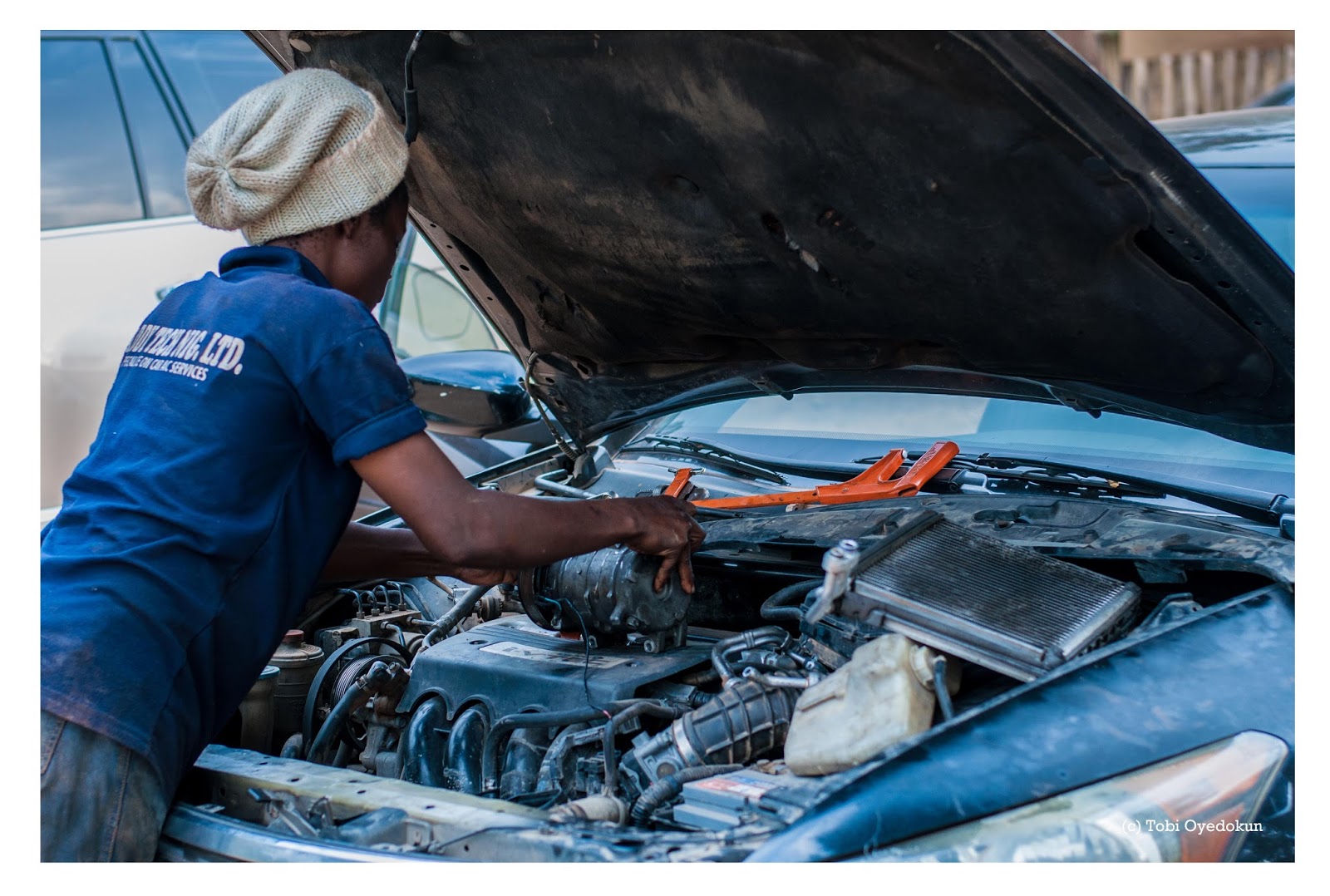
“I have been learning this skill for the past two years. We are specialist in the repair of automobile Air Conditioning system (AC)”.
“I have always been fascinated about male dominated jobs, while growing up, I had an uncle who was a Mechanical engineer, his specialty was in generator repairs; I remember that I use to follow him to his workshop back then and that was how I developed interest for this type of Job. The yearn and urge to do something masculine surfaced when i arrived at Abuja, so I decided to start learning how to repair automobile ACs. I love this Job because it is unique; I am so glad that my dream is coming through”.
“My major challenge is that some of our clients doubt my intelligence and capability because I am a lady, they always reckon with me after their cars has been fixed; while some of our clients can be so distractive, they get amazed that a lady can do this type of work, they always want to ask me questions while I am at work”.
“I have the support of my family members; my brother told me that if am sure this is what I want to do, I should go for it. So I advise parents to study their children while growing up and they should support them in whatever career they choose, children should not be forced into a certain profession”.
“My advice to females who want to venture into a male dominated field or career is to start something and they should start it now, within a certain period they would have become a professional in the chosen field”.


Photography : Tobi Oyedokun

Nigeria records the highest incidences of the sickle cell gene and disease globally with 150,000 children born with SCD each year and 100, 000 of them die before they are 5, because of her  personal experience with Sickle Cell and her passion to create greater awareness and support for people living with Sickle Cell Disease (SCD), Bukola Bolarinwa joined her friend Nkechi Azinge as a partner to run Sickle Cell Aid Foundation (SCAF) , a non-governmental organisation established to raise awareness about sickle cell disease and related health conditions. While Nkechi is the founder of the organisation, Bukola works in the capacity of the  President . Because she knows how important blood is to health care delivery system in Nigeria, Bukola founded Haima Health Initiative, to support hospitals who struggle to find blood in a safe and timely way because of the absence ofblood donors. She shares her inspiring story and the work she is doing through HHI in this interview

Growing Up

I think my challenges as a child made me resilient. I always had a passion for human rights growing up and our motto in my Primary school was “thoughts for others”. This stuck with me and influenced my personality today.

Bukola Bolarinwa!

I am a lawyer, Advocate, president of the Sickle Cell Aid Foundation (SCAF) and founder of Haima Health Initiative. I joined SCAF in 2011 at the Nigerian Law School in Bwari where it was set up by my friend Nkechi Azinge. We both had personal experiences with Sickle Cell and wanted an avenue to create greater awareness and support for people living with Sickle Cell Disease (SCD). Nkechi’s three siblings live with SCD and she knows first hand the emotional, physical, psychological and financial burden it places on families. She started SCAF to support those who do not have the kind of support her family does. I live with SCD and I have also been lucky to have an excellent support system of family and health care providers but I know this is not the case for majority of people in Nigeria. So we work together with an amazing team of staff and volunteers to carry out activities to raise awareness about SCD and aid those living with it.

Being a Lawyer

I have not stopped practicing per se, I definitely always see myself as a lawyer first and I am hoping to go back into it at a later date. For now I dedicate my time to SCAF and Haima because there are a number of projects we are working on which would be impossible to juggle with practising law full time.

Sickle Cell Aid Foundation(SCAF)

The Sickle Cell Aid Foundation is a youth led non-profit, non-governmental organisation established to raise awareness about sickle cell disease and related health conditions. Nigeria records the highest incidence of the sickle cell gene and disease globally with 150,000 children born with SCD each year and 100, 000 of them die before they are 5. This indicates that there is still a lot amiss regarding awareness and delivery of medical care to people who have SCD, especially the young and indigent.

In 2012, SCAF commenced the Know Your Genotype Campaign (KYGC) which involves carrying out free genotype tests, counselling and sensitisation in the F.C.T. We have so far carried out about 10,000 free genotype tests across 5 States in Nigeria and it remains the largest on-going campaign on sickle cell advocacy in Nigeria. Our activities have reached over 15,000 persons across Nigeria. In addition, SCAF runs the Sickle Cell Club Scheme (SCCS) to set up sickle cell clubs in secondary schools where we also carry out free genotype tests.  Students found to have SCD were placed on free drugs and their tuition fees paid.

Haima Health Initiative(HHI) 

I started Haima Health Initiative because our Sickle cell beneficiaries often need blood transfusions and would ask us to get them donors. Most hospitals does not have blood in stock or they require a replacement for the one they use. We started by calling our friends and families to donate at hospitals and as more people started heard about us, we decided to help as many people as possible get blood. Haima is the Latin word for blood and is the first of its kind in Nigeria. We have an online database which allows people to register as voluntary blood donors that can be called on in emergency situations. We currently have about 500 registered donors across 8 states in Nigeria who have donated over 300 pints of blood free of charge directly to patients. The goal is to increase the number of voluntary blood donors and create a culture of donation devoid of superstition especially amongst young persons.

What Inspires me

I am inspired by so many things and people.  I am inspired firstly by my mother who has taught me patience and perseverance during adversity. I am inspired by Nkechi who is extremely focused and innovative at such a young age. But most of all, I am inspired by people living with SCD and other health conditions in Nigeria who face unimaginable obstacles trying to survive. Living in Nigeria is very stressful for able bodied persons, but living with a disease, disability or physical challenge is a hundred times worse. Inspite of these, we are often the most positive, ambitious and  vibrant people you will come across!

My projects and Activities

We have recently published our school’s handbook on SCD which is a fun activity book for teenagers. We are working with the Ministry of Education to incorporate it into as many Government secondary schools as possible as an after school sickle cell club. We are doing this because sickle cell education has to start from a young age to ensure every child knows their genotype and to avoid discrimination. We aim to launch the book in June to mark World Sickle Cell Day and invite stakeholders to help fund this project.

In addition we are working to ensure hospitals have better access to blood using the Haima web and mobile service so that donors are constantly available. Nigeria has a young and largely healthy population and it is abysmal that health care providers are constantly short of blood. We hope to gain funding to embark on more marketing to register and inform more young people on the importance of voluntary, regular, non-renumerated blood donation.

Gratitude from Beneficiaries is my greatest reward

It has to be the gratitude of our beneficiaries who have become a community. A lot of Nigerians with conditions like SCD live in isolation and often do not tell even their closest famliy about their struggles because of fear of judgement or ridicule. When they reach out to us, they find comfort in speaking openly about their challenges and being able to assist them in any way I can is incredibly rewarding, In addition, I am receiving a Commonwealth Youth leader award from the Queen of England in June in recognition of my work and the accolade has been quite exciting.

Challenges

Gosh there are so many! Working in the non-profit sector is very challenging in Nigeria because there are always a lot more people in need of help than you can render. Funding is our primary challenge, as like most NGO’s, we run on donations from individuals and organisations. These are usually inconsistent and make it difficult to plan. We always have more projects than funds so we have to prioritise quite aggressively which can be frustrating.

Secondly, ignorance and misinformation are rife in Nigeria regarding SCD as well as most other health conditions. Often times people with SCD and their families have tried all forms of herbal, spiritual and religious interventions to their ailments before coming to us for help and this diminishes the effectiveness of their treatments. Trying to re-educate the public including health care providers on SCD is a constant challenge.

Finally, most Nigerians do not know their genotype or blood group. In fact I would say that 85% of the population have no idea what it is or are unsure. There is no way that an NGO like ours can work to correct this without the Government making SCD a priority. Implementing a new born screening program so that all babies born in hospitals are tested for their genotype during the immunisation programs has to be made a priority by the Government and we will keep advocating for this. It is regrettable that even though Nigeria has the highest rate of SCD and sickle cell trait in the world, it is not a health care priority allowing SCD to keep contributing a huge percentage to under 5 mortality.

I am a woman of rubies

I would say it is my ability to turn challenges into opportunities, not just for myself but for those around me!

Final word

Everyone that knows me knows that I am a card carrying feminist! Men and women are not the same but both sexes can achieve anything they set their minds to with passion and diligence. Unfortunately we still live in a very patriarchal society where a lot of the rules are determined by men, while women are marginalised socially and financially. However there has never been a greater time to be a woman anywhere in the world as things are improving slowly but surely. I would encourage women to always help each other up and not tear each other down, as we have obligations to further each other if we are to get ahead.  I am hopeful that the future will open up even greater opportunities for women.

Kindly add any other information you want to publicise.

For more information on SCAF, our activities, how to volunteer and donate, please visit www.scaf.org.ng or follow us on our social media handles @scafnigeria

To register as a blood donor and save a life please visit www.haimahealth.org.ng


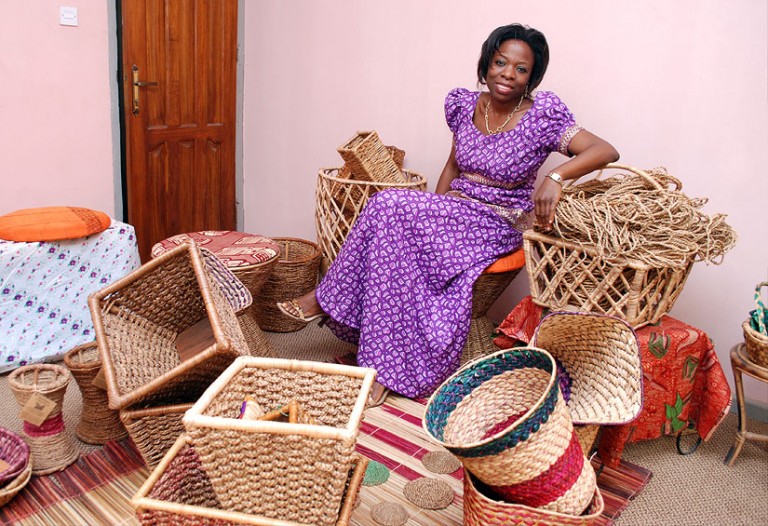
MEET SELLY Raby Kane, the Senegalese fashion designer who has been recruited by Swedish retail giant Ikea for its 2019 flagship collection. Selly, whose work has been featured in Vogue and on the back of Beyoncé will form part of a group of leading fashion designers, architects, and illustrators from across Africa who will come together to produce a historic range.

“The creative explosion which is taking place in several cities around Africa right now is something IKEA is curious about,” said Marcus Engman, Head of Design at IKEA. “We want to learn from this and spread it to the rest of the world.”

ENDORSEMENT: Beyonce Wears Senegalese Designer Selly Raby Kane’s signature Kimono and skirt

ENDORSEMENT: Beyonce Wears Senegalese Designer Selly Raby Kane’s signature Kimono and skirt

The project got off the ground through a chance meeting between Engman and Ravi Naidoo, founder of the creative hub Design Indaba, which holds an annual conference showcasing the best of African design.

The two men discussed an Africa range, and Naidoo supplied a list of talents from the Indaba alumni network, covering a range of disciplines from Rwandan architect Christian Benimana to Selly Raby Kane. The designers were invited to a brainstorming session in the woods of Almhult, Ikea’s headquarters in Sweden.

The first prototypes will be on display at the 22nd Design Indaba conference in Cape Town. The pieces will be in stores worldwide in 2019.

Source: Leadingladiesafrica


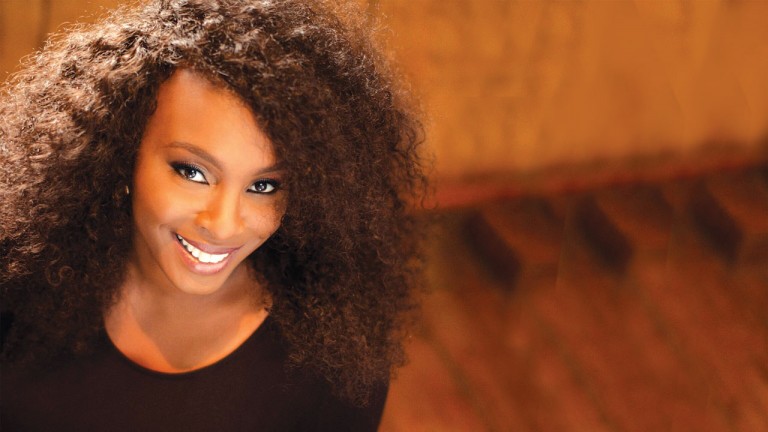
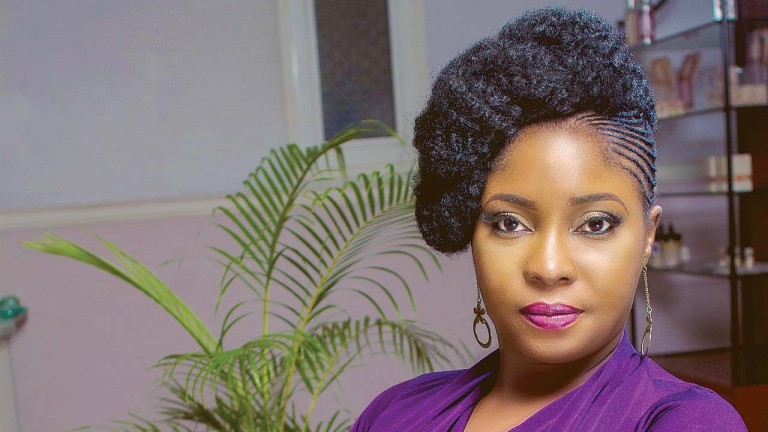
Toyin Igbafen is a Soul singer and writer, and also an entrepreneur with interest in women fashion and catering. She has a BSc in Computer Science from Lead City University but decided to opt for music because it has always been her first love.

Childhood

I would say my childhood did prepare me, not like I knew, but the fact that my parents loved music a lot, My dad had all kinds of records from different artists and my mum sings and write songs. So yes growing up with so much music helped shape me into what I do now.

Meet Me

My name is Wisdom Toyin Igbafen, the first of 3 siblings, I studied computer science at Lead City Universty Ibadan. I’m an alternative soul singer/writer with very clear message. I released my first single ‘Beautiful’ in Dec 2015, then followed it up with ‘Mr John’ featuring Johnnydrille in August 2016 and then ‘MOVE’ a collaborative effort with Terry the Beat Prince.
I’m also an entrepreneur with interest in women fashion and catering.

Why I opted for music

Music had always been my first love, music comes to me naturally, so I would say Music choose me.

Inspiration

Like I said earlier, it had always been music, I would sing at every available opportunity and memorize every song I heard. But I was inspired to go into music professionally after I realized it’s the only thing that gets me extremely excited.

Other projects and activities

I’m an entrepreneur with interest in fashion and catering. I have a TV show coming up, that helps discover fresh talents and give them a platform to express themselves. I also have my concert coming up in June and an Extended Play (EP) coming out also in June.

Greatest reward

Personally my greatest reward has been the messages I receive from people about our my music had helped them in difficult times, help to inspire them and serve as a model for female singers to aspire to be the best in whatever genre of music they do.

Where I see myself in five years time

The international Stage. In five years I see myself with a global audience.

Nigerian female artistes I want to collaborate with 

There are quite a couple of them, hmm Sinach, Ada, Jadiel, Asa, Shalom, Cill, etc.

On whether Nigerians appreciate female christian musicians enough

I feel they Nigerians love female Christian musicians, look at the likes of Sinach, Chioma Jesus, Jadiel, Ada Nathan, Shallom, Pastor Mercy…they are absolutely loved by Nigerians, so I would say they are appreciated a lot.

I Am A Woman Of Rubies

I’m bold, I stand for change, I am comfortable in my skin, I’m unique, I’m an entrepreneur and I know I am a Woman Of Rubies.

Final words for women all over the world

I will say, believe in yourself and your abilities, be bold, stand for change and never let anyone make you think you can’t be successful as a woman

Boyfriends, these are another elite set of champions in a woman’s perception of men. When a lady has gone through a series of boyfriends (which in our society today, both home and abroad) is usually the case, she tends to develop preferences. What preferences you ask?! I’m talking about your ‘spec’, your dream man or your ‘ideal man’. The ammunition boyfriends bring to the table is ‘love’. Love in any of its manifestations, is a very capable weapon that can build upon or destroy a woman’s perception of the man. I know a girl who dated close to four basket-ball athlete-looking bobos (really tall guys) and afterwards, claimed she couldn’t date men shorter than a 6-footer; this is a preference formed from the perception that tall guys are better lovers. I am also happy to report that in a funny twist of fate, she is now married to a guy barely 5’2.

The woman’s boss at the office is another trigger. He also has the power to build upon or destroy a woman’s perception. This is because, he is someone she respects (sometimes fears) and is also in a position of authority. A wicked boss, begets the perception that men at the reins of power, are wicked and heartless. These parameters were also used to measure male political leaders alone, for being heartless and shamelessly stealing public funds, or at least it was solely reserved for them, till a few flawed women (women inspired by these men) began to edit that line of thought.

Love, fear and respect. These are all emotional and psychological parameters that the woman uses to analyze the man. If a woman loves a man, fears a man or respects him, he can do a lot of good and a whole lot of bad to her perception of who the man is and what he represents. It seems unfair doesn’t it; well that’s just the cycle of life. The Holy Bible said the woman was torn from the rib of the man; is that where the perpetual need to love and respect them comes from? However, scientists would prefer to paint a picture that shows a natural animalistic tendency for male dominance over the female; after all they say we are only ‘higher animals’ right?!!

The Holy Grail influencing the woman’s perception of men is her husband. Permit me to refer to the Holy Bible again, a scripture says ‘’… of all these, LOVE is the greatest of them all”. Now, that scripture was talking about love in general, but nonetheless, the romantic love between a man and woman is a force that has managed to make little sense when it comes to a wholesome definition. Poets have tried, philosophers have pondered, but even with their brilliant conclusions, they have managed to fall short in perfectly describing the phenomenon that is love. Love for a man, can make a woman do crazy things (note that this goes both ways). A wo-man wooed by a man is practically high. What is she high on? She’s high on love. Whatever her lover does is the law, if he thinks a certain way, does things in a particular order, or even breathes a certain way; to the woman, this is how men behave or at least should behave. Anything that falls short of this is suddenly a surprise to her.


Loving someone includes loving their character and personality; it is even more intense when they have a bad habit or react in a not so pleasant way and to the woman that’s okay, it’s just fine. So imagine a woman being battered and abused and yet is still there playing the role of a punching bag without crying out, this is because to her ‘’that’s what men do, sometimes they get angry and they slap you’’. Then there is the woman who knows there’s even a limit to which a man can raise his voice at her. Love, love, love, it can suppress or appreciate the rationale behind the woman’s perception of the man. I beseech you women out there, check your perspective, make changes where and if necessary. Take back the power.


Kofo Akinkugbe is the Founder & CEO of SecureID Nigeria Ltd. She is a mathematics major, and also has a MBA from the University of Strathclyde.

Secure ID, is Nigeria’s leading Smart Card Manufacturing and Personalization Plant; providing comprehensive end-to-end payment, identity management and digital security solutions for the financial services sector, telecommunications, government, education, healthcare and private enterprises. The company is fully certified by VISA, Verve and MasterCard, and operates a world-class production plant employing best practices and international standards. The company’s client base spans over five (5) African countries and is the leading EMV certified card plant in West Africa, one of 6 in Africa and a member of the elite club of only 80 such companies in the world.

She started her career in the banking industry, working with International Merchant Bank Plc and Chartered Bank Limited.  She remained in the financial sector for over 12 years until 1997 when she left to start Interface Technologies, a security management and biometrics technologies company.

Kofo Akinkugbe won the Africa Awards for Entrepreneurship Mature Business Award.

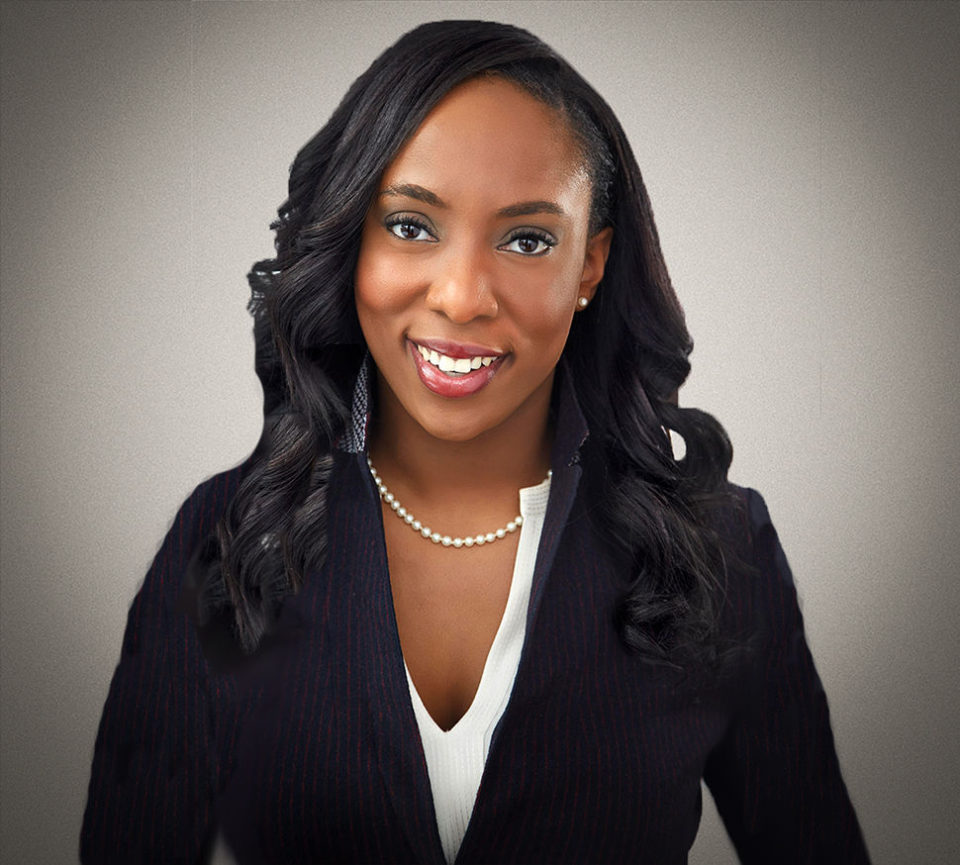
Christine Izuakor is a Senior Security Analyst at United Airlines. In this role, she is responsible for managing numerous security functions from network vulnerability management to negotiating legal aspects of data security for contracts across the enterprise. Christine earned a Ph.D. in security engineering from the University of Colorado at Colorado Springs, becoming the youngest and first African American woman to do so at the university. She is also the co-founder and Vice President of Gen Trend, United Airlines’ Millennial business resource group; a business resource group within United Airlines. The organizations mission is to attract, engage, and retain the next generation of aviation employees and customers.


Childhood

From childhood to adulthood, education has always been an integral part of my upbringing. In the 80’s both of my parents came to America from Nigeria to pursue higher education and new opportunities. It was natural that education was such a huge priority; so much so that I didn’t even know that attending university was “optional” until I was graduating from high school and saw some people in my school choosing not to go. I am very thankful that my parents raised me in this way because it’s cultivated a true passion for continuous learning and made me the person I am today.

Meet Me
Christine Izuakor is a Senior Security Analyst at United Airlines. In this role, she is responsible for managing numerous security functions from network vulnerability management to negotiating legal aspects of data security for contracts across the enterprise.
Christine earned a Ph.D. in security engineering from the University of Colorado at Colorado Springs, becoming the youngest and first African American woman to do so at the university. Her research focuses on critical infrastructure security and has been published in several international journals, including the International Journal of Critical Infrastructure Protection. Her original contributions to the security industry have also been presented in international conferences from Washington, DC to Rome, Italy. Christine also completed a master’s degree in information systems security from University of Houston in 2012 and is a Certified Information Systems Security Professional (CISSP). Dr. Izuakor is also active in the diversity and inclusion community. She is a co-founder and the Vice President of Gen Trend, United Airlines’ Millennial business resource group, serves as the Head Editor of the Illinois Diversity Council Editorial Board, is a member of the National Diversity Council Newsletter Committee, and volunteers as a cyber-security mentor with Year Up.
A first generation Nigerian in America, native Houstonian, and Chicago resident, Christine appreciates traveling and learning about different cultures.


How I feel about being the first African-American and youngest to complete my PHD at the age of 27 in my university.

It feels very exciting! We all know about the shortage of women in both STEM and cyber security. I am just glad to not only have studied a topic that I am very passionate about, but to also act as an example for other women and minorities who don’t see this as a traditional career option. I also feel a sense of pride and extreme gratitude when I think about where I started and the many sacrifices that my parents made to enable such an accomplishment.

Inspiration behind Gen Trend, United millenial business resource group
Gen Trend is a business resource group within United Airlines. The organizations mission is to attract, engage, and retain the next generation of aviation employees and customers. The work started with a core research team that I was leading back in 2012 to better understand the evolution of the work force and trends across generations, with specific attention to Millennials. I am very intrigued by generational challenges and felt inspired to find creative ways to address them. The work has since evolved, with the significant contributions of the other co-founders, United leaders, and the board, into the great organization it is today. In my role as the Vice President, I, in collaboration with the President, effectively led a collaborative team effort to translate ideas and priorities from numerous stakeholders into a 2017 strategy that aligned with the values and mission of the business resource group and company. Alongside 7 phenomenal leaders that make up our board, we are currently executing on that strategy and can’t wait to see how we will influence the future of the company.

How I cope with being a mentor, volunteer and head editor among several other caps I wear 
Time management has been a tremendous skill set that I’ve developed over several years. During my academic journey, I always worked full-time and engaged in many other charity and leisurely activities as well. I still maintained relationships and friends. I still made time for plenty of rest. Being able to make the most of every single minute has been extremely important. I plan every day out, including transition times. More specifically, every few hours I create tasks lists, and then I cross things out as I go so that I know how I’m progressing. I also often reprioritize the lists several times throughout the day. If I find myself procrastinating, I have learned to call myself out on it as well. To paint a picture of what my typical week looked like last year: On weekdays, I would work my 8 hour day…come home and eat dinner, and then go straight to library or Starbucks to do school work for 3-5 hours, often times until they closed. This still left me with 8-10 hours to sleep and rest each day. Then, I always tried to keep my weekends open to travel, socialize, rest, do charity work and take care of everything else.

What and who inspires me
A great deal of my inspiration and motivation comes from pain. There are certain struggles I remember from childhood that I simply don’t want to experience again, and so I work very hard to make sure that doesn’t happen. I also draw inspiration from many different people and platforms, so I don’t really specific role models. I look for people who have made it where I am trying to go, study their journeys, and use their lessons to create my own path and inspire my own journey. I also follow different inspirational pages and powerful multi-faceted women profiles on Instagram for inspiration. A few people I draw quite a bit of inspiration from include Michelle Obama, Sharon Grant, my family, Onika Maraj, and a young woman I recently met through Year Up, Symone Latham-Dior

Projects and activities
One of my favorite activities is travel. I have a goal to visit 30 countries before I turn 30 years old lol. So far, I have been to 22 countries. From exploring the rich Asian cultures of Japan and China, to the pure and scenic country sides of Switzerland and Ireland, and back to the relaxing beaches of Mexico and Dominican Republic, I learn so much about myself and this world through travel. A few future places on my list include Iceland, Australia, Brazil, Greece, and South Africa.

Greatest reward
The greatest reward that I’ve gotten is in being able to inspire people to want and pursue more in life. I like that people see my story and think of greater possibilities for themselves. I believe that’s my greater calling (to inspire) and it’s what gives me the most joy. People I’ve never met or even spoken to before often reach out to me with messages saying, “watching you makes me want to try harder and not give up” or “because of you I’ve decided to go back to school”. Those are the greatest rewards to me. I feel like by just being the best me that I can be, I am also influencing others to be their best selves. I think that’s very important to emphasize. I am not encouraging anyone to be me, or do what I did. I want people to just be great, whatever that means to them.

Challenges
A blessing and a curse for me is my ambition. Some people see it and love it, but some people also view it as a lack of direction or focus. I have had people learn of what I am doing and tell me “I can’t give you this opportunity because you don’t have the time to commit with everything else you are doing.” The truth is, that’s my call to make. How can someone else make decisions about my own time? I know what I am capable, and one of my strengths is in managing my time and reprioritizing. Unfortunately, some people assume they know my capacity by confusing it with their own. This can be very frustrating for someone who not only constantly dreams about accomplishing seemingly impossible things, but is always pursuing those dreams. In those moments, I have to remind myself again that as human beings we are always projecting. That person isn’t saying “You can’t manage all of these things.” They really mean, “Wow, if I were you I don’t know how I would manage all of these things.” I have taught myself to notice the difference.

I am a Woman Of Rubies
Crazy enough, I was literally told that I am a “rare gem” a few days ago by a very prominent and respected leader in my industry. Inside, I am still spazzing and in awe about that conversation, but I share that because it’s is exactly what a ruby is; a rare gem. I believe that I was described in that way because
I am resilient. I fail fast and learn quickly. I am not perfect and I don’t always win, but I never give up.
I work hard and relentlessly towards my goals. I have never been one to wait for anything to fall into my lap. I take ownership of fulfilling my destiny and maximizing on my potential.
I am dedicated to uplifting others along the way. As I take advantage of the paths previous generations created for me, I try to create new paths for future generations as well. When I leave this world, I want my legacy to live on through the success and realized potential of others throughout the world.

Final word for women all over the world
I’ll touch on a point I made in a previous interview: “Too often we, especially women, fear failure, what people will think, or not having all of the right answers. I think that inhibits our ability to dream beyond what those before us have done. Many instead get stuck in doing what’s ‘expected’ of us from parents, society, our cultures, etc. Those elements are important to acknowledge and honor, but can sometimes be limiting in today’s world.”
Instead, be curious. Don’t be afraid to question the way things have been done. Don’t be afraid to question the way people think. If your friends aren’t challenging you to consider different perspectives and outlooks, find new friends or explore new circles. It is questioning our norms that allows barriers to be overcome, ceilings to be shattered, and records to be broken. Questioning even my own way of thinking, has enabled me to break barriers and do things I didn’t know were possible; even when I didn’t have another role model or example to follow.

Men, have you seen them? Of course you have; they are practically everywhere. They have two arms, two legs, one head and basically all the typical features consistent with that of a human being. So what really makes a man, ‘a man’? Is it his role in the family? His position in the society? Or maybe it’s just the anatomical addition of that ‘thing’ that sits between his legs.

The first male figure most women encounter are their fathers. A lot of women don’t know that many of their ideologies about men, first come from their fathers. The second male figure is sometimes their brother(s). During a woman’s formative years, these two characters are responsible for the development of both her foundational perception and psychological comprehension of men. Unfortunately, these men are almost completely oblivious of the ‘power’ they behold. The words that proceed from their mouths, the way and manner in which they show love and care to these women (daughters and sisters) are very strong factors that come together to create a notion of who the man is to a woman.

In our world today, growing girls (future women) are bound to come across two types of early male encounters; the abusive father Vs the loving one, the stubborn brother Vs the kind one, the wayward (male) cousin Vs the level headed one. These men do not know how their actions affect the women around them. They are mostly unaware that their way of life affects the little girl that cohabits in their world. For some of them who rarely take cognizance of this, they are quick to resolve that a young woman, (like Esther, Bisi, Voke) is too small to understand what is going on around her. But Oh! How ignorant can they be!?! How negligent they have now become, expecting these things to wash away with time. I read somewhere that scientists have been somewhat able to estimate that if the human brain’s memory capacity were to be measured in bytes like that of a computer, it would be capable of holding all data seen, heard and experienced to a capacity of 100 terabytes to 1 petabyte; now that’s a lot of space.


As a woman progresses through the stages of life, she continues to meet more men. Classmates, schoolmates, neighbors and male friends from her church or mosque are all men she is bound to come across; I said it before, these men are practically everywhere. Note that as a woman grows, she is not impacted by every single man she meets. She is much older and can begin to form more meaningful bonds with specific men in her life. She is going to have male friends, male acquaintances, male classmates/colleagues, not forgetting the boyfriend and of course the toasters association that would be very present and sometimes remain present even after she is married.

However, whoever a woman decides to bond with, contributes a little ‘something something’ to her previously formed perception of men. It’s almost as if the girl’s idea of a man is a pot of soup and each meaningful bond she forms, is similar to someone adding a little salt, a bit of pepper or curry and at other times it’s a little sand or cement, to that pot of soup as the case may be.


It’s always inspiring to see how people go on to achieve great things after experiencing failure.

This Instagram user, Tricia Obazele‘s (@trishlina) story is one of such.

Tricia Obazele

After she was expelled in her penultimate year in the university, Tricia didn’t remain down but enrolled again at another university, although with the pain of failure in her heart.

Four years later, she’s the 2015/16 Best Grauating Student of her Department, Faculty, and the University.

That’s how you come back from failure!

Read her story below:

I’ve always  been the type of girl who’s always at a loss for the right words to express myself with but I’ve decided to give it a trial…

Hmmmmmmm. I’m so overwhelmed!!! I’ve had to my share of life’s ups and downs. To sum it, it really hasn’t been easy for me at all…

I remember getting expelled from Covenant University in my 300 level, having to start all over at Veritas University.

I remember wanting to finish school right from the day I resumed there.
I just didn’t know myself anymore…
I became a stranger to myself, you know… all because most of my secondary school mates were married with kids and were working already.

I felt like a disappointment to my family… But then God kept me going….
God never gave up on me….

My parents, sister and brothers never gave up on me…

I decided to channel my pain towards my studies….

I remember studying all night because of one test, assignment or exam!

I remember studying in hunger all because of brokage! Lol

I remember being sick almost everytime! Ulcer wasn’t funny at all…

Despite all these and many more, I wanted to make it, to make MUMMY and DADDY proud… I wanted to make them forget my past mistakes…

Now look, I made it!!! Please tell MUMMY, DADDY, OMO, EHIS and EMMA that I made it…

I graduated with a First Class Degree…
God made it happen.

God told me to work hard and always be a good girl and I tried my best….

Truly, it isn’t how FAR, but how WELL!!! Three Awards, like really???

Best Graduating Student, Accounting Department.

Best Graduating Student, College of Management Sciences

Overall Best Graduating Student
My name, EJEHIYOOKHIN, explains it all
THANK YOU JESUS???

Source: Bellanaija

White pick-up truck drives slowly into a deserted plot of land on the edge of the forest. There are two men in the front seat and one is wearing a red and white scarf over his face only exposing his eyes. The camera zooms into the scene as the men turn and speak in Hausa to the little girl in the back seat. She is no more than 12 years old. She climbs out of the truck alone and walks into the woods and through the other side until she reaches the highway. Here she finally rests, sits by the roadside, her head in her hands and waits for a taxi.

This is where the story begins for viewers watching the new short documentary, Through Her Eyes, a deeply moving account of a young girl’s internal journey to pulling off a suicide attack in Northern Nigeria. For many people living in northeastern Nigeria, the threat and fear of suicide attacks remain strong. Just two weeks ago there was news of another bombing in Maiduguri that reports say claimed at least 9 lives. The suicide bombers were young girls, a continuing phenomenon that is just another unimaginable tragedy of the ongoing reality of living in a world of insurgency and terrorism. There is a double mourning and an intensified horror that comes with every new headline of children used as weapons of warfare. But it remains a real and growing problem. According to UNICEF statistics, in 2015, 44 children were used in suicide attacks and 75% of those children were young girls.

Through Her Eyes was written and directed by Nadine Ibrahim, a young Nigerian filmmaker born in Kaduna and still based in northern Nigeria. So far, the short film has been featured in two international film festivals. It is a semi-finalist at the Los Angeles Cinema Festival and last November was nominated in the short film category at the Africa International Film Festival. For such a short film it is a stunningly powerful depiction, offering viewers an imaginative look at the life of a 12-year-old female suicide bomber. It tells the story of Azeeza, a young girl kidnapped from her village during a terrorist raid and trained to carry out a suicide attack. We see the world through her eyes, the people she encounters along the way to her destination, the other children she sees playing, and the conversation she has with the unknowing taxi driver carrying her to the place of the crime. Along the way, Azeeza flashes back to scenes from her own normal life before the kidnapping.

By choosing to tell the story from the perspective of the young girl, Ms. Ibrahim gives voice to a segment of society that usually remains voiceless. How does a young girl get to the point of committing such a morally incomprehensible act? We are reminded not to forget that such children are often victims themselves and not just villains. The film takes a single narrative on this large topic to raise vital and sensitive questions about the conditions under which young female suicide bombers find themselves.

Ms. Ibrahim is only 23 years old. She studied media and film production at the University of Gloucestershire and has worked on projects for the United Nations, Fictionless films, Ebony Life TV and FilmOne. She already knows the value of using her passion for the arts to tell important stories that can help alter perspectives on sensitive topics. I had a chance to watch Through Her Eyes during a private screening in Abuja last month. I knew I had to interview Ms. Ibrahim about her the film. She shared openly and with enthusiasm about her art and her convictions. It is refreshing to engage such a young woman who seems to have a clear sense of how to use her gifts to try and make a positive mark in the world.

Being a Filmamaker

I’ve always wanted to tell peoples’ stories, to create a platform for other voices and I realized I could do it in a visually captivating manner. I want to tell stories that can change the world. I think film can be used as a powerful tool to generate awareness about what’s going on in our country and the world in general.

Inspiration behind Through Her Eyes

To be honest, a part of it was from listening to my mother almost everyday on the phone during her interviews and in conversations. She would always go on about how urgent this situation was and how things needed to change. I heard her say, ‘Children are not born terrorists.” And that just stuck with me. Something automatically clicked and I knew I wanted to explore this subject more through film. And when I kept seeing stories in the media I decided to do a bit of research. I was stunned by how many children below the age of 18 were being recruited and sent out to do these crimes. I couldn’t get my head around it. I wanted to look at female suicide bombers as victims and not just criminals. I wanted to show people a different perspective.

My Mum, My Motivation

My mother gives a voice to the voiceless. She cares more about humanity than anything else. She always says, “Leave no one behind,” and I strongly believe that she actually stands by what she says. She’s dedicated her life towards making the world the type of place that everyone wants to actually live in. That’s why she worked so hard as Minister of Environment and with the SDGs, because it stands for what she wants the world to be. I thought to myself, if she can change the world, why can’t I?

I attended your private screening and loved how you framed the event. You had it in an art gallery surrounded by beautiful paintings all with themes of women, Islam and Northern Nigerian and Islamic cultures. Why did you do it this way?

I chose to show the film in an art gallery because of my passion for art. I love photography, painting and film. I love how you can use different mediums to tell the same story. And the story is so much bigger than what I get to show of it. I want people to understand the terrorism but I don’t want the main discussion to be about a terrorist group and how horrific they are, but rather I want people to think about why this is even happening and what can be done about these devastating consequences. I also want people to understand that there is a rich and beautiful culture to this part of the world that exists alongside the horror.

Challenges

Yes. A lot of people were scared of telling a story about the insurgency in the northeast. They were worried that if they took part in the filming it could put their lives in danger. I found it hard to find actors willing to be in the film. My first actress to play Azeeza eventually backed out of the role because her mother felt it was too unsafe. So two days before filming she called and said she couldn’t do it. A lot was riding on production and I was in a bind. It was nerve wracking.

Overcoming it

I started frantically asking around if anyone knew young female actresses. Eventually someone directed me to a young drama student at an Islamic primary school in the northern part of the country. I met with the student’s mother and she was keen on it because she believed strongly in the message of the film. But when we started filming I did have to have security on location.

Lessons learnt from making the movie

It was my first solo project in Nigeria. I learned a lot in terms of how things work here and I met interesting people who joined the cast and crew. No one on the production was older than 26 years old. We were a young crew with a similar passion to tell important stories about our country. That was very motivating and inspiring for me to give this film my best. But funding was hard to find because of the subject matter. When we were making the film there was a lot in the news about the insurgency and attacks, and people didn’t want their names attached to a film that would be making a statement about the issue.

You are a Muslim. What impact did your faith perspective have in making this film?

Islam is a religion of peace. Seeing it portrayed as a violent religion concerns me because people will misinterpret Islam to equate to terrorism. They won’t go further and research and see that is not true. So much of what insurgents preach about Islam is a misinterpretation of the Koran. What I show in my film has happened in so many countries besides Nigeria. Children in Turkey, Iraq, and Syria have been indoctrinated to believe that performing these crimes is in line with Islam. But in my film I tried to show that internal struggle a young person might have in believing this. The purpose of the film is not to point fingers, or to put my cast or anyone at risk. I’m just trying to tell a story the way I see it. Just creating awareness of what’s happening in our country. But I actually don’t mention any specific terrorists group in the film because I feel like it is a universal story. Using children as suicide bombers is happening in several countries around the world.

Expectations

I hope when people watch the film that they will think differently about what is happening in the country and that they will reconsider how their particular tools can be used to engage in important issues in our country. The youth can’t just leave it to the older generation because it doesn’t seem to be affecting us directly. At the end of the day it will affect us all.

Where can people view this film and what is next for you?

It’s available online on Youtube. I’m going to start working on my feature film. After this I’m ready to challenge myself even more and test the waters. It will be a coming of age story.