
Tag

Christina Koch

Browsing

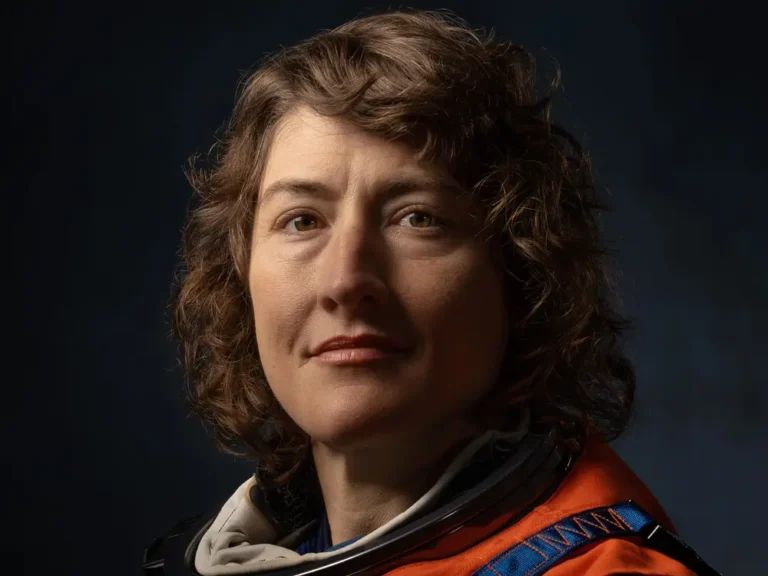
NASA astronaut Christina Koch is once again at the center of history, becoming the first woman to travel around the Moon as part of NASA’s Artemis program.

The Artemis II mission launched from the Kennedy Space Center in Florida, carrying a four-person crew on a 10-day lunar fly-by covering approximately 685,000 miles. It marks the first human mission to orbit the Moon in more than 50 years.

The crew includes Koch, Victor Glover, Reid Wiseman, and Canadian Space Agency astronaut Jeremy Hansen.

Artemis II Mission Overview

Artemis II is a critical test mission for NASA’s long-term goal of returning humans to the Moon and preparing for future deep space exploration.

The mission focuses on validating spacecraft systems, life support, and human performance in deep space conditions. The crew will travel aboard the Orion spacecraft on a lunar fly-by before returning to Earth.

Unlike previous missions, Artemis is designed to build long-term exploration capability rather than short-term lunar visits.

Christina Koch’s Path to Artemis II

Christina Koch’s selection for Artemis II is built on a strong foundation of experience and achievement.

She was first selected as a NASA astronaut in 2013 and quickly established herself as one of the most capable astronauts of her generation.

In 2019, she completed a record-breaking 328 consecutive days in space aboard the International Space Station during Expeditions 59, 60, and 61. This remains the longest single spaceflight by a woman.

During that mission, she also participated in the first all-female spacewalk alongside astronaut Jessica Meir and completed multiple additional spacewalks totaling over 42 hours.

Her scientific work included robotics operations on the Alpha Magnetic Spectrometer, protein crystal experiments for pharmaceutical research, and testing 3D biological printing in microgravity.
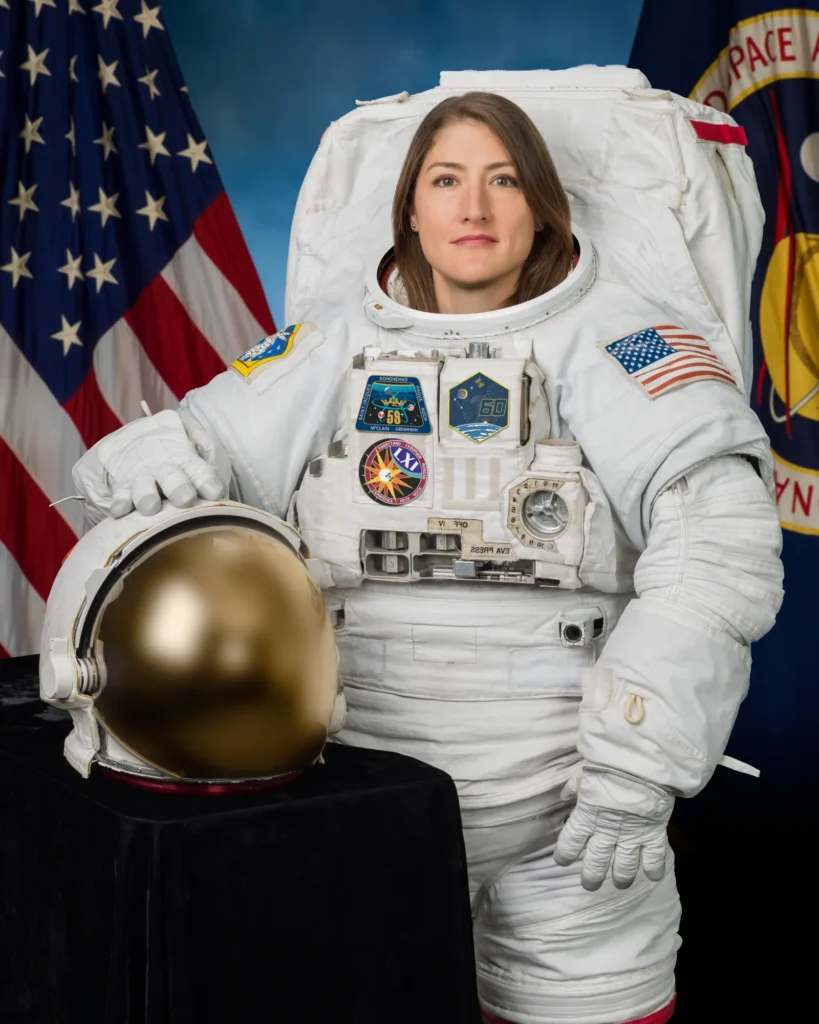
Christina Koch Artemis II Moon
Christina Koch Artemis II Moon Mission NASA Astronaut

Experience Beyond Spaceflight

Beyond her missions in orbit, Koch has held leadership roles within NASA, including serving as branch chief over the Assigned Crew Branch in the Astronaut Office.

She has also worked in technical integration roles at NASA’s Johnson Space Center.

Before becoming an astronaut, her engineering background included space science instrument development and fieldwork in extreme environments such as Antarctica and the Arctic. She also supported search and rescue and firefighting operations in Antarctica.

The Artemis II Crew

The Artemis II crew represents a new era of space exploration. Christina Koch, Victor Glover, Reid Wiseman, and Jeremy Hansen were selected for their operational expertise and experience in spaceflight.

Together, they are tasked with testing the systems and procedures that will support future lunar missions and long-duration exploration beyond Earth orbit.

Why This Mission Matters

Artemis II is the first crewed mission to travel beyond low Earth orbit since the Apollo era. It represents a major step toward establishing sustained human presence on the Moon and preparing for future missions to Mars.

The mission will help NASA understand how humans can live and work in deep space over extended periods.

Historic Achievement

With Artemis II, Christina Koch becomes the first woman to travel around the Moon, adding another milestone to an already groundbreaking career.

Her journey reflects the growing role of experienced astronauts in shaping the future of human space exploration.

From Earth orbit to lunar space, Christina Koch continues to play a defining role in space history. Alongside Victor Glover and the Artemis II crew, she is helping lead a mission that marks the beginning of a new era in exploration. The Moon is now a gateway to the future of human spaceflight.

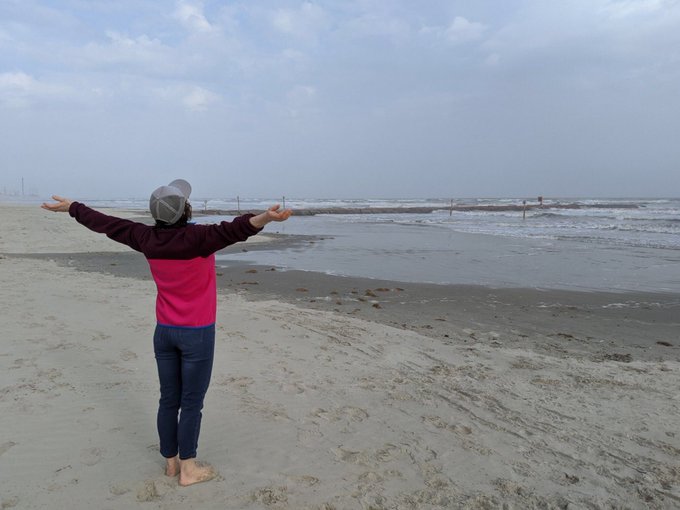
Christina Koch a female astronaut returned to Earth last Thursday after a record-breaking 328 days in space, the longest single spaceflight by a woman.  She did the simple things as soon as she arrived home, like reuniting with her dog, eating her favorite foods and taking a family trip to the beach, Koch said during a press conference Wednesday.

“After 328 days in space, the first six days back on Earth were full of just as much wonder and excitement,” she said. “We all live on a wonderful planet and it’s great to be back.”
Koch described the joy of seeing so many people again and feeling her body reacclimate as “her mind [wakes] up to sensory experiences that define Earth.”
Apart from regaining her balance and getting used to walking again, Koch has been lucky. Unlike previous astronauts who returned from long-duration spaceflight missions, Koch didn’t experience motion sickness. Muscle aches are normal, and she felt a few in her neck — something she compared to a two-week-old working hard to hold up her head after floating in microgravity for close to a year.
She received advice from astronauts Scott Kelly and Peggy Whitson, who also hold records for long spaceflights (Koch has surpassed Whitson’s record of 288 days). They told her to pace herself and do what she loved. Long missions on the space station are “an ultra-marathon, not a marathon,” they’re fond of saying.
Mentally, Koch decided to focus on the fact that her time on the station was special. So rather than focusing on the things she missed from Earth, Koch thought about the things she’d never have again once her mission was over. This “mental cheerleading” allowed Koch to put positive messages on repeat in her head, she said.
But Koch adjusted well to space initially. One of her favorite moments was when they arrived at the space station. “I regarded it as this amazing place, my new home for the next year,” Koch said. “Something I had trained for so long had come to life.”
It only took three months for Koch to feel like the space station was home, and replacing her routine from Earth with the unusual aspects of microgravity became normal. She forgot she was floating until a new crew would arrive, because they were so excited about experiencing the sensation.
When it was time to come home, Koch’s personal effects making the return trip all fit in a shoebox — mainly mementos donated by friends and family members that she was excited to give back with a new memory attached to their sentiment.
Koch’s message to young people who aspire to be astronauts is to “follow your passions, live the life you’ve imagined and do what scares you.”
Koch herself knew she wanted to be an astronaut at five years old — but she also knew the chances of becoming one were low. She began with a single-minded goal, but when she went to Space Camp and learned about the process for becoming an astronaut, she made a key decision.
“I wasn’t going to live according to a checklist,” Koch said. “If the experience I gained would allow me to contribute in a great way to the space program, only then would I apply.”

After an historic all-female spacewalk, astronaut has moon dream

Koch pursued other passions, like rock-climbing and quitting an engineering job at NASA to pursue work in Antarctica — both of which helped her become a better astronaut, she said.
As far as her records achieved in space — longest spaceflight, and the first three all-female spacewalks — Koch isn’t a stats person who keeps score. To her, the best thing that can happen when a record is set is when someone else breaks it
Koch will never forget how she felt when she saw Earth for the first time. She was in the Soyuz capsule on the six-hour rendezvous with the space station in March 2019, along with NASA astronaut Nick Hague and Russian cosmonaut Alexey Ovchinin. She looked out at Earth and exclaimed, “oh, my goodness.” Then she realized how dangerous that could be without explaining her reaction — because in space, it could mean any number of issues had come up. She clarified, “Everything is OK. It’s just Earth.”
“I looked out the window and there was Earth. It looked brighter and way more real than I imagined it could be,” Koch said. “I realized this was real and that I had left our planet.”
Source CNN

Two female astronauts are close to accomplishing something no women have done before.

U.S. astronauts Christina Koch and Jessica Meir will step outside the International Space Station Friday morning, the first time in history that two women have done a spacewalk together.

Koch and Meir are expected to spend more than five hours outside the space station to replace a failed power controller, according to NASA.

The remaining four astronauts aboard the International Space Station, all men, will remain inside while Koch and Meir complete their work.

NASA is marking Friday’s “HERstory in the making” by asking schoolteachers to share photos of their students celebrating the spacewalk, according to The Associated Press. NASA has a “HERstory” oral history project documenting the experiences of women who have contributed to the space agency.

Koch and Meir both joined NASA in 2013, the year NASA’s astronaut class was 50% female. Koch is also on her way to making history with a 300-day mission, which will be the longest single spaceflight by a woman.

The astronauts were asked in an interview from space earlier this month about whether they mind having their accomplishments qualified by their gender.

Story continues

“In the end I do think it’s important because of the historical nature of what we’re doing and in the past, women haven’t always been at the table,” Koch said on NASA TV. “And it’s wonderful to be contributing to the human spaceflight program at a time when all contributions are being accepted, when everyone has a role, and that in turn can lead to an increased chance for success.”

“There are a lot of people that derive motivation from inspiring stories from people that look like them and I think it’s an important aspect of the story to tell,” she said.

sonos sonos One (Gen 2) – Voice Controlled Smart Speaker with Amazon Alexa Built-in – Black read more

Meir added, “What we’re doing now shows all the work that went in decades prior. All the women that worked to get us where we are today. I think the nice thing for us is we don’t even really think about it on a daily basis. It’s just normal. We’re part of the team.”

Koch and Meir’s spacewalk comes seven months after NASA had to cancel its first attempt at making “HERstory,” because the space station did not have enough medium-size spacesuits on board.

Koch and another astronaut, Anne McClain, were supposed to make the first all-women spacewalk back in March.

When Koch and McClain, who is no longer on the ISS, discovered they both needed to wear a size medium in the “hard upper torso,” or the shirt of the spacesuit, the walk was canceled.

NASA faced swift backlash from people who viewed the spacewalk cancellation as yet another sign of women being held back on the job.

The decision by NASA though was largely one borne out of logistics, as there are a limited number of spacesuits on the space station and NASA has lacked the funds to update its spacesuits in recent years.

(MORE: NASA’s interns remixed Ariana Grande’s hit song to promote its next mission)

Since the cancellation of the female spacewalk in March, NASA has been preparing its spacesuits for a series of 10 spacewalks.

The International Space Station is now equipped to make four complete spacewalking suits, with two “hard upper torso” components of the same size to be available at any time, according to NASA.