Women of Rubies

Category

self development

Category

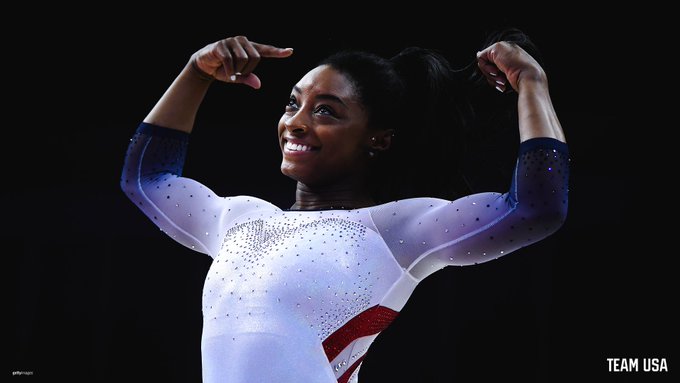
Simone Biles, the most outstanding gymnast, is clinching all the awards!

Biles has just been bestowed with “Female Olympic Athlete of the Year” at the Team USA awards.

Biles is the most decorated female gymnast Olympics and world championship history. She won five gold medals at the 2019 FIG World Championships, the most of any gymnast at a single event since 1958. In 70 years, she is the first woman to win six U.S. all around titles.

Team USA took to Twitter to congratulate Simone saying, “Synonymous with making history, synonymous with AMAZING us all every time she competes. GIVE IT UP for the 2019 Female Olympic Athlete of the Year, Simone Biles.”

Team USA

@TeamUSA

Synonymous with making history, synonymous with AMAZING us all every time she competes.

GIVE IT UP for the 2019 Female Olympic Athlete of the Year, @Simone_Biles!, Best of the Year presented by @DowNewsroom

View image on Twitter

Congrats Simone!

Having the ability and confidence to speak up at work is critical for several reasons. It’s important on a personal level because it can directly impact your career in either a positive or a negative way. Done correctly, it can have a very uplifting effect on your career and workplace happiness. Done in an inappropriate manner can have incredibly negative effects on your career, and also spread to those around you.

On a more macro level, the ability to speak up at work can be extremely productive and create great things for your immediate team and the organization as a whole. If you open your mouth at the wrong time or in the wrong place, all it’s going to do is create divides between your colleagues and negatively impact the work being done.

Let’s take a look at how to speak up at work without being offensive.

When and Where to Speak Up

As we mentioned, there are definitely times and places you should speak up at work; and there are also circumstances where you shouldn’t. Let’s look at some suggestions for when conditions are right for speaking up.

Situations

A general rule of thumb is if the situation involves you it’s a good idea to speak up. On the other hand, if it doesn’t involve you, that’s a good indicator to not worry about sharing your opinion.

Just today, my team and I had a meeting to review 4 different vendors that recently provided us with demo’s. We are looking for a tool to help us become more efficient as well as provide a better customer experience. We all offered our opinions regarding the products. This was a great situation for me to offer my thoughts on a tool we will all be using.

Several weeks ago, I walked by 2 associates who work in the same department as I do. We don’t work together daily but I do interact with them from time to time. One was expressing frustration and displeasure of having to work with someone in another department. This would be a situation where my input would be both not appreciated and not important, because it has nothing to do with me. So I kept walking.

Reasons

The best way to decide whether to speak up is to ask yourself – will something positive or good happen if I decide to offer my opinion? If the answer is yes, then by all means, speak up. If you have a hard time figuring out how something positive happens when you open your mouth, make sure you pause and really think about if you should say anything.

Referencing my situation before, where my team members and I were weighing in with our opinions on the vendors. This is a good reason to speak up and share my thoughts. My opinion was wanted for the good of the team. It’s a good reason for me to say what I’m thinking.

Let’s think about another situation. Let’s say a coworker of mine is starting to gossip to me about another coworker. First of all, there’s not really a good reason for the coworker to be gossiping to me about someone else. It is certainly not a good reason for me to start chiming in as well. Nothing good or positive is likely to come out of me speaking up in this situation.

Manner

The manner in which you speak up will make a difference too. If you share your opinion in a clear and positive way, typically good things will happen. This is true in most situations, from one-on-one with your boss or subordinate, to addressing a large group of people. Make sure you are prepared and communicate clearly.

On the other hand, if you mumble a lot or are unable to communicate in a clear manner, you aren’t doing yourself any favors. The people who are attempting to listen to you either won’t be able to hear you very well or understand you. This will only hurt your career and make the situation more muddied at work.

1. Be Clear

This is key to speaking up without being offensive. Make your opinion known or ask for what you want in a clear and straight forward manner without being demeaning to the other person.

Don’t make your voice softer or raise your volume, keep it in your normal speaking voice. Don’t try to emotionally manipulate the other person, just state your point in a clear and concise manner.

2. Stay Cool and Collected

Sometimes when we are stating our opinions, the conversation can begin to get heated. Different opinions and ways of doing things can cause friction. You think something should be done a certain way and someone else doesn’t agree with you.

If you are passionate about the subject, the conversation might begin to turn to a more animated discussion. When this happens, take a deep breath and pause. Let yourself calm down at least a little bit. Continuing the discussion when you are upset will usually only lead to saying things you’ll later regret.

3. Be Prepared

We all tend to feel a lot more confident when we feel prepared. This is true at work as well, whether it’s having a meeting or asking for a raise.

If you want to ask for a raise, come prepared and you probably won’t get defensive or aggressive when challenged. If you come prepared, you can show your boss the reasons why you deserve a raise. Maybe you could point out the money you saved the company or even better, new business you’ve brought it.

Come prepared and you’ll be ready to speak up at work without being offensive.

4. Use Good Body Language

When it’s time to be assertive and state what you want at work, make sure you are using positive body language. Keep your posture straight and use open body language. Look people in the eyes and and don’t clench your jaw or tighten your facial muscles. Smile from time to time. This will help you be assertive and clear.

When you use poor body language such as crossing your arms, frowning, talking in a loud and forceful manner, leaning in too much or pointing fingers, you will come across as aggressive and offensive.

5. Be Comfortable Saying No

Having the ability to say no will help you speak up at work without being offensive. Sometimes, what you see is a boss or manager who, for some reason, likes giving someone additional work simply because the other person allows it. As you might imagine, this can lead to resentment, anger, and eventually quitting and getting a new job. When things are busy, we all get extra work sometimes. If you are consistently getting more than your fair share, be comfortable saying no.

I recently was asked to take on an additional project. Okay, I’m a team player so I took the additional work on. A few weeks later, I was asked to take on another additional project. I said no, I simply don’t have the bandwidth and the project would suffer because I did not have the time to give it the attention it deserved. I said no and I did not get the project.

You can take a look at Leo Babauta’s advice on The Gentle Art of Saying No.

6. Offer Constructive Criticism

It’s okay to offer constructive criticism if it is your place. Personally, I am open to receiving constructive criticism. Not everybody is. I feel that if you can tell me something in a positive manner about how to get better, I am all for it. I like for that conversation to be able to swing both ways.

If you want to help someone get better and you feel they are receptive to it, by all means offer constructive criticism. Just make sure it is constructive.

If you are one of those people that likes to offer criticism without the constructive component, chances are you are coming across as offensive.

7. Let Other People Speak

A final component to remember is to let other people speak as well. You are entitled to speak up and share your opinions. It’s important for you to be assertive and have your voice heard at work to get what you want and need.

That being said, in order to not be offensive, make sure you let other people speak. Yes, your opinion is important and you should ensure you can be heard. It’s also important to allow other people the opportunity to speak up at work as well. Remember, half of effective communication is listening.

Bottom Line

We’ve taken a look at how to speak up at work without being offensive. As you can see, it’s important to be assertive at work when needed to get your opinion heard and speak up for your wants and needs.

It’s very possible to state your position and get what you need at work and in your career in a manner that works well for you and everyone you work with. This can be done in an assertive manner without being offensive.

Source: Life hack

Lagos State Commissioner for Women Affairs and Poverty Alleviation (WAPA), Mrs. Cecilia Bolaji Dada has said that the war against domestic violence must be jointly fought by parents, schools and society as a whole.

Dada made the call on Wednesday at a symposium organised by the Domestic Violence Unit of the Ministry with the theme, “Parents as Social Agents of Change”.

The Commissioner said that parents must play a crucial role in curbing domestic violence, appealing that they should set good examples for children by avoiding behavioural patterns that can set the young ones on the path destruction.“Parenting as an art is not limited to the biological parents of a child alone; rather, it is a tripartite phenomenon sitting on a three-legged stool.

This stool consists of the home, the school and the society at large, as what is fed into the child from the home front is what is taken to the larger society,”

Dada stated.While noting quarrels and disagreements are inevitable in some homes, Dada urged parents and other relevant stakeholders to make conscious efforts to shield children away from such fracas whenever they arise.According to Dada, the symposium was aimed at guiding parents against becoming a negative influence in the lives of their children and wards.In her words;

“I wish to state here that we do not encourage war or fighting in our homes, we are peace ambassadors. But then, as humans, challenging issues might arise from time to time, we disagree to agree. But when there are disagreements, let us avoid violence and also learn to shield our young ones from such challenging issues.”She advised both parents and young ones to engage themselves productively and avoid idleness at all cost, stressing that “an idle mind is the devil’s workshop.”.

I was in Uganda a few years ago for one of the programs we used to run at the African Women’s Leadership Institute. One day, there was a report about something that had happened in one of the local markets. One of the women in the market went into labour unexpectedly. It seemed there was no time to get her to a nearby hospital or clinic, so the women around went into action. Some of them ran around to look for basins, hot water, towels, and razors. A few held her hand and encouraged her to push. Majority of the women around took out their wrappers and held them up, creating a protective ring around the woman, shielding her from prying eyes. Every now and then, this scenario plays itself in other markets around the continent, and the response is mostly the same – women bring out their wrappers to protect one of their own.

Sadly, this is no longer the case these days. Instead of wrappers coming out, it would be cell phones to record every graphic detail. Sure, help might still come, but not before the person concerned has all their pain and agony out there for all the world to see. Recently, there was the case of a young woman in Ajah, Lagos, who was found wandering the streets. Reports on how she got there vary, but she was stark naked, extremely emaciated and incoherent. Instead of immediately rushing to help, covering her up and getting her medical attention, onlookers laughed at her, threw things at her and recorded her on their cell phones. Without any idea of who she was or how she got there, judgements were made on the spot about her being the victim of ritualists which she must have brought on herself in her quest to make quick money. A good Samaritan, Keira Hewatch, stepped in and took her to the hospital. Even though many onlookers where not prepared to help the poor woman on the road, they tried to stop Keira from helping her, saying she too might be bewitched. Essentially, they refused to bring out their wrappers to protect and save someone and tried to stop someone else who was willing to bring out hers.

What do these wrappers signify? To me they mean protection, solidarity, sisterhood, empathy, kindness, compassion, duty, all those things and more that make us human beings. In the market places where the scene I described in Uganda happens, there is an unspoken protocol amongst the women – a responsibility to take care of one of their own who needs them. She is in pain. Afraid. But she has sisters around her, rooting for her and helping her. So, I ask us my dear sisters, where is your wrapper? Where is your wrapper to shield and protect other women and girls who need you? Where was your wrapper for the little girl who was molested by someone in your household and you said ‘Shhhhh’ and looked the other way? Where was your wrapper when someone you know said she was raped by someone she trusted? Did you ask her what she was wearing? Or if she seduced him? Where was your wrapper when your friend needed succour from an abusive husband? Did you gossip behind her back that it served her right, she is too arrogant? Where was your wrapper when your sister or daughter told you that her lecturers were harassing her in the University? Did you tell them that they must have done something to encourage them? Where was your wrapper when a young woman who could have been your own sister, daughter or niece was found on the streets naked? Where you one of the women who stood by and recorded her misery and threw things at her? Where you one of the men who tried to stop brave Keira from helping? What was in it for you to have a very sick woman die untended in broad daylight, with human beings baying for her blood like animals? Even animals care more for their own.

Our wrappers might all look different, with varying sizes, shapes and colours, but each and every one of us has a wrapper. Bring that wrapper out to shield another woman, or a man. Use it to help get her a contract, help with her rent, pay her children’s fees, help her with capital for a business or simply a discreet shoulder to cry on. Never let a day go by without bringing out that wrapper. The way God works is that the more wrappers you bring out for others, the more will come out for you. We don’t only need wrappers when we celebrate and buy Aso Ebi. We need the wrappers for our trials and tribulations and we all have them.

The women in the market place might never see the woman they helped again. She might never be able to say thank you. Yet she will never forget that other women stood by her and gave her dignity and covered her nakedness. Are we prepared to cover the nakedness of others, or do we want to be part of the mob that strips them naked? These days there seems to be a war against women. Not only is sexual violence at an all time high, these crimes are now committed in full view of the public. A young woman is accused of stealing and stripped naked, hands all over her and objects being stuck into her. When this happens, what do we do, will we look the other way? When a woman is being harassed online, do we join in the abuse? The more wrappers we bring out, the safer we will all be. There is another conversation to be had with the men, with our male leaders, with those who have the powers and privileges that weaken our agency and make us forget that we have wrappers in the first place. Today, we are talking to and about ourselves.

Let us all agree to bring out our beautiful, strong, diverse wrappers. Our wrappers of respect, love, dignity, support and endless hope. Thank you for bringing out your wrapper Keira. God bless us all.

This is an expanded version of a brief speech that was given at the ARISE Women’s Conference in Lagos, October 26th, 2019.


Bisi Adeleye-Fayemi is a Gender Specialist, Social Entrepreneur and Writer. She is the Founder of Abovewhispers.com, an online community for women. She is currently the 1st Lady of Ekiti State. She can be reached at BAF@abovewhispers.com


In Rwanda, a traditional sexual practice almost guarantees female orgasm when done right. Female pleasure is not shunned but celebrated here. When contextualized to the current world realities, kunyaza is the height of equality in the bedroom.

Kunyaza: The Sensual Rwandan Tradition Which Guarantees Explosive Female Orgasms

 Photograph: Trevor Cole/Unsplash

Here are some important tips to help you safely handle your first date in the “real” world.

Becoming independent is a critical part of growth and making mistakes can be a natural phenomenon that every individual will go through. How it is handled and lessons learnt from mistakes make the difference.

When kids make mistakes, most parents can be quick to judge their incompetence and lack of maturity, but then, it is a learning curve that gives everyone the opportunity to grow and become truly independent.

According to a parenting enthusiast and mum, Gift Adokie, when kids make mistakes that embarrass or disappoint their parents, it is important for parents to learn how to overcome the feelings of failure and not take it personally.

Having worked with parents as an educator of students with severe behaviour issues, she said that parents can do everything “right” and children will still make mistakes. Mistakes are a natural part of life and critical to learning, growing, and becoming independent. Missteps and failures allow kids to gain valuable insight, develop critical thinking skills, and acquire essential traits like resilience, grit, and self-compassion.

According to Adokie: “When your child makes a mistake that disappoints or embarrasses you, berating yourself is not going to help this situation. Feeling guilty is not either. In both cases, you are taking responsibility for something that is not yours to own. If your children think you are blaming yourself for their actions or making excuses for them, that is giving them the wrong message.

“Taking time to communicate your expectations, your belief in their capability, and making a plan for moving forward is a far better way to spend your time and energy.”

Adokie stressed that it may be helpful to keep in mind that when parents take on their children’s mistakes, this becomes a detriment to their children when they get into the real world and do not know how to handle failure or take responsibility for their poor choices.

She added: “By communicating that mistakes are part of life, you also dismiss the notion that perfection is needed in life’s journey, which is also very damaging to personal growth, happiness and wellbeing. We never want our kids to believe they are failures when they experience failure.

“Commending them for owning a mistake and getting back up to try again is extremely beneficial. Sharing mistakes from your own life and how you handled them helps kids perceive you as a trusted source of support when things go wrong.”

Owning your own mistakes and apologising for them provides a powerful example for young people to follow.

She added that, above all, these are the three mistake reminders to keep in the forefront when kids make mistakes:

• How I collect myself and move forward in courage and love after making a misstep shows kids how to move forward in courage and love when they make a misstep.

• We are not the sum of our mistakes; we are not a collection of our failings; we are human and sometimes we just need a moment and every moment is a chance to start anew.

• Mistakes mean we are learning, growing, taking risks, and showing up. The day we stop making mistakes is the day we stop living. Let us live bravely, boldly, flawed, and full of hope.

By Ijeoma Thomas-Odia for Guardian

Chimamanda Ngozi Adichie has said she will not be silenced while advocating for gender equality.

The author said this on Wednesday, November 20, 2019, while receiving an award at the “Equality Now.”

She said: “I was a feminist long before I knew what the word meant. Not because I read books but because I observed the world around me and saw how women were treated. Sometimes it can feel very lonely trying to prove that sexism exists, that we haven’t achieved basic equality for women around the world. Tonight is an oomph that shows me that it truly matters.

She added: “I’m going to remember this night when people tell me to shut up. I’m not going to shut the fuck up!”


"I?m not going to shut the f*ck up" Chimamanda says about being an advocate for feminism


The international organization, Equality Now honored Chimamanda Ngozi Adichie and Scarlett Curtis at the annual Make Equality Reality Gala in New York City.

Equality Now Global Executive Director Yasmeen Hassan said at the event: “Changing laws and mindsets is only possible through persistent activism. Our honorees tonight, Chimamanda Ngozi Adichie and Scarlett Curtis, use the written word to do just that.”

Curtis is the author of the bestseller Feminists Don’t Wear Pink and Other Lies, and is a vocal activist across feminist issues from period poverty to female genital mutilation (FGM).


"I?m not going to shut the f*ck up" Chimamanda says about being an advocate for feminism


Singer-songwriter Rhonda Ross, daughter of singer and producer Diana Ross, presented Adichie with her Equality Now award. Ross invited a group of guests to welcome Adichie on stage by reading an excerpt from her book We Should All Be Feminists.

"I?m not going to shut the f*ck up" Chimamanda says about being an advocate for feminism


In her speech, Adichie also said storytelling has an important role to play in achieving equality.

“We really need to start thinking about ways to make women’s stories familiar to men. Men need to read more women’s stories.”


"I?m not going to shut the f*ck up" Chimamanda says about being an advocate for feminism

Credit: LIB

Adebanjo Aderinsola Abibat, a versatile young woman and entrepreneur is a graduate of Performing Arts, Olabisi Onabanjo University, (OOU). She is an indigene of Ogun State.

She is a hair stylist, a fashion designer, make up artist (including special effect) and an actor. She is also the CEO of Black doll and Rinsola Aesthetics and the Co-Founder of Costume Sisters.

Aderinsola shares her ‘Ruby Girl’ story in this interview.


MEET ME

My name is Adebanjo Aderinsola Abibat, popularly known as Rinsola. I am a graduate of Performing Arts, Olabisi Onabanjo University OOU. I am from Ogun State.

I’m an hair stylist, a fashion designer, make up artist (including special effect) and an actor. I am the CEO of Black doll and Rinsola Aesthetics and the Co-Founder of Costume Sisters.

HOBBIES

I am a freak when it comes to applying makeup and taking pictures. I also love dancing, drawing and standing in front of camera, either acting or making my short videos.

INSPIRATION

I am mostly inspired by my Milieu, especially when I have to express myself through drawing. I draw what I see, and I also do this sometimes when it comes to making a creative outfit. Social media is another source of my inspiration. When I see people’s work, I get motivated to do more than ever someone else has done, plus it’s a constant reminder not to relent and also improve to be the best. Hakeem Effects (Onilogbo Hakeem) inspires me more on the area of special effects or makeup fantasy.


ONE ACCESSORY I CAN’T LEAVE HOME WITHOUT

Earrings

BALANCING IT ALL…

Everything in life has its own season or time. Especially when it comes to hair and sewing. There are times when I get jobs for make up only or sewing e.t.c. So far, I haven’t been in a situation where I have to do all at the same time. It’s either two or three at most.

I remembered a situation where I had to dance, act, and was also the costumier and makeup artist for that production. It was actually stressful, but I was able to pull through because it was something I really enjoyed doing. I have passion for these things and also derive happiness from doing them.

BEST QUOTE

Make hay while the sun shine.


ONE THING I WILL LIKE TO CHANGE ABOUT ME

Low self esteem especially when it comes to competition or public speaking.

WHAT KEEPS ME UP AT NIGHT

Social media. I love feeding my eyes with things that are trending, especially things that have to do with fashion.

MOST MEMORABLE EXPERIENCE ON STAGE AS A THEATRE ARTS STUDENT…

My induction ( initiation to Theater Arts). Walking around the school bare footed with palm front in my mouth alongside my course mates and dancing on stage with public figures including the likes of Abbey Lanre, Yinka Quadri, Jide Kosoko, Shola Kosoko, Faithia Balogun, Toyosi Adesanya, and Victor Olaotan who was the chief priest of the occasion.


IF GIVEN THE CHANCE TO BE THE PRESIDENT FOR A DAY…

I would change the economy. It is one of the biggest problem that Nigeria is currently facing. The rate of buying and selling has drastically increased and is negatively affecting the citizens. Inflation in prices of goods and services is rising and our currency is depreciating. Income earned by workers can no longer sustain them, which is a threat in the lives of many people.

UPBRINGING

My upbringing didn’t prepare me for all that I am today. Maybe I would have been better than this if that was the case but I thank God for where I am today.


MY BRAND IN THE NEXT 5 YEARS

I see myself becoming the woman I have always dreamt of. A successful entrepreneur and a public figure.


WORDS OF ADVICE FOR GIRLS YOUNGER THAN ME

No matter how bad your background is, how broke you are, where you are today or what anyone else says about you, your life and your future matters. Hard work is the younger brother to miracle, put in effort and hard work in whatever you do, just be yourself and never follow anyone else path and the sky will be your starting point.

British actress Emilia Clarke who played Daenerys Targaryen in the popular HBO series ‘Game of Thrones’ has made an astonishing claim about the hit tv show producers.

Emilia, 33, who went nude and simulated sex scenes as Khaleesi in the first episodes of the Tv show, claims she was pressured by her bosses to perform the multiple nude scenes because according to her bosses she would be disappointing a lot of fans if she didn’t do them. She said she had to rely on a lot of alcohol to act those scenes.


Game of Thrones star Emilia Clarke alleges her producers
In an interview with Dax Shepard on his podcast Armchair Expert, the actress said she hadn’t agreed to the nude scenes in advance but felt she should do it anyway because she was new to the industry.

Emilia said: ‘I’m a lot more savvy [now] with what I’m comfortable with, and what I am okay with doing.

Game of Thrones star Emilia Clarke alleges her producers


‘I’ve had fights on set before where I’m like, “No, the sheet stays up”, and they’re like, “You don’t wanna disappoint your Game of Thrones fans”. And I’m like, “F**k you”.’

Season one filming began in July 2010, when Emilia was 23 and now admits the amount of nudity in the first season was ‘overwhelming’ and she had relied on alcohol to get through the scenes.

She said: ‘I took the job and then they sent me the scripts and I was reading them, and I was, like, “Oh, there’s the catch!”

‘But I’d come fresh from drama school, and I approached [it] as a job – if it’s in the script then it’s clearly needed, this is what this is and I’m gonna make sense of it. Everything’s gonna be cool.’

”So I came to terms with that beforehand, but then going in and doing it… I’m floating through this first season and I have no idea what I’m doing, I have no idea what any of this is.

‘I’ve never been on a film set like this before, I’d been on a film set twice before then, and I’m now on a film set completely naked with all of these people, and I don’t know what I’m meant to do and I don’t know what’s expected of me, and I don’t know what you want and I don’t know what I want.


Game of Thrones star Emilia Clarke alleges her producers


‘Regardless of there being nudity or not, I would have spent that first season thinking I’m not worthy of requiring anything, I’m not worthy of needing anything at all…

‘Whatever I’m feeling is wrong, I’m gonna cry in the bathroom and then I’m gonna come back and we’re gonna do the scene and it’s gonna be completely fine.’
In another scene, another of her love interests stripped for the camera, and she praised the show for that, but added that her love interest in season 1, Khal Drogo didn’t strip for the camera but she did..

She added: ‘No, I don’t know why. But I’d like to bring your memory back to Mr. Michiel Huisman and I copulating for the first time, which began with me saying, “Take off your clothes,” and then you got to see his perfect bottom.’

She explained: ‘I love that so many women watch the show. If you look at ‘Game of Thrones’ on face value — blood, t**s, dragons, swearwords — you’re like, “Oh, this must be for guys”.’

‘But if you take that away, the story lines are fascinating depictions of the struggle for power. And women are in on that conversation.’

She said about Khal Drogo: ‘Oh, I did. I saw his member’, she said. ‘But it was covered in a pink fluffy sock. Showing it would make people feel bad. It’s too fabulous.’


Credit: LIB