Women of Rubies

Category

Interviews&profile

Category

Akhona Makalima has made history as the first woman to officiate a men’s professional football match in the country.

Since South Africa’s Premier Soccer League (PSL) was founded in 1996, the league has fielded only male referees until 2015, when Ahkona changed the narrative.

Achieving this feat in a male-dominated sport wasn’t easy for Makalima. About seven years ago, she took advantage of an initiative created to get more women involved in football, and she eventually earned her first refereeing certificate.

She went on to become the first South African woman to pass FIFA’s fitness test for certifying referees, scaling through a series of trials most men fail.

When she eventually came on to officiate her first professional match in 2015, Makalima proved naysayers wrong by doing an incredible job. Since then she has officiated over a hundred matches in PSL, Sasol Women’s League and Africa Women Cup of Nations.

She started Inter-Refs in 2016. Through the initiative, she teaches girls about the laws of football and how they can make a livelihood through the sport.

(Photo: Lefty Shivambu/Gallo Images)


Ore Onile-Ere relocated to Nigeria with a ‘healthy dose of optimism, faith and grace’ to gain success in the motherland and afar. Having worked at the BBC, ITV, Vox Africa, she honed her craft in hospital radio for the NHS. Since moving back to Lagos two years ago, Ore has found a home at the newly launched Lagos Talks 91.3 FM, anchoring the popular drive-time belt, ‘The Live Drive With Ore’ every weekday. A host as well as a voice-over artiste, she has expanded her reach to include modeling, walking for ‘About That Curvy Life’ at the Arise Fashion Week earlier this year. With her sights firmly set on other media platforms such as television and more hosting gigs, this budding avid traveler talks about her move back to Nigeria, encouraging other women to pursue their dreams and her plans for the future.

You recently relocated to Nigeria from the U.K, what informed this decision and how easy or difficult was it?

I always had it at the back of my mind that living in England my whole life wasn’t what I wanted for myself.It was getting to a stage in my life where I knew I wanted a challenge; something that could take me out of my comfort zone and let me thrive at the same time.
So two years ago, after much deliberation and research, I moved to Nigeria.
It wasn’t the easiest of decisions, but it was important to me that I tried. What however made it easier was that I was landing straight into a job right in my field.
I knew if I moved here and then looked for a job, the frustrations would seep in quicker.

Why did you say you moved with a healthy dose of ‘optimism, faith and grace’?
Lagos is a terrain I am not familiar with, and when you have grown up seeing how things are done in a completely different manner, I really think you need those things; prayer included.
You hear about the realities of life in this country and you have to shut it out, with the belief that yours will be different and make a success of it. So I took a leap as big as I could contend with, and two years later, I’m still here.

Having worked for the BBC, ITV and Vox Africa, how did this experience prepare you for your career in the media and how will you compare with working in Nigeria?
The experience I gained in those media houses after graduating really helped put me through the steps needed to become a full-fledged Broadcast Journalist. It helped me recognise both my strengths and my weaknesses. Comparing it to working here, you almost have to compromise on things, because the rules are completely different here and you have to learn to adapt to it; not necessarily conform however.
Coming in guns blazing, saying ‘back in England, this is how it’s done and what not’, would do me no favours whatsoever. I’m still shocked about what is deemed acceptable and unacceptable for broadcast.

Tell us about your journey to working on radio in Lagos?
In 2013, I came to Nigeria for a family event and that’s when the media realm in Lagos caught my attention.Once I was back in England, I did a little research about it and then left it on a back-burner for a year.Early in 2015, eager not to get complacent about a change of scenery, I looked into it again, sent my show reel-out to various media houses (both TV and Radio) to see what was out there and the feedback was great. I spent the bulk of 2015 flying in and out, alongside doing Skype interviews. I ended that year feeling confident about the reception I got.
At this point, in the deliberation stages and tedious contract agreements going back and forth, I contemplated being on ground in Lagos without a concrete offer in place.
Luckily at the beginning of 2016, I got my first break with Lagos Talks, which was also a brand new station and we went live in August that year.

You wear several hats: radio host, voice over artiste, and even model, how do you make everything work?
(Laughing) Oh, am I a model? I didn’t realise that. Yes, radio here definitely opens many doors here.
You’re not just a Radio presenter; your personality gives way to a brand you make for yourself, which other people want to associate with. And all the other hats are most welcome.
Since being here, I’ve hosted governance ceremonies in Abuja, been on Television programmes, hosted luncheons for Women in Business and voice-overs for both popular and private clients.
It all seems surreal when I think about it long enough, but it’s all part of the bigger picture- branding. Anonymity is quite scarce in this industry.

Some people claim that the only criteria for getting on Radio/TV now is having a foreign accent, how true is this in your experience?
Yes, it’s a popular conundrum in this industry and although I’ve heard it and fallen prey to the authenticity of my accent, I don’t like to think so.
I work on Talk Radio, therefore, the requirements are that one must be knowledgeable in the topics being discussed. How far will your accent take you if you’re not concise?

What would you say has been your greatest achievement so far?
Besides moving here and immersing myself in all that this city throws at you? I’m joking! All the opportunities being here have afforded me so far has been fantastic.
My plan is to build myself up on radio, before going in for TV, that’s always been the end goal for me, but I’m enjoying the journey towards that.
On a daily basis though, getting on the airwaves talking to Lagos, interviewing interesting people and networking, it’s all been a big deal for me.

Has there been any experience recently that made you want to give up?
Thankfully not. The terrain can sometimes make you feel like packing it all in and booking a one-way ticket back to Heathrow Airport, but then again, it also adds colour and there’s no greater feeling than to conquer the struggle.At the end of the day, I’m happy with my decision thus far.
In the beginning, my parents were against this move, they did try to dissuade me at the time and I almost got the sense of them wanting to say, ‘if it doesn’t work out, don’t say we didn’t warn you.’

If I ever gave up (laughs) but I know it came from a place of concern and love, which I understand, but that’s all in the past. I’m taking in all of Lagos, flaws and all.

What changes would you like to see effected that would positively turn things around for Nigerian women?
I believe we have to start from an earlier age. Girls being told from a young age that they can do and be better.
This change in mindset from early on will result in Nigerian women who have no fears and can compete for all the positions they deserve.
There is definitely a change in movement where women are concerned, and not to sound like a feminist, because I’m not, their voices are getting louder, the faces around the tables are changing and they are getting what they want and deserve and teaching young women to do the same.
I look at the Forbes’ women under 30 and 40 lists and you can pick a number of Nigerian women from that list.Look at Genevieve, with her break with Netflix. It’s all happening and the generations of women behind are seeing this.

What inspires and motivates you?
Learning from my mistakes, because every experience or encounter, mainly the mistakes, helps teach and push me into being more of who I ought to be. It’s much like ticking off a goal I’ve set for myself.
Getting results. It is also encouraging to see my work help others accomplish their own goals.
When it comes to people that inspire and motivate me, a number of my family members that have surrounded me growing up, do well on that front.
Irrespective of how well and comfortable they were brought up, their work ethic, readiness and go-getting attitude to accomplishing success on their own, has afforded me a similar vision that I want for myself.

How do you relax and de-stress?
There’s a big social scene out here, whether you’re waiting out traffic, or weekends, there’s just always something to do in Lagos and I’m happy to be a part of it, sometimes.
When I’m not a part of that, my immediate family live in England, so nothing gives me more joy than checking in with my family and friends overseas; updating each other on what’s on ground. Sometimes it feels like I’m still there.

What should we expect from you in say, two years from now?
Well, I’ve started on radio in Lagos and plan to establish myself on that platform; after that, the next step is to get into television. By then, all anonymity will be out the window.
Television should be a focal point in my broadcasting career, be it in Nigeria or Diaspora, it all works for me.If ever I’m in England, I’d hope to be recognised as an African Broadcaster, that’s what I want for myself- doing great, informative things in this industry.

Any last words for women that have been inspired by you?
Thank you so very much! I do not take any of it for granted. I hope women see that what they want is attainable and they themselves can do it.
Don’t be afraid to take risks and push yourself out of your comfort zone that might just be the step that leads you to your biggest accomplishment yet.
And know that all our lights shine just as bright. Not brighter than another’s but just as bright.

Interview by: Tobi Awodipe

For : Guardian Nigeria


Nigerian-American, Nkechi Okoro Carroll is the showrunner of All American, the CW acclaimed new teen drama.

Nkechi Okoro Carroll took over as showrunner after the show’s creator, April Blair stepped aside last week for personal reasons. Nkechi plans to take charge of the storytelling by getting the show to tackle serious issues, ranging from gang violence to NFL protests.

Nkechi grew up in four different countries, Nigeria, Cote D’Ivoire, England and the US. She created several short films that were featured in film festivals on multiple continents, including Africa, Europe and North America.

The success of her short films caught the attention of certain executives in Hollywood, which moved her from working as a senior trader and analyst to taking on several roles at the Fox Broadcasting Company — from story editor for Bones to producer of Rosewood and The Resident.

According to her, when she read the script for All American, she believed in it and wanted to see it through:

“As the mother of two black boys, I want to see this show on television. So I’ve been involved since the start, and when April stepped down and Greg asked if I would be interested in stepping up into the showrunner position, I was happy and excited to do it.

We’ve got an amazing creative team here, and we look forward to continuing to tell these stories that I think haven’t really been told on network TV.”

Daniel Ezra and Samantha Logan in ‘All American’(Photo: Jesse Giddings/The CW)

All American is based on the real events of former pro football player, Spencer Paysinger’s life, and the show follows Spencer (Daniel Ezra), a rising football star from who is recruited by the football coach at a prestigious high school, introducing him to a world vastly different from his.

But Spencer isn’t leaving his home behind ­– he’ll live and study in Beverly Hills during the week, then go home to Crenshaw on weekends, creating a more complex fish-out-of-water story, in which they show the ups and downs of both worlds.

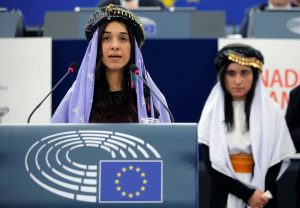
Nadia Murad is a German based Iraqi human right activist who recently won the Nobel Peace Prize awards at the age of 25. She is also the first Iraqi woman to win that award.

She was awarded alongside a Congolese doctor, Denis Mukwege for their efforts in ending the use of sexual violence as a weapon of war and armed conflict.

Murad and about 3,000 other Yazidi women were kidnapped and sold into sex slavery by ISIS in 2014, as part of the terrorist group’s genocidal campaign to wipe out the religious minority.

Here are 9 things you should know about Nadia Murad:

1.Her full name is Nadia Murad Basee Taha

2.Murad was born in the village of Kojo in Sinjar District, Iraq.

3.Nadia Murad was taken into slavery  by ISIS on 15 September, 2014.

4.She escaped from ISIS camp in November, 2014.


5.Murad started living in Germany in 2015 after leaving the refugee camp.

6.Murad  worked with United Nations in global and local advocacy initiatives to bring awareness of human trafficking and refugees in December, 2015.

7.In September, 2016, she announced her Initiative called “Murad’s Initiave”to provide advocacy and assistance to victims of genocide.

8.In 2016, she received her first award which was the first Goodwill Ambassador for the Dignity of Survivors of Human Trafficking of the United Nations.

9.Nadia Murad became the first Iraqi woman to be awarded a Nobel Peace Prize


Credit: Fabwoman.ng

Grace Alele-Williams (born December 16, 1932) is an Educator who made history as the first Nigerian woman to become the head (Vice Chancellor) of a Nigerian university, the University of Benin. She is also the first Nigerian woman to receive a doctorate degree. She is a professor of mathematics education.

Alele-Williams  was born in Warri. She attended Government School, Warri, and Queen’s College, Lagos. She attended the University College (now the University of Ibadan), the University of Vermont (U.S) and the University of Chicago (U.S).

Her teaching career started at Queen’s School, Ede Osun State,  where she was mathematics master from 1954 until 1957. She left for the University of Vermont to become a graduate assistant and later assistant professor. Between 1963 and ’65, Alele-Williams was a post doctoral research fellow, department (and institute) of Education, University of Ibadan from where she was appointed a professor of mathematics at the University of Lagos in 1976.

She has held and served in various capacities. By serving in various committees and boards, Alele-Williams had made useful contributions in the development of education in Nigeria. She was chairman of the curriculum review committee, former Bendel State 1973-1979. From 1979-1985, she served as chairman of the Lagos State Curriculum Review Committee and Lagos State Examinations Boards.

Alele-Williams was a member of governing council, UNESCO Institute of Education. She is also a consultant to UNESCO and Institute of International Education Planning. For a decade (1963–73) she was a member of the African Mathematics Programme, located in Newton, Massachusetts, United States. She was also vice-president of the World Organization for Early Childhood Education and later president of the Nigerian chapter.

Alele-Williams has published a book titled Modern Mathematics Handbook for Teachers. After serving as the Vice-Chancellor of the University of Benin, she joined the board of directors of Chevron-Texaco Nigeria. She is also on the board of HIP Asset Management Company Ltd, an Asset Management Company in Lagos, Nigeria.

Professor Grace Awani Alele-Williams was a force to reckon with in the dark period for Nigeria’s higher education. Then, the activities of secret cults, confraternities and societies had spread within the Nigerian Universities especially in University of Benin. She made valuable impacts, with combination of courage, ingenuity and strategy that the growing tide of cultism was stemmed in the university.

Bunmi Solabi is a Trained Female Mechanic and the CEO of Ladymek  Stores. She studied Science Lab Tech( Microbiology option) and Biology at the  universities of Ilorin and Lagos respectively. She’s  a mother of two who started her career as a Banker and resigned to follow her passion for Cars. She was a Participant at the German-Nigeria Business Forum 2018 and she has been a guest speaker at women conferences across the Nation and beyond. The beautiful Lady Mechanic, Bunmi Solabi  shares her story with Esther Ijewere   in this exclusive interview

Childhood Influence 

My childhood did not prepare me in anyway to be a Female Mechanic. My childhood dream was to be Medical Doctor, But while growing up, I have always loved cars.

Read Also: My Dream Is For Every State In Nigeria To Have Facility For Special Needs Children

Meet Me

I am Bunmi Solabi CEO of Ladymek Stores, a mother of two adorable children, Biologist and a trained Mechanic. I started my career as banker, I resigned after a while and later joined a pharmaceutical company where I  worked for over five years to later pursue my passion for cars.

What made me quit my job to become a mechanic…

My inspiration comes first from my passion for cars and also the need to
make an impact and difference  in the society. I just wanted to make a difference and pitch my tent in a sector where you hardly find women.

The reception so far

Because it’s a male dominated terrain the reception and reactions from
people especially the men have not been encouraging even some ladies, the attitude is beyond horrendous especially when I was a trainee. But I soldier on because I know I can’t afford that distractions from my dream.

Challenges faced

Right now my major challenge is setting up a standard workshop. I will like Ladymek stores to be in at least Five States in five years time.

Read Also: How Chioma Ogamba Is Helping People Achieve Their Dream Of Relocating To Canada

Other projects and activities

Apart from being a mechanic, I am also a public speaker especially on women/Girl empowerment. I have been opportune to speak at Women conferences organised by First Ladies, Organizations, and women in Technical Education. I am also an advocate for Girl Child Education.

Greatest reward

The greatest reward so far is being able to impact my knowledge to women, girls and boys who are my trainees.

Ladymek in five years 

I see my brand Ladymek Stores in five states in Nigeria. I will like to have a Standard workshop in at least five States across the nation where we can offer Premium Services and train more Youths and unemployed Graduates to be certified Mechanics.

On giving up

First of all, I will like to say I have never regretted quiting my 8-5 job. However, I must say, there are times I have felt like running back to it because of the on and off challenges I face in this profession. What keeps me going is that I always remember why I started this journey in the first place. There are a lot of ladies that I am mentoring in this Profession who I cannot afford to let down.

My inspiration
My Mother inspires me a lot to be a better version of myself everyday. I also get inspiration from circumstances around me everyday.

I am a Woman Of Rubies
I am a Woman of Rubies because I have dared to break limitations place on women in my profession. I have made the society believe that a woman can do more.

Advice for aspiring female mechanics
My advice for aspiring female mechanics are three words: Determination, Patience and Honesty. Sometimes Comfort Makes us complacent your oars and keep rowing. #findyourself

Chief Folake Solanke (born 29 March 1932), SAN, CON, is a Nigerian Lawyer, administrator, and social critic. She is the first female Senior Advocate of Nigeria and the first Nigerian female lawyer to wear the silk gown as Senior Counsel. She is the first Commissioner of Western State, and is a former Chairperson of the Western Nigeria Television Broadcasting Corporation (WNTBC).

She was the 42nd and the first African International President of Zonta International, an international service organization that focus primarily on advancing the status of women. The 43rd International President was also African.

Upon her return to Nigeria in August 1962, Solanke began her law career at the chamber of late Honourable Justice Michael Adeyinka Odesanya (rtd), while teaching Latin and Mathematics at Yejide Girls Grammar School in Ibadan, Oyo State. Her father died in April 1963. In May 1963, after she was called to the Bar in absentia, she moved to the law office of Chief Frederick Rotimi Williams as junior counsel.

In 1972, Solanke was appointed the first Commissioner of Western State and chairperson of the Western Nigeria Television Broadcasting Corporation (WNTBC).

In 1981, Solanke became the first female Senior Advocate of Nigeria and the first Nigerian female lawyer to wear the silk gown.

Solanke rose through the ranks of Zonta International, first serving as the District Governor for Africa and then as International Vice-President. In 1988, 1990, and 1994, Solanke ran for election to the International Presidency of the organization (she did not run in 1992). She lost the first two times, but won the third time, being elected in Hong Kong on July 21, 1994 as the 42nd International President, the first non–caucasian, African president of the organization since its establishment in 1919.

Solanke’s autobiography, Reaching for the stars was published in 2007. The book described her as a “Lady of many firsts” and how she rose to prominence in the legal profession.

Ronke  is the Founder of “Shoefetish” a Made-In-Nigeria shoe brand  that is gradually getting recognition abroad, when she started  getting high demands for shoes, she decided to change her brand name  and be simply known as Ronke Adeshina “RA”, fully identifying with her Nigerian roots and making  a bold “Proudly Nigerian” statement as a brand.

The English Language and Literature graduate from the University of Lagos started working at a financial institution right after her NYSC and this greatly influenced her journey into the business of shoe and bag making industry.

According to her;

“I realised that most of the shoes my colleagues and I really loved and needed to get were too expensive and felt I could do better. In 2010, I started making shoes for myself, few friends and colleagues”

She draws a lot of inspiration from Richard Branson’s signature quote; “If somebody offers you an amazing opportunity but you are not sure you can do it, say yes – then learn how to do it later” …and she adds: “especially if it’s in your area of interest or business”.

Ronke is  ambitious, imaginative and adventurous  and  she put all these  in the pieces she creates. The young entrepreneur who sees Oprah Winfrey and the Queen of England wearing her brand one day shares her inspiring story with me in this interview

Growing up

I drew a lot as a little girl and that helped my ability to sketch; making designs a reality now. I enjoyed working with my hands. I once made a purse and skirt by hand; including the stitching.

While at the university, I did a little graffiti on one of my jeans while receiving a lecture and people loved it. I guess I have always been creative.

My love for shoes also started as a child. The first pair of stilettos I bought was when I was in my third year at the university. It cost me a lot (especially my allowance for the week) but I didn’t care…those shoes were beautiful.


Meet Ronke!

I am the only girl amongst three boys. I attended the University of Lagos where I studied English Language and Literature.   I have garnered a lot on-the-job experience; I am also self-taught especially in the art of creating embellishments, bejeweled pieces like bead art, bead embroidery, embellishing fabrics with crystals and more. Creating shoes, bags, embellishments and other leather items is something I really love doing especially wedding (traditional and white wedding) pieces for brides and grooms. I get to meet people with different personalities and styles and this I try to incorporate into their products.


The “Ronke Adeshina” brand journey

I started posting pictures of my works on Facebook, then I started getting messages from people asking how they could get a pair or two of shoes. I have garnered a lot of on-the-job experience and I am also self taught especially in the art of creating embellishments, bejewelled pieces, bead art, bead embroidery and working with crystals and more.


Balancing my 9-5 job  with family and my side hustle

It isn’t easy running a business and family. You can’t do it all. A lot is expected from women: she is expected to perform many roles with apparently superhuman efficiency. I have learnt to delegate duties both at home and work. I have a team of amazing people that makes things easier for me. It’s important to delegate duties /task to people in their area of expertise so as to get the best from them.


Work Challenges

Initially, getting capable people to work with was quite difficult. People want money but not ready to go through the process of getting it. Because I am passionate about empowering youths especially the girl child, there was a period I was ready to teach for free but no one came. But over time I have been able to build a team of hardworking staff.  When I just started there were few ladies in the business, so it was quite tasking. But I guess growing up with boys helped a lot.

Getting quality materials to work with here in Nigeria are quite expensive and this tends to affect the cost of products.

other project and activities

I was recently contacted by an NGO. We are working on going to secondary schools (especially girls only schools) to talk to them about the importance of being independent and acquiring one or more skills. We are also going to teach them handwork and I would be teaching them bead art works, embellishments and embellishing fabrics.  Asides this, I do personal charitable works which I intend to keep private.


Customer satisfaction is my reward

The excitement and thank you I get when clients receive their purchase(s) makes me happy. The mother of one of the brides I worked with once called to appreciate the pieces her daughter got from us. She couldn’t believe it was handmade; and she prayed and also encouraged me. Most of my clients are referrals from family, friends and clients that have patronized us; I also have customers turn friends. All these and more makes me feel like I am doing something right.


Nigerians and patronage of “Made in Nigeria” products

There is still this misconception that made in Nigeria isn’t authentic enough. Well, I cannot blame them because they might have purchased item(s) which did not serve them well. But there are still brands like us and others that produce quality products using original leathers and other materials needed for production.

Another problem is most Nigerians like to be associated with foreign brands that are well known. But what they fail to realize is that these brands have been in existence since the 1950s, some as far back as 1830s. They did not grow to become international brands on their own; they did with the support of their own people. If Nigerians can do the same for their own made in Nigeria products, that would help brands grow and become global too. This will also help generate more jobs for our people and grow our economy. They are trying but more needs to be done.


Giving up

The road to building a brand is not easy. I have felt like giving up several times and still do but the love for what I do keeps me motivated. I have learnt a lot while growing the brand: what to do and what not to do. Some experiences shake you but it only makes you better. Running a business is a continuous process. It is just like the popular cliché about marriage being an institution you never graduate from. I am still learning

My Inspiration

Inspirations are everywhere – you just need to open your eyes and breathe in. I am inspired by things I face and work through in my daily life. I get inspired by patterns and colours in nature and love to translate that to products in a new way. I am inspired by the people I meet every day; most especially the ones I get to work with: lifestyle and personality differs with every individual and that is unique. This I tend to put into pieces we create. I am inspired by stories of brands that started as far back as 1803. Most importantly, God is the major source of my inspirations.

Being a woman of Rubies

My life is a story. The ups and downs I have experienced especially while growing my brand is my story. I am still learning because life and business is a continuous phase/process. Every woman is a woman of Rubies: from the road side seller to the CEO; our day to day activities are tales – we all have stories to tell. I hope my story and that of other women, inspires and transforms lives; that is the greatest achievement.

Advice to women going into my line of business

One of my mantras is “You never know what you can do until you try”. No business is off limit for you. There are women doing great things in male dominated businesses and even doing better. You are even at an advantage because it gets you noticed.

At the early stage of my business, people especially men were surprised to see a lady in the shoe and bag making industry. They wanted to see me and always wanted me to give them their orders not my staff. Keep learning new things, do not be intimidated by others and do not be distracted. Mistakes are inevitable but when that happens, do not give up: you just learnt a valuable lesson(s) which is how not to do things; try another method. Put God first and other things follow.

My view of the fashion industry in Nigeria and it’s impact on women

The fashion industry in Nigeria is growing. It is actually much better than years back and more women are getting involved.Women are doing incredible works and since the advent of #wcw (women crush Wednesday) and #womensupportingwomen (women supporting women), we have seen women trying to encourage and support one another. Women in the fashion industry need to collaborate more with other women – it is amazing what we can accomplish when we are in it together.

Women of Rubies is also doing a great job by recognising women doing well in whatever field they are in either big or small.


On Friday, September 14, 2018, Zainab Shamsuna Ahmed was appointed as the acting Minister of Finance by the President Muhammadu Buhari, following the resignation of Kemi Adeosun as the Minister of Finance over a certificate forgery scandal.

Before her new appointment, Ahmed was the state minister, Budget and national planning of the federal republic of Nigeria.

Here are six facts to know about Zainab Ahmed, the new minister of finance

1. Zainab Shamsuna Ahmed was born 55 years ago in Kaduna state.

2. She obtained a Bachelors Degree in Accounting from the Ahmadu Bello University, Zaria in 1981 and an MBA from the Ogun state University, Ago Iwoye.

3. She started work in 1982 as an Accountant in Kaduna state ministry of finance in Kaduna state and moved to Nigerian Telecommunication Ltd (NITEL)

4. In 1995, where she worked in various departments and rose to the rank of the Deputy General Manager (DGM).

5. In 2010, she was appointed to serve as the executive secretary of the Nigeria Extractive Industries Transparency Initiative.

6. Before her appointment to oversee finance ministry, she was minister of state Budget and national planning.

7. She is a fellow of the Association of National Accountants of Nigeria (ANAN), a member of the Nigerian Institute of Taxation and the Nigerian Institute of Management.

8. In March 2009, she was appointed Managing Director of Kaduna Investment Company. She was then appointed a member of the National Stakeholders Working Group (NSWG).

Three African American designers from Harlem, NYC – Kimberly Goldson, Felisha Noel, and Undra Celeste Duncan, have designed the first Lebron signature shoe. The three designers were selected for the project based on their previous work and passion for sport.

At the request of Nike and Lebron James himself, the three designers first traveled to Nike World Headquarters to learn how a performance shoe was made before meeting back in New York City for a working design session. The designers and James say they felt a kinship the moment that he described his vision for the shoe.

“We each had something that connected the four of us based on what LeBron saw from his mom, and the sacrifices she made for him,” says Goldson. “My mom did it. LeBron’s mom did the same for him. The connectivity was there between all of us.”

Their new design called the HFR x Lebron 16 was inspired by James’ belief that “African-American women are some of the strongest people on earth.”

He comments, “As someone who has a platform, because of what I do, I thought it was important to lend that platform to a group of people that I believe are under-recognized.  Being the son, husband and father of strong African American women, I felt like this was something I wanted to do for them and for all the strong women out there who are succeeding despite what might be stacked against them.”

In its cooperative creation, representatives at Nike say that the HFR x LeBron 16 is a symbol of unified strength.

The limited edition shoes can be purchased online at www.nike.com/launch/t/womens-lebron-16-hfr-white-sail/

Watch their story below:


https://youtu.be/07DWXkYf6-8

Credit: blog.blackbusiness.org